Capital Gains Tax Rules for Selling Real Estate
Understand how capital gains tax applies when you sell a home or investment property, and learn strategies to reduce or avoid tax legally.
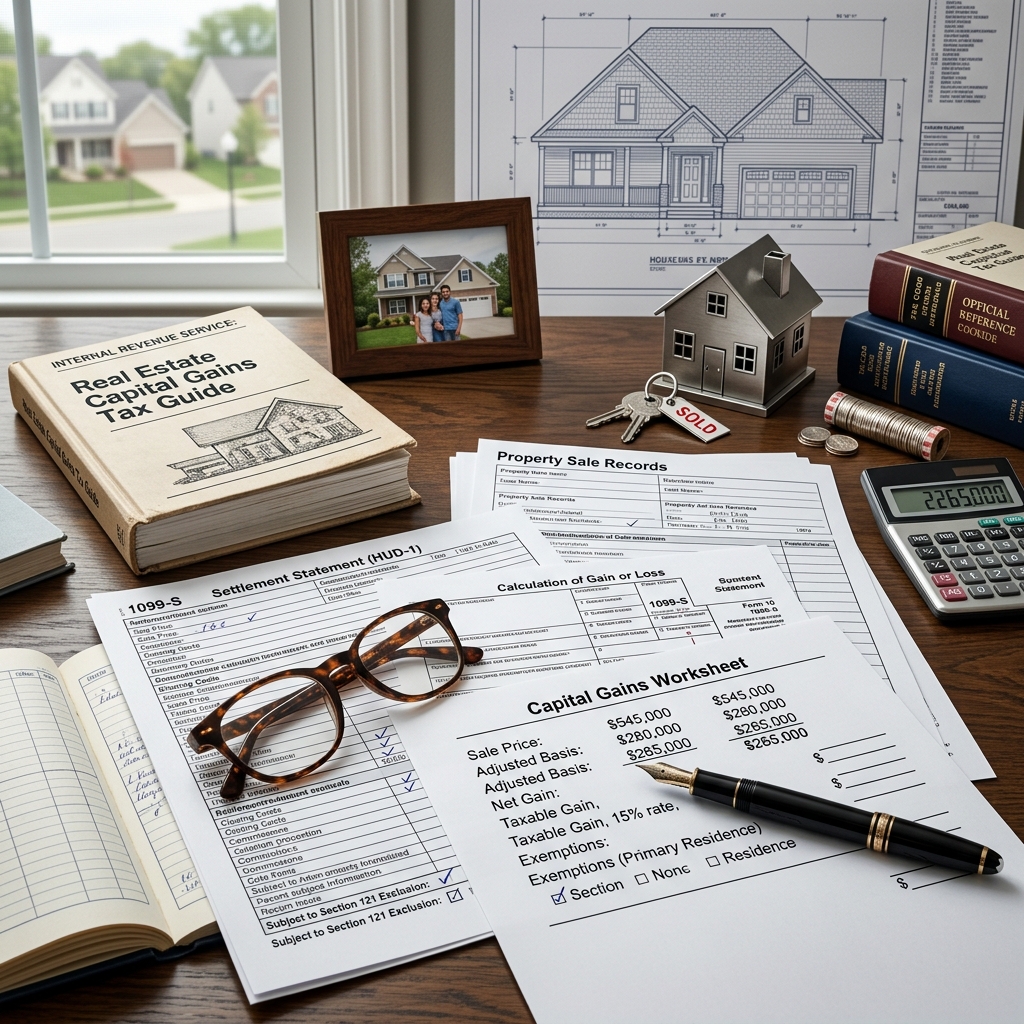
When you sell a house, rental, or land for more than you paid, the profit is usually subject to capital gains tax. In some situations, however, you can exclude a large portion of that profit, especially when selling your main home. Understanding these rules before you list a property can help you keep more of your proceeds and avoid costly mistakes.
This guide explains how capital gains tax works on real estate, how to calculate your gain, when you may qualify for the home sale exclusion, and practical strategies to manage or reduce the tax bill.
1. What Is Capital Gains Tax on Real Estate?
Capital gains tax is a federal tax on the profit you realize when you sell a capital asset, such as a home, rental property, or land, for more than your adjusted cost. The profit is called a capital gain, and it is generally taxable in the year of the sale.
Real estate gains are categorized into two broad types:
- Short-term capital gains – Profit from property held for one year or less, usually taxed at your ordinary income tax rates, which can range from 10% to 37% depending on your income bracket.
- Long-term capital gains – Profit from property held for more than one year, taxed at preferential rates of 0%, 15%, or 20%, depending on your taxable income and filing status.
For many homeowners, long-term gains combined with specific exclusions and adjustments can significantly soften or eliminate the tax impact of a sale.
2. Basic Steps to Calculate Capital Gain on a Property Sale
Capital gain is not simply the selling price minus the original purchase price. The tax law allows adjustments that can reduce your taxable gain, such as selling expenses and qualifying improvements.



Understanding Modern Phishing Scams >

2.1 Key Calculation Components
| Concept | What It Means | Typical Items Included |
|---|---|---|
| Amount realized | Net proceeds from the sale after certain expenses. | Contract price minus real estate commission, legal fees, transfer taxes, and some closing costs. |
| Adjusted basis | Your cost in the property, adjusted over time. | Purchase price, some acquisition costs, capital improvements, minus any depreciation claimed. |
| Capital gain | Taxable profit before exclusions or other offsets. | Amount realized − adjusted basis. |
2.2 Simplified Formula
The core formula for determining gain or loss is:
Capital gain (or loss) = Amount realized on sale − Adjusted basis
- If the result is positive, you have a capital gain.
- If the result is negative, you have a capital loss (which generally is not deductible on a personal residence, but can matter for investment property).
Once you know the gain, you then determine whether it is short-term or long-term and whether any exclusions or special real estate rules apply.
3. The Home Sale Exclusion for Your Main Residence
One of the most important tax breaks for homeowners is the home sale exclusion under Internal Revenue Code Section 121. If you qualify, you may be able to exclude up to $250,000 of gain from income if you file as a single taxpayer, or up to $500,000 if you are married filing a joint return.
3.1 Who Can Use the Exclusion?
According to IRS guidance, you may qualify to exclude up to $250,000 or $500,000 of gain on the sale of your main home if you meet both an ownership and use test within the five-year period before the sale.
- Ownership test – You (or your spouse, if filing jointly) must have owned the home for at least 24 months out of the 5 years before the sale.
- Use test – You must have used the home as your main residence for at least 24 months out of the same 5-year period. For joint filers, both spouses must meet the use test individually.
- Frequency limit – In general, you cannot have used the exclusion for another home sale in the 2-year period immediately before this sale.
The ownership and use periods do not have to be the same exact months, as long as both tests are satisfied within the 5-year window ending on the sale date.
3.2 How Much Gain Can Be Excluded?
- Single or married filing separately: Up to $250,000 of gain may be excluded.
- Married filing jointly: Up to $500,000 of gain may be excluded, provided certain conditions are met for both spouses.
- Certain surviving spouses: In some circumstances, a surviving spouse may still qualify for the larger exclusion for a limited period after a spouse’s death.
If your gain exceeds the available exclusion, the excess amount is generally taxed as a capital gain at the applicable short- or long-term rate.
3.3 When the Exclusion Does Not Apply
Several common situations do not qualify for the main home exclusion, for example:
- Sale of rental property or vacation homes that are not your primary residence.
- Sale of commercial real estate or purely investment properties.
- Property held for less than two years as both owner and occupant, unless you qualify for a limited partial exclusion based on specific unforeseen circumstances (which requires careful review of IRS rules).
- Sales where you already used the exclusion for a different property within the previous 2 years.
4. Short-Term vs. Long-Term Gains on Property
The length of time you own the property before selling affects both your tax rate and, in some cases, the availability of exclusions.
4.1 Holding Period and Tax Rates
- Short-term gains (owned 1 year or less): Taxed at your ordinary income rate, which can reach up to 37%, making these gains potentially more expensive.
- Long-term gains (owned more than 1 year): Generally taxed at 0%, 15%, or 20%, based on your filing status and taxable income.
For example, many middle-income taxpayers pay the 15% long-term capital gains rate on profits from property held more than one year, while lower-income taxpayers may pay 0% and higher-income taxpayers may pay 20%.
4.2 Effect on the Home Sale Exclusion
You must meet both the 2-year ownership and use requirements to claim the primary residence exclusion. If you sell before reaching two years of ownership and occupancy, the gain may be fully taxable even if you held the property long enough to qualify for long-term rates.
In other words:
- Owning more than 1 year may earn you long-term capital gains rates.
- But owning and living in the home at least 2 years (within 5 years) is needed to use the full $250,000/$500,000 exclusion.
5. Primary Residence vs. Rental and Investment Property
Tax treatment varies significantly depending on how you use the property.
5.1 Your Main Home
Your main home (also called your principal residence) is generally the place where you live most of the time, receive mail, and register to vote. Profit from selling this property may qualify for the Section 121 exclusion if you meet the ownership and use tests described earlier.
5.2 Rental Properties and Second Homes
Profits from rental properties, vacation homes, or purely investment properties do not qualify for the main home exclusion. Instead, the gain is typically taxed in full as a capital gain, and if you claimed depreciation, additional tax rules (including depreciation recapture) may apply.
Key distinctions include:
- Rental real estate – Income and expenses are usually reported annually; when sold, you calculate adjusted basis including past depreciation, then compute gain or loss. Gains are generally taxed at capital gains rates; some portion related to depreciation may be taxed at different maximum rates.
- Second homes – Properties used occasionally for personal purposes but not as your main residence typically do not qualify for the Section 121 exclusion.
6. Practical Strategies to Reduce or Manage Capital Gains Tax
While you cannot avoid all taxes, careful planning can reduce the amount you owe. Strategies must comply with IRS rules and, in many cases, should be implemented with the assistance of a tax professional.
6.1 Maximize Your Adjusted Basis
Because gain equals amount realized minus adjusted basis, increasing the latter legitimately reduces your taxable gain.
- Keep detailed records of capital improvements such as additions, major kitchen or bath remodels, new roofs, and system upgrades. These can be added to your basis.
- Include certain purchase and selling costs (for example, some closing costs, legal fees, transfer taxes, and agent commissions) when calculating adjusted basis and amount realized.
- Track any depreciation taken for home office or rental use; this generally must be subtracted from basis and may have its own tax consequences upon sale.
6.2 Time Your Sale to Meet the Home Sale Tests
One of the most straightforward ways to reduce tax is to ensure you meet the 2-out-of-5-year ownership and use tests before selling your main home.
- Consider delaying a sale until you have occupied the home for at least 24 months in the last 5 years.
- If you have used the exclusion for another property within the past two years, you might postpone the second sale until you become eligible again.
6.3 Understand the Impact of Your Filing Status
Your filing status (single, married filing jointly, married filing separately, or head of household) affects both the exclusion amount and the long-term capital gains rate thresholds.
- Married couples filing jointly can potentially exclude up to $500,000 of gain versus $250,000 for single filers.
- The income thresholds for the 0%, 15%, and 20% capital gains brackets differ by filing status, potentially making strategic planning around income and timing of the sale valuable.
6.4 Coordinate with Other Capital Gains and Losses
Homeowners and investors sometimes manage their overall tax picture by combining gains and losses.
- Capital losses from other investments (for example, stocks) may offset taxable capital gains from real estate, within IRS limits.
- Careful sequencing of asset sales in a given year can help smooth out the total tax burden.
Because real estate transactions can be large, it is sensible to consider the broader portfolio impact and not treat the property sale in isolation.
7. Reporting the Sale and Working with Professionals
When you sell real estate, you may need to report the transaction on your federal tax return. The IRS provides specific forms and instructions to calculate and report capital gains or losses.
- The IRS Topic No. 701 notes that individuals may need to use Schedule D (Form 1040), Capital Gains and Losses, and Form 8949, Sales and Other Dispositions of Capital Assets, to report home sales in many cases.
- Certain states, such as California, may require additional state-specific capital gain schedules, which can differ from federal treatment.
Because rules can be complex and change over time, many sellers choose to work with:
- Tax professionals (CPAs or enrolled agents) to calculate basis, determine eligibility for exclusions, and prepare required forms.
- Real estate attorneys for legal questions around ownership structure, title issues, or complicated multi-party transactions.
- Financial planners to integrate the sale into an overall financial and investment strategy.
8. Frequently Asked Questions (FAQs)
8.1 Do I pay capital gains tax every time I sell a home?
Not always. If the home is your main residence and you meet the eligibility requirements, you may be able to exclude up to $250,000 of gain if filing single, or $500,000 if filing jointly. Only the gain above that amount, if any, is generally taxable.
8.2 What if I sell my home at a loss?
Losses on the sale of a personal residence are generally not deductible for federal income tax purposes. For investment properties, however, capital losses may be used to offset other capital gains, subject to IRS limitations.
8.3 Does the home sale exclusion apply to a rental property I used to live in?
It can, but the rules are more complex. If you convert a former primary residence into a rental and then sell, you may qualify for a partial exclusion based on how long you used the property as your main home versus as a rental, and you must account for depreciation taken during rental years.
8.4 Can I claim the exclusion if I owned the home but my spouse did not?
For a joint return, either spouse can meet the ownership test, but both must meet the use test to claim the full $500,000 exclusion.
8.5 Where can I find official IRS rules about selling my home?
The Internal Revenue Service publishes detailed guidance in Topic No. 701, “Sale of Your Home,” and in the instructions for Schedule D and Form 8949. These resources explain eligibility criteria, calculation methods, and reporting requirements.
References
- Topic No. 701, Sale of Your Home — Internal Revenue Service. 2023-03-15. https://www.irs.gov/taxtopics/tc701
- Capital gains tax on real estate — Jackson Hewitt Tax Service. 2024-01-10. https://www.jacksonhewitt.com/tax-help/tax-tips-topics/real-estate/capital-gains-tax-on-home-sale/
- Guide to capital gains on real estate sales — New York Life Insurance Company. 2023-08-05. https://www.newyorklife.com/articles/capital-gains-on-real-estate
- Understanding capital gains taxes on your home — Fidelity Investments. 2023-06-20. https://www.fidelity.com/learning-center/personal-finance/capital-gains-on-residence
- Income from the sale of your home — California Franchise Tax Board. 2022-11-01. https://www.ftb.ca.gov/file/personal/income-types/income-from-the-sale-of-your-home.html
Similar Articles








Read full bio of medha deb