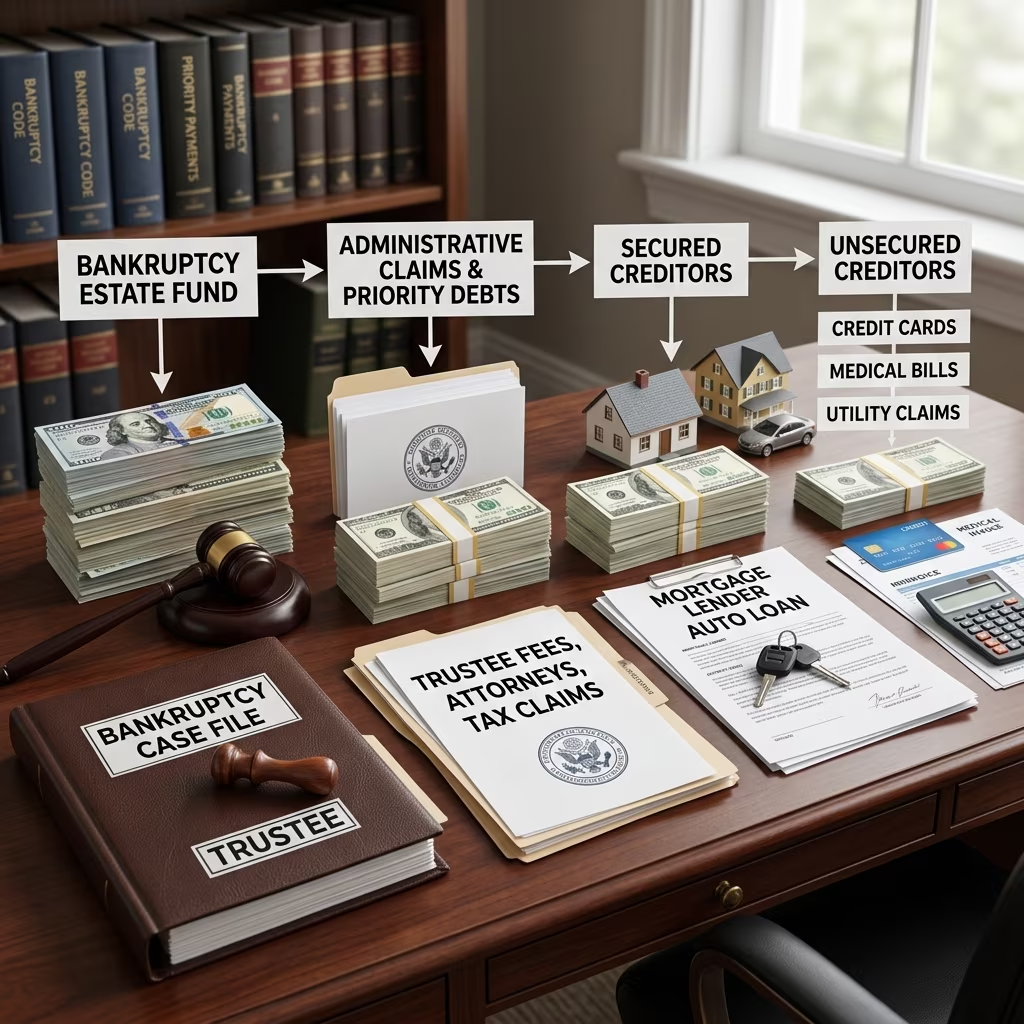
When someone files for bankruptcy, a central question is how, and in what order, creditors are paid. Bankruptcy law creates a structured system that determines which creditors are first in line, which may receive only partial payment, and which might not receive any payment at all. Understanding this system is essential for both debtors trying to regain financial stability and creditors assessing how much they might recover.
Why Payment Order Matters in Bankruptcy
The U.S. bankruptcy system is designed around the principle of fair and orderly distribution of a debtor’s limited assets or income. Not all debts are treated the same, and the law ranks claims by priority to balance social policies (like protecting family support and taxes) against commercial interests.
Payment order matters because:
- High-priority claims are paid before others, often in full if possible.
- Secured creditors have special rights in the debtor’s property and are generally more likely to be paid.
- General unsecured creditors usually receive the smallest share and sometimes nothing.
- The debtor’s chapter choice (Chapter 7, 11, or 13) affects whether payments come from asset sales or future income.
Key Types of Claims: Secured, Priority, and Unsecured
Before looking at specific bankruptcy chapters, it helps to understand the main categories of claims recognized by bankruptcy law.
Secured Claims
Secured creditors hold claims backed by collateral, such as a mortgage on a home or a lien on a car. If the debtor does not pay, these creditors have the legal right to foreclose or repossess the property securing the debt.
In most bankruptcy cases:
- Secured creditors are paid from the value of their collateral first.
- If the collateral is sold, the sale proceeds go to the secured creditor up to the amount owed.
- If the collateral’s value is less than the debt, the remaining balance becomes a unsecured deficiency claim.
Priority Unsecured Claims
Not all unsecured debts are equal. Under the Bankruptcy Code, certain unsecured claims are labeled priority claims because public policy favors their payment ahead of other debts.
Examples include:
- Domestic support obligations, such as child support and alimony.
- Certain recent income taxes and other specified tax debts.
- Some wage claims for employees of a business debtor.
Priority unsecured claims must be paid before general unsecured creditors receive anything, and in many cases they must be paid in full in reorganization plans.
General Unsecured Claims
General unsecured creditors are those whose claims are not backed by collateral and do not qualify as priority. Common examples include credit card accounts, medical bills, and many personal loans.
These creditors:
- Stand last in the line of payment in the insolvency process.
- Often receive only a percentage of what they are owed, or in some cases nothing.
- Share available funds on a pro rata basis, meaning proportionally based on the size of each allowed claim.
How Chapter 7 Bankruptcy Pays Creditors
Chapter 7 is commonly called a liquidation bankruptcy. In this process, a trustee may sell non-exempt assets and use the proceeds to pay creditors following the statutory priority rules.
Basic Flow of Payments in Chapter 7
In a typical Chapter 7 case:
- Exempt property is set aside for the debtor under federal or state exemption laws, and is not used to pay creditors.
- Non-exempt assets (for example, investment property or non-essential items) may be sold by the trustee.
- The sale proceeds are collected into an estate and distributed according to the Bankruptcy Code priority rules.
Order of Payment in Chapter 7
Although the specific hierarchy is detailed in federal law, a simplified sequence of payments in Chapter 7 normally looks like this:
| Priority Level | Who Gets Paid | Typical Treatment |
|---|---|---|
| 1 | Administrative expenses (trustee, court-approved attorney fees) | Usually paid first from available funds. |
| 2 | Secured creditors | Paid from collateral value; may repossess if not paid. |
| 3 | Priority unsecured claims (support, certain taxes) | Paid ahead of general unsecured creditors; often in full if funds allow. |
| 4 | General unsecured claims | Share remaining funds; frequently receive only a fraction of their claims. |
In many consumer Chapter 7 cases, exemptions protect most or all of the debtor’s property, so there may be little or no money available for general unsecured creditors. Those debts are instead discharged, meaning the debtor is no longer legally required to pay them, subject to specific nondischargeability rules.
How Chapter 13 Bankruptcy Pays Creditors
Chapter 13 is known as a wage earner’s plan and is used by individuals with regular income who want to keep their property while repaying debts over time. Instead of selling assets, the debtor makes periodic payments into a plan, and the Chapter 13 trustee distributes those funds to creditors.
The Role of the Chapter 13 Plan and Trustee
Under Chapter 13:
- The debtor proposes a repayment plan lasting three to five years, subject to court approval.
- Regular payments (often monthly) are made to the Chapter 13 trustee, starting within 30 days of filing even before plan confirmation.
- The trustee distributes funds to creditors according to the confirmed plan and applicable priority rules.
Payment Sequence in Chapter 13
While local practices can differ, the overall structure of who gets paid in Chapter 13 follows federal priorities:
- Administrative costs such as filing fees and approved legal fees are paid early from plan funds.
- Secured debts that are being cured (like mortgage arrears or a car loan) are paid to protect collateral and allow the debtor to keep needed property.
- Priority unsecured claims (such as domestic support obligations and certain taxes) must generally be paid in full over the life of the plan.
- General unsecured debts receive a share of whatever is left after higher-priority obligations are satisfied.
General unsecured creditors in Chapter 13 are often paid on a pro rata basis—that is, each allowed claim receives the same percentage of repayment relative to its claim amount. The exact percentage depends on the debtor’s disposable income and on what creditors would have received in a hypothetical Chapter 7 liquidation.
Impact on Different Creditor Types in Chapter 13
For creditors, Chapter 13 can produce varied outcomes:
- Secured creditors with collateral the debtor keeps typically receive full payment of the secured portion of their claims, often with interest.
- Priority creditors are more likely to be paid in full because the law requires full payment in most cases.
- General unsecured creditors may receive anything from a modest percentage of their claims to nothing, depending on the plan terms.
How Chapter 11 Bankruptcy Pays Creditors
Chapter 11 is primarily used by businesses, though individuals with substantial debts may sometimes file under this chapter. It allows a debtor to reorganize and continue operations while restructuring its obligations.
Reorganization Plans and Creditor Classes
In Chapter 11:
- The debtor (or sometimes another party) proposes a plan of reorganization that classifies creditors and describes how each class will be treated.
- Creditors may vote on the plan, and the court must confirm it if legal requirements are met.
- Payments often occur over an extended period, and some debts may be reduced or rescheduled.
Priority Rules and the Absolute Priority Concept
Chapter 11 follows the same basic priority structure for claims as other chapters: secured claims, priority unsecured claims, and general unsecured claims. However, business reorganizations often invoke the absolute priority rule.
In simplified terms:
- Higher-priority creditors must be paid in full before lower-priority creditors or equity holders receive value, unless the higher-priority creditors agree otherwise.
- General unsecured creditors may receive only a portion of their claims, often less than secured or priority creditors.
- Equity owners (such as shareholders) typically receive nothing unless all creditors above them are paid in full.
How Creditors Get Paid Across Chapters: A Comparison
The chapter of bankruptcy significantly affects how creditors are paid and what debtors must contribute. The table below offers a high-level comparison.
| Feature | Chapter 7 | Chapter 13 | Chapter 11 |
|---|---|---|---|
| Main Purpose | Liquidation and discharge of debt. | Individual repayment plan over 3–5 years. | Business or complex individual reorganization. |
| Source of Payments | Sale of non-exempt assets. | Future income paid into a plan. | Business income, asset sales, new financing. |
| Secured Creditors | Paid from collateral, may foreclose. | Paid through plan to cure arrears and maintain collateral. | Negotiated treatment; often restructured but collateral rights preserved. |
| Priority Claims | Paid before general unsecured from estate funds. | Usually must be paid in full in the plan. | Must be treated according to statutory priority; often paid in full. |
| General Unsecured Creditors | Share any remaining funds; often minimal recovery. | Paid a percentage based on disposable income and legal tests. | Lowest in priority; may receive a small portion of claims. |
Proof of Claim and Participation in Distributions
Creditors do not automatically receive payment just because a debtor files for bankruptcy. In most cases, a creditor must file a proof of claim to participate in distributions from the bankruptcy estate.
Key points include:
- A claim is broadly defined as a right to payment, regardless of whether it is liquidated, disputed, contingent, or reduced to judgment.
- In Chapter 13, unsecured creditors generally must file their claims within 90 days after the first date set for the meeting of creditors.
- If a creditor fails to file a timely claim, it may lose the right to receive distributions from the plan or estate.
What Debtors Should Know About Creditor Payments
From a debtor’s perspective, the rules governing creditor payments are crucial for deciding which bankruptcy chapter to file and for planning life after bankruptcy.
- Chapter choice affects who gets paid: Chapter 7 focuses on asset liquidation, whereas Chapter 13 and Chapter 11 emphasize repayment over time.
- Some debts survive bankruptcy: Domestic support obligations, certain taxes, and other nondischargeable debts often remain even after the case ends.
- Budgeting is essential in Chapter 13 and Chapter 11, because debtors must make regular payments over several years.
- Legal advice is important to evaluate how different types of debts will be treated and what outcome is realistic.
What Creditors Should Know When a Debtor Files
For creditors, understanding bankruptcy payment rules helps in setting expectations and taking timely action.
- Monitor notices from the court to learn the case number, deadlines, and when to file a proof of claim.
- Identify your claim type (secured, priority, or general unsecured) to understand your place in the payment hierarchy.
- Review proposed plans in Chapter 13 and Chapter 11 to see how your claim will be treated and whether you should object or vote against the plan.
- Consider the cost-benefit of participating, especially for small claims that might receive limited payment.
Frequently Asked Questions
Do all creditors get paid in bankruptcy?
No. Whether a creditor is paid depends on the chapter filed, the debtor’s assets and income, and the type of claim. General unsecured creditors are the least likely to be paid in full and may receive only a partial dividend or nothing at all.
Who gets paid first in bankruptcy?
Generally, administrative expenses and secured creditors are addressed first, followed by priority unsecured claims like domestic support obligations and certain taxes. General unsecured creditors are paid last from any remaining funds.
How much do unsecured creditors usually receive?
There is no fixed amount. In Chapter 7, unsecured creditors may receive little or nothing if there are no non-exempt assets to liquidate. In Chapter 13 or Chapter 11, they receive a percentage of their claims based on the debtor’s disposable income, the value of assets, and statutory tests, often substantially less than the full amount.
Can a creditor refuse payments under a confirmed plan?
Once a plan is confirmed by the bankruptcy court, it is binding on the debtor and all creditors. Creditors may object before confirmation, but afterward they must accept the treatment provided, subject to their enforcement rights under the plan and the Code.
What happens to debts that are not paid?
In Chapter 7 and Chapter 13, many unpaid unsecured debts are discharged at the end of the case, meaning the debtor is no longer personally liable. However, some debts, such as domestic support obligations and certain taxes, are nondischargeable and must still be paid after bankruptcy.
References
- Chapter 13 – Bankruptcy Basics — United States Courts. 2023-01-01. https://www.uscourts.gov/court-programs/bankruptcy/bankruptcy-basics/chapter-13-bankruptcy-basics
- Who Pays for Bankruptcy? | How Costs Are Covered — Field Law Office. 2022-05-01. https://www.fieldlawoffice.com/bankruptcy/who-pays-for-bankruptcy/
- How Creditors Are Paid in Chapter 13 Bankruptcy Cases — Attorney Brooks. 2021-10-15. https://attorneybrooks.com/blog/how-creditors-are-paid-in-chapter-13-bankruptcy-cases/
- How Much Are Unsecured Creditors Paid in Chapter 11? — Blazek & McHugh. 2023-03-10. https://blazek-law.com/blog/how-much-are-unsecured-creditors-paid-in-chapter-11/
- What to Do If a Company Goes Bankrupt and Owes You Money — Allianz Trade. 2022-09-20. https://www.allianz-trade.com/en_US/insights/customer-bankruptcy.html
- Justice Manual §63: Creditor’s Claims in Bankruptcy Proceedings — U.S. Department of Justice. 2015-01-01. https://www.justice.gov/archives/jm/civil-resource-manual-63-creditors-claims-bankruptcy-proceedings
- Surviving Debt: How Chapter 13 Bankruptcies Work — National Consumer Law Center. 2021-01-01. https://library.nclc.org/book/surviving-debt/how-chapter-13-bankruptcies-work