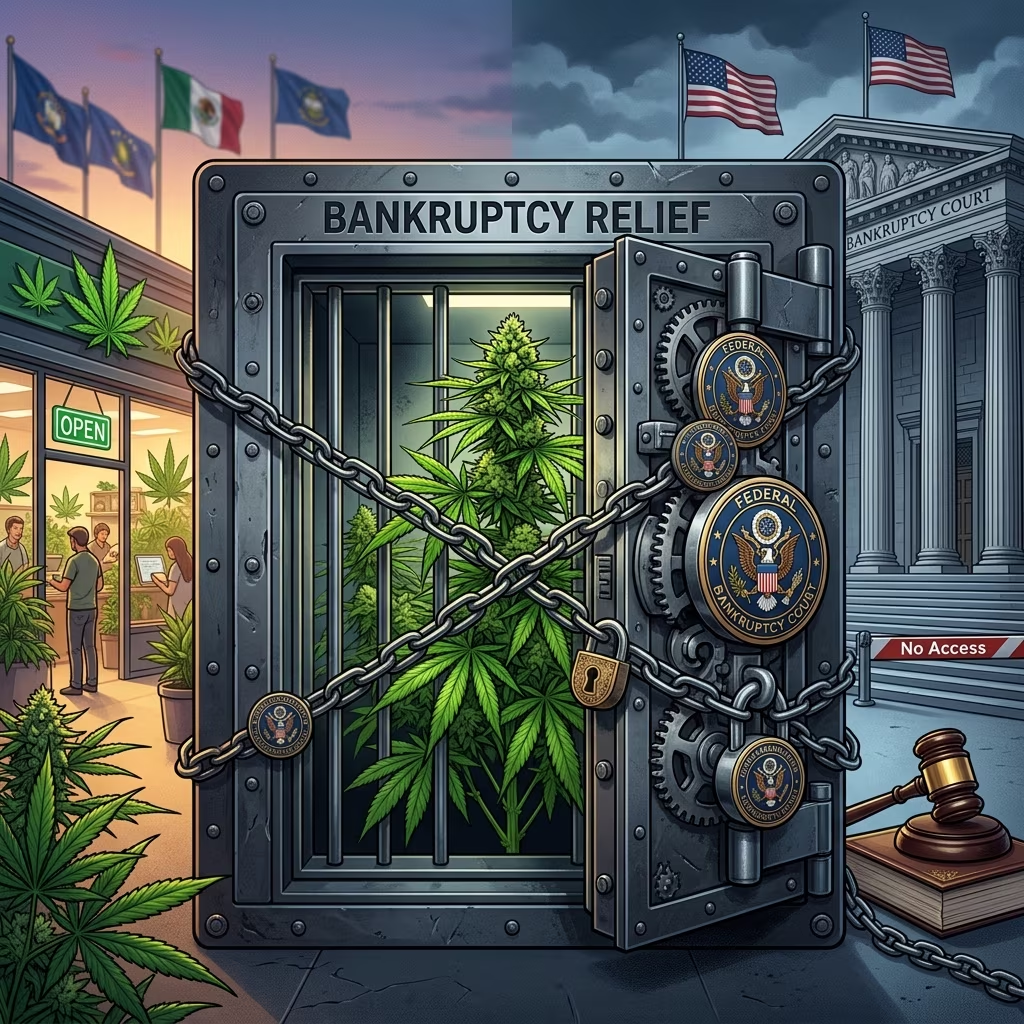
As the legal cannabis industry has expanded across the United States, one problem has remained stubbornly unchanged: marijuana businesses generally cannot access federal bankruptcy protections when they run into serious financial trouble. Even companies that are fully compliant with state law find that the doors to U.S. bankruptcy courts are effectively closed because federal drug laws still classify cannabis as illegal.
This article explains the legal reasons behind that barrier, the practical consequences for cannabis entrepreneurs, and the most common alternatives used to manage insolvency without bankruptcy. It is written for business owners, investors, and advisors who need a clear, practical understanding of how federal law affects financially distressed cannabis operations.
The Core Conflict: State Legalization vs. Federal Illegality
Many states authorize medical or adult-use cannabis businesses and issue licenses for cultivation, processing, and retail sales. At the same time, federal law still classifies marijuana as a Schedule I controlled substance under the Controlled Substances Act (CSA). Under Section 841(a)(1) of the CSA, it is unlawful to manufacture, distribute, or dispense marijuana, or to possess it with intent to do so.
Bankruptcy is governed exclusively by federal law through the U.S. Bankruptcy Code and administered by federal courts. That means any business seeking bankruptcy relief must be able to do so in a way that is consistent with federal statutes, including the CSA. Cannabis companies, by definition, are involved with conduct that federal law still treats as criminal.
As a result, federal judges and the United States Trustee Program (USTP) regularly conclude that marijuana businesses cannot use the bankruptcy system because granting relief would require the court and court-appointed fiduciaries to administer assets and income derived from federally illegal activity.
Why Bankruptcy Courts Reject Marijuana Cases
The USTP is part of the Department of Justice and serves as a watchdog over the bankruptcy system. Its published guidance explains two key principles that drive the dismissal of marijuana-related bankruptcy filings:
- Bankruptcy cannot be used to continue criminal conduct. Reorganization plans that depend on income from ongoing cannabis operations would effectively require a federal court to bless continuing violations of the CSA.
- Trustees cannot be forced to violate criminal law. Bankruptcy trustees and other fiduciaries should not be required to take possession of or manage marijuana inventory, licenses, or other assets if doing so could expose them to criminal liability under federal law.
In practice, this policy means that whenever a marijuana business files for Chapter 7 liquidation or Chapter 11 reorganization, the USTP will usually move to dismiss the case if cannabis-related assets or income are central to the debtor’s operations. Courts have routinely agreed, holding that they cannot confirm plans or oversee estates that rely on conduct Congress has expressly prohibited.
Scope of the Restriction: Direct and Indirect Cannabis Ties
The limitation is not confined to companies that grow or sell marijuana directly. Legal scholars and courts note that businesses even tangentially involved in the cannabis industry may be denied bankruptcy protection if their income or assets are tied to marijuana-related activities. This can include:
- Landlords leasing space to cannabis dispensaries
- Ancillary service providers whose revenue exclusively depends on cannabis clients
- Holding companies with equity stakes in marijuana entities
In some cases, businesses that claim to operate only with hemp or CBD have still seen their Chapter 11 cases dismissed when the court remained unconvinced that no CSA violations were involved or potentially involved. Judges may examine whether future operations, cash flow, or collateral are connected to marijuana-derived income, and if so, treat the debtor as ineligible for relief.
What Bankruptcy Protection Normally Provides
To understand the impact of this restriction, it helps to recall what bankruptcy ordinarily offers distressed businesses:
- Automatic stay. A court order immediately halts most collection activity, lawsuits, and foreclosure efforts while the case proceeds.
- Orderly debt resolution. The debtor can liquidate assets or reorganize operations under court supervision, prioritizing creditors according to a statutory scheme.
- Discharge of eligible debts. After complying with the process, a debtor may obtain relief from many obligations, enabling a fresh start.
- Transparency and predictability. Creditors and investors have a well-developed framework for negotiating and resolving claims.
Because cannabis businesses are cut off from these tools, they must rely on a patchwork of state remedies and private agreements to handle insolvency, which often provide less certainty and fewer protections than federal bankruptcy law.
Alternatives to Bankruptcy for Cannabis Companies
Despite being excluded from federal bankruptcy relief, cannabis businesses still have options to address severe financial distress. The most commonly discussed alternatives include state-court receiverships, negotiated workouts, and out-of-court wind-downs.
Receivership: A Key State-Law Tool
A receivership is a legal process in which a court appoints a neutral third party (the receiver) to take control of a company’s assets and operations. For cannabis businesses that cannot file bankruptcy, receivership has become an important mechanism for stabilizing operations and protecting creditors.
In a typical receivership:
- The receiver manages day-to-day business activities.
- Assets can be sold or restructured under court supervision.
- Creditors present claims and may receive distributions from sale proceeds.
- Existing management may lose operational control but retain certain ownership rights.
Because receiverships are creatures of state law, their availability and procedures differ significantly from state to state. Cannabis businesses and lenders must understand local statutes and regulatory requirements, including how a receiver must interact with state cannabis regulators and licensing authorities.
Out-of-Court Restructuring and Wind-Down
In some cases, cannabis businesses attempt to resolve distress through private negotiations rather than court proceedings. Common strategies include:
- Restructuring debt by extending maturities, reducing interest rates, or partially writing down principal.
- Selling assets or business units to strategic or financial buyers, sometimes through assignment of licenses where allowed.
- Entering into forbearance agreements where creditors temporarily delay enforcement in exchange for specific payments or collateral.
- Orderly wind-down plans that prioritize critical obligations and minimize legal risk.
While out-of-court solutions can be cheaper and more flexible than formal proceedings, they lack the binding, comprehensive effect of bankruptcy. A single holdout creditor can derail a restructuring, and there is no automatic stay to prevent aggressive collection tactics.
Comparing Bankruptcy and Receivership for Cannabis Businesses
| Feature | Federal Bankruptcy | State-Court Receivership |
|---|---|---|
| Availability to cannabis businesses | Generally unavailable due to CSA conflicts. | Often available, depending on state law. |
| Automatic stay against creditors | Yes, immediate and broad. | Varies; some states provide limited stay-like protections. |
| Control of the business | Debtor-in-possession (Chapter 11) or trustee (Chapter 7). | Receiver controls operations; existing management often displaced. |
| Debt discharge | Available for eligible debts. | Typically no statutory discharge; resolution via asset sales and distributions. |
| Legal framework | Uniform federal law and extensive case authority. | State-specific statutes and case law; more variation and uncertainty. |
Policy Debates and Potential Future Changes
Legal scholars and policy experts have argued that the current system unfairly disadvantages state-legal marijuana businesses by denying them access to basic insolvency tools available to other industries. Proposals include:
- Revising federal bankruptcy law to carve out limited relief for state-compliant cannabis enterprises.
- Rescheduling or de-scheduling cannabis under the CSA, which could remove the underlying criminal conflict.
- Creating specialized insolvency regimes at the state level focused on cannabis businesses.
Some commentators have examined how federal rescheduling of cannabis (for example, moving it to a lower schedule) might impact eligibility for bankruptcy. A change in the drug’s classification could weaken the argument that administering cannabis assets necessarily involves criminal conduct, potentially opening room for courts to treat cannabis companies more like businesses in heavily regulated but legal sectors. However, until Congress or federal regulators make substantive changes, the basic barrier remains.
Practical Guidance for Cannabis Entrepreneurs
For cannabis business owners, the inability to rely on bankruptcy means that risk management and proactive planning are particularly important. Consider the following practical steps:
- Monitor cash flow closely. Because there is no guaranteed safety net, early detection of distress is critical.
- Diversify income sources where possible. Ancillary businesses that are not dependent solely on cannabis revenue may have more restructuring options.
- Document relationships with creditors and investors. Clear contract terms can facilitate negotiated workouts if problems arise.
- Understand state receivership rules. Knowing how receivers are appointed and what powers they have in your state can inform contingency planning.
- Consult counsel early. Lawyers familiar with cannabis regulation and insolvency can help structure deals and operations to minimize vulnerabilities.
Frequently Asked Questions
Can a cannabis business ever file for bankruptcy successfully?
In rare and fact-specific situations, some courts have allowed limited use of bankruptcy where marijuana-related activity was minimal or had ceased entirely, or where assets did not include cannabis products themselves. However, these are exceptions rather than the rule, and most marijuana businesses should assume that federal bankruptcy relief will be denied.
Does legalization at the state level help with bankruptcy eligibility?
State legalization does not change federal law. Bankruptcy judges and the USTP focus on whether the debtor’s activities comply with federal statutes, especially the CSA. If the business remains engaged in conduct federal law prohibits, state authorization does not make it eligible for bankruptcy.
What about individuals earning income from cannabis businesses?
Individuals whose income or assets are tied to marijuana operations may also face obstacles in personal bankruptcy. Courts and trustees can question whether the debtor’s property or earnings involve administering marijuana-related assets, and may move to dismiss if doing so would conflict with federal law.
Is receivership a good substitute for bankruptcy?
Receivership can offer some of the same benefits—such as centralized control of assets and supervised sales—but it does not provide a federal discharge of debts and can be more fragmented because rules vary by state. It is a useful tool, but not a perfect replacement.
How might federal rescheduling of cannabis change the picture?
If cannabis is moved off Schedule I or removed from the CSA entirely, courts and trustees would have a different legal context for evaluating marijuana-related cases. Depending on the specifics, rescheduling could make it easier for cannabis companies to access bankruptcy, though statutory or regulatory changes might still be needed to clarify eligibility.
References
- Cannabis-Related Companies Can’t File Bankruptcy Until Federal Legalization — Harris Beach Murtha. 2023-03-21. https://www.harrisbeachmurtha.com/insights/cannabis-related-companies-cant-file-bankruptcy-until-federal-legalization/
- Options for Struggling State-Legal Marijuana Businesses Barred From Bankruptcy — Missouri Law Review. 2018-01-01. https://scholarship.law.missouri.edu/betr/vol7/iss1/9/
- Why Marijuana Assets May Not Be Administered in Bankruptcy — U.S. Department of Justice, U.S. Trustee Program. 2017-04-26. https://www.justice.gov/archives/ust/blog/why-marijuana-assets-may-not-be-administered-bankruptcy
- Dismissal of Chapter 11 Case Calls Into Question Bankruptcy Protections for Cannabis Companies — Temple University Beasley School of Law. 2020-07-27. https://law.temple.edu/10q/dismissal-of-chapter-11-case-calls-into-question-bankruptcy-protections-for-cannabis-companies/
- Can I File Bankruptcy if Earn Income from Marijuana? — Detroit Bankruptcy Lawyer. 2022-10-01. https://www.detroitbankruptcylawyer.com/filing-bankruptcy-in-michigan-3/2022/10/can-i-file-bankruptcy-if-earn-income-from-marijuana/
- Cannabis Receiverships Are (and Will Be) On the Rise — Harris Bricken, Canna Law Blog. 2024-11-06. https://www.cannabislawnow.com/2024/11/cannabis-receiverships-are-and-will-be-on-the-rise/
- Receiverships in the Cannabis Industry: Navigating Financial Distress Without Bankruptcy — Kegler Brown Hill + Ritter. 2022-09-20. https://www.keglerbrown.com/publications/receiverships-in-the-cannabis-industry-navigating-financial-distress-without-bankruptcy
- Impacts of Cannabis Rescheduling on Bankruptcy — Bloomberg Law. 2024-05-01. https://www.bloomberglaw.com/external/document/XC0TEPKO000000/bankruptcy-professional-perspective-impacts-of-cannabis-reschedu