
Business Tax Records: What to Keep and Why
Learn which business records you must maintain for tax purposes, how long to keep them, and practical tips to build a reliable recordkeeping system.
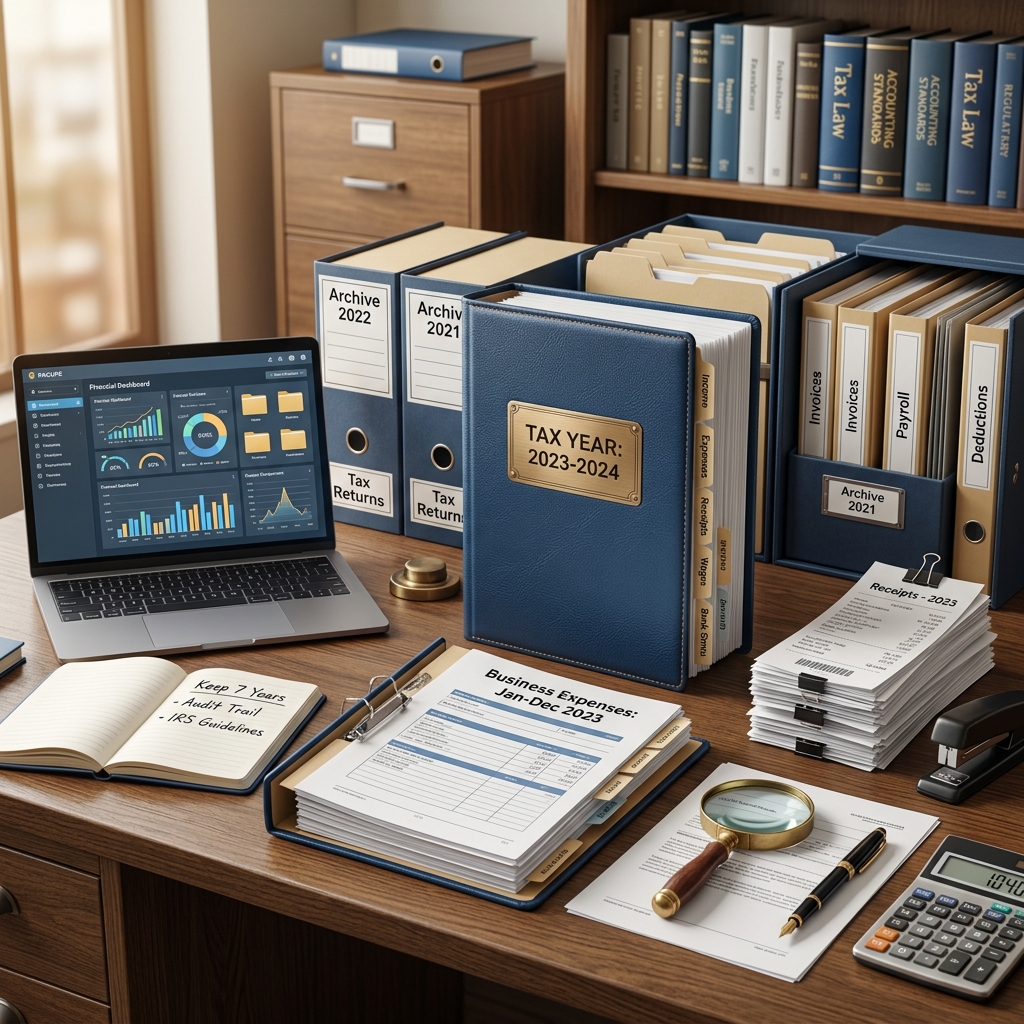
Keeping thorough and organized records is one of the most important responsibilities for any business owner. Strong recordkeeping helps you file accurate tax returns, supports deductions, prepares you for audits, and gives you a clear picture of your company’s financial health. While the law usually does not require a specific format or software, it does expect your records to clearly show your income, expenses, assets, and other key transactions.
Why Business Recordkeeping Matters for Taxes
Tax authorities rely on your records to verify the information you report on your returns. Without proper documentation, you may lose deductions, face penalties, or struggle to respond to audit requests. Good records also simplify everyday management tasks, including budgeting, cash flow monitoring, and decision-making.
Your recordkeeping system should enable you to:
- Prove income reported on your tax returns and other filings.
- Support deductions and credits with receipts, invoices, and payment records.
- Track assets for depreciation and gain or loss when sold.
- Document employment taxes and payroll records for several years.
- Comply with multiple laws that set minimum retention periods for certain documents.
Core Categories of Tax-Related Business Records
Although businesses differ in size and industry, most must keep records in a few common categories. Understanding these groups helps ensure you do not overlook important documentation.
1. Records of Income (Gross Receipts)
Gross receipts are all income your business receives from sales or services before expenses. To support this income, you should retain documents that show the sources, amounts, and dates of each transaction.
Typical income records include:
- Cash register tapes for in-person sales.
- Bank deposit slips and statements showing business deposits.
- Sales invoices and receipt books.
- Credit card charge slips and merchant statements.
- Information returns such as Form 1099-MISC for nonemployee compensation.
For tax purposes, these documents should make it easy to match amounts on your books to amounts on your tax return.
2. Purchase and Inventory Documentation
If you buy items for resale or purchase materials that become part of the products you sell, you need clear records of those purchases and inventory activity.
Key records include:
- Supplier invoices detailing goods or materials purchased.
- Canceled checks or proof of electronic payments.
- Cash register receipts and credit card statements.
- Inventory count sheets and valuation reports.
These documents should identify the vendor, describe the items, show the date and amount paid, and provide proof of payment. Accurate inventory records help substantiate cost of goods sold and gross profit calculations.
3. Expense Records
Business expenses include costs you incur to operate your company beyond direct purchases for resale. Examples are rent, utilities, marketing, professional fees, and travel.
To support these deductions, your records should show:
- Who you paid (vendor or service provider).
- Amount and date of the transaction.
- Description of the item or service proving it was business-related.
- Proof of payment, such as bank or credit card records.
Common documents include receipts, invoices, canceled checks, bank statements, and online payment confirmations.
4. Asset and Depreciation Records
Business assets are property you use in the business, such as machinery, vehicles, computers, and furniture. These items often qualify for depreciation or special tax treatment, so you must keep detailed records.
Asset records usually include:
- Purchase agreements and invoices.
- Documentation of how and when you acquired the asset.
- Records of improvements that increase value.
- Depreciation schedules and worksheets.
- Sales documents when the asset is disposed of, showing price and date.
These documents help you compute annual depreciation and calculate gain or loss when you sell or retire the asset.
5. Employment and Payroll Tax Records
Businesses with employees must keep a separate set of records related to wages, benefits, and taxes. Employment tax documentation is subject to specific retention requirements.
Examples include:
- Payroll registers and wage summaries.
- Time sheets, pay stubs, and direct deposit records.
- Forms W-2 and related year-end statements.
- Employment tax returns and deposit records.
- Documentation of tips, bonuses, and fringe benefits.
The IRS recommends keeping all records of employment taxes for at least four years after the date the tax becomes due or is paid.
6. Legal, Organizational, and Ownership Documents
Some documents define your business’s legal existence and ownership structure. These are vital for long-term reference and should be retained permanently.
Typical examples are:
- Articles of incorporation or organization and partnership agreements.
- Bylaws, operating agreements, and shareholder records.
- Property deeds, bills of sale, and title records.
- Trademark registrations, patents, and other intellectual property documents.
Ownership and formation records help prove control, support major transactions, and resolve disputes.
How Long Should You Keep Business Tax Records?
The length of time you should keep records depends on the type of document and the laws that apply. As a general rule, you must retain records for as long as they are needed to support the items reported on a tax return.
| Record Type | Typical Retention Period | Main Reason |
|---|---|---|
| Ownership and formation documents | Permanent | Prove business existence and ownership, support major transactions. |
| Business tax returns | At least 3–7 years | Audit window and amended return or refund claims. |
| Accounting and financial statements | Usually 7 years, often longer | Support tax positions and historical financial analysis. |
| Payroll and employment tax records | At least 3–4 years | Compliance with tax and labor laws. |
| Bank and credit card statements | Around 7 years | Proof of payments, income deposits, and audit support. |
In addition to these guidelines, you may need to keep certain records longer if they relate to ongoing claims, lawsuits, or unresolved tax issues.
Setting Up an Effective Business Recordkeeping System
The IRS allows you to use any recordkeeping system that clearly shows your income and expenses. This flexibility means you can choose a manual, digital, or hybrid approach, as long as it is reliable and consistent.
Choosing a Recordkeeping Approach
Many small businesses use accounting software, cloud storage, or a combination of paper and digital files. When selecting a system, consider:
- Accuracy and clarity—can someone unfamiliar with your business understand your records?
- Backup and security—do you protect records from loss, theft, or damage?
- Ease of retrieval—can you quickly find documentation for a specific transaction or tax year?
Best Practices for Organizing Tax Records
Whatever system you adopt, a few practical habits make recordkeeping more effective:
- Separate business and personal accounts to avoid mixing transactions.
- Use consistent file names and folder structures for digital documents (e.g., by year and category).
- Store paper documents in labeled binders or files organized by tax year and record type.
- Back up electronic records regularly to secure cloud or external storage.
- Maintain written policies for retention periods and destruction methods.
Common Recordkeeping Mistakes to Avoid
Poor recordkeeping can cause problems long after a transaction occurs. Being aware of common mistakes helps you protect your business.
- Discarding records too early: Destroying documents before the end of the recommended retention period may leave you exposed during audits or disputes.
- Ignoring employment tax documentation: Payroll and related records carry specific legal requirements; failing to retain them properly can lead to penalties.
- Keeping incomplete receipts: Receipts without dates, amounts, or descriptions make it difficult to prove deductions.
- Not tracking asset details: Missing purchase and sale records complicate depreciation and gain or loss calculations.
FAQs About Business Tax Records
Do I have to use a particular software for my records?
No. Tax authorities generally do not require any specific software or format. You may choose any system that clearly shows your income and expenses, including paper ledgers, spreadsheets, or accounting programs.
Are digital copies of receipts acceptable for tax purposes?
Yes, electronic storage systems are generally acceptable as long as they accurately reproduce the original information and remain accessible for the required retention period. You must ensure that the digital copies are clear, complete, and properly backed up.
How long should I keep my business tax returns?
Business tax returns and supporting documentation are typically kept for at least three to seven years, depending on the situation and potential audit timelines. Many advisers recommend retaining them for seven years or longer for additional protection.
What if I run a very small or home-based business?
Even small or home-based businesses must maintain records that support income and deductions. The scale may be smaller, but the types of documents—receipts, invoices, bank statements, and tax forms—are similar.
Can good recordkeeping reduce stress during an audit?
Yes. Having well-organized, complete records makes it much easier to respond to audit questions quickly and confidently. It also helps demonstrate that your business takes compliance seriously, which can streamline the process.
References
- What kind of records should I keep — Internal Revenue Service. 2023-03-01. https://www.irs.gov/businesses/small-businesses-self-employed/what-kind-of-records-should-i-keep
- Recordkeeping — Internal Revenue Service. 2023-03-01. https://www.irs.gov/businesses/small-businesses-self-employed/recordkeeping
- How Long Should You Keep Business Records? — AccountingDepartment.com. 2022-02-15. https://www.accountingdepartment.com/blog/how-long-should-you-keep-business-records
- How Long to Keep Business Documents: A Small Business Guide — U.S. Chamber of Commerce. 2023-07-10. https://www.uschamber.com/co/start/strategy/how-long-to-keep-business-documents
- A Comprehensive Guide to Effective Small Business Record-keeping — Eco-Tax. 2023-08-09. https://eco-tax.com/2023/08/09/a-comprehensive-guide-to-effective-small-business-record-keeping/
Similar Articles








Read full bio of medha deb




