
Algorithmic Policing: When Facial Recognition Fails
How flawed biometric tech disproportionately targets marginalized communities.
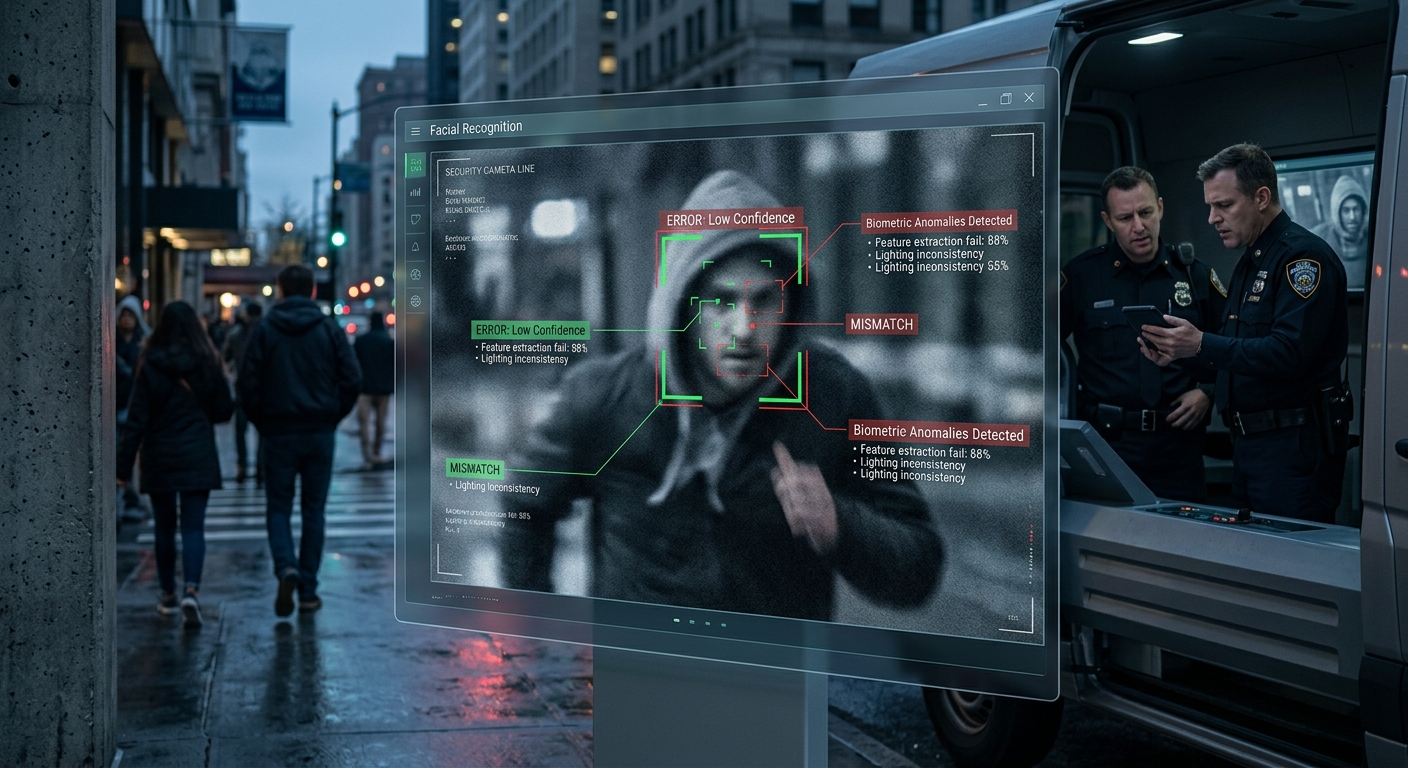
Law enforcement agencies across the globe have increasingly turned to artificial intelligence in an attempt to modernize criminal investigations and streamline the identification of suspects. Promising unprecedented efficiency and rapid results, facial recognition technology has been eagerly adopted by local, state, and federal police departments as a revolutionary tool for solving crimes. However, behind the glossy veneer of high-tech crime fighting lies a deeply troubling reality. Instead of serving as an objective arbiter of truth, facial recognition systems have proven to be dangerously flawed, frequently perpetuating racial bias and facilitating severe miscarriages of justice.
The deployment of these biometric tools in public spaces and criminal investigations has transformed a theoretical debate about artificial intelligence into an urgent civil rights crisis, where the cost of algorithmic error is the unjust deprivation of human liberty. As the debate intensifies, lawmakers, technologists, and civil rights advocates find themselves at a critical crossroads. The decisions made today regarding the regulation and implementation of biometric surveillance will unequivocally define the boundaries of privacy and justice for generations to come.
The Illusion of Infallibility in Biometric Surveillance
Humans possess an innate tendency to trust machines, a psychological phenomenon known as automation bias. When a complex computer program generates a result, individuals are naturally inclined to accept it as objective and accurate, often disregarding their own critical judgment or contradictory physical evidence. In the context of criminal investigations, this profound over-reliance on facial recognition technology has fundamentally altered the traditional detective process. Historically, identifying a suspect required painstaking investigative work, corroborating witness testimonies, and an accumulation of physical evidence. Today, a digital scan can instantly produce a name, an address, and a photograph, creating a dangerous illusion of absolute certainty.
When an algorithm outputs a match, the mathematical probability provided by the software often translates into unquestioned fact in the eyes of an untrained law enforcement officer. This blind faith in technology ignores the fundamental reality that algorithms are created by humans and trained on human-curated datasets, thereby inheriting the biases, prejudices, and blind spots of their creators. The systemic failure to critically evaluate algorithmic outputs has led to a dangerous paradigm where the computer’s word is taken as gospel, even when basic investigative logic dictates otherwise.
Quantifying the Bias: Why Demographics Matter in AI
The assertion that facial recognition algorithms are impartial and universally accurate is a pervasive technological myth. Extensive scientific research has definitively proven that these systems do not perform equally across all demographic groups. The core issue lies in the historical data used to train these complex machine learning models. If an algorithm is trained primarily on datasets featuring an overwhelming majority of white faces, it will inherently struggle to accurately map, distinguish, and identify the facial features of people from other racial and ethnic backgrounds.
In December 2019, the National Institute of Standards and Technology (NIST) published one of the most comprehensive evaluations of facial recognition algorithms to date, specifically focusing on demographic differentials. The NIST study analyzed hundreds of algorithms from various global developers and uncovered staggering disparities in performance. According to the report, false positive rates—the instances where the software incorrectly matches a person to a completely different individual’s photograph—were significantly higher for demographic groups that were not white males.
The research highlighted that false positive identification rates spiked dramatically when the algorithms attempted to identify individuals of West African, East African, and East Asian descent. For certain algorithms evaluated by NIST, the rate of false positive matches for Black demographics was disproportionately high compared to white demographics, sometimes by a factor of 100. A false positive in a controlled laboratory setting represents a mere statistical error; however, a false positive in a police department translates directly into an innocent person immediately becoming the prime suspect in a criminal investigation.
The Mechanics of a False Match
To fully comprehend how a flawed algorithm leads to an erroneous arrest, one must meticulously examine the operational mechanics of a facial recognition search. The process typically begins with a probe image—often a still frame captured from a low-resolution security camera, a blurry cellphone video, or a poorly lit ATM camera. This low-quality probe image is fed into a biometric software system, which measures the geometry of the face, including the distance between the eyes, the shape of the cheekbones, and the contour of the jawline. The software then compares this mathematical map against massive databases of known individuals, such as driver’s license repositories or criminal mugshot databases.
The system eventually produces a gallery of “candidate” images ranked by their similarity score. The technological danger peaks when investigators treat these candidate images not as potential leads requiring rigorous independent verification, but as definitive identifications. Detectives have been known to place the computer-generated candidate into a photo lineup and present it to witnesses who only caught a fleeting glimpse of the actual perpetrator. When the technology struggles to distinguish between Black individuals with similar broader physical characteristics, it effectively creates a rigged lineup, funneling an innocent person straight into the criminal justice system without a shred of physical evidence.
The Human Toll: Civil Rights and Wrongful Detentions
The transition from a digital misidentification to a physical arrest is an agonizing and life-altering experience for the victims. It is impossible to overstate the profound trauma of being apprehended by armed officers, handcuffed in front of neighbors or family members, and locked inside a jail cell for a crime committed by someone else entirely. For the individuals wrongfully targeted by this technology, the psychological scars, financial burdens, and reputational damage linger long after the charges are eventually dropped.
The burden of proof in these scenarios subtly and unlawfully shifts. Instead of the state bearing the responsibility to prove the accused’s guilt beyond a reasonable doubt, the wrongfully arrested individual is suddenly forced to prove their innocence against the perceived infallibility of a computer system. They must provide alibis, secure expensive legal representation, and fight to clear their name, all while navigating a justice system that is predisposed to trust the algorithmic match. Furthermore, because these false matches disproportionately affect Black and Brown communities, the unmitigated use of facial recognition technology actively exacerbates existing racial disparities within the policing and mass incarceration systems.
The Regulatory Vacuum and Lack of Oversight
Despite the well-documented technical flaws and the severe threat to civil liberties, the deployment of facial recognition by government agencies operates in a profound regulatory vacuum. There is a glaring absence of standardized, nationwide legislation governing how this technology can be used, who can authorize its use, and what safeguards must be in place to protect the public.
A comprehensive review published by the U.S. Government Accountability Office (GAO) in September 2023 illuminated the systemic failures in federal law enforcement’s use of biometric tools. The GAO investigation revealed that federal agencies had conducted tens of thousands of facial recognition searches without ensuring their personnel had any formalized training on how the technology works or how to accurately interpret its results. Furthermore, the report highlighted a critical lack of specific policies addressing civil rights and civil liberties protections regarding biometric surveillance.
This alarming lack of oversight extends down to state and local police departments, many of which purchase commercial facial recognition software without public knowledge or consent. Without mandatory training on the limitations of the technology—especially regarding demographic bias—officers are ill-equipped to recognize when a system is producing a flawed lead. This “wild west” environment of biometric policing allows unchecked technological experimentation on marginalized communities with zero accountability.
Constitutional Implications and Due Process
The unmitigated use of algorithmic surveillance also raises profound constitutional questions, particularly concerning the Fourth Amendment, which strictly protects citizens from unreasonable searches and seizures. The bedrock of the American legal system is the absolute requirement of probable cause before an arrest warrant can be lawfully issued. However, if an arrest warrant is based heavily on a racially biased algorithmic output, the very foundation of that probable cause is inherently compromised.
In many documented instances of wrongful arrests linked to biometric technology, the arresting officers deliberately failed to disclose to the magistrate or judge that the primary lead was generated by a facial recognition search. By obscuring the role of the algorithm, law enforcement effectively bypasses the judicial scrutiny necessary to evaluate the reliability of the evidence. Denying the defense the knowledge that an algorithm was utilized also violates the accused’s fundamental right to due process, as they cannot challenge the accuracy of the software or the methodology used in the investigation.
Building Guardrails and Moving Toward Equitable Justice
Addressing the civil liberties crisis created by algorithmic policing requires swift, decisive, and comprehensive legislative action. Policymakers must acknowledge that technological convenience is never a substitute for constitutional protections. Many civil rights advocates and technology scholars argue for an outright ban or a strict moratorium on law enforcement’s use of facial recognition technology until the software can be proven demonstrably safe, completely accurate, and entirely free of demographic bias.
For jurisdictions that refuse to enact bans, stringent regulatory guardrails are non-negotiable. These safeguards must include absolute statutory prohibitions on using biometric matches as the sole basis for an arrest, search warrant, or detention. Furthermore, rigorous transparency laws must compel police departments to publicly disclose their use of facial recognition software, audit logs of every search conducted, and explicitly state in all court documents when an algorithm was involved in an investigation. Independent audits of the algorithms used by law enforcement must be mandatory, carrying clear penalties for agencies that fail to comply with civil rights standards.
The intersection of artificial intelligence and the criminal justice system represents one of the most critical human rights battlegrounds of the modern era. A democratic society cannot allow the allure of technological efficiency to erode the foundational principles of justice and equality. We must fiercely prioritize the protection of vulnerable communities over the untested promises of biometric surveillance, ensuring that the future of public safety is built on a foundation of fairness, radical accountability, and an unyielding respect for civil liberties.
Frequently Asked Questions
What is facial recognition technology?
Facial recognition technology is a sophisticated biometric software application capable of uniquely identifying or verifying a person by comparing and analyzing patterns based on the person’s specific facial contours. It maps facial features from a photograph or video frame and mathematically compares the data with a database of known faces to find a potential match.
Why is facial recognition considered racially biased?
The technology is widely considered racially biased because the machine learning algorithms are primarily trained on datasets featuring a disproportionate number of white faces. Consequently, the software severely struggles to accurately map and differentiate the facial features of Black, Indigenous, and other people of color, leading to significantly higher rates of false positive matches for these demographics.
What is a false positive match?
A false positive match occurs when the facial recognition software incorrectly identifies an innocent person as the individual in a target photo (such as a blurry image from a security camera). In the context of law enforcement, a false positive can directly lead to an innocent person being wrongfully investigated, detained, or arrested.
Has anyone actually been wrongfully arrested due to this technology?
Yes. There have been numerous highly publicized and documented cases across the United States where individuals—disproportionately Black men and women—were wrongfully arrested, jailed, and charged with serious crimes they did not commit based entirely on incorrect matches generated by police facial recognition systems.
Are there federal laws regulating police use of facial recognition?
Currently, there is no comprehensive federal law in the United States that strictly regulates or standardizes how local, state, or federal law enforcement agencies use facial recognition technology. While some cities and municipalities have independently passed localized bans or restrictions, the national landscape remains largely unregulated, leading to inconsistent and often nonexistent civil rights protections.
Can facial recognition be improved to eliminate racial bias?
While developers are continually updating their algorithms with more diverse training data in an attempt to reduce demographic differentials, many experts argue that technological tweaks cannot solve a fundamentally systemic issue. Even if the algorithms become perfectly accurate, the technology is often deployed in heavily policed, marginalized communities, meaning the tool will still disproportionately impact people of color. Eliminating bias requires not just better code, but a fundamental reassessment of how and where biometric surveillance is utilized by law enforcement.
References
- Face Recognition Vendor Test (FRVT) Part 3: Demographic Effects — National Institute of Standards and Technology (NIST). 2019-12-19. https://nvlpubs.nist.gov/nistpubs/ir/2019/NIST.IR.8280.pdf
- Facial Recognition Services: Federal Law Enforcement Agencies Should Take Actions to Implement Training, and Policies for Civil Liberties — U.S. Government Accountability Office (GAO). 2023-09-12. https://www.gao.gov/products/gao-23-105607
- Facial Recognition Technology: Federal Law Enforcement Agency Efforts Related to Civil Rights and Training — U.S. Government Accountability Office (GAO). 2024-03-08. https://www.gao.gov/products/gao-24-107372
Similar Articles








Read full bio of medha deb


