
When Police Can Search Your Home Without a Warrant
Understand when officers may enter and search your home without a warrant, what legal exceptions apply, and how to protect your constitutional rights.
The
general rule
in the United States is that police officers must obtain asearch warrant
before entering and searching your home, because your residence carries the highest expectation of privacy under theFourth Amendment
to the U.S. Constitution. However, the law also recognizes specific situations where officers may legally enter or search without a warrant. Understanding those exceptions helps you recognize when your rights may be violated and how to respond effectively.Your Home and the Fourth Amendment
The Fourth Amendment protects people against unreasonable searches and seizures by the government. Courts have repeatedly stated that warrantless searches inside a home are
presumptively unreasonable
, meaning they are generally not allowed unless a recognized exception applies.In practical terms, this means:
- Police usually need
judicial approval
(a warrant signed by a judge) to enter and search your house. - Any search without a warrant must fall within a
narrow, well-defined exception
to be lawful. - Evidence obtained through an unconstitutional search can potentially be excluded from court under the
exclusionary rule
.
Because the home is treated as a special, highly protected space, courts carefully scrutinize warrantless entry and searches there.
What a Search Warrant Normally Requires
Before looking at warrantless searches, it is helpful to understand what a valid warrant typically requires. Under federal and state law, a search warrant must generally be based on
probable cause
and must describe the place to be searched and the items to be seized.| Warrant Requirement | What It Means |
|---|---|
| Probable Cause | Facts and circumstances that would lead a reasonable person to believe a crime has been committed and that evidence is likely found in the place to be searched. |
| Particularity | The warrant must clearly identify the specific location and the items or evidence officers are authorized to look for. |
| Judicial Authorization | A judge or magistrate reviews law enforcement’s sworn statement and formally approves the search. |
When officers conduct a search
without
such a warrant, the government bears the burden of showing that a recognized exception to the warrant requirement applies.Core Exceptions Allowing Warrantless Home Searches
Courts have recognized a limited set of circumstances where police may enter or search a home without first obtaining a warrant. While the exact wording can vary by jurisdiction, the main categories are broadly similar.
1. Voluntary Consent
The
consent exception
is one of the most common ways police legally enter homes without a warrant. If you or another person with apparent authority over the home voluntarily agrees to let officers in or to allow a search, that consent can make the search lawful even though no warrant exists.Key points about consent:
- Consent must be
voluntary
, not the result of coercion, threats, or deception. - The person consenting must have
actual or apparent authority
(for example, a resident or someone who seems to have control over the premises). - You have the right to
refuse
consent and to say no when officers ask to come in or to search. - The search cannot go beyond the
scope of consent
given; if you consent only to a quick look in the living room, officers normally cannot open closed drawers in a bedroom.
Legally, you do not have to answer the door or allow officers inside unless they have a warrant or another recognized legal basis. Many legal aid organizations advise individuals to politely decline consent when officers could otherwise be required to obtain a warrant.
2. Plain View Doctrine
The
plain view doctrine
allows police to seize evidence without a warrant when it is clearly visible and officers are lawfully present at the location.For plain view to apply, three conditions generally must be met:
- Officers are
legally present
in the home or at the doorway (for example, executing a valid warrant, responding to an emergency, or entering with consent). - The item’s incriminating nature is
immediately apparent
(such as drugs or an illegal firearm lying on a table). - Officers have lawful access to the item without further illegal intrusion.
Plain view does not authorize officers to enter a home unlawfully just to look inside; they must already have a legitimate reason to be there.
3. Exigent Circumstances
**Exigent circumstances** exist when an urgent situation makes it unreasonable for officers to delay and obtain a warrant, often because waiting could lead to harm, escape, or destruction of evidence.
Common examples include:
- Immediate threat to life or serious injury (for instance, responding to screams, a domestic violence emergency, or a report of someone unconscious).
- Risk that key evidence will be
destroyed
before a warrant can be obtained (such as officers seeing someone actively dispose of drugs). - Concern that a suspect will
flee
, especially in connection with serious offenses.
When exigent circumstances are present and officers also have probable cause, courts may uphold warrantless entry and limited searching related to resolving the emergency or preventing harm.
4. Hot Pursuit of a Fleeing Suspect
The
hot pursuit
doctrine is closely related to exigent circumstances. If officers are actively chasing a suspect from a public place and that person runs into a residence, they may follow the suspect into the home without first obtaining a warrant.Important aspects of hot pursuit include:
- The pursuit usually begins in a
public setting
where officers have lawful authority to confront the suspect. - Officers must be in
continuous, immediate pursuit
, not returning hours later. - The entry is tied to arresting the fleeing suspect and addressing any related safety or evidence concerns.
Even in hot pursuit, the scope of any search is typically limited to what is necessary for the arrest and immediate safety, plus any evidence in plain view.
5. Search Incident to a Lawful Arrest
When police lawfully arrest a person, they may conduct a
search incident to arrest
without a warrant. This allows officers to search the arrestee and the area within the person’s immediate reach for weapons, contraband, or evidence.Applied inside a home, this doctrine can permit officers to:
- Pat down the person being arrested.
- Search nearby containers or surfaces within the person’s grabbing distance.
- Seize incriminating items in plain view during the arrest process.
This exception does not authorize a broad, room-by-room search of the entire house unless another doctrine (such as consent, a warrant, or exigent circumstances) also applies.
Other Contexts: Vehicles and Lower Expectations of Privacy
While the focus here is on homes, it is helpful to note that the law treats
vehicles
differently. Because individuals have a reduced expectation of privacy in cars, and because vehicles can quickly be moved, courts recognize amotor vehicle exception
allowing warrantless searches of vehicles when officers have probable cause.However, that exception does
not
automatically extend to homes. Your residence remains the most protected place, and the default rule remains that a warrant is required absent a recognized exception.How Your Rights Work at the Door
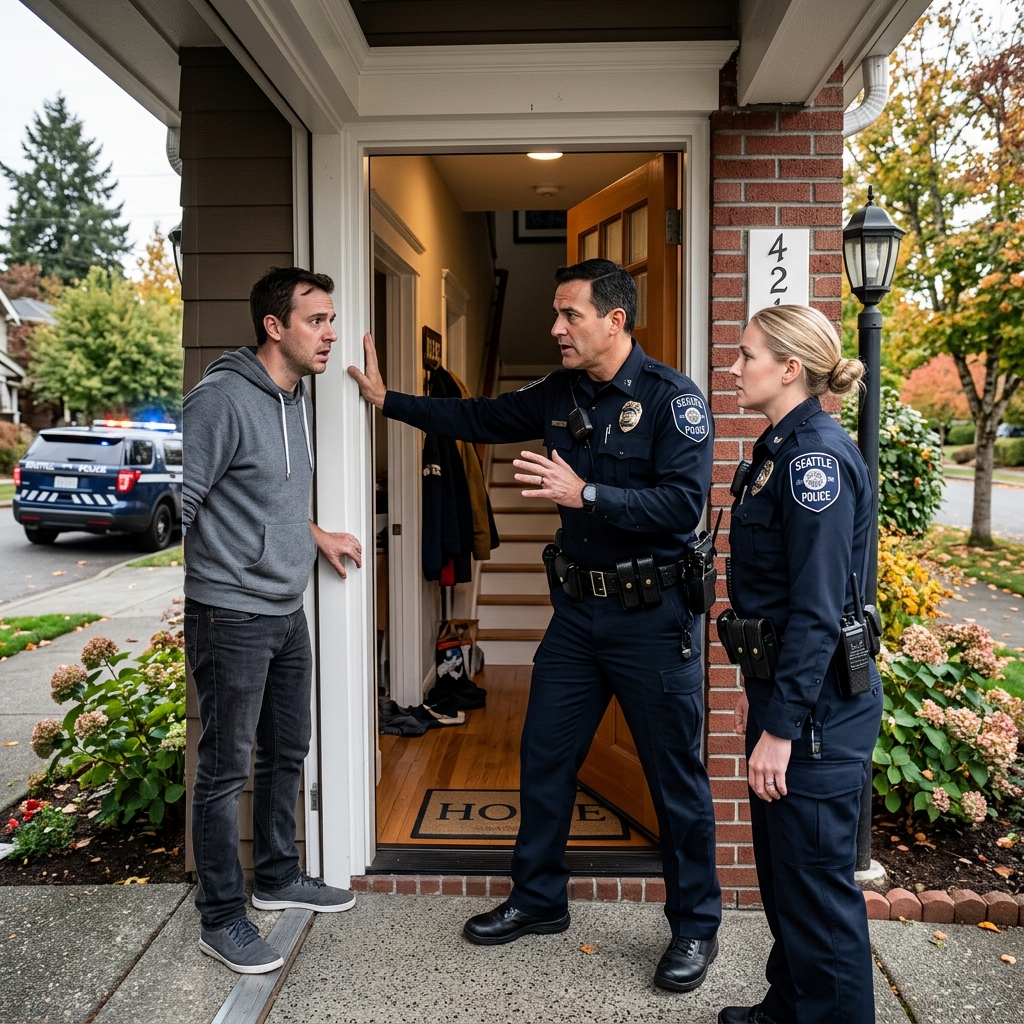
Interactions at your front door often determine whether a search is lawful or unlawful. Legal aid guidance emphasizes that, in most circumstances, you can decline to let police enter if they lack a warrant or an applicable exception.
Practical steps include:
- Calmly ask, “Do you have a warrant?” and request to see it if they say yes.
- If no warrant exists, you may say, “I do not consent to any search” and choose not to open the door, unless officers state a clear emergency or exigent circumstance.
- Avoid making statements that could be interpreted as granting consent, such as “Sure, you can look around.”
- Keep interactions brief and respectful, and consider stating that you wish to speak with a lawyer before answering questions.
Remember, once consent is given and officers enter, the legal landscape changes. Items in plain view and observations made inside can be used in court, even though the initial entry was warrantless.
Consequences of Illegal Home Searches
When police conduct a home search in violation of the Fourth Amendment, the primary remedy in criminal cases is the
exclusionary rule
, which allows courts to suppress unlawfully obtained evidence. Some state constitutions and statutes provide additional protections and remedies.Potential consequences of an illegal search can include:
- Suppression of evidence obtained directly through the unconstitutional search.
- Exclusion of certain evidence discovered later if it is considered “fruit of the poisonous tree.”
- Negative impact on the prosecution’s ability to prove its case.
Whether a particular search is illegal can be a complex legal question. Consulting a qualified criminal defense attorney is critical if you believe your home was searched improperly.
Frequently Asked Questions
FAQ 1: Can police enter my home if I do not answer the door?
In most situations, officers
cannot
lawfully enter your home simply because you failed to answer the door. They typically need either a warrant, consent, or an applicable exception such as exigent circumstances or hot pursuit to enter.FAQ 2: If I let officers inside to “talk,” have I consented to a search?
Allowing officers to step inside can be treated as
consent to enter
, and any contraband or evidence they see in plain view may be seized. However, that does not automatically authorize them to open closed containers or search other rooms unless you consent to a broader search or another legal basis exists. To avoid misunderstandings, many legal professionals recommend clearly stating that you do not consent to any search.FAQ 3: Can a roommate or family member consent to a search of the whole home?
A person with
common authority
over a residence (such as a roommate who shares living areas) can consent to a search of those shared spaces, and police may rely on that consent. Consent to search a private, exclusively controlled area (for example, a locked bedroom used only by one person) may be more limited and could be legally contested.FAQ 4: What if police say they will “get a warrant” if I do not consent?
Officers may state they will seek a warrant if you refuse consent, but you are not legally required to waive your rights because of that statement. Whether a warrant will be issued depends on whether they can demonstrate
probable cause
to a judge. Many legal resources advise individuals not to consent simply to avoid the possibility of a warrant, especially when they are unsure of their legal position.FAQ 5: Should I talk to police during or after a search?
You have a constitutional right to remain silent and to request an attorney. Speaking freely may unintentionally provide information that supports probable cause or additional charges. Many criminal defense attorneys advise that individuals politely decline to answer questions and ask to consult counsel, particularly if they are the target of a search.
Practical Tips to Protect Your Rights
While every situation is unique, several general practices can help safeguard your rights when police appear at your home:
- Stay calm and keep interactions respectful; confrontations can escalate and may create new legal issues.
- Ask clearly whether officers have a warrant and request to review it if they claim they do.
- If no warrant is present, clearly state: “I do not consent to any search of my home.”
- Avoid volunteering information or granting broad permission to “look around.”
- If a search occurs, make note of what officers do, what they say, and any items they seize.
- Contact a qualified attorney as soon as possible if your home has been searched or if officers indicate you are under investigation.
Understanding when police may lawfully search your home without a warrant empowers you to recognize the boundaries of government authority and assert your rights in a clear, lawful manner.
References
- Warrants and Illegal Searches and Seizures — University of North Carolina School of Government (Defender Manual). 2016-01-01. https://defendermanuals.sog.unc.edu/sites/default/files/pdf/14.2%20Warrants%20and%20Illegal%20Searches%20and%20Seizures.pdf
- When can the police search my home or car? — Illinois Legal Aid Online. 2023-06-01. https://www.illinoislegalaid.org/legal-information/when-can-police-search-my-home-or-car
- Police Searches With and Without a Warrant — Arnold & Smith PLLC. 2022-05-10. https://www.arnoldsmithlaw.com/police-searches-with-and-without-a-warrant.html
- Warrant and Warrantless Searches in North Carolina — Browning & Long, PLLC. 2021-04-15. https://www.browninglonglaw.com/blog/warrant-and-warrantless-searches-in-north-carolina.cfm
- Can A Cop Enter My Home Without A Warrant? — Law Office of Shawn M. Hennessy (Not Guilty Adams). 2020-11-05. https://www.notguiltyadams.com/faqs/can-a-cop-enter-my-home-without-a-warrant-.cfm
- What are my rights if police want to search my home? — National Police Accountability Project (video transcript via YouTube). 2019-08-01. https://www.youtube.com/watch?v=z3DvkAxHD4U
Similar Articles








Read full bio of Sneha Tete




