
Late Child Support: When Payments Are Due, Arrears, Remedies Now
Understand when child support is considered late, how arrears accumulate, and what enforcement options exist when payments do not arrive on time.
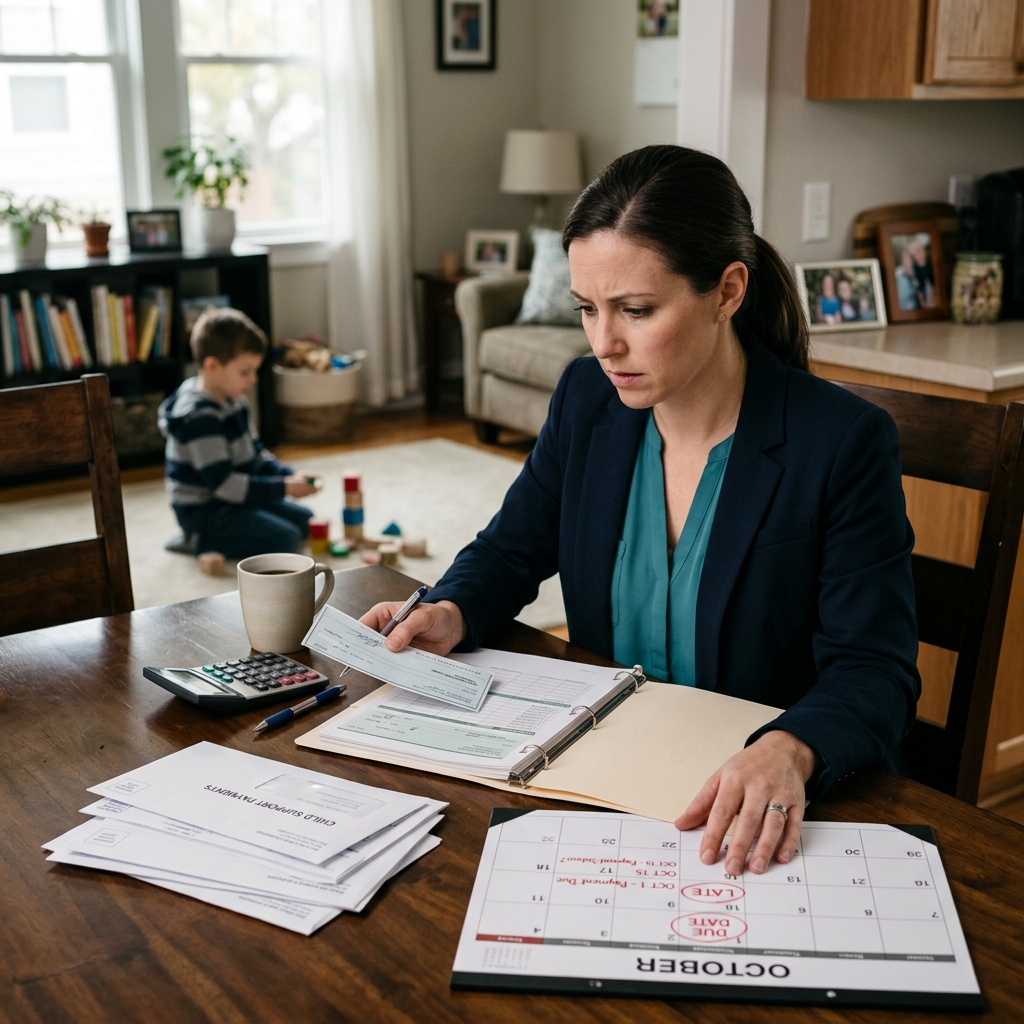
Child support is not just a private agreement between parents; it is a court-ordered obligation backed by state and federal law. Understanding when a payment is considered late, how debt (called arrears) builds up, and what consequences follow is essential for both parents. Late payments can affect a child’s well-being and can trigger financial and legal consequences for the paying parent.
How Courts and Agencies Define Late Child Support
Every child support order includes a due date or a clear schedule for payments, commonly monthly or bi-weekly. A payment is generally considered late as soon as it is not received in full by the due date stated in the court order or administrative notice.
However, in practice, courts and child support agencies recognize that bank transfers, payroll deductions, and administrative processing can take time. A brief delay of a few days is often treated differently from a missed payment that stretches into the next month.
Payment Due Dates vs. Processing Delays
Many support orders specify that payments are due on a particular day of the month, such as the 1st, or tied to pay periods. The obligation is to send or arrange payment by the due date, but the funds may not reach the receiving parent’s account immediately.
- Employer withholding: When support is taken directly from wages, the employer typically forwards the money to the state child support agency, which then disburses it. This process can add a delay of several business days.
- Bank transfers: Electronic payments may take one to three business days to clear, especially around weekends or holidays.
- Agency processing: State agencies often process large volumes of payments. Routine administrative handling can cause short delays even when the paying parent acted on time.
Because of these timing issues, the distinction between an administratively delayed payment and a truly late payment matters. An agency may still record a payment as timely if it was initiated by the due date but received a few days later.
When Arrears Begin to Accumulate
Once a scheduled payment is not made in full by the end of the period it covers, the unpaid amount becomes past-due support, often called arrears. In many jurisdictions, arrears begin as soon as a required payment is missed for the month, even if partial payments were made.
State definitions of arrears are similar: arrears are any support obligation amounts that are overdue and unpaid as of a certain date, usually the end of a month or the date an enforcement review occurs.
| Situation | Typical Treatment |
|---|---|
| Payment initiated on due date, received a few days later | Often treated as timely, especially if consistent with pay cycles |
| Payment made within the same month, but after due date | May be informally tolerated; still technically late in many orders |
| No payment by the end of the month | Commonly recorded as past-due support and may increase arrears |
| Repeated months with partial or no payment | Triggers enforcement measures and possible interest or penalty |
Arrears: What Happens When Support Is Not Paid on Time
When a payment is not made in full by the end of the period covered, the unpaid amount becomes arrears. Arrears can grow quickly if multiple payments are missed or if the paying parent regularly pays less than ordered.
How Arrears Are Calculated
Arrears are calculated by comparing the total ordered support to the total payments actually received during a given period. Any shortfall is added to the past-due balance.
- If the current monthly obligation is $500 and only $300 is paid, $200 becomes past-due support.
- Each subsequent month with unpaid amounts adds to the arrears balance.
- In cases with multiple orders (for example, multiple children in different households), arrears are usually calculated separately for each case.
Interest and Penalties on Late Child Support
Many states charge interest and sometimes penalties on arrears. These charges are designed both to compensate for late payment and to encourage parents to stay current.
As one state example, Massachusetts assesses interest and penalty only when the past-due amount exceeds a specified threshold—$500 at the end of a month—and when the paying parent has not made at least the required minimum payment for that month. Other states use different thresholds or interest rates but follow similar logic.
- Interest: Calculated on the total past-due support owed as of a specified date. It is not generally compounded on previously assessed interest.
- Penalties: May be added on top of arrears and interest. In some jurisdictions, penalty amounts are paid to the state rather than the custodial parent.
- No interest on interest: Some states explicitly prohibit charging interest on previously assessed interest or penalty, keeping the calculation based strictly on unpaid support.
Common Reasons Child Support Payments Arrive Late
Late child support does not always mean intentional nonpayment. There are many practical reasons why a payment may show up after the expected date, even when the paying parent is trying to comply with the order.
Administrative and Banking Delays
Routine administrative delays are among the most common reasons payments appear late on the receiving parent’s account.
- Payroll timing: Employers often remit withheld support on a fixed schedule after processing payroll. A change in pay dates or payroll cycles can temporarily alter when the payment reaches the agency.
- Bank processing: Interbank transfers, weekends, and holidays can extend the time between initiation and receipt of funds.
- Agency backlog: High caseloads can create processing backlogs, meaning payments may sit in an agency system for a short period before disbursement.
Changes in Employment or Income
Job loss, reduced hours, or switching employers can cause interruptions in wage withholding. During transitions, a parent may need to switch to direct payments temporarily, and missing a due date can be more likely.
Even if income changes, the obligation remains the same until a court or child support agency modifies the order. Failure to seek a modification can result in arrears, even when the parent’s income has legitimately decreased.
Failure to Prioritize Support Obligations
Sometimes, late payments reflect budgeting problems or disagreements about the amount ordered rather than administrative error. Because child support is a legal obligation, courts generally do not excuse late payments based on other debts or voluntary expenses.
Legal Consequences of Late and Unpaid Child Support
Once arrears accumulate, both courts and child support agencies have a range of enforcement tools at their disposal. These measures can escalate from gentle reminders to substantial financial and even criminal consequences, particularly in cases of chronic nonpayment.
Administrative Enforcement Actions
Child support agencies often begin with administrative enforcement before seeking court sanctions. Common actions include:
- Income withholding: Direct deductions from wages or salaries, often initiated by sending a notice to the employer.
- Tax refund interception: Seizing state or federal tax refunds to apply toward arrears.
- License suspension: Suspension of driver’s licenses or professional licenses for substantial arrears or repeated late payments.
- Credit reporting: Reporting the arrears to credit bureaus, which can affect credit scores and access to loans.
These tools aim to bring the paying parent back into regular compliance while collecting past-due amounts.
Court-Based Sanctions
If administrative enforcement is not sufficient, courts may resort to stronger measures. A judge can find a parent in contempt for willful failure to obey a support order. Contempt may result in fines, payment plans enforced by the court, and, in serious cases, jail time.
Although imprisonment is possible, it is typically reserved for situations where less severe enforcement tools have failed and the court finds that the parent has the ability to pay but refuses to do so.
When Is a Slightly Late Payment Overlooked?
In day-to-day practice, there is a difference between being technically late and being late in a way that triggers enforcement. Small delays within the same month, especially when explained and consistent with pay cycles, may not lead to immediate legal action.
For example, a payment due on the first of the month that arrives in the middle of that month may still satisfy the order in some informal arrangements, although it can create hardship for the receiving parent.
Patterns Matter More Than Isolated Delays
Courts and agencies focus heavily on patterns of nonpayment. A single payment that arrives a few days late rarely leads directly to sanctions. Repeated late or partial payments, however, suggest that the paying parent is not reliably meeting the obligation.
Once a pattern is documented, enforcement measures such as wage withholding, interest, or required payment plans are more likely to be used.
Practical Steps When Child Support Is Late
Both parents can take practical steps when child support payments do not arrive on time. Acting promptly can minimize confusion and help determine whether the issue is temporary or a sign of ongoing nonpayment.
Actions for the Receiving Parent
- Check official records: Review the child support agency’s online portal or payment history to see whether the payment shows as processed or pending.
- Account for weekends and holidays: Look at the calendar for dates that might slow down bank or agency processing.
- Give a short grace period: Allow a few business days before assuming a serious problem, particularly if payments are usually on time.
- Contact the agency: If a delay stretches beyond the normal pattern or if multiple payments are late, contact the child support office for clarification and possible enforcement.
Actions for the Paying Parent
- Review the order: Confirm the exact due dates, amounts, and method of payment required by the court or agency.
- Communicate early: If you anticipate a delay due to job changes or banking issues, notify the other parent and, if appropriate, the agency as soon as possible.
- Seek modification if needed: When income changes significantly, request a formal modification rather than simply paying less; otherwise arrears will continue to accumulate.
- Keep documentation: Save records showing when and how payments were made, including receipts, bank confirmations, and employer statements.
Frequently Asked Questions About Late Child Support
Is child support considered late if it arrives a few days after the due date?
Legally, a payment can be considered late once it is not made by the due date in the order. In practice, however, short delays due to payroll or bank processing may not trigger immediate enforcement, especially if consistent with normal timing.
When do interest and penalties start on late child support?
This depends on state law. Many states begin charging interest only when arrears exceed a certain threshold and the minimum required payment for the month has not been made. For example, one state applies interest and penalty only when past-due support is more than $500 at the end of the month and the minimum monthly payment was missed.
Can the child support agency enforce arrears after the child turns 18?
Yes. Even after the child becomes an adult, agencies typically continue to enforce collection of past-due support until the full balance, including interest, is paid.
What if I lose my job and cannot pay the full amount?
You remain responsible for the ordered amount until a court or agency officially modifies the order. If your income changes significantly, you should promptly request a modification rather than simply reducing payments, because any shortfall will become arrears.
Does a single late payment mean I could go to jail?
Jail is typically reserved for serious, willful nonpayment after other enforcement tools have failed. A single late payment that is quickly corrected rarely leads directly to incarceration, though it may still be recorded as past-due if not made by the due date.
Key Takeaways for Parents
- Child support becomes late when the ordered amount is not paid by the due date, even if small administrative delays sometimes occur.
- Arrears are unpaid support obligations that accumulate when payments are missed or paid in part, and they can trigger interest and penalties depending on state law.
- Courts and agencies are most concerned with patterns of nonpayment, not isolated short delays.
- Both parents can reduce confusion by monitoring payment records, communicating early, and seeking legal modification when circumstances change.
References
- Frequently Asked Questions (Child Support) — California Child Support Services. 2023-05-01. https://childsupport.ca.gov/faq/
- Interest and Penalties on Past-Due Child Support — Massachusetts Department of Revenue. 2022-09-15. https://www.mass.gov/info-details/interest-and-penalties-on-past-due-child-support
- Child Support Terms Glossary — Minnesota Department of Human Services. 2021-03-10. https://secure.childsupport.dhs.state.mn.us/mcso/participants/Glossary.request
- Interest on Child Support Arrears — National Conference of State Legislatures. 2025-07-01. https://www.ncsl.org/human-services/interest-on-child-support-arrears
- Why Is My Child Support Payment Late This Week? — The Jackman Law Firm. 2023-02-20. https://www.jackmanfirm.com/why-is-my-child-support-payment-late-this-week/
Similar Articles








Read full bio of Sneha Tete


