
Compensation Options for Victims of Vandalism
Learn how vandalism victims can seek compensation through insurance, civil claims, and crime victim programs.
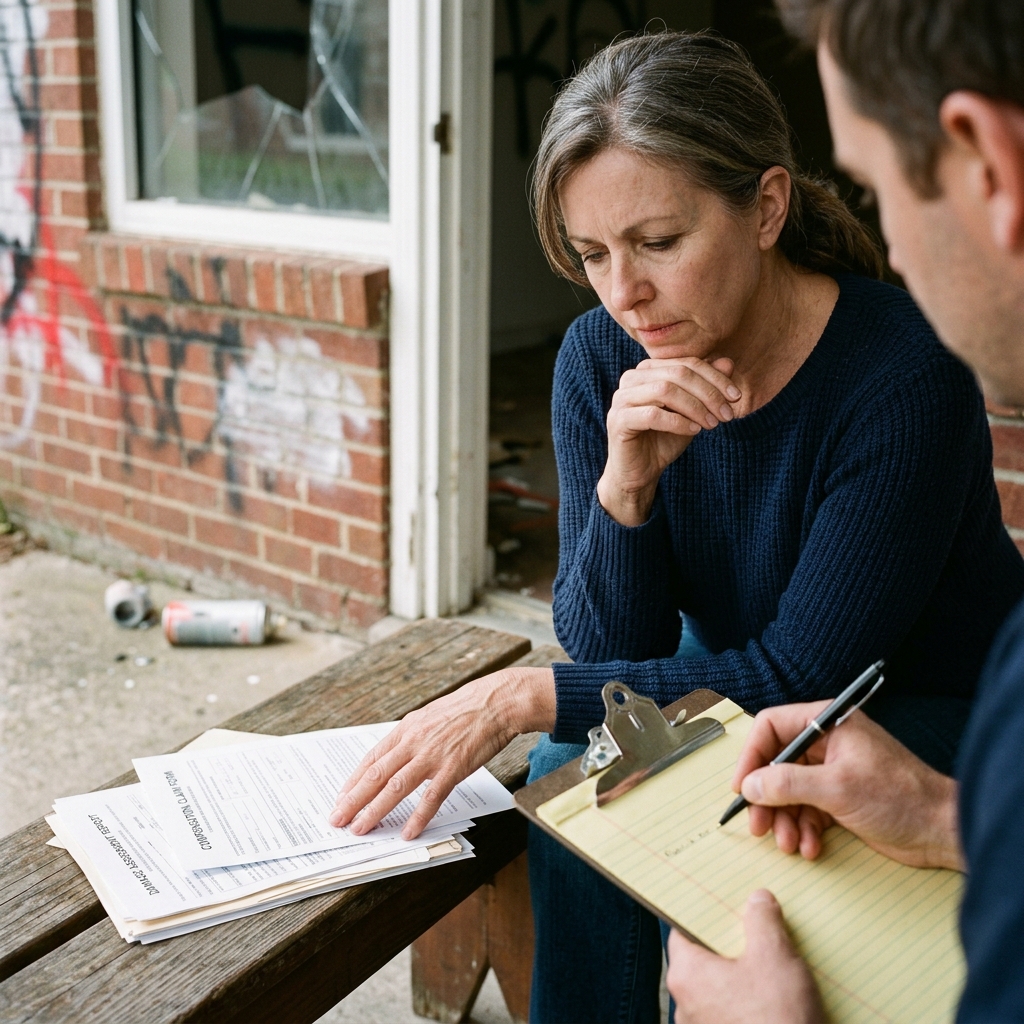
Vandalism can leave victims with broken windows, damaged vehicles, defaced homes, and a lingering sense of violation. Beyond the emotional impact, the cost of repairs, cleaning, and lost business or use of property can be significant. This article explains the main ways victims of vandalism may seek compensation in the United States, including insurance claims, civil lawsuits, criminal restitution, and state crime victim compensation programs.[10]
Understanding Vandalism and Your Legal Position
Vandalism generally refers to the intentional destruction or defacement of property, such as graffiti, broken fixtures, damaged vehicles, or destroyed personal belongings. In most states, vandalism is treated as a criminal offense, often classified under terms like criminal mischief, malicious destruction of property, or similar statutes.[10]
While the criminal case focuses on punishing the offender, victims usually care most about how to be made financially whole. Compensation can come from several sources, and the best approach often involves using more than one remedy.
- Insurance coverage for property damage
- Civil lawsuits against the offender or other responsible parties
- Criminal restitution ordered by a court
- State crime victim compensation programs for qualifying losses[10]
First Steps After Discovering Vandalism
Your actions immediately after the incident can strongly influence whether you receive compensation and how much you receive. Many insurance policies and victim compensation programs require prompt reporting and documentation.
Document the Damage Thoroughly
- Take clear photos and videos from multiple angles.
- List damaged items with estimated value and purchase dates.
- Save receipts for emergency repairs, boarding up windows, or cleaning.
- Preserve any physical evidence (e.g., paint cans, tools) if safe to do so.
Report the Crime to Law Enforcement
Most insurance policies and state victim compensation programs require a police report documenting the vandalism. Reporting promptly has several benefits:
- Creates an official record of the incident and timing.
- Helps law enforcement identify suspects who may later be ordered to pay restitution.
- Supports applications for state victim compensation and civil claims.
Protect Yourself and Your Property
- Arrange temporary repairs to prevent further damage (e.g., covering broken windows).
- Keep receipts for all protective measures; they may be reimbursable.
- Notify your landlord or property manager if you rent.
Insurance Coverage for Vandalism Damage
For many victims, insurance is the first and often fastest source of compensation. Coverage varies depending on the type of policy and the specific terms, but vandalism is commonly covered under several standard policies.
Homeowner and Renter Insurance
Homeowner policies typically cover vandalism damage to the dwelling and sometimes to personal property inside, subject to deductibles and policy limits. Renter insurance may cover damaged personal property but not the building structure, which is usually the landlord’s responsibility.
- Structure damage: walls, windows, doors, fixtures.
- Personal property: furniture, electronics, clothing, art.
- Additional living expenses: short-term housing if damage makes a home uninhabitable, depending on policy terms.
Auto Insurance
Vandalism damage to vehicles, such as broken glass, slashed tires, or graffiti, is generally covered under comprehensive auto insurance, not basic liability coverage. Victims usually must pay their deductible, and the insurer may seek recovery from an identifiable offender later.
Commercial Insurance for Businesses
Businesses often have commercial property policies that cover vandalism to buildings, signage, and equipment. In some cases, business interruption coverage may compensate for lost income if vandalism forces a temporary shutdown.
Key Points When Filing an Insurance Claim
- Contact your insurer as soon as possible after discovering the damage.
- Provide the police report number and copies when available.
- Submit photos, repair estimates, and receipts.
- Keep notes of all conversations with the insurer, including dates and names.
| Policy Type | Typical Coverage | Common Limitations |
|---|---|---|
| Homeowner | Damage to structure and personal property from vandalism | Deductibles, exclusions for certain property types |
| Renter | Damage to personal belongings; sometimes temporary housing | No coverage for building structure; policy limits |
| Comprehensive Auto | Broken windows, graffiti, slashed tires, other vandalism | Deductible; no coverage under basic liability-only policies |
| Commercial Property | Damage to business premises, signage, fixtures | Coverage depends on specific endorsements and exclusions |
Civil Lawsuits Against Offenders and Other Parties
If the offender is identified, victims may file a civil lawsuit seeking money damages. Unlike a criminal case, a civil lawsuit is focused on compensating the victim rather than punishing the defendant.
When a Civil Lawsuit May Be Appropriate
- The offender has known assets or income.
- The damage is extensive and exceeds insurance coverage.
- There may be other responsible parties (e.g., property owners who failed to secure a site).
Victims can claim the cost of repairs, replacement of destroyed property, lost business income, and sometimes emotional distress, depending on state law and the circumstances.
Third-Party Liability
In some situations, parties other than the direct vandal may bear civil responsibility. For example:
- Property owners who negligently fail to maintain security measures.
- Businesses that did not follow required safety protocols.
- Parents, in limited circumstances, for vandalism committed by minor children under state-specific statutes.
These cases can be complex, and victims typically benefit from consulting an attorney to assess whether third-party claims are viable.
Criminal Restitution Orders
When a vandalism case leads to criminal charges and a conviction or guilty plea, courts may order the offender to pay restitution. Restitution is money paid directly to the victim to reimburse documented losses resulting from the crime.[10]
How Restitution Works
- Victims submit information about their expenses to the prosecutor or probation department.
- The court issues a restitution order specifying the amount.
- Payments may be made in installments through a probation office or court clerk.
Restitution is not a guarantee of full recovery. Offenders may have limited financial resources, and collection can take years. However, many states give restitution orders special status that can aid enforcement, such as treating them like civil judgments.
State Crime Victim Compensation Programs
Every state and many territories operate crime victim compensation programs that reimburse certain expenses for victims of violent crime. Some programs also cover property damage related to specific crimes, and a few explicitly include vandalism or residence damage in limited circumstances.[10]
General Features of Crime Victim Compensation Programs
Although each state’s program is different, common elements include:
- Programs are funded by state sources and federal grants under the Victims of Crime Act.[10]
- Compensation is typically a “payer of last resort,” available only after other sources like insurance and workers’ compensation are exhausted.
- Benefits often focus on violent crimes resulting in physical injury or death, but some programs can cover related property damage or moving expenses.
Eligibility Requirements
Eligibility rules vary, but many states share requirements similar to these:[10]
- The crime must be reported to law enforcement within a specified time (e.g., 72 hours to one week).
- The victim must cooperate with law enforcement and prosecutors.[10]
- The victim must be an “innocent” victim; compensation may be denied if the victim’s own misconduct contributed to the crime.
- Claims must be filed within a set period, commonly one to two years from the crime.
Types of Costs That May Be Covered
Most programs emphasize personal injury rather than property damage. However, vandalism-related incidents that involve violent crime, such as arson or hate crimes, may qualify. Typical covered categories include:[10]
- Medical and dental expenses.
- Mental health counseling and therapy.
- Lost wages or support for victims and dependents.
- Funeral and burial costs for homicide victims.
- Relocation and security expenses, often with specific caps (for instance, up to a set amount for moving or safety improvements).
Several states set upper limits for compensation, such as up to $45,000 in Illinois for eligible victims of violent crime and up to $35,000 or more for injury-related claims in West Virginia, depending on whether the victim suffered injury or death. Colorado’s program may also help with damage to a residence in certain situations, underscoring that some property-related losses can be compensable when tied to qualifying crimes.
How to Apply
Most states provide online portals, downloadable forms, and telephone assistance lines for applicants.[10]
- Identify your state’s victim compensation office through the Office for Victims of Crime “Help in Your State” directory.[10]
- Gather documentation: police reports, medical bills, counseling bills, proof of lost wages, and receipts for repair or relocation costs.
- Submit the application within the required time frame, ensuring all sections are completed and signed.
- Respond promptly to requests for additional information to avoid delays in processing.
Comparing Compensation Paths for Vandalism Victims
| Option | Primary Purpose | Strengths | Limitations |
|---|---|---|---|
| Insurance Claim | Reimburse property damage and related costs under a policy | Often relatively quick; does not require identifying the offender | Deductibles and coverage gaps; may not cover all types of loss |
| Civil Lawsuit | Seek full financial compensation from offenders or third parties | Potential to recover uncompensated losses, including non-economic damages | Can be expensive and time-consuming; recovery depends on defendants’ assets |
| Criminal Restitution | Court-ordered payments from convicted offenders | Structured through the criminal justice system; may be enforced like a judgment | Limited by offender’s ability to pay; depends on successful prosecution |
| State Victim Compensation | Public program to reimburse specified crime-related expenses | Available regardless of whether offender is identified; can supplement other remedies | Focuses mainly on violent crime and personal injury; benefits capped and usually secondary to insurance |
Practical Tips for Maximizing Compensation
Victims often need to combine different compensation sources to fully address their losses. The following strategies can help maximize recovery:
- Use all available documentation: Detailed records improve your position with insurers, courts, and compensation programs.
- Consider legal advice: An attorney can help evaluate civil claims and assist in navigating restitution and victim compensation processes.
- Stay in contact with law enforcement and prosecutors: Cooperation may be an eligibility requirement for state compensation and can help secure restitution orders.
- Check deadlines: Missing filing deadlines can bar compensation claims, even when the underlying damage is clear.
Frequently Asked Questions (FAQs)
Does vandalism always qualify for state crime victim compensation?
Not necessarily. Most state programs are designed primarily for victims of violent crime who suffer physical injury or relatives of homicide victims.[10] Some programs may cover related property damage or residence damage, especially when it is part of a qualifying crime (such as arson or burglary), but simple property damage without injury may not be covered. Eligibility depends on state law, so you should review your state’s rules or speak with the victim compensation office.
Can I apply for victim compensation if I already received insurance payments?
Yes, but victim compensation programs generally act as payers of last resort. They usually reimburse only those expenses not covered by insurance, workers’ compensation, or other benefits.[10] You must disclose other sources of payment, and the program will subtract those amounts when calculating benefits.
What if the vandal is never identified or arrested?
You can still pursue compensation through insurance and, in many instances, through state victim compensation programs if the crime otherwise qualifies and you meet reporting and cooperation requirements.[10] Restitution and civil claims against the offender, however, typically depend on identifying the responsible person.
How quickly do I need to report the vandalism to be eligible for compensation?
Deadlines vary by state and by program. Some victim compensation programs require reporting within hours or days, such as 72 hours or one week after the crime. Many also require filing a compensation claim within one or two years. Insurance policies typically require prompt notice, which may be defined in the policy. Reporting and filing as soon as possible is the safest approach.
Where can I find information specific to my state?
The U.S. Office for Victims of Crime maintains a national directory of state victim assistance and compensation programs, including eligibility rules and contact information.[10] You can use that directory to locate your state’s official program and learn about available benefits, application procedures, and deadlines.
References
- Help in Your State — Office for Victims of Crime, U.S. Department of Justice. 2023-06-01. https://ovc.ojp.gov/help-for-victims/help-in-your-state
- Crime Victim Compensation — New York Crime Victims Legal Help. 2023-04-15. https://crimevictimshelpny.org/rights/victims/item.9002-Crime_Victim_Compensation
- Victim Compensation Program — North Carolina Department of Public Safety. 2024-02-10. https://www.ncdps.gov/dps-services/office-victim-compensation-services/victim-compensation-program
- OVP: Crime Victim Compensation — Colorado Division of Criminal Justice. 2023-11-20. https://dcj.colorado.gov/dcj-offices/ovp/crime-victim-compensation
- Crime Victim Compensation — Illinois Attorney General. 2023-09-01. https://www.illinoisattorneygeneral.gov/safer-communities/supporting-victims-of-crime/crime-victim-compensation/
- West Virginia Crime Victims Compensation Fund Eligibility — West Virginia Legislature. 2022-08-10. https://www.wvlegislature.gov/joint/Victims/eligibility.cfm
- Victims of Crime Act (VOCA) — National Network to End Domestic Violence. 2024-03-05. https://nnedv.org/content/victims-of-crime-act/
Similar Articles








Read full bio of Sneha Tete




