
Patent Prosecution: 5 Key Stages, Practical Tips For Inventors
Learn how patent applications move from filing to allowance, with key steps, timelines, and strategy.
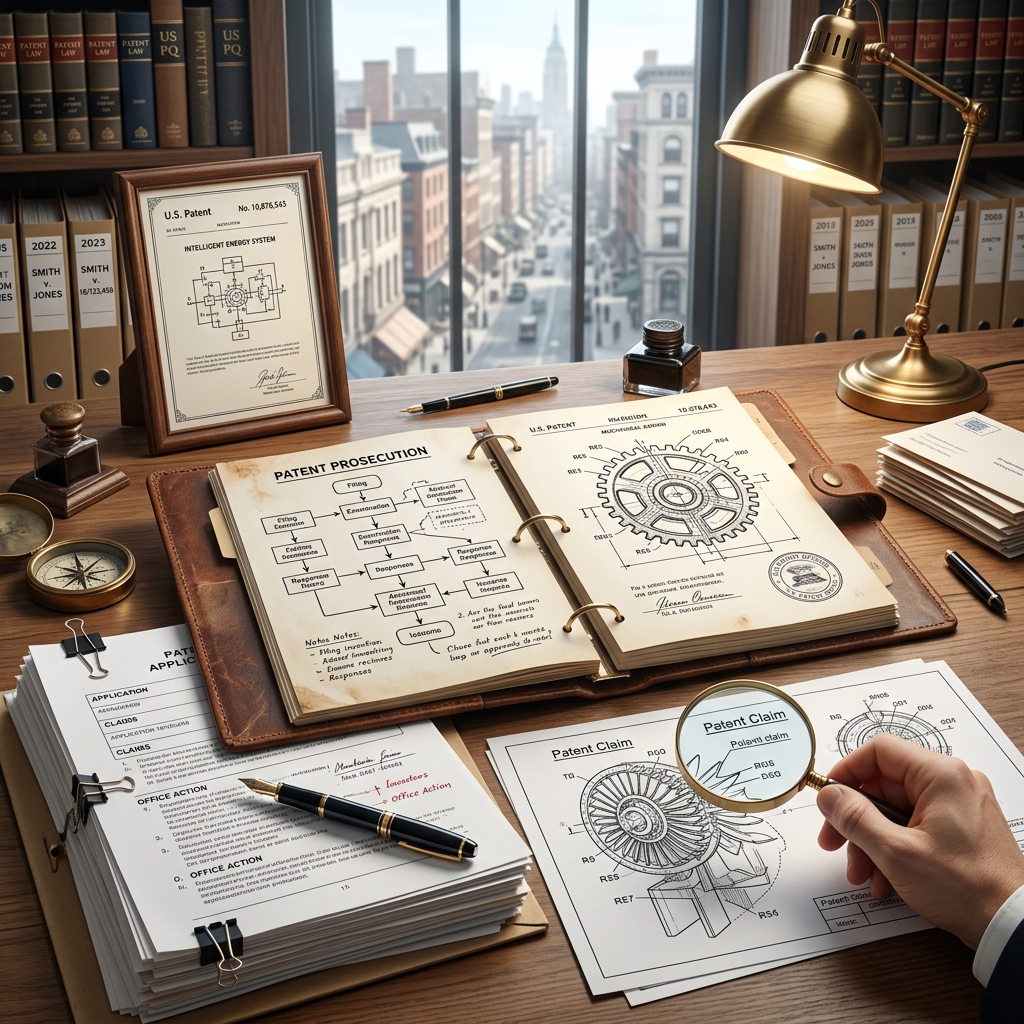
Patent prosecution is the process of moving a patent application through the patent office until it is either allowed, finally rejected, or otherwise resolved. It is not the same as patent litigation, which concerns infringement disputes in court. Instead, prosecution focuses on preparing a strong application, answering examiner objections, and shaping the legal scope of protection around the invention.
For inventors and businesses, this process matters because the quality of prosecution can influence whether a patent is granted, how broad the resulting rights will be, and how well those rights hold up later. A well-handled application can protect a useful commercial edge, while a poorly prepared one may end up narrow, delayed, or abandoned.
What Patent Prosecution Means
In ordinary legal usage, the word prosecution can sound like a criminal case, but in patent law it has a different meaning. It refers to the back-and-forth between the applicant and the patent office over whether the invention meets the legal standards for patentability. The process begins with the application and continues through examination, responses, amendments, possible appeals, and final disposition.
The United States Patent and Trademark Office describes patenting as a process that requires preparing the application and navigating USPTO procedures. That process generally involves technical disclosures, formal requirements, and legal argument about novelty, non-obviousness, and other statutory conditions.
| Stage | Purpose |
|---|---|
| Preparation | Gather invention details, prior art, drawings, and draft claims |
| Filing | Submit the application to the patent office |
| Examination | USPTO reviews the application and issues office actions |
| Response | Applicant argues, amends, or clarifies the application |
| Outcome | Allowance, final rejection, appeal, or abandonment |
Building the Application Before Filing
Patent prosecution begins long before the examiner reviews the file. The inventor and patent professional usually work together to define the invention carefully, identify what makes it different from existing technology, and gather enough detail to describe how it works. This early stage is not just administrative; it is the foundation for the legal boundaries of the eventual patent.
A complete utility patent application typically includes a written description, claims, and often drawings that help explain the invention. The claims are especially important because they define the exact legal scope of protection. If the claims are too narrow, the patent may be easy to design around. If they are too broad or poorly supported, the examiner may reject them.
- Specification: explains the invention in enough detail to teach how it is made and used.
- Claims: define the exclusive rights sought by the applicant.
- Drawings: help show structure, flow, or components when visuals improve understanding.
- Oath or declaration: confirms the inventorship requirements required by patent procedure.
- Fees: must be paid to complete filing and keep the application moving.
How Examiners Review Patent Claims
After filing, the application waits in the queue until an examiner is assigned. Once examination begins, the examiner compares the claims against the prior art, which includes earlier patents, published applications, and other public disclosures. The central question is whether the invention is new, useful, and non-obvious in light of what was already known.
In many cases, the first office action rejects some or all claims. That is not unusual. The examiner may argue that the claimed invention is anticipated by a single reference or rendered obvious by combining multiple references. The applicant then must respond with legal and technical arguments, amended claims, or both.
Non-obviousness often becomes the core dispute. A patent is not meant to reward an ordinary step that a skilled person in the field would likely have taken. The applicant therefore needs to show that the invention represents a meaningful advance rather than a predictable variation.
Responding to an Office Action
An office action is the examiner’s written response to the application. It may raise rejections, objections, or requests for clarification. The applicant’s response must address each issue carefully. Ignoring one point can weaken the entire reply.
A strong response usually does one or more of the following:
- explains why the cited prior art does not disclose the claimed invention;
- shows why the references do not make the invention obvious;
- amends the claims to distinguish the invention more clearly;
- clarifies language that may be ambiguous or unsupported;
- points out factual mistakes in the examiner’s reading of the record.
Patent procedure gives applicants a limited time to reply, so speed matters. If a response is not submitted properly and on time, the application can be treated as abandoned. In practice, this means prosecution is both a legal process and a project-management exercise.
Why Claims Matter So Much
The claims are often described as the heart of the patent because they define what the owner can exclude others from making, using, or selling. Two applications may describe similar inventions, but the one with stronger claims will usually provide better protection. For that reason, claim drafting is one of the most strategic parts of prosecution.
Good claim strategy tries to balance breadth and defensibility. Broad claims may capture more commercial value, but they also face a greater risk of rejection. Narrow claims may be easier to obtain, yet they may offer less practical protection. Skilled prosecution often involves adjusting claim language during examination without losing the core value of the invention.
Common Paths After a Rejection
A rejection does not necessarily end the application. Applicants often continue prosecution through amendments and rebuttal. In some cases, the examiner is persuaded and allows the claims. In others, the applicant may pursue a continuing application, refine the claim set, or appeal an adverse decision.
The main post-rejection paths can include:
- Amendment: revising claim language to overcome prior-art concerns.
- Argument: explaining why the examiner’s analysis is incomplete or incorrect.
- Continuation: filing a related application to pursue different claim coverage.
- Appeal: asking a higher tribunal to review the examiner’s final rejection.
- Abandonment: ending the application if it is no longer worth pursuing.
Timelines, Cost, and Practical Expectations
Patent prosecution is rarely quick. Some applications move efficiently, while others take years of correspondence, revisions, and review. A university technology transfer office notes that prosecution can take two to five years in some cases, while other sources observe that the process may last much longer depending on complexity and the number of office actions.
Cost also varies widely. Expenses depend on the invention’s complexity, the number of claim revisions, the need for prior-art analysis, and whether the applicant chooses to appeal. Because every response can affect the final scope of protection, saving money too aggressively at the drafting stage can create larger problems later. A careful approach often improves the odds of a stronger patent and may avoid unnecessary rounds of prosecution.
Appeals and Further Review
If the examiner issues a final rejection and the applicant still believes the invention is patentable, the matter may be appealed. Appeals allow a higher-level reviewer to consider whether the examiner applied the law and the prior art correctly. In some situations, applicants may also continue prosecution through other procedural options instead of immediately appealing.
Appeal is often chosen when the dispute is primarily legal rather than factual. For example, the applicant may believe the examiner combined references incorrectly or gave too much weight to an overly broad interpretation of the claims. Because appeals take time and resources, they are usually best reserved for cases with a credible argument that the examiner’s position is mistaken.
Post-Grant Issues and Ongoing Control
Although many people use “prosecution” to mean the pre-grant process, patent law also involves later-stage proceedings that affect the life of the patent. After grant, owners may need to pay maintenance fees, correct documents, or defend the patent against post-grant challenges. In some systems, third parties can challenge validity through opposition or similar procedures.
This later phase matters because a patent is valuable only if it remains enforceable. A grant certificate is not the end of the story. Owners must continue monitoring deadlines, market activity, and potential validity attacks. Effective patent management therefore extends beyond the office action phase and into the life cycle of the right itself.
Patent Prosecution vs. Patent Litigation
Patent prosecution and patent litigation are related but distinct. Prosecution is the process of obtaining the patent from the patent office. Litigation happens later, when a patent owner accuses another party of infringement or when a defendant challenges validity in court. The two processes use different procedures, different goals, and often different legal strategy.
| Topic | Patent Prosecution | Patent Litigation |
|---|---|---|
| Main goal | Obtain patent rights | Enforce or defend those rights |
| Forum | Patent office | Court |
| Focus | Patentability and claim scope | Infringement and validity disputes |
| Key actors | Applicant, attorney, examiner | Parties, judges, experts, juries |
Practical Tips for Stronger Prosecution
Applicants improve their odds when they approach prosecution as a long-term strategy instead of a single filing event. Clear invention disclosure, careful claim drafting, and a realistic reading of prior art can reduce later disputes. It also helps to keep the business goal in mind: the best patent is not always the broadest one, but the one that offers the most durable and commercially useful protection.
- Document the invention thoroughly before filing.
- Identify the closest prior art early.
- Write claims with both breadth and support in mind.
- Respond to office actions on every issue raised.
- Plan for continuation, appeal, or abandonment if needed.
Frequently Asked Questions
What is the main purpose of patent prosecution?
The main purpose is to obtain a patent by satisfying the legal and procedural requirements of the patent office. That includes showing that the invention is patentable and that the claims are properly supported.
How long does patent prosecution usually take?
It can take months or years depending on the application, the technology, and the number of office actions. Some applications move relatively quickly, while others require repeated responses and amendments.
Why do examiners reject claims?
Claims are often rejected because the examiner believes they are too similar to prior art, lack novelty, or would have been obvious to a skilled person in the field. Formal problems in the application can also trigger objections.
Can a rejected application still become a patent?
Yes. Many patents are allowed only after revisions, arguments, or multiple rounds of examination. A rejection is often part of the normal process rather than the final word.
Is a patent attorney necessary?
While an inventor may be able to file in limited circumstances, patent prosecution is highly technical and procedural. A patent attorney or agent can help draft claims, evaluate prior art, and respond effectively to office actions.
References
- How to apply for a patent — United States Patent and Trademark Office. 2026-01-01. https://www.uspto.gov/patents/basics/patent-process-overview
- Patent Prosecution Process — Rosalind Franklin University. 2026-01-01. https://www.rosalindfranklin.edu/research/research-support-offices/office-of-technology-transfer/inventors-resources/patent-prosecution-process/
- Patent Process — West Virginia University Office of Innovation and Commercialization. 2026-01-01. https://commercialize.wvu.edu/inventor-resources/patent-process
- What is patent prosecution? — Wolf Greenfield. 2026-01-01. https://wolfgreenfield.com/resources/what-is-patent-prosecution
- Understanding U.S. Patent Prosecution — IPWatchdog. 2018-06-30. https://ipwatchdog.com/2018/06/30/understanding-u-s-patent-prosecution/
- Patent Prosecution — Wikipedia. 2026-01-01. https://en.wikipedia.org/wiki/Patent_prosecution
Similar Articles








Read full bio of medha deb




