
Understanding Void and Voidable Contracts
Learn when a contract is treated as void or voidable, why the distinction matters, and what practical steps you can take if your agreement is legally defective.
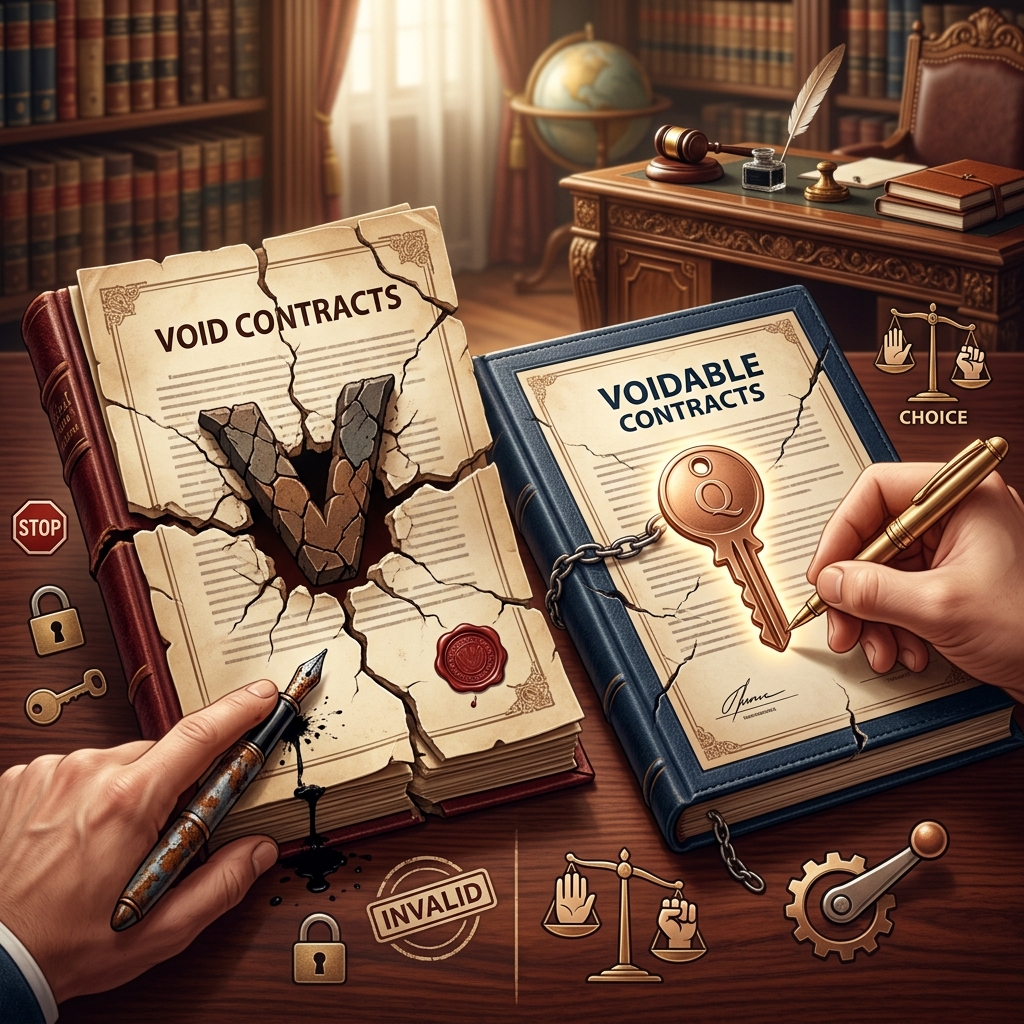
Contracts underpin most business transactions and many everyday agreements. When a contract turns out to be legally defective, lawyers and courts often describe it as void or voidable. Those two words sound similar, but they carry very different consequences for whether an agreement can be enforced and what remedies are available if something goes wrong.
This article explains what makes a contract void, what makes it voidable, why the distinction matters, and the practical steps parties can take when facing a questionable agreement.
Contract Validity: The Starting Point
To understand void and voidable contracts, it helps to start with the idea of a valid contract. Under basic contract principles in the United States, a contract generally requires:
- Offer – one party proposes clear terms.
- Acceptance – the other party agrees to those terms.
- Consideration – something of value is exchanged, such as money, services, or goods.
- Capacity – parties have the legal ability to enter into the agreement.
- Legality – the subject matter and purpose of the contract comply with the law.
When these elements are properly present and no major defects exist, the contract is generally valid and enforceable in court.
What Is a Void Contract?
A void contract is treated as if it never legally existed. It is invalid from the outset and never creates enforceable rights or obligations. Because of a fundamental defect, courts typically refuse to enforce the agreement.
Key Characteristics of Void Contracts
- No legal effect – the contract is unenforceable from the moment it is formed.
- Cannot be ratified – parties generally cannot “fix” a void contract by later agreeing to go forward.
- Anyone can challenge – not just one party; a court or third party may treat it as invalid.
- Restitution may apply – courts often seek to restore the parties to their original positions, returning money or property transferred under the void agreement.
Common Grounds That Make a Contract Void
Typical situations where courts find a contract void include:
- Illegality – Agreements involving unlawful activity (for example, contracts to commit a crime or violate licensing rules) are void because the law refuses to support illegal bargains.
- Impossibility from the start – If the promised performance is objectively impossible when the contract is made, the agreement may be void. For example, a contract to sell property that does not exist.
- Fundamental lack of capacity – In some cases, if a party is legally incapable of contracting (such as certain persons declared incompetent by a court), the contract may be treated as void rather than merely voidable.
- Serious defects in formation – A contract might be void if essential elements like offer, acceptance, or consideration are missing in a way that cannot be cured.
What Is a Voidable Contract?
A voidable contract is different. It begins as a valid contract, but one party has a legally protected option to cancel (rescind) it due to certain problems surrounding its formation or performance. Until that party exercises the right to reject, the contract is generally enforceable.
Core Features of Voidable Contracts
- Initially valid – the contract meets basic legal requirements on its face and can be enforced.
- Right to rescind – one party, often called the aggrieved or protected party, can choose to cancel the agreement.
- Choice to affirm – that party may instead confirm the contract, making it fully binding.
- Time-sensitive – failing to act within a reasonable period or continuing to perform after discovering the defect may eliminate the right to rescind.
Typical Grounds for Rendering a Contract Voidable
Many voidable contracts involve problems with consent, information, or fairness. Common grounds include:
- Fraud – One party intentionally misrepresents important facts, causing the other to enter into the contract. Fraud undermines genuine consent.
- Misrepresentation – False statements or omissions about material facts, even without intent to deceive, may give the misled party the right to rescind.
- Duress – If someone is forced, threatened, or coerced into signing, the contract is often voidable at their option.
- Undue influence – Excessive pressure by a person in a position of trust (such as a caregiver or advisor) can make the contract voidable.
- Mistake – Certain serious mistakes about facts or contract terms may justify rescission, particularly when the mistake is mutual or known to the other party.
- Lack of capacity – Minors and some persons with mental impairments frequently have the right to affirm or reject contracts as voidable under state law.
- Unconscionable terms – Extreme unfairness or one-sided provisions may support treating an agreement as voidable in some jurisdictions.
Void vs. Voidable: A Side-by-Side Comparison
The table below highlights how void and voidable contracts differ in practice.
| Aspect | Void Contract | Voidable Contract |
|---|---|---|
| Legal status at formation | Invalid from the beginning; no enforceable obligations. | Valid when formed; enforceable unless rescinded. |
| Main cause of defect | Illegality, impossibility, or fundamental lack of formation elements. | Problems with consent, information, fairness, or capacity. |
| Who can challenge? | Typically any party or the court can treat it as void. | Usually only the protected/aggrieved party may rescind. |
| Ability to cure | Cannot be cured; must be replaced by a new, valid contract. | Can often be cured through ratification, amendment, or waiver. |
| Effect of ratification | Not applicable; void contracts cannot be ratified. | Once ratified, the contract is fully enforceable and no longer voidable. |
| Typical remedies | Restitution to return parties to their original positions. | Rescission plus restitution; sometimes damages depending on circumstances. |
Practical Consequences for the Parties
Whether a contract is void or voidable affects what parties can do after a dispute arises and how courts respond to claims of breach.
If the Contract Is Void
- No enforcement for breach – a party generally cannot sue for breach of a void contract because it is not legally recognized.
- Restitution becomes central – courts often order money or property returned to the original owner if a void contract led to exchanges.
- Need for a new agreement – parties wishing to continue the relationship must create a fresh contract that complies with the law.
If the Contract Is Voidable
- Risk of later collapse – the contract operates normally until the protected party rescinds. Businesses may perform for months or years before discovering a defect that allows cancellation.
- Strategic choice for the aggrieved party – they can either affirm the contract (often to preserve beneficial terms) or rescind it to avoid future obligations.
- Potential damages – when fraud or other wrongdoing is involved, courts may award damages in addition to rescission and restitution.
Void, Voidable, and Unenforceable Contracts
Legal commentary sometimes distinguishes void contracts from unenforceable contracts. A void contract is substantively invalid, often due to illegality or missing essential elements. An unenforceable contract may be substantively valid but cannot be enforced because of procedural problems, such as lack of a required written form or expiration of the statute of limitations.
A contract can also become practically unenforceable if the costs of litigation exceed any realistic recovery, even if it remains legally valid. Understanding these distinctions helps parties gauge their risk and decide how aggressively to pursue or defend a claim.
Examples Illustrating Void and Voidable Agreements
While specific outcomes depend on state law and facts, the following examples demonstrate how contracts might be characterized:
- Contract for illegal services – An agreement to pay for unlawful insider trading is typically void. Courts will not enforce any aspect of the arrangement.
- Sale of a non-existent asset – A contract to sell a particular parcel of land that the seller does not own and cannot acquire may be void because performance is impossible from the start.
- Business contract signed under threat – If a supplier signs a distribution agreement only after a competitor threatens serious harm, the contract may be voidable. The threatened party can ask a court to cancel it on grounds of duress.
- Minor’s purchase of high-value goods – A teenager who buys an expensive item on credit may have the right under state law to cancel the contract as voidable, though exceptions apply for necessities.
- Investment deal based on false financials – If a company secures investment by presenting materially false statements, investors may treat the contract as voidable due to fraud and seek rescission and damages.
How Courts Typically Handle Rescission and Restitution
When a contract is void or voidable and a party seeks to unwind it, courts often apply principles of rescission and restitution.
- Rescission – The contract is canceled, and the parties are released from future obligations.
- Restitution – Each party is, as far as possible, restored to the position they were in before the contract, often through returning money, goods, or other benefits.
- Equitable adjustments – When full restoration is impossible, courts may make equitable adjustments to prevent unjust enrichment.
In some cases, especially involving fraud or serious wrongdoing, courts may award additional damages beyond simply undoing the transaction.
Practical Steps If You Suspect a Contract Is Void or Voidable
Parties facing a questionable contract can take several practical steps to protect their interests. While specific legal advice must come from a qualified attorney, common actions include:
- Review the agreement carefully – Identify terms that might indicate illegality, impossibility, unfairness, or misrepresentation.
- Gather documentation – Keep copies of emails, messages, drafts, and notes that show how the contract was formed and what was represented at the time.
- Consult legal counsel – An attorney can help determine whether the contract is likely void, voidable, or merely risky, and whether rescission, modification, or enforcement is appropriate.
- Avoid ratifying unintentionally – If you believe the contract is voidable, be cautious about continuing performance or accepting benefits after discovering the problem, as this may be treated as affirming the agreement.
- Communicate concerns in writing – If you suspect fraud, duress, or misrepresentation, formally notify the other party and document your position.
- Consider negotiation or settlement – Many disputes over void or voidable contracts can be resolved through renegotiation, partial refunds, or replacement agreements, avoiding costly litigation.
Frequently Asked Questions (FAQs)
1. Is a void contract always illegal?
No. Many void contracts are illegal, but some are void simply because they lack essential legal elements or involve performance that is impossible. Illegality is a common reason, not the only one.
2. Can a voidable contract become fully valid?
Yes. If the protected party knowingly continues performance, accepts benefits, or formally confirms the agreement after discovering the defect, courts often treat the contract as ratified and fully enforceable.
3. Who decides whether a contract is void or voidable?
Ultimately, a court decides when a dispute arises. Lawyers may advise clients that a contract is likely void or voidable based on the facts and applicable law, but judicial decisions are authoritative.
4. Does misrepresentation always make a contract voidable?
Not always. Minor or non-material misstatements may not justify rescission. Material misrepresentations that influenced a party’s decision to contract are more likely to support a voidable classification.
5. Are oral contracts treated differently?
Oral contracts can be valid, void, or voidable just like written ones. However, some agreements must be in writing under statutes of frauds, and failure to do so may render them unenforceable even if they are not void.
6. If a minor signs a contract, is it automatically void?
Under many state laws, contracts with minors are voidable at the minor’s option, not automatically void. Minors may affirm or reject such agreements, subject to exceptions for necessities.
Why the Distinction Matters for Businesses and Individuals
From consumer purchases to major corporate deals, understanding whether an agreement is void or voidable helps parties assess:
- Enforcement risk – Will a court recognize the contract and enforce its terms?
- Exposure to litigation – Could the other party unwind the transaction long after performance has begun?
- Need for due diligence – Are there signals of fraud, undue influence, or capacity issues that should be addressed before signing?
- Remedy planning – Should you pursue damages, rescission, restitution, or negotiation as the preferred strategy?
In complex or high-value transactions, legal review before signing can significantly reduce the chance that a contract will later be attacked as void or voidable.
References
- Voidable — Legal Information Institute, Cornell Law School. 2020-05-01. https://www.law.cornell.edu/wex/voidable
- Void vs. Voidable Contracts: Key Differences Explained — SirionLabs. 2023-03-10. https://www.sirion.ai/library/contracts/void-vs-voidable-contract/
- Litigation Overview: Void vs. Voidable Contracts — Bloomberg Law. 2021-08-15. https://www.bloomberglaw.com/external/document/X6T9531K000000/litigation-overview-void-vs-voidable-contracts
- Under What Circumstances is a Contract Voidable? — Binnall Law Group. 2022-04-12. https://www.binnall.com/insights-news/under-what-circumstances-is-a-contract-voidable/
- What is the Difference Between a Void and a Voidable Contract? — Simon Monahan Law. 2023-02-20. https://www.simonmonahanlaw.com/blog/2023/02/what-is-the-difference-between-a-void-and-a-voidable-contract/
- Void vs. Voidable Contract – Similarities and Differences — PandaDoc. 2022-11-05. https://www.pandadoc.com/blog/void-vs-voidable-contract/
- Voidable Contract Explained: Definition, Examples, and Legal Context — Investopedia. 2023-06-01. https://www.investopedia.com/terms/v/voidable-contract.asp
Similar Articles








Read full bio of Sneha Tete


