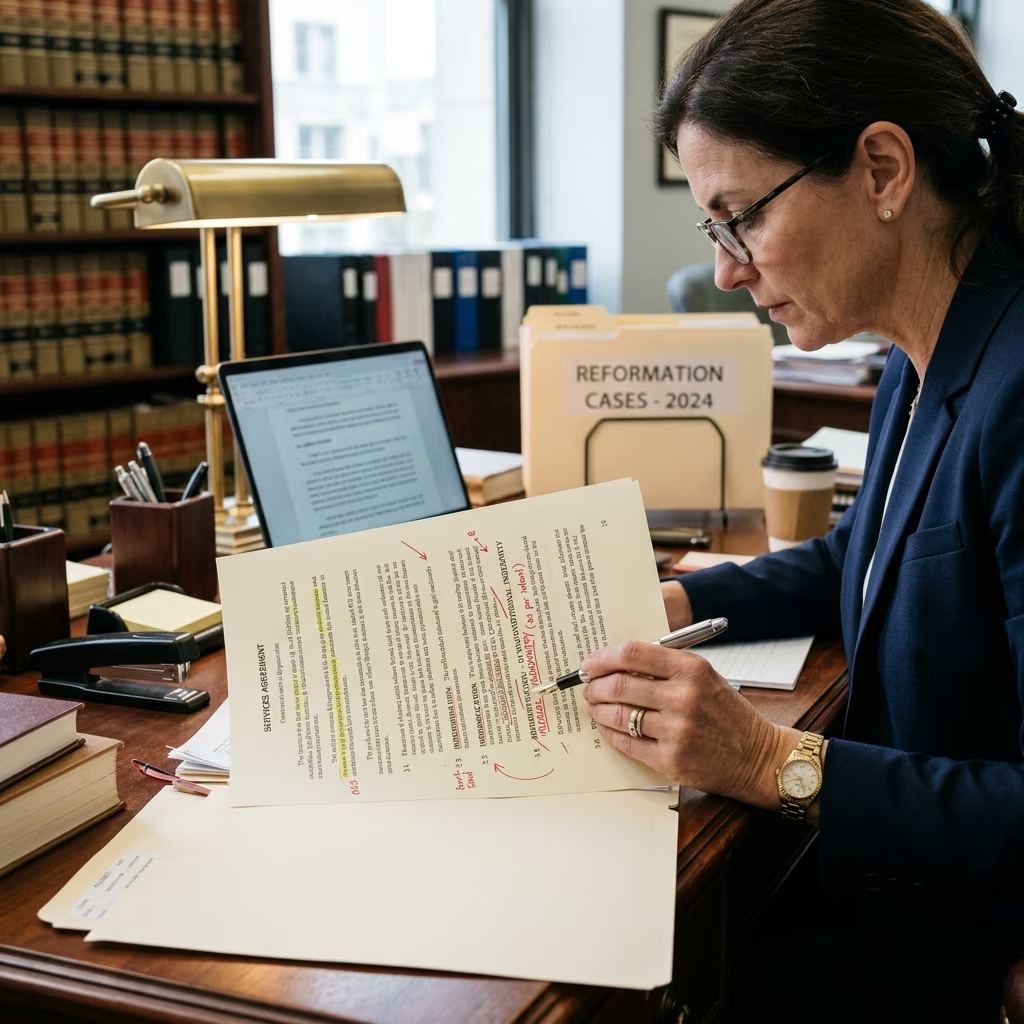
Contracts are meant to capture the actual agreement between parties, but written documents do not always match what was truly intended. In those situations, courts may use a special tool called contract reformation to correct the writing so that it reflects the real bargain, rather than leaving the parties stuck with a mistaken or misleading document.
This article explains what contract reformation is, when it is available, how it differs from other remedies, and the practical limits parties face when asking a court to rewrite their agreement.
What Is Contract Reformation?
Contract reformation is an equitable remedy that allows a court to modify the language of a written contract so the document conforms to the parties’ actual agreement. Rather than canceling the contract or awarding damages, the court changes the written terms to cure specific errors, usually involving a mistake or fraud.
In other words, the court is not creating a new deal; instead, it is correcting the writing so it accurately memorializes the deal the parties already made.
- Goal: Make the written instrument mirror the parties’ genuine intent.
- Scope: Corrects terms affected by mistake, misrepresentation, or fraud.
- Nature: Equitable (discretionary) remedy, often paired with other relief like damages or specific performance.
Courts apply reformation cautiously because written contracts are generally presumed to express the parties’ true agreement. Overcoming that presumption requires strong, persuasive evidence.
When Do Courts Consider Reformation?
Reformation is not available for every grievance about a contract. Instead, it is limited to situations where there is a clear mismatch between the written document and what both parties actually agreed to. Common categories include:
1. Mutual Mistake of Fact or Law
A mutual mistake occurs when both parties share the same erroneous belief about a vital aspect of their contract—such as a key term, legal effect, or factual assumption. When the written contract embodies that shared mistake, reformation may be appropriate.
Examples include:
- Both sides intended a 10-year lease term, but a clerical error produced a 1-year term.
- Parties agreed that interest would be 5% annually, but the contract mistakenly states 15%.
- An insurance policy misstates coverage dates that both parties believed were different.
In many jurisdictions, the party seeking reformation must prove the mutual mistake with clear and convincing evidence, a higher standard than ordinary civil cases.
2. Fraud or Misrepresentation Combined with Mistake
Reformation is also available when one party has engaged in fraud or material misrepresentation and the other party signed a contract that does not reflect the true understanding because of that deception.
This typically involves:
- A written term inserted or altered without the other party’s informed consent.
- A party misrepresenting the meaning or effect of a clause to induce signature.
- Withholding critical information so the innocent party believes the contract says one thing while it legally says something materially different.
In such cases, the court may reform the contract to remove or correct the fraudulent term, aligning the document with the agreement the innocent party reasonably believed they were making.
3. Scrivener’s Errors and Clerical Mistakes
Another common ground is a scrivener’s error, meaning a mistake made by the person who drafted or typed the contract, such as a mis-typed number, misnamed party, or omitted word.
Where the parties clearly agreed on a particular term, but the drafting process introduced an error, courts often see reformation as the proper remedy because:
- The parties’ true intent is relatively easy to prove.
- The error is mechanical rather than substantive.
- Correcting the mistake does not create a new bargain; it merely reflects the original one.
Reformation vs. Other Contract Remedies
Reformation is frequently discussed alongside other contract remedies. Understanding the distinctions helps parties decide which remedy to seek.
| Remedy | What It Does | Typical Use Case |
|---|---|---|
| Reformation | Rewrites specific terms of a written contract to reflect the parties’ actual agreement. | Mutual mistake, fraud plus mistake, or clerical errors where parties still want the relationship to continue. |
| Rescission | Cancels the contract and restores parties to their pre-contract positions. | Serious defects such as fraud, duress, or material misrepresentation making the contract voidable. |
| Damages | Monetary compensation for losses caused by breach or wrongful conduct. | When performance has occurred under a flawed contract and a party seeks financial redress. |
| Specific Performance | Court order requiring a party to perform as promised. | Unique subject matter (e.g., real estate) where money damages are inadequate. |
Reformation is usually a preliminary step that ensures the contract accurately reflects the parties’ intent before a court decides whether to enforce it through damages or specific performance.
Key Requirements for Contract Reformation
While specifics vary by jurisdiction, several core elements frequently appear in reformation cases.
1. Valid Contract Exists
There must be a legally valid contract: offer, acceptance, consideration, and no fundamental defenses like illegality or incapacity. Reformation presumes there was an actual agreement—its problem lies in the written memorialization, not the underlying bargain.
2. Clear Evidence of Mistake or Fraud
The party seeking reformation must show that the written document diverges from the true agreement due to:
- Mutual mistake (both parties misunderstand a term or fact).
- Unilateral mistake plus fraud or inequitable conduct by the other party.
- Scrivener’s error or drafting mistake.
Many courts require clear and convincing evidence to support reformation—meaning the proof must be highly persuasive and leave little doubt about both the existence of the mistake and the precise terms that should replace the erroneous language.
3. Proof of the Parties’ True Intent
It is not enough to show that the contract contains an error. The proponent must also prove exactly what the parties agreed to and how the reformed wording should look. Evidence may include:
- Earlier drafts or written negotiations.
- Emails or correspondence describing the agreed terms.
- Testimony from both parties or witnesses.
- Course of performance showing how the parties behaved before discovering the error.
Court decisions often stress that reformation cannot be granted based on vague recollections or generalized complaints; the exact corrected language must be supported by solid proof.
4. No Injustice to Third Parties
Because reformation is equitable, courts consider its impact on third parties who may have relied on the written contract, such as subsequent purchasers or lenders. Where reformation would unfairly prejudice innocent third parties, courts may refuse to grant it.
Limits on Contract Reformation
Courts are careful not to use reformation to do more than correct genuine errors. Several important limitations apply.
1. Courts Do Not Create New Contracts
Reformation may not be used to give a party better terms than were originally agreed or to add new provisions that were never part of the bargain. The remedy is restricted to making the writing express the agreement the parties actually made.
That means:
- No inserting clauses the parties deliberately left out.
- No expanding rights or obligations beyond what was originally intended.
- No rewriting the contract simply because one party now views it as unfair or unfavorable.
2. Not Available for “Bad Bargains” Alone
Courts repeatedly emphasize that reformation is not a tool to relieve a party from a tough or one-sided deal. If the contract accurately reflects the agreed terms—even if those terms later prove burdensome—reformation is not appropriate. The error must be in the writing, not in the business judgment of the parties.
3. Statute of Limitations
Like other legal actions, reformation claims are subject to time limits. For example, New York applies a six-year statute of limitations from the date the mistake was made. Other states, such as Florida, set time limits for various contract-related actions, including rescission and other equitable remedies.
Parties who suspect an error in their contracts should act promptly, because waiting too long may bar reformation even if the evidence is strong.
4. Need for Consistent, Convincing Evidence
Because reformation involves altering a written document, courts scrutinize the evidence carefully. Inconsistent testimony, lack of documentation, or self-serving recollections may cause a court to deny reformation even where some mistake seems likely.
Practical Steps if You Suspect a Contract Needs Reformation
If you discover that a signed contract does not match what you intended, there are practical steps you can take before and during any legal action.
Evaluate the Nature of the Error
- Identify whether the issue is a clerical mistake, a mutual misunderstanding, or potential fraud.
- Determine whether both parties recognize the same problem or whether only one side believes an error exists.
- Consider the impact of the error on performance, payments, or risk allocation.
Gather Supporting Evidence
- Collect all drafts, emails, letters, and notes related to negotiations.
- Document how both parties have interpreted and performed the contract so far.
- Preserve messages and communications where the other party acknowledges the mistake.
Discuss Correction with the Other Party
In many cases, the easiest solution is for parties to agree on a written amendment that corrects the error without court involvement. Courts often prefer that parties resolve clerical mistakes collaboratively, reserving reformation for contested or more serious disputes.
Consult a Legal Professional
Because reformation involves specific pleading requirements and evidentiary standards, parties should consult an attorney familiar with contract and equity principles in their jurisdiction. For instance, practitioners in states like Florida emphasize the need for detailed complaints outlining the facts, the mutual mistake, and the exact language sought as a correction.
Frequently Asked Questions About Contract Reformation
Is contract reformation available if only one party made a mistake?
Reformation typically requires either a mutual mistake or a combination of one party’s mistake and the other party’s fraud or inequitable conduct. A purely unilateral mistake without wrongful behavior by the other party is rarely enough on its own.
Can reformation change the entire contract?
Courts generally limit reformation to the parts of the contract affected by mistake or fraud. If the entire agreement is flawed, parties may instead seek rescission and negotiate a new contract.
What standard of proof applies in reformation cases?
Many courts require clear and convincing evidence to support reformation, particularly when mutual mistake is alleged. This is a higher standard than the typical preponderance of the evidence used in most civil disputes.
Can parties agree to reform a contract without going to court?
Yes. Parties can often sign an amendment or restated agreement that corrects errors by mutual consent. Court-ordered reformation is mainly needed when the parties disagree about whether a mistake exists or how it should be fixed.
How does reformation affect future performance under the contract?
Once a contract is reformed, the corrected terms govern future performance, remedies, and enforcement. Courts typically require proof of how the reformed language will change the parties’ obligations to justify granting the remedy.
References
- 216. Reformation — United States Department of Justice. 2015-01-13. https://www.justice.gov/archives/jm/civil-resource-manual-216-reformation
- What is Reformation in Contract Law and How Does it Happen? — PandaDoc. 2022-06-14. https://www.pandadoc.com/ask/reformation-contract-law/
- Florida’s Reformation Contract Law Explained — St. Pete Law Group. 2021-03-01. https://www.stpetelawgroup.com/floridas-reformation-contract-law-explained/
- Rescission or Reformation of Contract — Jimerson Birr. 2020-09-15. https://www.jimersonfirm.com/services/business-litigation/rescission-or-reformation-of-contract/
- REFORMATION OF CONTRACTS — Freiberger Haber LLP. 2018-10-01. https://www.fhnylaw.com/reformation-of-contracts
- Contract Reformation Because Of Mutual Mistake of Fact — Wilson Legal Group. 2019-07-10. https://www.wilsonlegalgroup.com/blogs/business-law/contract-reformation-because-of-mutual-mistake-of-fact
- Reformation of Contract Correction Remedy — Barnes Walker, Goethe, Perron & Shea, PLLC. 2020-05-05. https://barneswalker.com/legal-glossary/r/reformation-contract-correction-remedy-fl/