
Fake Driver’s Licenses: 4 Key Elements, Penalties & Defenses
Understanding how fake driver’s licenses are treated under criminal law, who is at risk, and what consequences can follow a conviction.
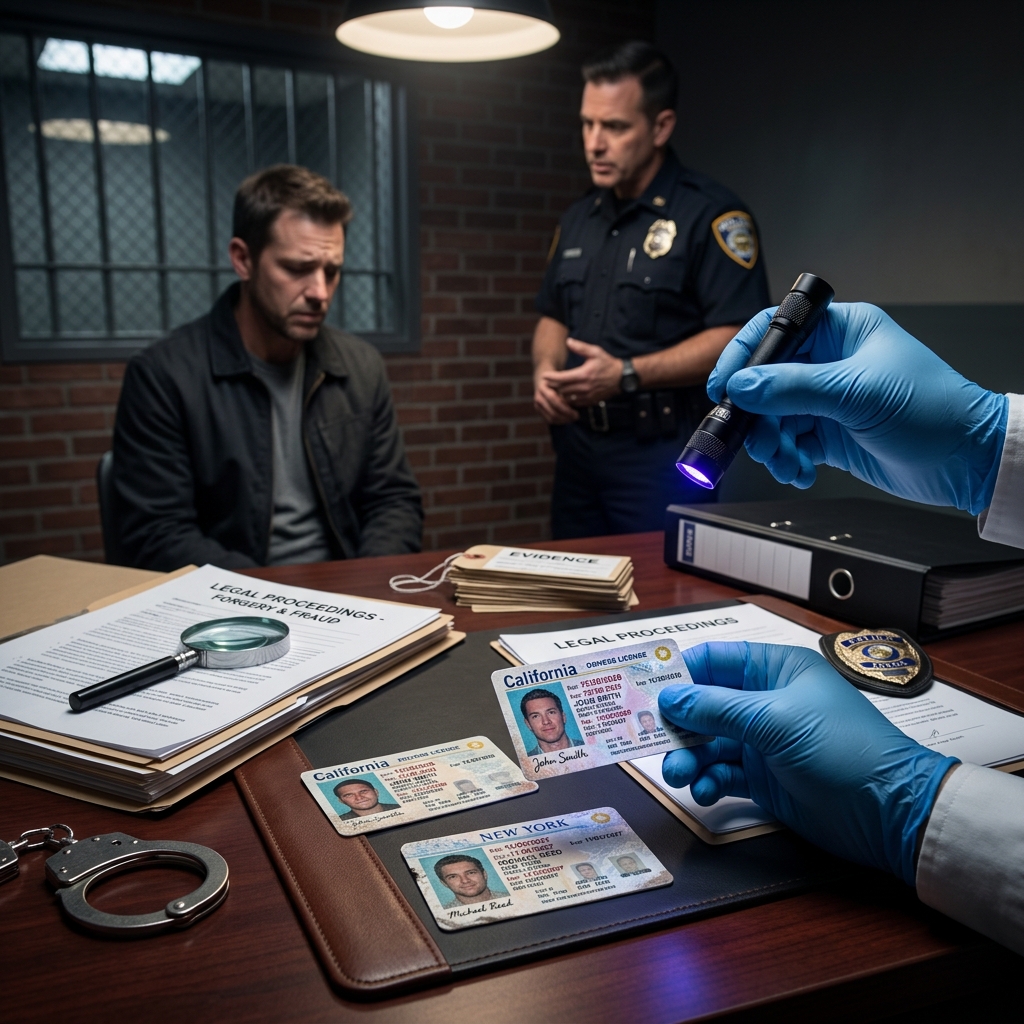
Fake driver’s licenses might appear harmless or even routine in certain social settings, but under modern criminal law they are treated as serious tools of fraud and forgery. Legislatures, courts, and law enforcement agencies view counterfeit or altered licenses as a gateway to identity theft, financial crime, and public safety risks, and penalties can be severe even when no other crime is committed.
This article explains how fake driver’s licenses are defined, why they are criminalized, the range of penalties that can follow, and what defenses may be available. It is general information, not legal advice, and laws vary by jurisdiction. Anyone facing charges should consult a licensed attorney in their state.
What Counts as a “Fake” Driver’s License?
Most jurisdictions use a broad definition of a fake driver’s license. Laws typically cover both completely fabricated documents and any government-issued driver’s license that has been altered in a way not authorized by law.
- Counterfeit licenses – documents that were never issued by a motor vehicle agency but are made to resemble genuine licenses.
- Altered genuine licenses – real licenses with changed photos, dates of birth, names, or other identifying information.
- Duplicated or reproduced licenses – copies, scans, or reprints that could be mistaken for legitimate licenses.
- Fraudulently obtained licenses – licenses issued by a motor vehicle agency based on false documents or information.
Many vehicle codes explicitly ban altering a license, duplicating it in a way that could be confused with a valid credential, or possessing photographic or printed copies that resemble the original. Importantly, a person does not need to present the license to be charged; mere possession can be enough where statutes criminalize possession with fraudulent intent.
Intent: The Line Between Innocent Mistake and Crime
A key element in many fake ID statutes is intent to defraud or commit forgery. Forgery is generally defined as knowingly creating or altering a written instrument with intent to gain a benefit or cause loss through deception. When a person holds or uses a fake license to mislead someone about their identity, age, or driving status for personal benefit, that intent can satisfy forgery or fraud elements.
Typical examples of fraudulent intent include:
- Using a fake license to obtain credit or open bank accounts.
- Renting vehicles while hiding a suspended or revoked license.
- Accessing age-restricted venues or purchasing alcohol or tobacco.
- Misrepresenting identity to law enforcement during a traffic stop.
In many states, prosecutors must show the defendant knew the license was fake or altered and intended to use it to facilitate deception. Accidental possession or confusion about the document’s authenticity can be relevant to the defense.
Overview of Legal Framework
Fake driver’s licenses can implicate several overlapping legal provisions. While the specific section numbers differ by state, the structure of the law is often similar.
- Forgery statutes – cover creating or altering documents, including driver’s licenses, with fraudulent intent.
- Fake ID or counterfeit document statutes – specifically address possession, display, or manufacture of fraudulent identification.
- Vehicle code provisions – prohibit altering, duplicating, or displaying canceled, revoked, fictitious, or fraudulently obtained licenses.
- Identity theft and fraud laws – may be triggered if the fake license uses another person’s data or is part of a broader scheme.
Some jurisdictions classify possession or display of a fake license as a wobbler offense, meaning it can be charged either as a misdemeanor or a felony depending on factors such as the defendant’s prior record and the seriousness of the conduct.
Elements Commonly Required for Conviction
Although language varies, many statutes require prosecutors to prove four core elements beyond a reasonable doubt:
| Element | Typical Requirement |
|---|---|
| Possession or display | The defendant possessed, displayed, or allowed another person to display a driver’s license or ID card. |
| Fake or altered status | The license or ID was altered, falsified, forged, duplicated, reproduced, counterfeited, canceled, or fictitious. |
| Knowledge | The defendant knew the document was fake, altered, or invalid. |
| Fraudulent intent | The defendant intended to use the document to commit forgery or fraud, such as deceiving another person to obtain a benefit. |
Failure to prove any one of these elements can result in acquittal.
Criminal Penalties for Fake Driver’s Licenses
Penalties vary widely but are often structured around whether the offense is charged as a misdemeanor or a felony. Even at the misdemeanor level, courts impose fines, jail time, and probation in many cases.
Misdemeanor-Level Consequences
In states that treat simple possession or use of a fake license as a misdemeanor, typical exposure includes:
- Up to one year in county or local jail.
- Fines, often up to approximately $1,000.
- Summary or informal probation, which may involve check-ins, maintaining employment or schooling, and avoiding further legal trouble.
- Community service requirements, especially in cases involving alcohol or campus-related incidents.
While these penalties may sound modest, a misdemeanor conviction can still create lasting issues with employment, professional licensing, and immigration status.
Felony-Level Consequences
Where the conduct is more serious—such as producing multiple fake licenses, using IDs in larger fraud schemes, or having a significant prior record—prosecutors may file felony charges.
- One to three years of incarceration, often served in state prison or in a county facility depending on jurisdiction.
- Fines that can reach or exceed $10,000.
- Formal probation, with stricter supervision and conditions.
- Potential exposure to additional charges, such as identity theft or financial fraud, if the license was used in broader criminal activity.
Some states treat manufacturing or selling counterfeit licenses more harshly than simple possession. Separate provisions may criminalize creating or distributing fake ID cards, with penalties comparable to other forgery offenses.
Collateral Consequences Beyond the Criminal Case
Legal sanctions are only part of the picture. A conviction related to fake licenses can trigger parallel consequences, some imposed by agencies and institutions outside the criminal court system.
- Driver’s license suspensions – courts or motor vehicle agencies may suspend or revoke a person’s driving privileges for one to three years, particularly if the matter involves traffic or alcohol-related misconduct.
- School discipline – colleges and universities can impose their own sanctions for student misconduct involving fake IDs, including suspension, loss of housing, or mandatory counseling.
- Professional and occupational licensing issues – boards overseeing teaching, nursing, law, and other professions may view fraud-related convictions as evidence of untrustworthiness.
- Immigration impact – noncitizens can face immigration consequences when convicted of crimes involving fraud or moral turpitude.
Because these collateral effects can be complex and long-lasting, individuals often seek legal advice early, even if the criminal charge appears minor.
Common Scenarios Involving Fake Driver’s Licenses
Fake driver’s licenses arise in a range of settings. Some are associated with youthful misjudgment, others with organized criminal activity. Understanding these contexts helps explain why lawmakers treat fake IDs seriously.
- Underage access to alcohol or clubs – perhaps the most widely known scenario, where minors use fake licenses to enter bars, clubs, or purchase alcoholic beverages.
- Employment and housing applications – individuals may attempt to pass off altered identities when applying for jobs, housing, or benefits.
- Traffic stops and law enforcement encounters – some drivers present a fake license to hide a suspended status, outstanding warrants, or immigration concerns.
- Financial fraud and identity theft – counterfeit licenses can serve as tools to open bank accounts, secure loans, or impersonate victims in complex fraud schemes.
Law enforcement agencies and universities often conduct outreach campaigns to emphasize that what may seem like a minor attempt to circumvent age limits can still result in criminal charges and long-term consequences.
Defenses and Mitigating Strategies
Facing allegations involving fake driver’s licenses does not automatically guarantee conviction. Multiple legal and factual defenses may be available, and even when evidence is strong, effective advocacy can reduce penalties.
Potential Legal Defenses
- Lack of knowledge – the defendant may argue they did not know the license was fake, altered, or invalid. For example, a person might purchase what they believed was a legitimate license from a fraudulent vendor.
- No intent to defraud – possessing a novelty item or a document used in a theater production without intent to deceive anyone in real life may differ from criminal conduct. The absence of fraudulent intent can undermine forgery elements.
- Improper search or seizure – if law enforcement located the fake license through an unconstitutional search, the defense may seek to suppress the evidence.
- Identity or possession disputes – questions may arise about who actually possessed the license or whether the defendant controlled the document.
- Document not legally “fake” – in some situations, the prosecution may misinterpret minor administrative irregularities as fraudulent, and the defense can show the license was not altered or counterfeit within the meaning of the statute.
An experienced criminal defense attorney can review the specific statute, police reports, and evidence to identify which defenses apply and how best to present them.
Mitigation, Plea Negotiations, and Alternative Outcomes
Even where the evidence is strong, defendants have options to seek reduced penalties.
- Plea agreements – negotiating a plea to a lesser offense, such as a non-fraud-related violation, can limit long-term impacts.
- Diversion programs – in some jurisdictions, first-time offenders—especially students—may qualify for deferred prosecution, counseling, or education programs in lieu of a conviction.
- Community service and restitution – demonstrating accountability and cooperation can help persuade courts to impose lighter sentences.
- Record relief – after completing sentencing, defendants may pursue expungement or record sealing where available under state law, reducing public visibility of the conviction.
Because law and policy differ among states, local legal advice is crucial when evaluating these options.
Practical Guidance: If You Are Accused of Using a Fake License
Anyone confronted by law enforcement about a suspected fake license should proceed carefully. Decisions made in the first hours and days can influence the outcome of the entire case.
- Exercise the right to remain silent – individuals generally do not have to answer questions about where the license came from or why they used it, beyond providing basic identifying information as required.
- Request legal counsel – asking for an attorney before detailed questioning helps protect constitutional rights and reduces the risk of self-incrimination.
- Avoid destroying evidence – attempts to hide or destroy a suspected fake license can result in additional charges.
- Gather documents and context – receipts, communication records, or witness statements about how the license was obtained may help clarify intent and knowledge.
Legal assistance is especially important for noncitizens, young adults with academic or athletic scholarships, and professionals whose licensing boards closely monitor criminal records.
Frequently Asked Questions About Fake Driver’s Licenses
Is it always illegal to possess a fake license, even if I never use it?
In many jurisdictions, yes. Statutes often criminalize mere possession of a forged or altered driver’s license or identification card when coupled with fraudulent intent. You may be charged even if you never successfully present the license to anyone.
Can I be charged for just taking a photo or photocopy of my license?
Most people can lawfully photograph their own license for personal records, but certain vehicle codes prohibit reproductions that could be mistaken for genuine licenses or displayed as if they were original documents. Problems arise when copies are used in ways that suggest they are real, or when they facilitate fraud.
What if I bought a fake license online and thought it was legal?
Claims of misunderstanding may be considered, but laws generally presume that individuals are responsible for knowing that official driver’s licenses must come from government agencies. Purchasing IDs from unauthorized sellers usually supports the inference of fraudulent intent, though each case is fact-specific.
Are penalties different for minors and college students?
Some states and universities impose additional sanctions tailored to underage drinking and campus safety, such as mandatory education programs, fines, or temporary license suspensions. However, criminal courts still treat fake licenses as fraud-related offenses, and minors can face similar charges to adults.
Can a fake license conviction be removed from my record?
Record relief depends on state law and the nature of the conviction. In some jurisdictions, eligible individuals may apply for expungement, sealing, or set-aside after completing all sentencing terms. A local attorney can advise on specific eligibility rules and procedures.
References
- California Penal Code §470b – Possession of a Fake ID — Shouse Law Group. 2024-01-10. https://www.shouselaw.com/ca/defense/vehicle-code/470b/
- Penal Code 470b – Possession of a Fake Driver’s License — Cronis, Israels & Stark. 2023-09-01. https://www.cronisraelsandstark.com/possession-of-fake-drivers-license-california-penal-code-470b
- Unlawful Use of a Fictitious or Fraudulently Altered Driver License — DMV Defenders. 2022-06-15. https://www.dmv-defenders.com/use-fictitious-or-fraudulently-altered-driver-license/
- Forging a Driver’s License or ID Card in California — McElfresh Law. 2023-02-20. https://www.criminallawyersandiego.com/fraud/forging-drivers-license-id-card/
- Consequences of Being Caught With a Fake ID — University of Southern California Department of Public Safety. 2019-02-21. https://dps.usc.edu/2019/02/21/consequences-of-being-caught-with-a-fake-id/
Similar Articles








Read full bio of medha deb


