When a company goes bankrupt, employees often worry first about paychecks and then about retirement security. Pension rights are especially important because they may represent years of earned compensation. The good news is that pension assets are usually treated differently from ordinary company property, which means they are often protected from business creditors. Still, the outcome depends on the kind of plan, the type of bankruptcy, and whether the plan is fully funded.
Why pension benefits are usually not part of company assets
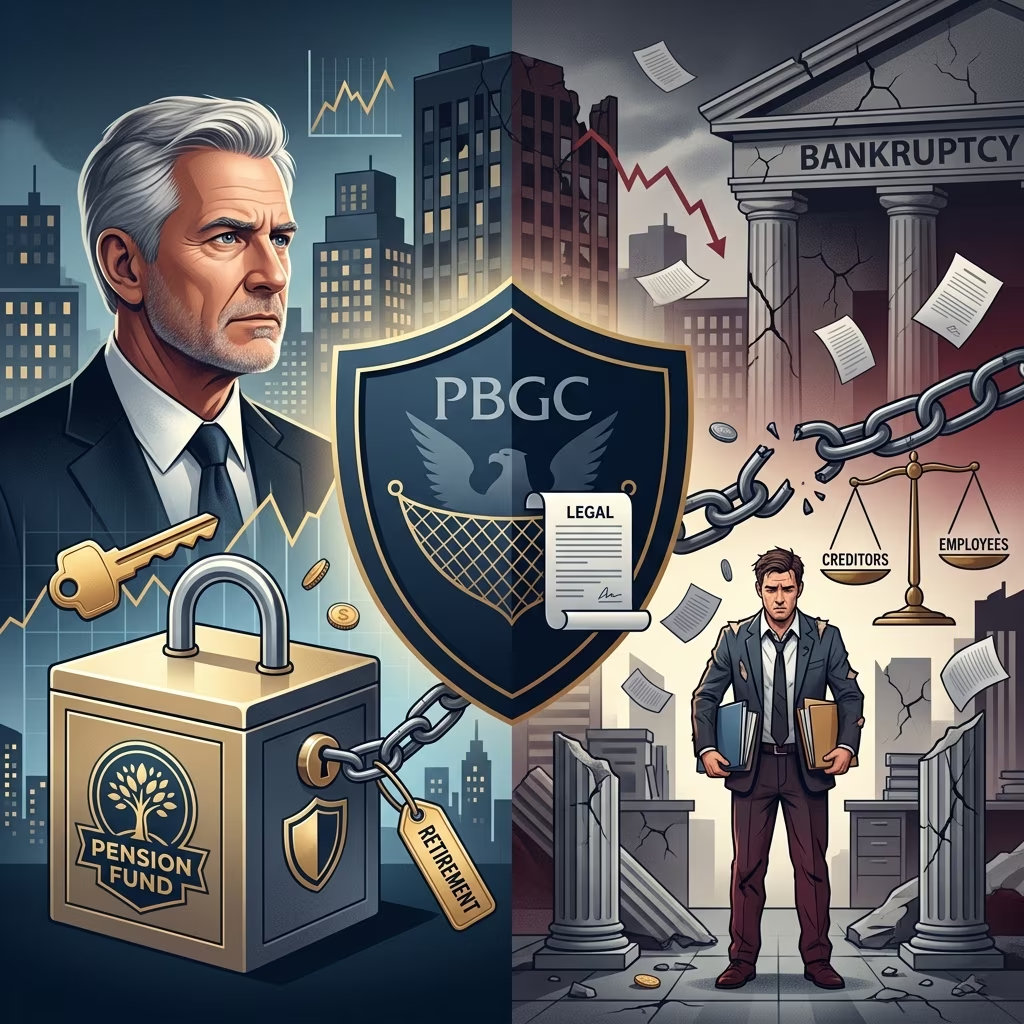
In the United States, pension plans for private employers are generally governed by federal retirement law. Those rules require many retirement assets to be kept separate from the employer’s operating money. As a result, pension funds are ordinarily held in trust or in a similar protected arrangement rather than in the employer’s general accounts. That separation matters because a bankrupt company’s creditors typically cannot simply reach into the pension plan and use those funds to pay business debts.
This structure exists to keep retirement promises meaningful. If pension money could be mixed with payroll, equipment, or other corporate assets, workers would face a much greater risk of losing benefits whenever a company ran into financial trouble. The law therefore aims to preserve earned retirement benefits even if the employer itself fails.
The difference between the employer’s bankruptcy and the pension plan itself
A company filing bankruptcy does not automatically mean the pension plan disappears. The employer and the pension plan are related, but they are not the same thing. A business can enter bankruptcy while its retirement plan remains solvent enough to keep paying benefits. On the other hand, if the plan is underfunded and the employer can no longer support it, the plan may eventually be terminated or transferred to a federal guaranty system.
This distinction is important because workers sometimes assume that a company’s failure erases all benefits at once. In reality, the plan’s condition and funding level are separate questions. A bankrupt employer may still have a pension plan that continues, at least for some time, during the restructuring process.
How Chapter 11 differs from Chapter 7
The type of bankruptcy matters. In a Chapter 11 case, a company usually tries to reorganize and continue operating, which means employee benefit plans may stay in place during the process. In some cases, the business may modify benefits or negotiate changes, but the plan does not necessarily end immediately.
Chapter 7 is different. That form of bankruptcy is a liquidation, meaning the company stops operating and sells assets to pay creditors. When liquidation occurs, retirement plans are much more likely to be terminated. If that happens, the next question is whether the plan has enough money to cover the benefits workers have already earned.
| Bankruptcy type | Typical effect on pension plans |
|---|---|
| Chapter 11 | Plan may continue while the company reorganizes |
| Chapter 7 | Plan is more likely to terminate because the company shuts down |
Defined benefit plans and defined contribution plans are not the same
Employees often use the word “pension” broadly, but retirement arrangements come in different forms. A traditional defined benefit plan promises a specific monthly payment at retirement, usually based on salary and years of service. A defined contribution plan, such as a 401(k), is different. In that setup, the worker and sometimes the employer contribute money to an individual account, and the eventual retirement value depends on contributions and investment performance.
These differences affect what happens during bankruptcy. Defined benefit plans are more likely to involve federal pension insurance if the employer cannot keep the plan going. Defined contribution plans, by contrast, are generally not covered by the same federal pension guaranty system because the money already belongs to individual accounts and is not a promised monthly pension in the same way.
What ERISA does to protect retirement money
The Employee Retirement Income Security Act, commonly called ERISA, sets important minimum standards for private retirement plans. One of its central goals is to make sure promised retirement benefits are funded and managed separately from the employer’s ordinary business assets. ERISA also imposes fiduciary duties on the people who manage the plan, requiring them to act responsibly and in the interest of participants.
For workers, the practical result is that retirement money should not simply vanish because the company has unpaid debts. ERISA generally keeps plan assets outside the bankruptcy estate, and that separation is one of the strongest protections available to private-sector employees.
When the PBGC may step in
If a defined benefit pension plan becomes unable to pay promised benefits, the Pension Benefit Guaranty Corporation may take over. The PBGC is a federal agency that insures many private pension plans. If a covered plan terminates and does not have enough assets, the PBGC can assume responsibility for paying benefits, subject to legal limits.
That protection is valuable, but it is not unlimited. The PBGC does not guarantee every dollar of every pension promise in every situation. Benefits may be capped, and in some cases participants may receive less than what they expected under the original plan. The exact amount depends on the plan terms, the participant’s age, and the benefit structure.
What happens if a pension plan is underfunded
A plan can be underfunded even before a company formally declares bankruptcy. Underfunding means the plan does not have enough assets to pay all promised benefits if it were terminated right away. Bankruptcy can make the problem worse because the employer may stop making required contributions or may no longer have the cash to shore up the plan.
If the plan is later terminated, participants are generally entitled to the benefits they have already earned. However, “earned” does not always mean “fully collectible in the original form.” If the PBGC steps in, the agency calculates protected benefits under its rules. That calculation may reduce the amount payable compared with the original company promise.
Accrued benefits versus future accruals
Workers should distinguish between benefits already earned and benefits expected from future work. If a plan ends, the company typically must preserve the value of benefits accrued up to the termination date. That means the plan owes participants what they have accumulated so far.
Future service is another matter. If an employee keeps working after the bankruptcy filing but before plan termination, the treatment of those later-earned benefits depends on the facts of the case and the structure of the plan. In many cases, once the plan ends, participants no longer earn additional pension credit under that plan.
Can creditors take money that has already been set aside?
Usually, no. Pension assets that are properly held in trust are not part of the employer’s general asset pool. That means ordinary business creditors generally cannot seize them to satisfy vendor claims, loan balances, or other corporate debts. The protection is strongest when the plan has been maintained according to the rules and the funds have not been improperly commingled.
That said, the existence of the trust does not solve every problem. A protected plan can still be underfunded, and an underfunded plan can still leave participants facing reduced benefits if the employer cannot continue supporting it.
What workers should watch for during a bankruptcy case
Employees who rely on a pension should pay attention to plan notices, court filings, and communications from the employer or plan administrator. Important questions include whether the employer is filing under Chapter 11 or Chapter 7, whether the plan is continuing, whether contributions are being made, and whether the plan has been terminated or transferred to the PBGC.
- Look for written notices about plan changes or termination.
- Keep copies of pay stubs, benefit statements, and summary plan descriptions.
- Check whether you are in a covered defined benefit plan or a self-directed retirement account.
- Ask whether any benefits already earned have been frozen or locked in.
- Confirm who now administers the plan if the employer is no longer handling it.
Private-sector pensions and public-sector pensions are treated differently
Most of the strongest federal pension protections apply to private employers. Public pensions for state and local government workers may follow different legal rules and are not always backed by the same federal insurance system. That means government workers may face a different set of risks if the public employer has financial distress.
Because of that difference, employees should not assume that one set of rules automatically applies to all retirement plans. The legal status of the employer and the source of the pension funding both matter.
Common questions employees ask
Bankruptcy raises practical concerns beyond the legal structure of the plan. People often want to know whether they will keep receiving checks, whether early retirees are protected, and whether years of service can disappear. The answer depends on plan funding, federal insurance coverage, and the stage of the bankruptcy case.
In many cases, retirees already receiving payments continue to receive them for a period of time while the plan is being reviewed. If the PBGC becomes involved, benefits may later be adjusted to fit the guaranty rules. For active employees, the main issue is often whether the accrued portion of the pension is preserved even if future accrual stops.
Steps to take if your employer announces bankruptcy
Workers do not need to panic, but they should act promptly. A good first step is to review the plan documents and any recent notices to understand whether the pension is a defined benefit plan, a defined contribution plan, or some other retirement arrangement. It is also helpful to contact the human resources department or plan administrator for an update.
If the situation is unclear, employees may want to seek legal advice from someone who handles employment or benefits matters. That can be especially helpful if the plan appears to be underfunded, if benefits are being reduced, or if a termination notice has been issued.
Practical examples of possible outcomes
Consider three common scenarios. First, a large employer files Chapter 11 but continues operations and keeps funding the pension plan. In that case, the plan may continue with little immediate disruption. Second, a company files Chapter 7 and liquidates. In that situation, the pension plan is likely to terminate, and participants may have to rely on the plan’s remaining assets and any PBGC coverage. Third, a company’s pension is already healthy and fully funded when bankruptcy begins. Even then, employees still benefit from the legal separation between pension assets and employer assets.
These examples show why a bankruptcy filing is not the end of the story. The actual effect on retirement income depends on the plan’s design and the way the case develops.
Frequently asked questions
Will my pension automatically disappear if my employer files bankruptcy?
No. A bankruptcy filing does not automatically erase pension rights. The effect depends on the bankruptcy chapter, the plan’s funding level, and whether the plan continues or terminates.
Can the company use pension money to pay its debts?
Generally, no. Pension assets are usually held separately from company assets and are protected from ordinary creditors.
What if my defined benefit plan is taken over by the PBGC?
The PBGC may pay benefits after termination, but it does so subject to federal limits. Some participants may receive less than the amount originally promised by the employer.
Are 401(k) plans insured the same way as pensions?
No. Defined contribution plans like 401(k)s are not insured by the PBGC in the same manner as traditional defined benefit pensions.
Should I keep working while my employer is in bankruptcy?
That is a personal and financial decision, but many workers continue employment during Chapter 11 reorganizations. The pension impact depends on whether the plan remains active and whether benefits continue to accrue.
References
- Employee Benefits in Bankruptcy — U.S. Department of Labor, Employee Benefits Security Administration. 2024-02-01. https://www.dol.gov/sites/dolgov/files/ebsa/about-ebsa/our-activities/resource-center/fact-sheets/employee-benefits-bankruptcy.pdf
- What Happens to My Pension if My Employer Declares Bankruptcy? — Pension Rights Center. 2024-01-15. https://pensionrights.org/what-happens-to-my-pension-if-my-employer-declares-bankruptcy/
- Member Guide: My Employer Is Bankrupt. What Does That Mean for My Workplace Pension Plan? — Financial Services Regulatory Authority of Ontario. 2024-03-20. https://www.fsrao.ca/consumers/pensions/member-guide-my-employer-bankrupt-what-does-mean-my-workplace-pension-plan
- Chapter 7 and 11 Bankruptcy of Employers and Employee Benefits — Goldsmith Firm. 2024-04-10. https://www.goldsmithfirm.com/chapter-7-and-11-bankruptcy-of-employers-and-employee-benefits
- What Happens to a Pension if the Company Files for Bankruptcy? — Personal Finance discussion thread, Reddit. 2020-06-20. https://www.reddit.com/r/personalfinance/comments/hnm0jr/what_happens_to_a_pension_if_the_company_files/