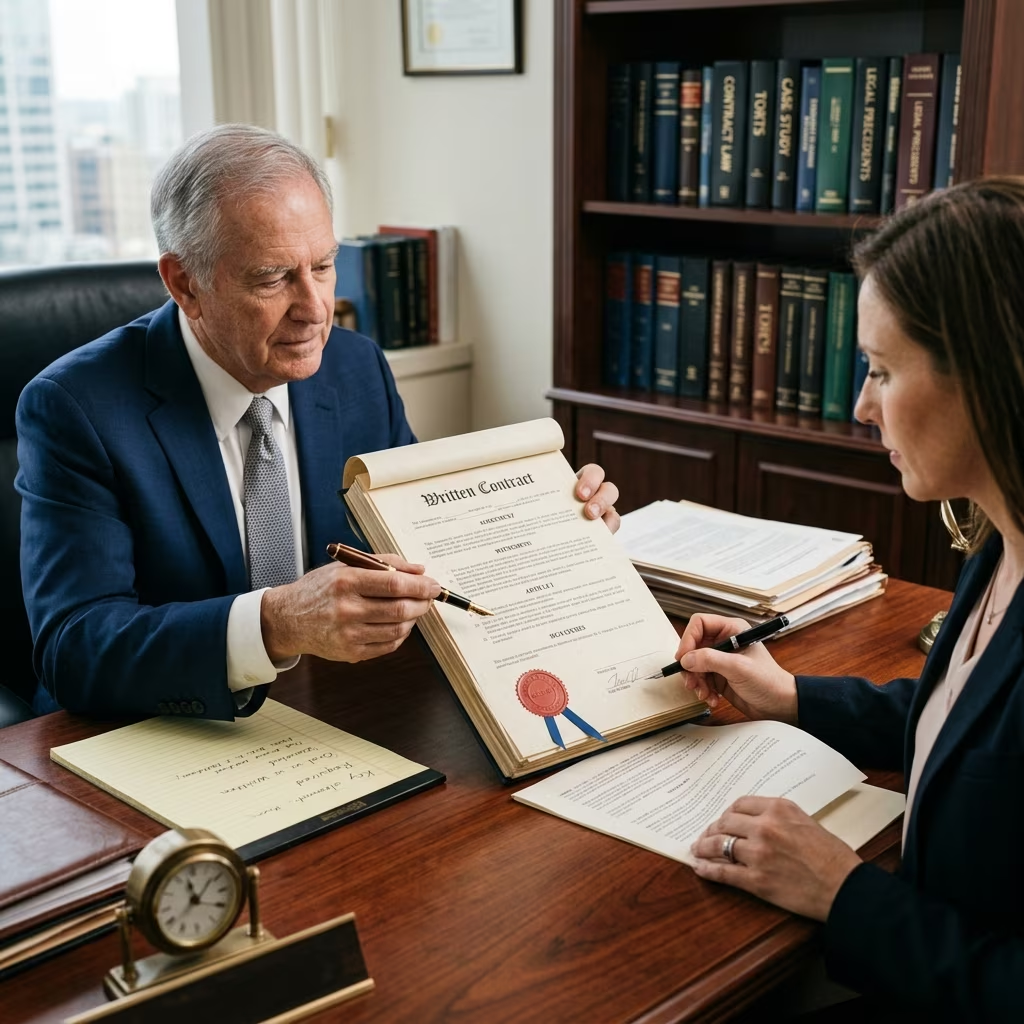
Many everyday deals are sealed with a handshake or a quick message, and the law will often treat these as binding contracts. However, certain agreements are only enforceable if they are in writing. This requirement, often known as the statute of frauds, can determine whether you can successfully sue to enforce a promise or defend yourself against a claim.
This article explains which contracts generally must be written, what a written contract should typically contain, and how the writing requirement can be satisfied in modern practice, including electronic signatures. It is a general overview of U.S. law concepts and is not a substitute for tailored legal advice in your state.
1. Core Elements of Any Enforceable Contract
Before considering whether an agreement must be written, it is important to understand that not every promise is enforceable. Under U.S. contract law, a valid contract generally requires several basic elements.
- Legal purpose – The agreement must involve a lawful objective. Courts will not enforce a contract for an illegal purpose, such as an agreement to commit a crime.
- Mutual assent – The parties must reach a genuine agreement, often described as a “meeting of the minds,” usually through an offer and an acceptance.
- Consideration – Each party must give or promise something of value (money, goods, services, or a legal right) in exchange for the other party’s performance.
- Capacity – The parties must have legal capacity to contract. In general, minors, those lacking mental capacity, or people so intoxicated that they cannot understand their actions may not be bound in the same way as competent adults.
- Voluntary consent – The agreement must not result from duress, fraud, or a significant mistake. A person cannot be forced or tricked into a contract.
If any of these elements is missing, the contract can be void or voidable even if it is in writing. The writing requirement is an additional layer: certain otherwise valid contracts must also be documented in writing to be enforceable in court.
2. The Statute of Frauds: Why Some Contracts Must Be Written
The rule that some contracts must be in writing is generally known as the statute of frauds. Historically, it developed to reduce false claims about agreements that were never made and to provide clear evidence of important deals.
Under the statute of frauds, a contract that falls into specific categories is usually unenforceable in court unless there is a writing signed by the party against whom enforcement is sought. The statute does not make the agreement automatically void; rather, it limits whether a court can enforce it.
2.1 Typical Categories Covered by the Statute of Frauds
Exact rules vary by jurisdiction, but in many U.S. states the following types of contracts generally must be in writing:
- Sale of real estate – Agreements to buy or sell land or interests in land.
- Long-term leases – Leases of real property longer than one year.
- Guarantees of another’s debt – Promises to answer for the debt or duty of another person, often called surety or guaranty agreements.
- Contracts not performable within one year – Agreements that by their terms cannot be fully performed within one year from the date they are made.
- Certain contracts for the sale of goods – Under the Uniform Commercial Code (UCC), contracts for the sale of goods priced at $500 or more typically must be in writing.
- Some agreements related to death – For example, promises to transfer personal property at the promisor’s death, separate from a will.
Because each state may add or interpret categories differently, it is important to check local law or consult a licensed attorney for specific transactions.
3. Common Situations Where a Writing Is Usually Required
The broad categories above can feel abstract. The situations below illustrate typical real-world deals that usually require written documentation.
3.1 Real Estate Transactions
Real estate transactions almost always fall within the statute of frauds. This includes:
- Contracts to buy or sell residential or commercial property.
- Options to purchase real estate in the future.
- Leases for more than one year.
Because real estate is unique and valuable, courts insist on written evidence to reduce uncertainty about price, property description, and other material terms.
3.2 Promises to Pay Another Person’s Debt
An agreement to pay or guarantee another person’s debt or financial obligation often must be in writing. This can arise, for example, when:
- A parent guarantees a commercial lease for their child’s business.
- A business owner personally guarantees the debt of the company.
- One person agrees to cover another’s loan if they default.
These arrangements expose the guarantor to significant risk, so the law typically requires clear written proof of the commitment.
3.3 Contracts That Cannot Be Completed Within One Year
If a contract, by its terms, cannot possibly be fully performed within one year, most states require it to be in writing.
- A three-year employment agreement starting on a fixed date.
- A five-year service contract with defined duties over that period.
- A multi-year licensing agreement with fixed obligations.
By contrast, if the contract could be fully performed within a year, even if this is unlikely, many courts treat it as outside the statute of frauds and do not require a writing.
3.4 Sale of Goods Under the UCC
For contracts involving the sale of goods, Article 2 of the Uniform Commercial Code (UCC) sets specific rules. In general, a contract for the sale of goods priced at $500 or more must be in writing to be enforceable.
The UCC’s writing requirement for goods contracts is more flexible than traditional contract rules. Under UCC section 2-201:
- The writing does not have to contain all material terms, but must at least indicate that a contract for sale has been made and specify the quantity of goods.
- The writing must be signed by the party against whom enforcement is sought, although the form of signature can be informal.
- Certain exceptions apply, such as for specially manufactured goods that cannot be resold to others, admissions in court, or partial performance.
Similar rules apply to leases of goods under UCC Article 2A, especially for leases above a certain total payment threshold.
3.5 Other Deals Often Covered
State statutes may recognize additional agreements that should be in writing. Examples include:
- Contracts involving payments above a specified dollar amount set by state law.
- Agreements that will last beyond the life of the person performing the contract.
- Promised transfers of personal property at death that are separate from a will.
Because these rules are state-specific, professional legal advice is often helpful for high-value or long-term agreements.
4. What Counts as a Sufficient “Writing”?
Many people imagine a formal, multi-page document printed on letterhead when they think of a written contract. In reality, the statute of frauds can be satisfied by a wide range of written materials, including digital records.
4.1 Basic Requirements of the Writing
To satisfy the statute of frauds, the writing typically must:
- Identify the subject matter of the contract with reasonable certainty (for example, specific real estate or goods).
- Indicate that a contract exists between the parties, rather than a mere negotiation.
- State the essential terms with reasonable clarity (such as price, quantity, or duration), depending on the type of contract.
- Be signed by the party against whom enforcement is sought, or their authorized agent.
The writing does not always need to be a single document. Multiple documents, emails, or messages can sometimes be read together if they clearly relate to the same agreement and collectively show the necessary terms and signatures.
4.2 Modern Forms of Writing and Signature
In today’s environment, the definition of “writing” and “signature” has expanded significantly. Courts and statutes increasingly recognize electronic forms as valid, including:
- Typed names at the end of an email that indicate intent to sign.
- Digital signatures created through e-signature platforms.
- Scanned images of handwritten signatures.
The key question is whether the mark or symbol was made with the intent to authenticate the writing as the party’s agreement. Many jurisdictions also follow laws modeled on the federal Electronic Signatures in Global and National Commerce Act (E-SIGN) and the Uniform Electronic Transactions Act (UETA), which broadly validate electronic signatures and records.
5. Essential Terms Commonly Included in Written Contracts
Even when the law only requires a minimal writing, parties generally benefit from a more detailed written agreement. Although specifics differ by contract type, many written contracts address the following topics:
- Identity of the parties – Full legal names and contact information of each party.
- Description of the subject matter – Clear details of the goods, services, or property involved.
- Price and payment terms – Total price, payment schedule, due dates, and acceptable payment methods.
- Time for performance – Start and end dates, milestones, deadlines, or delivery dates.
- Rights and obligations – Specific duties of each party, performance standards, and any warranties or disclaimers.
- Termination and remedies – Circumstances under which the contract can be terminated and the consequences of breach.
- Dispute resolution – Choice of law, forum selection, arbitration clauses, or mediation requirements.
Well-drafted contracts reduce the risk of misunderstanding and make it easier to enforce rights if a dispute arises.
6. Verbal Agreements: When They May Still Be Enforceable
Not all oral agreements are invalid. If a contract falls outside the categories covered by the statute of frauds, an oral agreement can still be legally binding, provided it satisfies the general elements of contract formation.
Even for contracts that usually require a writing, there are limited exceptions recognized by courts, such as:
- Partial performance – For real estate sales, if one party has taken significant steps in reliance on the agreement (for example, moving in and making improvements), a court may enforce the oral contract to avoid injustice.
- Admissions in court – Under the UCC, if a party admits in court that a contract for the sale of goods was made, the contract may be enforced up to the quantity admitted.
- Specially manufactured goods – Where goods are custom-made for the buyer and cannot reasonably be sold to others, the UCC may allow enforcement without a written contract if the seller has begun production.
Because exceptions are narrow and fact-specific, relying on them can be risky. The safer approach is typically to document important agreements in writing.
7. Practical Tips to Protect Yourself
Understanding the writing requirement is only part of minimizing legal risk. The steps below can help individuals and businesses avoid disputes and strengthen their contractual positions.
| Best Practice | Why It Matters |
|---|---|
| Put important agreements in writing, even if not strictly required. | Provides clear evidence of terms and reduces misunderstanding. |
| Identify all parties and signatories clearly. | Prevents disputes about who is bound by the contract. |
| Describe the subject matter and price with precision. | Makes enforcement easier and limits room for conflicting interpretations. |
| Use electronic signatures only through trusted methods. | Helps prove authenticity and compliance with e-signature laws. |
| Consult a lawyer for complex or high-value transactions. | Ensures compliance with state-specific statute of frauds rules and industry regulations. |
8. Frequently Asked Questions
Does a text message or email count as a written contract?
In many situations, yes. Courts often treat text messages and emails as writings if they contain essential terms and show that the parties intended to form an agreement. If a person types their name or otherwise clearly indicates intent to sign, this can sometimes satisfy the signature requirement, especially under modern e-signature laws.
What happens if a contract that must be in writing is only oral?
If a contract falls within the statute of frauds but is not documented in writing, it is usually unenforceable in court. This means that a party may not be able to obtain damages or specific performance, even if the other side admits the agreement was made. Some equitable or statutory exceptions may apply, but relying on them is uncertain and often depends on detailed facts.
Do both parties have to sign the contract?
Generally, a writing must be signed by the party against whom enforcement is sought. Under the UCC, for instance, a contract for the sale of goods priced at $500 or more must be signed by that party. In practice, both parties usually sign to avoid disputes about who is bound and to reflect mutual assent, but the legal minimum can be lower.
Is a handshake agreement still legally binding?
A handshake agreement can be binding if it meets basic contract requirements and is not subject to the statute of frauds. For example, a small, one-time transaction that can be completed within a year and does not involve land or high-value goods may be enforced even if it was only agreed orally. However, proving the terms of a handshake deal can be difficult, which is why written contracts are generally safer.
How do I know whether my state requires additional contracts to be in writing?
While many statute of frauds rules are similar across states, there are variations. Some states add categories or adjust dollar thresholds. The most reliable way to determine the rules that apply to your situation is to consult local statutes and case law or speak with a licensed attorney familiar with contract law in your jurisdiction.
References
- Electronic Signatures in Global and National Commerce Act (E-SIGN) — U.S. Congress. 2000-06-30. https://www.govinfo.gov/content/pkg/PLAW-106publ229/html/PLAW-106publ229.htm
- How to Write a Contract or Contract Agreement — Adobe Inc. 2023-05-01 (last updated, approximate). https://www.adobe.com/acrobat/business/resources/how-to-write-a-contract.html
- When Is a Written Contract Required Under the UCC? — Nolo. 2023-07-15 (approximate). https://www.nolo.com/legal-encyclopedia/when-is-written-contract-required-under-the-ucc.html
- What Contracts Are Required to Be in Writing? — FindLaw. 2022-03-10 (approximate). https://www.findlaw.com/smallbusiness/business-contracts-forms/what-contracts-are-required-to-be-in-writing.html
- Which Contracts Must Be in Writing? — PandaDoc. 2022-11-20 (approximate). https://www.pandadoc.com/ask/which-contracts-must-be-in-writing/
- Contract Law and the Writing Requirement: Satisfying the Statute of Frauds — LawShelf Educational Media. 2019-01-01 (approximate, video lecture). https://www.lawshelf.com/shortvideoscontentview/satisfying-the-statute-of-frauds/