
Evaluating U.S. Compliance with Global Human Rights Standards
Assessing U.S. policies against global human rights laws.
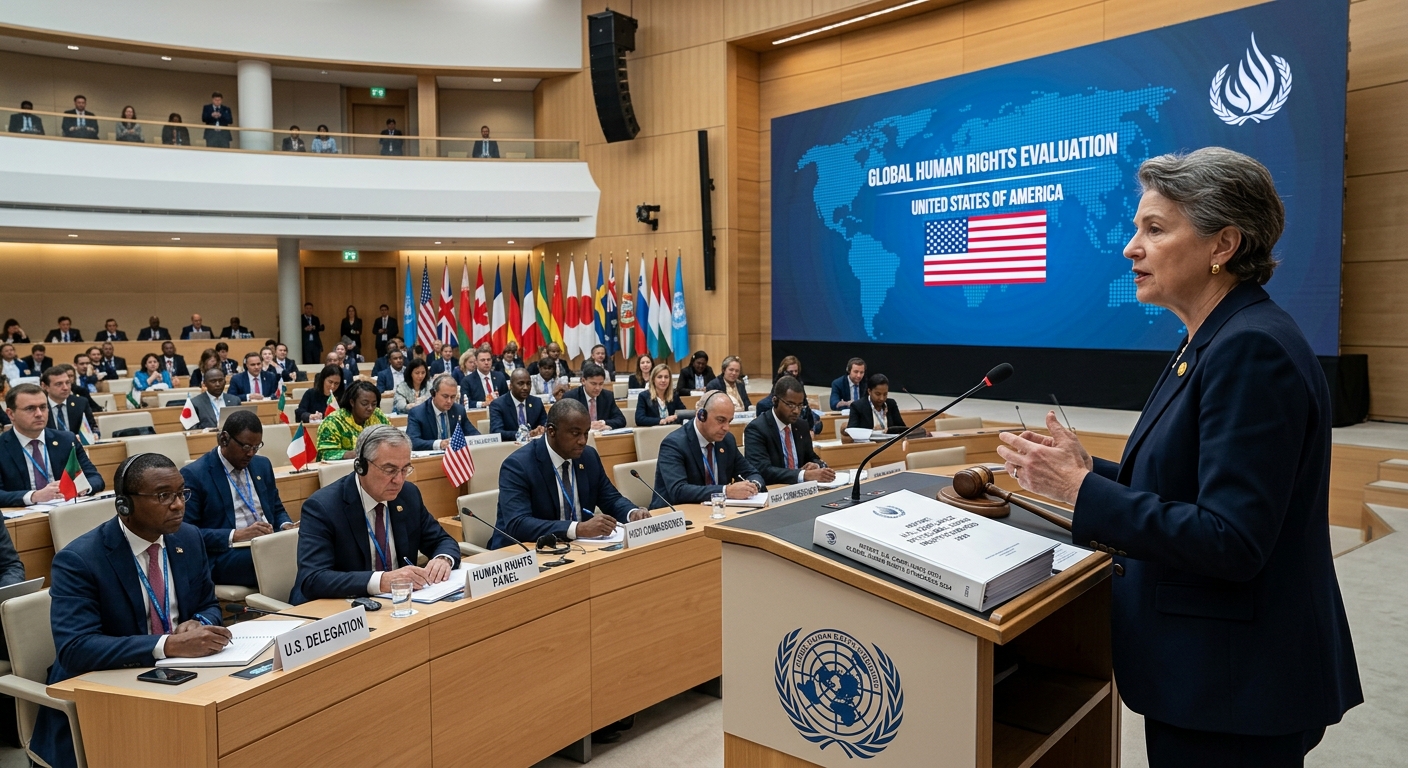
The United States has historically projected itself as a preeminent global champion of human liberties, frequently advocating for the virtues of freedom, equality, and justice on the world stage. However, domestic policies and institutional practices routinely face intense, critical scrutiny from international governing bodies. When examined under the rigorous standards of global treaties, systemic challenges within the U.S.—ranging from sweeping digital surveillance to extreme prison conditions—reveal profound tensions between the nation’s stated democratic ideals and its ground-level realities. This dichotomy presents a complex narrative of American exceptionalism that often clashes with universal human rights laws.
The Framework of Accountability: The ICCPR and United Nations Oversight
At the center of international human rights law sits the International Covenant on Civil and Political Rights (ICCPR). Adopted by the United Nations General Assembly in 1966 and officially ratified by the United States in 1992, this multilateral treaty legally commits its participating states to respect and protect the fundamental rights of individuals. These foundational protections encompass the right to life, freedom of expression, freedom of assembly, electoral rights, and stringent guarantees to due process and a fair trial. The ICCPR forms the bedrock of international civil liberty standards against which all member nations are judged.
To monitor adherence to these high standards, the UN established the Human Rights Committee, a dedicated body of independent experts that periodically reviews member states. During these rigorous evaluations, civil society organizations, legal scholars, and domestic advocates present evidence highlighting discrepancies between a country’s legal obligations and its actual enforcement practices. For the United States, these periodic reviews have repeatedly underscored a broad spectrum of violations. While the U.S. government often cites constitutional constraints or national security imperatives as justifications for certain controversial policies, international monitors consistently assert that human rights obligations cannot be selectively applied.
The Digital Frontier: Mass Surveillance and the Erosion of Privacy
In the modern era, a fiercely contentious intersection of U.S. policy and international human rights exists within the realm of digital privacy. The explosive revelations of bulk data collection by the National Security Agency (NSA) fundamentally altered the global discourse on surveillance and individual privacy. The UN Human Rights Committee has frequently expressed deep concern over the sheer scale, secrecy, and opacity of American intelligence gathering. The committee notes that such expansive surveillance architectures inherently conflict with the ICCPR’s protections against arbitrary, indiscriminate, or unlawful interference with an individual’s private communications.
A major focal point in this ongoing debate is Section 702 of the Foreign Intelligence Surveillance Act (FISA). Originally designed to target non-U.S. persons located abroad for foreign intelligence purposes, Section 702 has been heavily criticized by rights groups for sweeping up vast amounts of communication data belonging to ordinary American citizens and global residents alike. Critics argue that the incidental collection of domestic emails, text messages, and phone calls effectively circumvents the Fourth Amendment’s traditional warrant requirements. This creates a loophole where domestic law enforcement can access deeply private data without proper judicial oversight.
Because global internet traffic heavily relies on American digital infrastructure, the extraterritorial reach of U.S. intelligence agencies means that citizens of other nations also find their sensitive data captured without any legal recourse. The United Nations has consistently urged the U.S. to align its surveillance laws with stringent international standards. International experts emphasize that national security concerns, while entirely legitimate and necessary for state preservation, do not grant governments a blank check for the indiscriminate, warrantless monitoring of digital lives across borders.
The Labyrinth of Criminal Justice and Mass Incarceration
Moving beyond the digital realm, the physical realities of the U.S. penal system represent a persistent, glaring area of international concern. The United States houses a vastly disproportionate percentage of the global prison population. According to recent data from the Bureau of Justice Statistics, while federal prison populations have seen marginal fluctuations—totaling approximately 154,000 inmates recently—the aggregate number of individuals held in state prisons, local county jails, and specialized detention centers remains staggeringly high. Millions of individuals are currently incarcerated nationwide, maintaining America’s status as one of the world’s leading incarcerators.
The UN Human Rights Committee has repeatedly underscored severe racial disparities deeply embedded within this sprawling justice system. Black and Hispanic Americans are arrested, convicted, and incarcerated at rates far exceeding their white counterparts. This demographic disparity infects nearly every stage of the judicial process, from initial police encounters and bail determinations to trial sentencing and parole board hearings. Furthermore, the pervasive criminalization of poverty—exacerbated by the deeply flawed cash bail system—ensures that thousands of legally innocent individuals remain trapped in local jails simply because they cannot afford to purchase their pre-trial freedom.
Prison Conditions: Solitary Confinement and the Nelson Mandela Rules
The harsh conditions of confinement within American penitentiaries have similarly drawn intense international condemnation, particularly regarding the widespread, routine use of solitary confinement. In numerous maximum-security facilities across the country, inmates are isolated in small, windowless cells for up to 23 hours a day. This extreme isolation can persist for months, years, or even decades in certain controversial cases. The psychological and physiological toll of such severe social deprivation is thoroughly documented, leading to profound anxiety, chronic depression, cognitive impairment, and alarmingly increased rates of self-harm among the incarcerated population.
Under the United Nations Standard Minimum Rules for the Treatment of Prisoners, widely known as the Nelson Mandela Rules, prolonged solitary confinement is strictly prohibited. The rules clearly define prolonged isolation as lasting beyond 15 consecutive days, classifying any duration beyond this threshold as a form of torture or cruel, inhuman, and degrading treatment. Despite these explicit global benchmarks, tens of thousands of individuals remain in prolonged isolation across the United States. UN experts have consistently called out this practice, emphasizing that segregation should never be utilized as a long-term prison management strategy.
The Persistence of Capital Punishment
The continued application of the death penalty in various U.S. jurisdictions remains a significant point of profound friction with established international human rights norms. While the ICCPR does not outright abolish capital punishment in its initial text, its Second Optional Protocol explicitly mandates its complete elimination. Furthermore, the foundational covenant strictly restricts the application of the death penalty to only the ‘most serious crimes’ and requires rigorous, flawless procedural safeguards. The United Nations has consistently raised alarms over the geographic and racial arbitrariness of capital punishment in the U.S. As a growing majority of the democratic world abolishes executions entirely, the United States finds itself increasingly isolated on the global stage.
Border Policies and the Treatment of Migrants
U.S. immigration enforcement and southern border policies form another critical pillar of the UN’s human rights critiques. The heavy militarization of the border region and the extensive, profitable use of private immigration detention centers have raised profound humanitarian and legal concerns. The fundamental rights of asylum seekers, robustly guaranteed under international refugee conventions, are frequently compromised by rapid expulsion policies, border metering, and systemic, bureaucratic barriers to legal representation. The prolonged detention of families and historical practices of family separation directly violate core international principles regarding the rights of the child and the essential preservation of family unity.
International observers have strongly urged the U.S. government to pivot away from a purely punitive enforcement framework. Recommendations include expanding community-based alternatives to detention, drastically reducing the backlog in immigration courts to ensure swift but fair hearings, and ensuring that all asylum seekers are provided with comprehensive legal counsel. These measures would not only improve compliance with the ICCPR but also restore the nation’s historical standing as a refuge for the persecuted.
National Security and the Legacy of the “War on Terror”
The enduring shadow of the post-9/11 era continues to heavily complicate the U.S. human rights record on the international stage. The ongoing operation of the military prison facility at Guantanamo Bay, Cuba, stands as a stark, highly visible symbol of indefinite detention without standard judicial trial. Despite numerous political pledges across different administrations to close the controversial facility, a subset of detainees remains trapped in legal limbo, denied the basic due process guarantees foundational to the ICCPR. Moreover, the ongoing failure to ensure legal accountability for historical abuses severely undermines the United States’ moral authority globally.
The Path Forward: Reconciling Policy with Principles
The rigorous periodic reviews by the United Nations Human Rights Committee serve an incredibly essential function: they hold a global mirror to the United States, reflecting the undeniable gap between its soaring democratic rhetoric and its daily administrative practices. Addressing these deep-rooted, systemic issues requires far more than superficial policy tweaks or temporary political concessions; it demands a fundamental paradigm shift in how justice and security are conceptualized. Domestic civil society organizations play an absolutely crucial role in leveraging these international findings to drive meaningful local change.
Furthermore, legal experts argue that bringing domestic policy into alignment with international standards is not an abdication of national sovereignty, but rather a fulfillment of the constitutional promises of liberty and justice for all. As the world becomes increasingly interconnected, the United States’ ability to lead on the global stage is intrinsically linked to its willingness to confront and rectify its own domestic human rights shortcomings. True compliance with the ICCPR will necessitate comprehensive, bold legislative action to dismantle the architectures of mass surveillance, end the reliance on mass incarceration, abolish solitary confinement, and ensure human dignity.
Frequently Asked Questions (FAQs)
What is the International Covenant on Civil and Political Rights (ICCPR)?
The ICCPR is a foundational United Nations treaty adopted in 1966 that legally commits member states to respect and protect basic civil and political rights. These include the right to life, freedom of expression, freedom of assembly, and robust fair trial guarantees.
Why does the United Nations periodically review the United States?
As a signatory and ratifying party to the ICCPR, the United States is legally obligated to undergo periodic evaluations by the UN Human Rights Committee. This systematic process assesses how accurately the country’s domestic laws and practices align with its international treaty commitments.
How do U.S. mass surveillance programs violate international human rights?
Bulk data collection and warrantless surveillance programs, such as those historically conducted under FISA Section 702, are viewed by international bodies as violating the fundamental right to privacy. The UN argues these programs lack necessary judicial oversight and indiscriminately infringe on digital liberties.
What are the Nelson Mandela Rules regarding prison conditions?
The Nelson Mandela Rules are the universally accepted UN Standard Minimum Rules for the Treatment of Prisoners. They provide critical global guidelines for humane confinement and explicitly define prolonged solitary confinement (lasting beyond 15 consecutive days) as a form of torture.
Can the United Nations force the U.S. to change its domestic laws?
No, the UN Human Rights Committee does not possess binding enforcement mechanisms or police powers to directly compel changes in U.S. domestic law. However, its official findings carry significant diplomatic and moral weight, frequently utilized by domestic advocates to push for essential reforms.
References
- Concluding observations on the 5th periodic report of the United States of America — United Nations Human Rights Committee. 2023-12-07. https://digitallibrary.un.org/record/4030040
- Federal Prisoner Statistics Collected Under the First Step Act, 2025 — Bureau of Justice Statistics, U.S. Department of Justice. 2026-03-12. https://bjs.ojp.gov/document/fpscfsa25.pdf
- The Nelson Mandela Rules: Protecting the Rights of Persons Deprived of Liberty — United Nations Chronicle. 2019-07-18. https://www.un.org/en/un-chronicle/nelson-mandela-rules-protecting-rights-persons-deprived-liberty
- Foreign Intelligence Surveillance Act (FISA) and Section 702 — Federal Bureau of Investigation. 2024-03-11. https://www.fbi.gov/investigate/terrorism/fisa
Similar Articles








Read full bio of Sneha Tete


