
Understanding U.S. Drug Classifications and Legal Consequences
Learn how controlled substance schedules and drug categories affect criminal charges, penalties, and your rights under U.S. law.
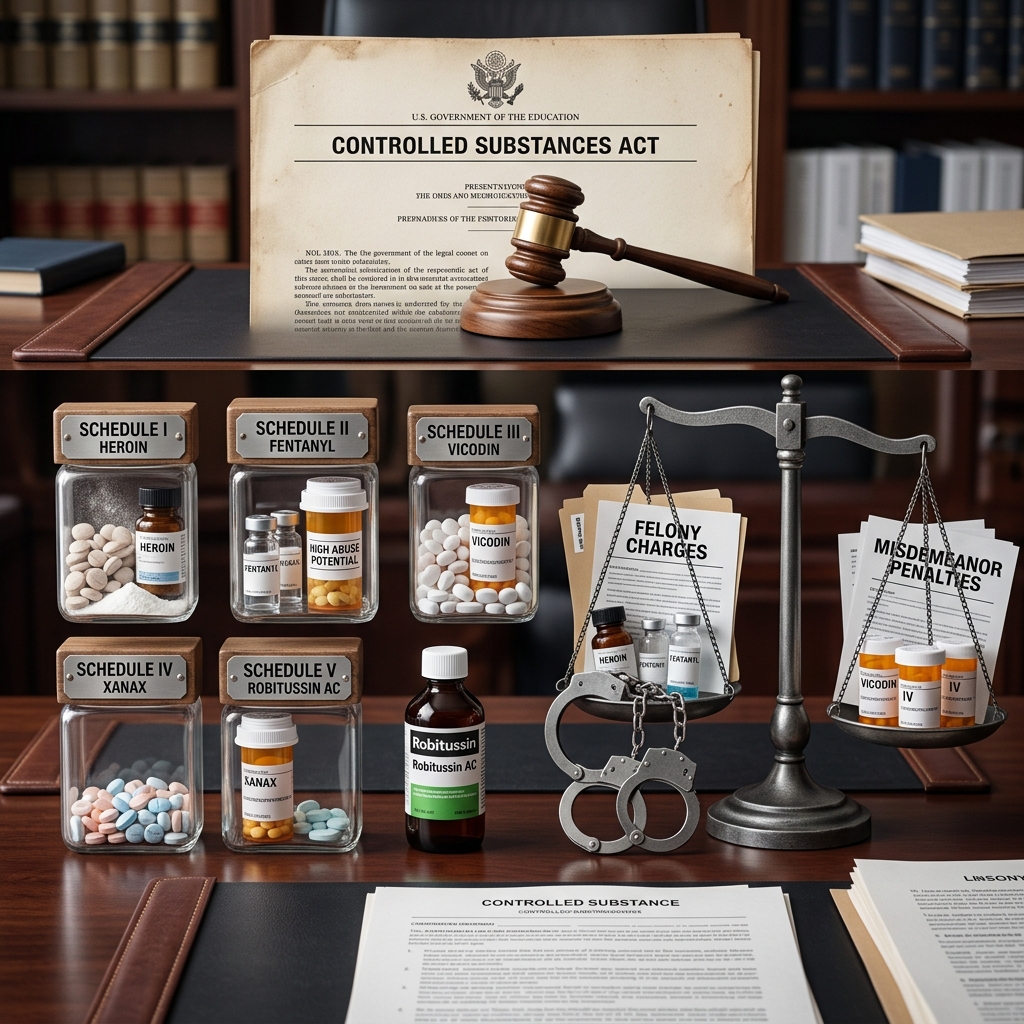
Drug classifications are at the core of how the United States regulates substances, prosecutes drug crimes, and decides which medications can be safely prescribed. Federal law uses a structured system of controlled substance schedules and medical drug categories to balance public safety, medical need, and the risk of abuse.
This article explains how drugs are classified, why those classifications matter in criminal cases, and what people facing drug charges need to understand about the legal framework around controlled substances.
Why Drug Classification Matters in Criminal Law
In U.S. criminal law, not all drugs are treated the same. A substance’s classification directly affects:
- The severity of potential charges (misdemeanor vs. felony)
- Possible sentencing ranges and mandatory minimums
- Whether a case is handled in state or federal court
- Eligibility for diversion programs or treatment alternatives
- The way prosecutors and defense attorneys build or challenge a case
Because classification shapes penalties, understanding where a substance falls on the legal spectrum is often one of the first steps in analyzing a drug case.
The Legal Foundation: The Controlled Substances Act
The primary federal law governing drug classification is the Controlled Substances Act (CSA), enacted in 1970. It created a unified system for regulating certain drugs and chemicals that can be abused or cause dependence. Under the CSA:
- Drugs are placed into five schedules (Schedule I through Schedule V)
- Each schedule reflects a combination of medical use, risk of abuse, and potential for dependence
- Federal agencies, including the Drug Enforcement Administration (DEA) and the Food and Drug Administration (FDA), jointly participate in classification decisions.
When a new substance emerges, or when scientific understanding of an existing drug changes, federal authorities can move a drug from one schedule to another or add new substances to the schedules.
Key Factors Used to Classify Controlled Substances
Under federal law, a drug’s schedule is not arbitrary. The CSA outlines specific criteria that must be evaluated, including:
- Potential for abuse: how likely the substance is to be misused
- Accepted medical use: whether it is recognized for treatment in the U.S.
- Risk of dependence: physical and psychological dependence potential
- Scientific evidence: data on pharmacological effects and safety
- Patterns of abuse: history, scope, and significance of misuse
- Public health impact: risk posed to individuals and communities
- Relationship to other controlled drugs: including whether it is a precursor to already-controlled substances
These factors are weighed to determine how strictly a drug should be controlled and what kinds of criminal penalties should apply when it is possessed, manufactured, or distributed illegally.
Overview of the Five Federal Drug Schedules
Federal drug schedules create a structured hierarchy from the most tightly controlled substances to those considered least dangerous. While many details vary by statute and case, the basic framework is as follows.
| Schedule | Abuse Potential | Accepted Medical Use | Control Level |
|---|---|---|---|
| Schedule I | High | None under federal law | Most restrictive |
| Schedule II | High | Accepted, but with tight controls | Very strict |
| Schedule III | Moderate | Accepted | Controlled, less strict than I–II |
| Schedule IV | Lower | Accepted | Less restrictive |
| Schedule V | Lowest among controlled substances | Accepted | Least restrictive |
Schedule I: Substances with No Accepted Medical Use
Schedule I includes substances that federal law considers to have:
- High potential for abuse
- No currently accepted medical use in U.S. treatment
- A lack of safety even under medical supervision
These drugs cannot be prescribed and are illegal for general use. Their classification often results in the most serious criminal penalties for possession, manufacturing, and trafficking.
Schedule II: High Risk but Medical Use Permitted
Schedule II substances also carry a high risk of abuse and dependence, but they are recognized for specific medical uses. They may be prescribed under strict rules, such as limited refills, special prescription requirements, or close monitoring.
Illegal possession or distribution of Schedule II drugs can lead to severe penalties, but courts sometimes treat medical use differently than purely recreational use, particularly where there is a valid prescription.
Schedule III: Moderate Risk, Widely Used Medically
Schedule III drugs have a lower abuse potential than Schedule I or II but still pose a meaningful risk of dependency.
- They have accepted medical uses
- They can lead to moderate physical dependence or high psychological dependence
- They remain controlled substances, subject to criminal penalties when misused or diverted
Schedule IV: Lower Risk, Commonly Prescribed
Schedule IV drugs have a relatively low potential for abuse compared with higher schedules and are widely accepted for medical treatment.
- Often used to treat anxiety, sleep disorders, or similar conditions
- Still controlled, but penalties for unlawful possession may be less severe than higher schedules
Schedule V: Minimal Abuse Potential
Schedule V substances are considered the least risky among controlled drugs, with a low abuse or dependence potential compared to Schedule IV.
- Often contain small quantities of narcotics in combination with other medications
- May be available with fewer prescription requirements in some circumstances
Penalties for illegal possession are still possible but are typically less harsh than for higher schedules, depending on the quantity and circumstances.
Drug Categories Beyond Scheduling
In addition to schedules, drugs are also grouped by how they affect the body or how they are used in medical practice. These broader categories matter in both healthcare and law enforcement contexts.
Medical and Therapeutic Drug Categories
The FDA and other health authorities classify drugs by therapeutic use, such as:
- Analgesics: medications that relieve pain, including both non-narcotic and narcotic pain relievers.
- Antianxiety drugs: medicines that reduce anxiety and tension, sometimes called sedatives or minor tranquilizers.
- Antidepressants: used to treat mood disorders, divided into groups such as tricyclics, monoamine oxidase inhibitors, and selective serotonin reuptake inhibitors.
- Antihypertensives, antibiotics, antiepileptics and many other specialized categories.
These therapeutic groupings are crucial for prescribing and monitoring medication but can also intersect with legal concerns when drugs in these categories are misused or diverted.
Law Enforcement Drug Categories
Police and drug recognition experts often use functional categories based on how substances affect the central nervous system. Common categories include:
- Central Nervous System (CNS) depressants – slow brain and body activity
- CNS stimulants – increase heart rate, blood pressure, and activity
- Hallucinogens – alter perception and cause sensory distortions
- Dissociative anesthetics – interfere with pain perception and awareness
- Narcotic analgesics – relieve pain and can induce euphoria
- Inhalants – volatile substances producing mind-altering effects
- Cannabis – drugs derived from or related to marijuana and THC
These categories help officers identify impairment in contexts such as traffic stops or DUI investigations, even before laboratory testing is complete.
How Classification Influences Criminal Charges
When a person is arrested for a drug-related offense, classification plays a central role in determining the legal outcome. The main ways schedules and categories affect criminal charges include:
- Type of offense: simple possession, possession with intent to distribute, manufacturing, trafficking, or conspiracy
- Level of offense: certain schedules are more likely to trigger felony charges
- Sentencing guidelines: punishments are often more severe for higher-risk schedules
- Eligibility for alternative sentencing: lower-schedule or prescription drug cases sometimes have more options for treatment or diversion, depending on jurisdiction
Additionally, federal scheduling can interact with state laws, which may classify substances differently or impose their own penalties. This can be particularly important in areas where state law permits certain uses that remain illegal under federal law.
Classification and Evidence in Drug Cases
Drug classification is not just a background concept; it can also affect evidence and strategy in a criminal case.
- Proof of substance type: prosecutors typically must show that the seized material is a specific controlled substance, often through lab testing.
- Quantity and schedule: higher schedules and larger quantities often support arguments about intent to distribute rather than personal use.
- Expert testimony: in some cases, experts may testify about a drug’s effects, medical use, or abuse potential, all of which relate to classification.
Defense attorneys may challenge how the substance was tested, whether it was properly identified, or whether classification has been correctly applied in the charges.
Practical Implications for Individuals and Professionals
Understanding how drugs are classified has practical consequences for several groups:
- Patients and consumers – need to know which medications are controlled and the legal risks of sharing or misusing prescriptions.
- Healthcare providers – must comply with prescription rules, recordkeeping, and monitoring requirements for controlled substances.
- Pharmacists – enforce dispensing regulations and help prevent diversion.
- Law enforcement and prosecutors – rely on schedules and categories to shape investigations and charges.
- Defendants and defense counsel – use classification information to evaluate risk, explore defenses, and negotiate outcomes.
Frequently Asked Questions About Drug Classifications
Do drug schedules ever change?
Yes. Federal agencies can move substances between schedules or add new drugs when scientific research, medical practice, or patterns of abuse change. A substance’s legal status today may differ from its status in the past.
Are all prescription drugs controlled substances?
No. Many prescription medications are not scheduled under the Controlled Substances Act, although they are still regulated. Only drugs that meet specific criteria related to abuse and dependence risk are placed into Schedules I–V.
Can a state treat a drug differently from federal law?
Yes. States can pass their own laws around drug possession, distribution, and medical use, and they may classify substances differently. However, federal law still applies, and federal authorities can prosecute certain conduct even if state law is more permissive.
How does classification affect research on drugs?
Scheduling affects how easy or difficult it is to study a substance. Drugs in higher schedules typically face more regulatory hurdles for research. Researchers need special approvals and must meet strict security and reporting requirements.
What should I do if I am charged with a drug crime?
If you face drug charges, the schedule and category of the substance involved will significantly affect your case. It is important to:
- Identify exactly which substance is alleged
- Determine its schedule and legal status
- Understand how that schedule affects potential penalties and options
- Seek legal advice from a qualified criminal defense attorney
An attorney can explain how classification impacts your situation and help you navigate the legal process.
References
- Controlled Substances Act — U.S. Government / Legal Overview (via secondary summary). 2024-01-01. https://en.wikipedia.org/wiki/Controlled_Substances_Act
- Drug Classification Act of 1970 — EBSCO Research Starters. 2017-06-01. https://www.ebsco.com/research-starters/political-science/drug-classification-act-1970
- Drug Scheduling & Classifications (Schedule I–V Controlled Drugs) — American Addiction Centers. 2023-04-10. https://americanaddictioncenters.org/prescription-drugs/classifications
- U.S. Controlled Drug Classifications — Recovery Research Institute. 2020-09-01. https://www.recoveryanswers.org/resource/u-s-drug-classifications/
- 7 Drug Categories — International Association of Chiefs of Police. 2018-05-01. https://www.theiacp.org/7-drug-categories
- General Drug Categories — U.S. Food and Drug Administration. 2022-03-15. https://www.fda.gov/drugs/investigational-new-drug-ind-application/general-drug-categories
- USP Drug Classification — U.S. Pharmacopeia. 2019-11-01. https://www.usp.org/health-quality-safety/usp-drug-classification-system
Similar Articles








Read full bio of medha deb




