
Understanding the U.S. Court-Martial Process
A practical, step‑by‑step guide to how court‑martial cases move through the military justice system from accusation to appeal.
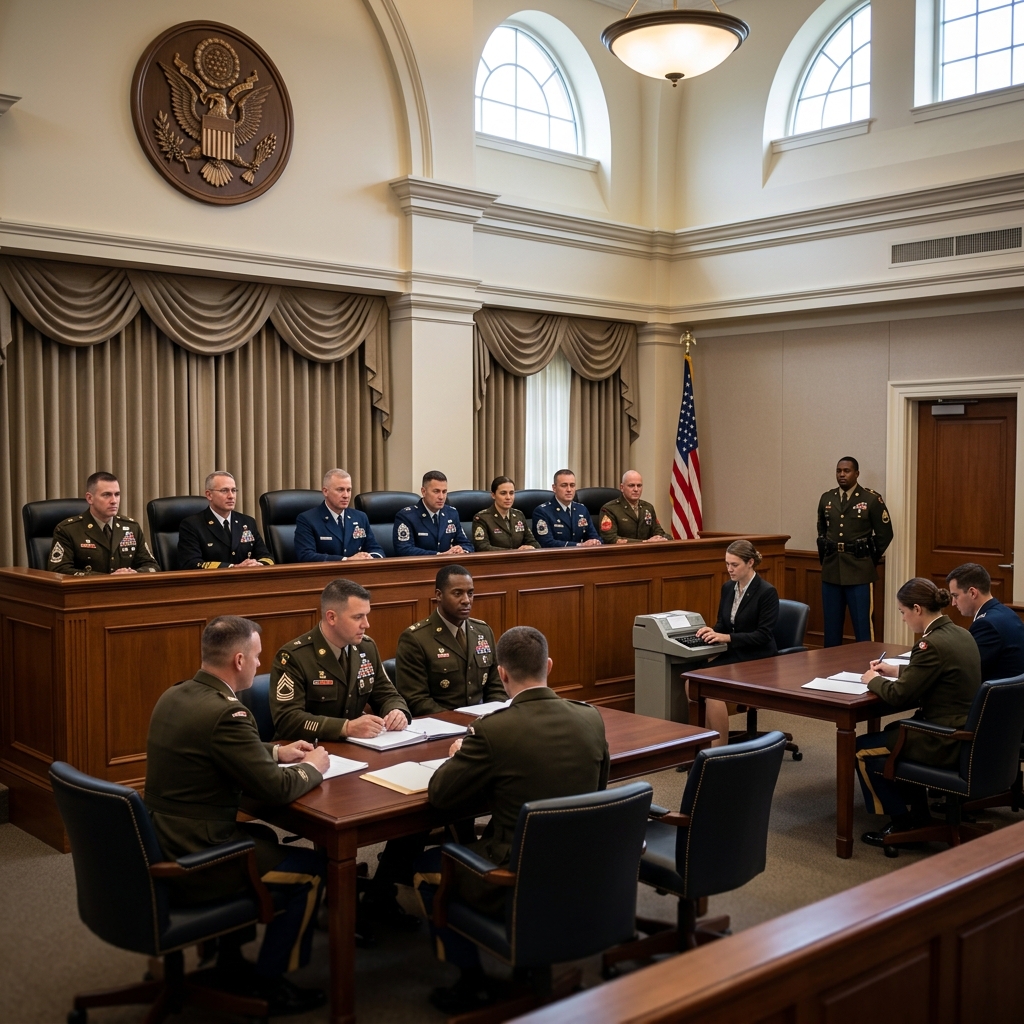
A court-martial is the military’s criminal trial system, used to determine whether a service member has violated the Uniform Code of Military Justice (UCMJ) and, if so, what punishment is appropriate. Though it resembles civilian criminal court in many ways, it operates under distinct rules, procedures, and command structures that reflect the unique needs of the armed forces.
What Is a Court-Martial and When Is It Used?
Courts-martial are convened to address alleged criminal misconduct by members of the U.S. armed forces, including violations such as assault, theft, sexual offenses, desertion, and other crimes specifically listed in the UCMJ’s punitive articles. They can also address some misconduct that would be handled as administrative or disciplinary matters in civilian life, but has special significance in a military environment, such as absence without leave or disobedience of lawful orders.
A court-martial may be ordered when a commander and legal advisors conclude that the alleged misconduct is serious enough to justify formal criminal charges instead of lesser measures such as counseling, reprimand, or nonjudicial punishment.
Three Levels of Courts-Martial
The U.S. military uses three primary levels of courts-martial, each designed to address different degrees of severity and potential punishment. Understanding these levels helps a service member gauge the possible consequences if charges are referred to trial.
Summary Court-Martial
A summary court-martial is the least serious level and is typically reserved for minor offenses.
- Presided over by a single commissioned officer acting as judge and fact-finder.
- Used for noncapital offenses and generally for enlisted personnel.
- Procedures are simplified and punishments are limited; confinement and restrictions are usually measured in days rather than years.
- The record of a summary court-martial is more limited, though it can still have long-term career consequences.
Special Court-Martial
A special court-martial is roughly comparable to a misdemeanor-level criminal court in the civilian system.
- Includes a military judge and, if requested, a panel of members who function similar to a jury.
- Maximum punishment typically includes up to one year of confinement, reduction in rank, forfeitures of pay, and a bad-conduct discharge for enlisted members.
- Conviction normally requires a three-fourths concurrence of the panel members when a panel is used.
General Court-Martial
A general court-martial is the highest level of military criminal trial and is reserved for the most serious offenses, including felonies such as rape, murder, and major fraud.
- Presided over by a military judge and typically includes a panel of at least five members for noncapital cases, and more for capital cases.
- May impose any punishment authorized by the UCMJ, including lengthy confinement, dishonorable discharge, dismissal of officers, and in rare cases, the death penalty.
- For most offenses, conviction requires at least a two-thirds vote of the panel; capital offenses require a unanimous verdict and unanimous agreement on a death sentence.
Key Players in a Court-Martial
Several participants have distinct roles within the court-martial process, each contributing to the fairness and legality of proceedings.
- Accused service member: The person facing charges under the UCMJ. They have substantial rights, including the right to counsel, to remain silent, and to present a defense.
- Defense counsel: Appointed military attorneys, and sometimes civilian counsel, who represent the accused.
- Trial counsel: The military prosecutor representing the government.
- Military judge: A legally trained officer who presides over the trial, rules on evidence and motions, and provides legal instructions to the panel.
- Panel members: Service members selected by the convening authority to serve as fact-finders; they are similar to a jury, though they are not randomly chosen.
- Convening authority: The commander or official with authority to order a court-martial and to refer specific charges to a particular level of court.
From Allegation to Charges: The Pretrial Path
The court-martial process begins long before the service member steps into a courtroom. Several stages occur between initial allegation and formal charging.
Initial Report and Command Response
When possible misconduct is reported, military law enforcement or investigative agencies (such as the service’s criminal investigative organization) may open an investigation. Commanders retain responsibility for maintaining good order and discipline and may take preliminary administrative steps, such as issuing no-contact orders or placing the member under certain restrictions.
Article 32 Preliminary Hearing
For general courts-martial, there is typically a formal preliminary hearing under Article 32 of the UCMJ. This hearing:
- Examines whether there is probable cause to believe the accused committed the offense.
- Allows the defense to hear much of the government’s evidence and cross-examine witnesses.
- Results in a report and recommendation to the convening authority on how to proceed.
Article 32 hearings serve a function loosely similar to a grand jury review in the civilian system, but they are adversarial and the defense is present and active.
Preferring and Referring Charges
The formal charging process usually unfolds in two steps.
- Preferral of charges: A commander or authorized officer swears to the charges against the accused and the charges are read in the accused’s presence with another officer as a witness.
- Referral of charges: The convening authority reviews the case, consults legal advisors, and decides whether to send the charges to a court-martial and at what level (summary, special, or general).
Once charges are referred, the case enters the formal pretrial phase, during which both sides prepare for trial.
Pretrial Rights and Preparation
During pretrial, the accused and the government both engage in extensive preparation. Many protective rights exist for the service member during this period.
Core Rights of the Accused
- Right to counsel: The accused has the right to free military defense counsel and may hire qualified civilian counsel.
- Right to remain silent: No one may compel the accused to incriminate themselves; statements must comply with constitutional protections and applicable military rules.
- Right to be informed of charges: The accused must be formally notified of the specific offenses alleged.
- Right to access evidence: The defense has the right to review relevant evidence held by the government, subject to certain legal limits, and to conduct its own investigation.
- Right to call and cross-examine witnesses: At trial, the defense may question government witnesses and present its own witnesses.
Discovery, Motions, and Plea Negotiations
Pretrial practice can be complex, but it generally includes three recurring elements.
- Discovery: Exchange of evidence between prosecution and defense, including reports, statements, and physical or digital evidence.
- Pretrial motions: Written or oral requests asking the judge to rule on legal questions such as suppression of evidence, dismissal of charges, or admissibility of certain testimony.
- Plea discussions: The parties may negotiate a plea agreement, under which the accused admits guilt to specific charges in exchange for a more limited sentence or dropping other allegations, subject to judicial approval.
The Court-Martial Trial: Step-by-Step
When a case proceeds to trial, the structure is broadly similar to a criminal trial in civilian courts, but with important military-specific rules.
| Stage | Main Purpose |
|---|---|
| Arraignment | Accused is formally advised of charges and enters a plea (guilty or not guilty). |
| Selection of panel members | For member trials, the court selects a panel and both sides may challenge for bias. |
| Opening statements | Each side outlines the evidence they expect to present. |
| Prosecution case | Government presents witnesses and exhibits; defense cross-examines. |
| Defense case | Defense presents evidence and witnesses to refute or mitigate charges. |
| Rebuttal and surrebuttal | Limited additional evidence responding to points raised by the other side. |
| Closing arguments | Each side summarizes the evidence and argues how the law applies. |
| Instructions and deliberation | Judge instructs on the law; panel deliberates in private to reach a verdict. |
Standards of Proof and Voting Rules
As in civilian criminal court, the government must prove each charged offense beyond a reasonable doubt. However, the voting rules in a court-martial differ from civilian juries.
- For most noncapital offenses, conviction usually requires at least a two-thirds or three-fourths majority of panel members, depending on the level of court.
- For capital offenses, a unanimous verdict is required to convict.
- When the accused elects trial by judge alone, the military judge decides guilt or innocence without a panel.
Sentencing After Conviction
If the panel or judge returns a guilty finding on any charge, the case moves into a separate sentencing phase.
- Sentencing evidence: Both sides may present additional information, including the accused’s service record, character statements, victim impact, and mitigating circumstances.
- Role of judge and panel: For noncapital cases, a military judge typically imposes the sentence; for death-eligible offenses, panel members vote on the sentence, and unanimity is required for a death penalty.
- Types of punishment: Possible sanctions include confinement, reduction in rank, forfeiture of pay, reprimands, and in general and some special courts-martial, punitive discharges such as bad-conduct or dishonorable discharge.
Post-Trial Review and Appeal
The court-martial process does not end with sentencing. Various layers of review help ensure that convictions and sentences comply with the law and with military regulations.
Convening Authority Review
After trial, the convening authority typically reviews the record of trial and may approve, reduce, or (in limited circumstances) disapprove portions of the findings or sentence, subject to current statutory limits. This step is unique to the military justice system and reflects the command’s responsibility for discipline and fairness.
Appellate Courts
Serious cases, especially those involving confinement or punitive discharge, are usually subject to automatic appellate review.
- Service courts of criminal appeals: Each major branch has an appellate court that reviews the record for legal error and factual sufficiency.
- U.S. Court of Appeals for the Armed Forces (CAAF): A civilian court that provides an additional layer of review of selected cases.
- Further review: In rare cases, matters can reach the Supreme Court of the United States.
Frequently Asked Questions About Courts-Martial
Do court-martial convictions count as criminal convictions outside the military?
Yes. A conviction at a general court-martial is generally treated as a federal criminal conviction and can appear on civilian criminal records checks. Special and summary court-martial outcomes may also affect a service member’s record, but the details and long-term impact depend on the specific case and applicable regulations.
Can a service member refuse a summary court-martial?
In many circumstances, an enlisted service member may decline a summary court-martial and instead request that the matter be handled through a higher level court-martial or other disciplinary processes, though this choice carries significant risks because potential punishments may be more severe. Legal advice is important before making that decision.
How long does the court-martial process usually take?
Timeframes vary widely depending on the complexity of the case, the number of witnesses, and pretrial motions. Summary courts-martial may be resolved in weeks, while special courts-martial often take several months and general courts-martial can extend for a year or more. Statutory and regulatory timelines also influence how quickly a case moves from charging to trial.
Are court-martial panel members truly independent from command influence?
Panel members are selected by the convening authority rather than randomly, but they must swear an oath to decide the case impartially and without unlawful command influence. They may not be disciplined for their findings, and allegations of improper influence can themselves lead to legal challenges and potential remedies.
Can a service member be tried both in civilian court and by court-martial for the same conduct?
Yes, it is legally possible for both civilian authorities and the military to assert jurisdiction over the same underlying conduct. Whether this occurs depends on coordination between prosecutors and policy considerations. Double jeopardy protections are interpreted differently when separate sovereigns are involved, though practical and policy limits often discourage dual prosecutions.
References
- The Court Martial Process — FindLaw. 2023-06-01. https://www.findlaw.com/military/criminal-law/the-court-martial-process.html
- Manual for Courts-Martial, United States (2024 Edition) — Joint Service Committee on Military Justice / U.S. Department of Defense. 2024-01-01. https://jsc.defense.gov/Portals/99/2024%20MCM%20files/MCM%20(2024%20ed)%20-%20TOC%20no%20index.pdf
- Courts-martial of the United States — U.S. military justice overview via secondary source, drawing on UCMJ and MCM. 2023-10-01. https://en.wikipedia.org/wiki/Courts-martial_of_the_United_States
- The Court-Martial Process: What to Expect and How to Prepare — Court-Martial.com (Law Office of Jocelyn C. Stewart). 2022-04-15. https://www.court-martial.com/practice-areas/appeal-of-actions-under-the-ucmj/court-martial-or-adverse-action/what-to-expect-with-your-court-martial/
- What Happens in a Court-Martial? — The Military Defense Firm. 2023-09-10. https://themilitarydefensefirm.com/blog/what-happens-in-a-court-martial/
- What Exactly is a Court-Martial? — Military Justice Attorneys. 2021-11-05. https://www.militaryjusticeattorneys.com/blog/what-exactly-is-a-court-martial/
- US Army Court-Martial Public Record System — U.S. Army JAG Corps. 2020-01-01. https://www.jagcnet.army.mil/ACMPRS
Similar Articles








Read full bio of medha deb




