
Federal Safety Valve: What Defendants Need To Know Explained
How federal courts can sentence below mandatory minimums for qualified nonviolent drug defendants.
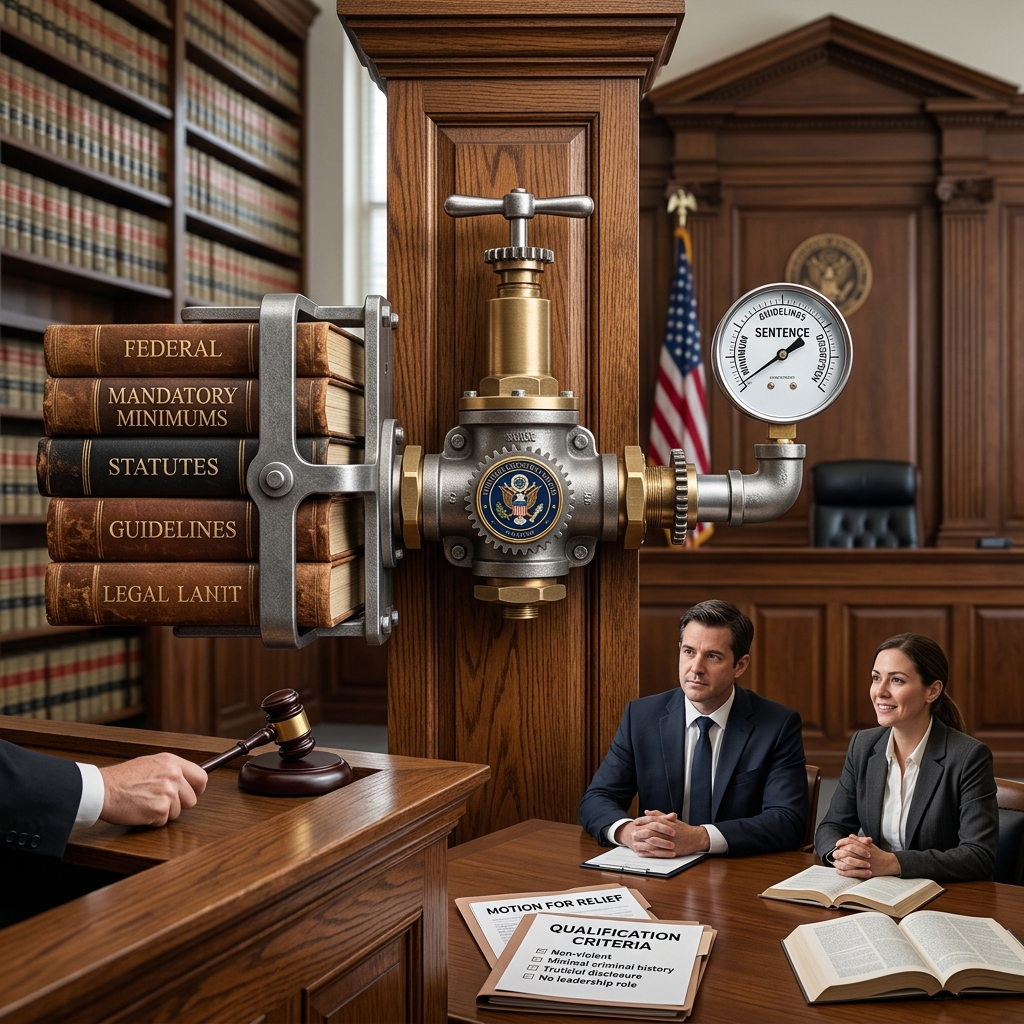
The federal safety valve is one of the most important tools available to reduce harsh mandatory minimum sentences in certain drug cases. When a defendant qualifies, a judge may sentence below the statutory floor and instead rely on the Sentencing Guidelines, which can significantly lower the prison term.
For defendants with limited criminal histories and no aggravating conduct, the safety valve can make the difference between a mandatory prison term and a more individualized sentence. It is not automatic, however, and eligibility depends on several statutory conditions that must all be satisfied.
Why the Safety Valve Exists
Federal mandatory minimums were designed to punish certain drug offenses severely, but they can sometimes produce sentences that are higher than necessary for low-level participants. The safety valve was created to give judges limited discretion in cases involving nonviolent offenders who present less risk and who have not played a leading role in the offense.
In practical terms, the rule gives courts a way to distinguish between major traffickers and defendants whose conduct is less serious. Instead of applying a rigid minimum sentence, the court may impose a guideline-based sentence if the defendant satisfies the statute’s requirements.
What the Rule Does in a Federal Case
When the safety valve applies, the judge must ignore the statutory mandatory minimum and sentence under the normal guideline framework. That can produce a lower sentence even when the charged offense ordinarily carries a five-year or ten-year minimum term.
There is also an additional sentencing benefit. The guidelines provide a two-level reduction for qualifying defendants, which can reduce the advisory range even further.
Who May Qualify
Eligibility is limited to certain federal drug offenses and related conduct. The safety valve applies to specific offenses under the Controlled Substances Act and Controlled Substances Import and Export Act, along with certain maritime drug offenses.
Even within those categories, the defendant must meet every statutory requirement. Courts do not have discretion to waive the conditions, and a single disqualifying fact can eliminate eligibility.
The Main Eligibility Requirements
The statute requires the court to examine five separate criteria. These are often discussed together, but each one matters independently.
- The defendant must have a limited criminal history.
- The defendant must not have used violence or credible threats of violence, and must not have possessed a firearm or other dangerous weapon in connection with the offense.
- The offense must not have caused death or serious bodily injury to any person.
- The defendant must not have been an organizer, leader, manager, or supervisor, and must not have been engaged in a continuing criminal enterprise.
- Before sentencing, the defendant must truthfully provide the government all information and evidence the defendant has concerning the offense and related conduct.
Criminal History Is Often the First Hurdle
The criminal history requirement is frequently the hardest part of the analysis. After the First Step Act, the statute uses a more detailed test that looks at criminal history points and certain prior offenses.
Under the current rule, a defendant is disqualified if the person has more than four criminal history points, excluding points from one-point offenses, or if the defendant has a prior three-point offense, or if the defendant has a prior two-point violent offense. The Supreme Court confirmed in Pulsifer v. United States that these are separate disqualifying characteristics.
That means a defendant may lose eligibility even if the overall criminal record is not extensive. The structure of the statute makes precision important, because the presence of any one disqualifying characteristic can close the door to relief.
Violence and Weapons Usually End the Analysis
The safety valve is intended for nonviolent defendants. If the offense involved violence, credible threats, or the use or possession of a firearm or dangerous weapon in connection with the crime, the defendant will generally not qualify.
This requirement matters because federal drug cases often involve allegations of firearms or intimidation. Even if a defendant did not personally use a weapon, the statute can still bar relief if the conduct involved possession or inducement of another participant to use a weapon.
No Serious Injury or Death
The safety valve also excludes offenses that result in death or serious bodily injury. This reflects the statute’s narrow focus on defendants whose conduct, while still serious, did not cause the most severe physical harm.
Courts treat this requirement as a straightforward factual question. If the offense led to grave injury or death, the sentencing court cannot use the safety valve to reduce the sentence below the mandatory minimum.
Role in the Offense Matters
A defendant cannot qualify if the person acted as an organizer, leader, manager, or supervisor of others in the offense. The rule also excludes defendants involved in a continuing criminal enterprise.
This distinction is important because many federal drug cases involve groups of participants. The safety valve is meant for lower-level participants, not for those directing others or coordinating a broader trafficking operation.
Truthful Disclosure Before Sentencing
One of the most important parts of the safety valve is the disclosure requirement. Before sentencing, the defendant must truthfully provide the government with all information and evidence the defendant has about the offense and related conduct.
This does not mean a defendant must become a witness for the government or provide information the defendant does not actually know. It does mean that the defendant must be fully candid about the offense conduct, the participants, and related acts within the defendant’s knowledge.
Lawyers often focus on this requirement because a defendant who is otherwise eligible can still lose the benefit by withholding information, minimizing involvement, or giving incomplete answers.
How the Sentencing Process Changes
If the court finds that the defendant satisfies the statute, the mandatory minimum no longer controls the sentence. The judge then sentences within the framework of the advisory Sentencing Guidelines, while still considering the usual federal sentencing factors.
This can substantially change the sentencing outcome. A defendant who would otherwise face a harsh mandatory floor may instead receive a sentence based on offense level, criminal history, acceptance of responsibility, and any other applicable guideline adjustments.
Why Defense Lawyers Pay Close Attention
The safety valve can be the most valuable sentencing issue in a federal drug case because it can lower both the starting point and the final result. For that reason, defense counsel must identify potential eligibility early, well before the sentencing hearing.
Early attention matters because the defendant may need to collect records, analyze criminal history points, prepare a truthful proffer, and resolve factual disputes with the probation office or the government. Waiting until the end of the case can make it harder to secure the benefit.
Common Problems That Create Disputes
Several issues commonly arise in safety valve litigation:
- Whether a prior conviction counts as a disqualifying offense under the criminal history rules.
- Whether a weapon was possessed “in connection with” the offense.
- Whether the defendant played a leadership role.
- Whether the defendant’s disclosure was complete and truthful.
- Whether the offense conduct fits within the narrow list of covered federal offenses.
These disputes are often fact-specific. In many cases, the legal question turns on the presentence report, prior records, plea materials, and the defendant’s own account of events.
Safety Valve vs. Other Sentence Reductions
The safety valve is different from cooperation-based sentence reductions. A defendant does not need to provide substantial assistance against others to qualify. Instead, the rule is tied to offense characteristics and truthful disclosure.
That distinction matters because some defendants have information but do not want to enter a cooperation agreement. The safety valve can still offer relief if the statutory conditions are met.
Key Takeaways for Defendants
| Issue | Why It Matters |
|---|---|
| Criminal history | Too many points or a disqualifying prior offense can eliminate eligibility. |
| Violence or weapons | Any relevant violence or firearm possession can bar relief. |
| Injury or death | Serious bodily injury or death makes the safety valve unavailable. |
| Role in the offense | Leaders and organizers are excluded. |
| Disclosure | Incomplete or untruthful statements can defeat the request. |
Frequently Asked Questions
Does the safety valve erase the conviction?
No. It affects sentencing, not guilt. The defendant is still convicted of the offense, but the court may sentence below the mandatory minimum if the statute applies.
Is the safety valve available in every federal case?
No. It is limited to specific drug and maritime offenses identified by statute.
Can a defendant with some criminal history still qualify?
Yes, in some cases. The current test is more nuanced than a simple “no record” rule, but certain criminal history characteristics still disqualify the defendant.
Does the defendant have to cooperate with prosecutors?
No. The defendant must truthfully provide all information known about the offense, but that is not the same as becoming a government cooperator in the traditional sense.
Why does the Supreme Court matter here?
The Supreme Court’s interpretation of the criminal history rule controls how lower courts apply the statute, including who is disqualified based on prior offenses.
Practical Lessons from the Rule
The federal safety valve is narrow, but when it applies, it can dramatically improve sentencing outcomes for eligible defendants. Its structure shows that Congress wanted to preserve tough mandatory minimums for serious trafficking cases while giving judges limited flexibility for lower-level, nonviolent offenders.
For defense teams, the lesson is straightforward: evaluate eligibility early, analyze the criminal history carefully, avoid weapon or violence-related issues, and prepare the defendant for a complete and truthful disclosure before sentencing.
References
- Safety Valve – §18 USC 3553(f) — Attorney Truslow. 2023-09-01. https://www.attorneytruslow.com/blog/2023/september/the-safety-valve-in-federal-sentencing/
- Federal Safety Valve — Burnham & Gorokhov. 2023-09-01. https://www.burnhamgorokhov.com/criminal-defense-resources/federal-sentencing/federal-safety-valve/
- Pulsifer v. United States, No. 22-340 — Supreme Court of the United States. 2024-03-15. https://www.supremecourt.gov/qp/22-00340qp.pdf
- Safety Valve — United States Sentencing Commission. 2009-03-01. https://www.ussc.gov/topic/safety-valve
- Supreme Court narrows the “expanded” safety valve — Federal Defenders of New York Blog. 2024-03-15. https://blog.federaldefendersny.org/supreme-court-narrows-the-expanded-safety-valve/
Similar Articles








Read full bio of Sneha Tete




