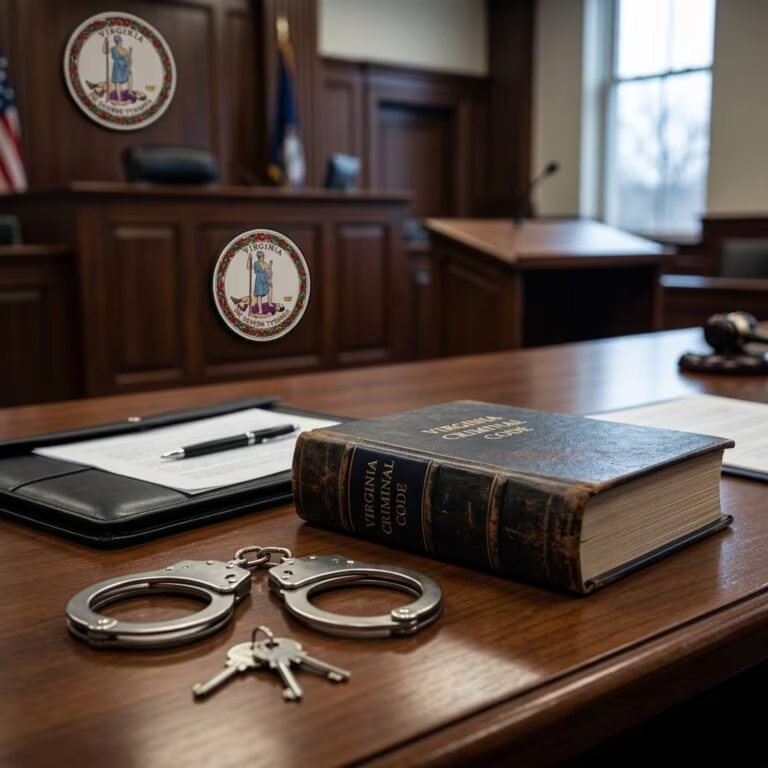
Being charged with a crime is a formal accusation by the government that you committed a specific offense, and it triggers a structured legal process that can profoundly affect your freedom, finances, and future. This guide explains, in clear language, what generally happens from the moment you are under investigation or arrested through possible trial, conviction, and sentencing.
1. From Investigation to Formal Criminal Charge
Most criminal cases start long before a person ever steps into a courtroom. Police and prosecutors follow specific steps to decide whether to file criminal charges.
1.1 Investigation and Initial Police Action
Law enforcement typically gathers information and evidence before any charges are filed. Depending on circumstances, officers may:
- Respond to a reported incident and interview witnesses
- Conduct surveillance or review video footage
- Collect physical evidence such as documents, devices, or biological samples
- Execute search warrants authorized by a judge or magistrate
If officers believe they have enough evidence, they may either arrest a suspect or issue a citation requiring a future court appearance.
1.2 What It Means to Be “Charged”
To be charged with a crime means you are formally accused through a legal document issued by a governmental authority, usually a prosecutor or sometimes the police. Common charging documents include:
- Complaint
- Information
- Indictment (often used for serious or federal offenses)
- Citation or ticket (often used for minor offenses like traffic violations)
This document lists the specific laws you are alleged to have violated and starts the criminal case in court.
1.3 Who Decides the Charges?
Police reports and evidence are typically sent to a prosecutor’s office, staffed by government lawyers whose job is to initiate and pursue criminal cases on behalf of the state or federal government. The prosecutor may:
- File charges as recommended by law enforcement
- File different or fewer charges than police suggest
- Decline to file charges if evidence is weak or insufficient
- Seek an indictment from a grand jury in certain serious or federal matters
In many jurisdictions, charges must be filed within a relatively short time after arrest, sometimes within 24 to 72 hours, especially if the person is held in custody.
2. Arrest, Booking, and Initial Detention
The period immediately after an arrest can be confusing and stressful. Understanding the typical steps may help you exercise your rights and avoid mistakes.
2.1 The Arrest Event
An arrest may occur when police witness a suspected crime, respond to a call, or act on a warrant or indictment. After an arrest, officers usually:
- Handcuff and transport the suspect to a police station or detention facility
- Advise the suspect of key rights, such as the right to remain silent and the right to an attorney (often referred to as Miranda rights in the United States)
- Complete reports summarizing the incident and evidence gathered
2.2 Booking and Identification
The booking process formally records the arrest and the person’s identity. It may include:
- Taking fingerprints and photographs
- Recording personal information, such as name, address, and date of birth
- Inventorying personal belongings
- Placing the person in a holding cell or local jail pending further proceedings
2.3 Initial Custody vs. Release
After booking, authorities decide whether the person will remain in custody or be released before the first court hearing. Depending on jurisdiction and the seriousness of the alleged offense, police or a judge may:
- Release the person with a notice to appear in court
- Release the person on bail, subject to conditions such as staying away from certain people or locations
- Keep the person in custody (also known as remand or being held on remand) until they appear in court
3. The First Court Appearance: Arraignment
The first formal court hearing in a criminal case is commonly known as an arraignment. This stage serves several important legal functions.
3.1 Purpose of Arraignment
At arraignment, the court:
- Officially informs the defendant of the specific charges and the relevant laws allegedly violated
- Ensures the defendant has a copy of the charging document
- Advises the defendant of fundamental rights, including the right to counsel
- Requests the defendant to enter a plea
- Considers whether the defendant will be released or held in custody while the case continues
3.2 Timing of the Arraignment
Many jurisdictions require that a person accused of a crime appear before a court within a short period after arrest. For example, New York law generally requires a first court appearance within 24 hours of arrest, while other jurisdictions may allow up to 72 hours if the person is in custody.
3.3 Pleas: How You Respond to the Charge
During arraignment, the defendant typically enters one of the following pleas:
- Not guilty – denies the charges and requests that the government prove the case at trial
- Guilty – admits the offense and accepts that the court can proceed to sentencing
- No contest (nolo contendere, where available) – does not admit guilt but also does not contest the charges; the court may treat it similarly to a guilty plea for sentencing purposes
Entering a plea is a serious decision that should be made with the assistance of legal counsel whenever possible.
3.4 Bail, Custody, and Pretrial Conditions
At or shortly after arraignment, the court decides what conditions will apply while the case is pending.
- Release on recognizance – the defendant is released based on their promise to return to court, usually with minimal conditions
- Bail – the court sets a monetary amount that must be posted to secure release; failure to post bail means the defendant remains in custody
- Supervised release or monitoring – may involve regular check-ins, electronic monitoring, or participation in specific programs
- Remand or custody – the defendant is held in jail without the option of bail, often in serious cases or where there is a high risk of flight or danger to the community
| Option | Key Feature | Typical Use |
|---|---|---|
| Recognizance | Released based on promise to appear | Low-risk defendants, minor charges |
| Bail | Requires payment or bond | Moderate risk or more serious charges |
| Supervised release | Conditions like monitoring or testing | When some oversight is needed |
| Remand | Held in custody, no bail | High-risk or very serious cases |
4. Rights of the Accused During the Criminal Case
Being charged does not mean you are guilty. In criminal court, defendants are generally presumed innocent until proven guilty beyond a reasonable doubt. Throughout the process, several core rights apply.
4.1 Presumption of Innocence and Burden of Proof
The government must prove every element of the charged offense beyond a reasonable doubt, whether at trial or through evidence supporting a guilty plea. Until that standard is met, the defendant remains legally presumed innocent.
4.2 Right to Counsel
In many jurisdictions, anyone charged with a misdemeanor or felony has the right to an attorney, and if they cannot afford one, the court must appoint a lawyer to represent them. Legal counsel helps the defendant:
- Understand the charges and possible penalties
- Review the evidence and identify weaknesses in the prosecution’s case
- File motions to exclude or challenge evidence
- Negotiate plea agreements
- Present a defense at trial
4.3 Right to Jury Trial
For many criminal charges, especially felonies, defendants have the right to have their case decided by a jury of peers rather than solely by a judge. The jury must unanimously agree that the prosecution has met its burden of proof before a guilty verdict may be entered.
5. Pretrial Proceedings and Case Management
Between arraignment and trial, the case may involve several important steps and decisions.
5.1 Discovery and Evidence Review
Both the prosecution and defense typically exchange relevant information and evidence, a process called discovery. This helps ensure the defendant can prepare an informed defense.
5.2 Pretrial Motions
Defense attorneys often file motions to shape the case before trial, such as:
- Requests to suppress evidence obtained in violation of constitutional or statutory rights
- Motions to dismiss charges if the evidence is legally insufficient or the law does not apply to the alleged conduct
- Motions to change venue in high-profile cases
5.3 Plea Negotiations
Many criminal cases are resolved without trial through plea agreements. In plea negotiations, the prosecutor and defense may agree that the defendant will plead guilty or no contest to some or all charges in exchange for:
- A reduction in the number or seriousness of charges
- A recommendation for a lighter sentence
- Alternative sentencing such as probation or community-based programs
Judges typically review and must approve any plea agreement before it becomes final.
6. Trial: How Guilt or Innocence Is Determined
If the case is not dismissed and no plea agreement is reached, it may proceed to a criminal trial before a judge or jury.
6.1 Structure of a Criminal Trial
While procedures can vary by jurisdiction, many trials follow a similar pattern:
- Opening statements – the prosecutor outlines the case against the defendant, followed by the defense’s explanation of how it views the evidence or why the prosecution cannot meet its burden.
- Prosecution’s case – the government presents witnesses and physical or documentary evidence; the defense may cross-examine each witness.
- Defense case – the defense may present its own witnesses and evidence, though the defendant is not required to testify.
- Rebuttal – the prosecution may present additional evidence responding to the defense case.
- Closing arguments – each side summarizes its position, with the prosecution typically speaking first and last because it bears the burden of proof.
- Jury instructions and deliberation – the judge instructs the jury on the law, and the jury deliberates in private before announcing a verdict.
6.2 Verdict: Guilty, Not Guilty, or Other Outcomes
At the end of a trial, the jury or judge returns a verdict:
- Not guilty – the prosecution did not prove the case beyond a reasonable doubt; the defendant is acquitted.
- Guilty – the court finds that the prosecution has proved one or more counts in the charging document; the case moves to sentencing.
- Mistrial – in some circumstances, such as a hung jury, the judge may declare a mistrial; the prosecution may decide whether to retry the case.
7. Sentencing: What Happens After a Conviction
A conviction occurs when the legal process ends in a finding of guilt—either through a guilty plea or a verdict at trial. Once convicted, the defendant is no longer presumed innocent and becomes subject to sentencing.
7.1 Sentencing Hearing
After a guilty verdict or plea, the court holds a sentencing hearing. The judge considers:
- Applicable laws and sentencing guidelines
- The nature and seriousness of the offense
- The defendant’s criminal history and personal circumstances
- Statements from the prosecutor, defense, the defendant, and, in many cases, victims of the offense
7.2 Types of Sentences
Potential sentences vary widely depending on jurisdiction and offense. Common options include:
- Imprisonment – time in jail or prison
- Probation – supervised release with conditions such as regular reporting, employment requirements, or counseling
- Fines – monetary penalties
- Community service – unpaid work benefiting the community
- Restitution – payment to compensate victims for financial losses
7.3 After Sentencing: Appeals and Record Consequences
In many systems, defendants have the right to appeal convictions or sentences on legal grounds, such as improper admission of evidence or incorrect application of the law. A criminal record can affect employment, housing, immigration status, and other areas of life, though some jurisdictions offer procedures for expungement or record sealing in certain circumstances.
8. Being Charged vs. Being Convicted
It is important to distinguish between simply being charged and being convicted of a crime.
| Stage | Meaning | Legal Status |
|---|---|---|
| Charged | Formal accusation that you committed a specific offense | Presumed innocent; case is just beginning |
| Convicted | Court determination of guilt, either by plea or verdict | No longer presumed innocent; subject to sentencing |
9. Practical Steps if You Are Charged with a Crime
Although procedures differ between countries and states, several practical steps are widely recommended if you learn you are under investigation or formally charged.
- Exercise your right to remain silent where applicable, and avoid answering questions without legal counsel present.
- Request an attorney as soon as possible, whether privately retained or court-appointed.
- Attend all scheduled court hearings and comply with any release conditions, such as travel restrictions or check-ins.
- Provide your lawyer with accurate information about the incident, witnesses, and any evidence that may help your case.
- Avoid contacting alleged victims or witnesses directly, especially where protective orders or bail conditions limit contact.
10. Frequently Asked Questions (FAQ)
10.1 Does being charged mean I will be convicted?
No. Being charged is the beginning of the criminal process, not the end. A charge is a formal accusation that must still be proven in court beyond a reasonable doubt. The case may be dismissed, resolved through a plea agreement, or result in acquittal at trial.
10.2 How quickly must I see a judge after arrest?
Time limits vary by jurisdiction. Many places require a first court appearance within one to three days if you are in custody. Some systems, such as New York’s, generally require arraignment within about 24 hours. Check local law or consult a lawyer for specific rules in your area.
10.3 What happens at arraignment?
At arraignment, the court formally informs you of the charges, ensures you understand your rights, asks for your plea, and decides whether you will be released or held on bail or in custody while the case proceeds.
10.4 What is the difference between jail and prison?
Jails typically hold people for shorter periods, such as pretrial detention or sentences for minor offenses, whereas prisons generally house people serving longer sentences after conviction for more serious crimes. Both can be possible outcomes after being charged, depending on the case.
10.5 Can my criminal record ever be cleared?
Some jurisdictions allow expungement or sealing of certain criminal records, especially for less serious offenses or where a person has completed all sentencing requirements and remained law-abiding. Eligibility and procedures differ significantly, so legal advice is essential.
References
- A Brief Description of the Federal Criminal Justice Process — Federal Bureau of Investigation (FBI). 2023-06-01. https://www.fbi.gov/how-we-can-help-you/victim-services/a-brief-description-of-the-federal-criminal-justice-process
- What Happens After You Get Arrested — Vera Institute of Justice. 2020-07-15. https://www.vera.org/news/what-happens-after-you-get-arrested
- Being Charged with a Crime: Overview — GOV.UK. 2022-11-10. https://www.gov.uk/charged-crime
- Guide to Criminal Court — Judicial Council of California Self-Help. 2023-05-01. https://selfhelp.courts.ca.gov/criminal-court
- How People are Charged With Crimes — H. Michael Steinberg, Attorney at Law. 2019-03-10. https://www.hmichaelsteinberg.com/articles/if-you-are-under-investigation/how-people-are-charged-with-crimes/
- What Is the Difference Between Being Charged and Convicted? — Combs Waterkotte. 2021-08-24. https://www.combswaterkotte.com/faqs/what-is-the-difference-between-being-charged-and-convicted/