
Understanding Proxy Marriage in U.S. Law
Explore how proxy marriages work, where they are allowed, and the legal issues couples should consider before marrying from afar.
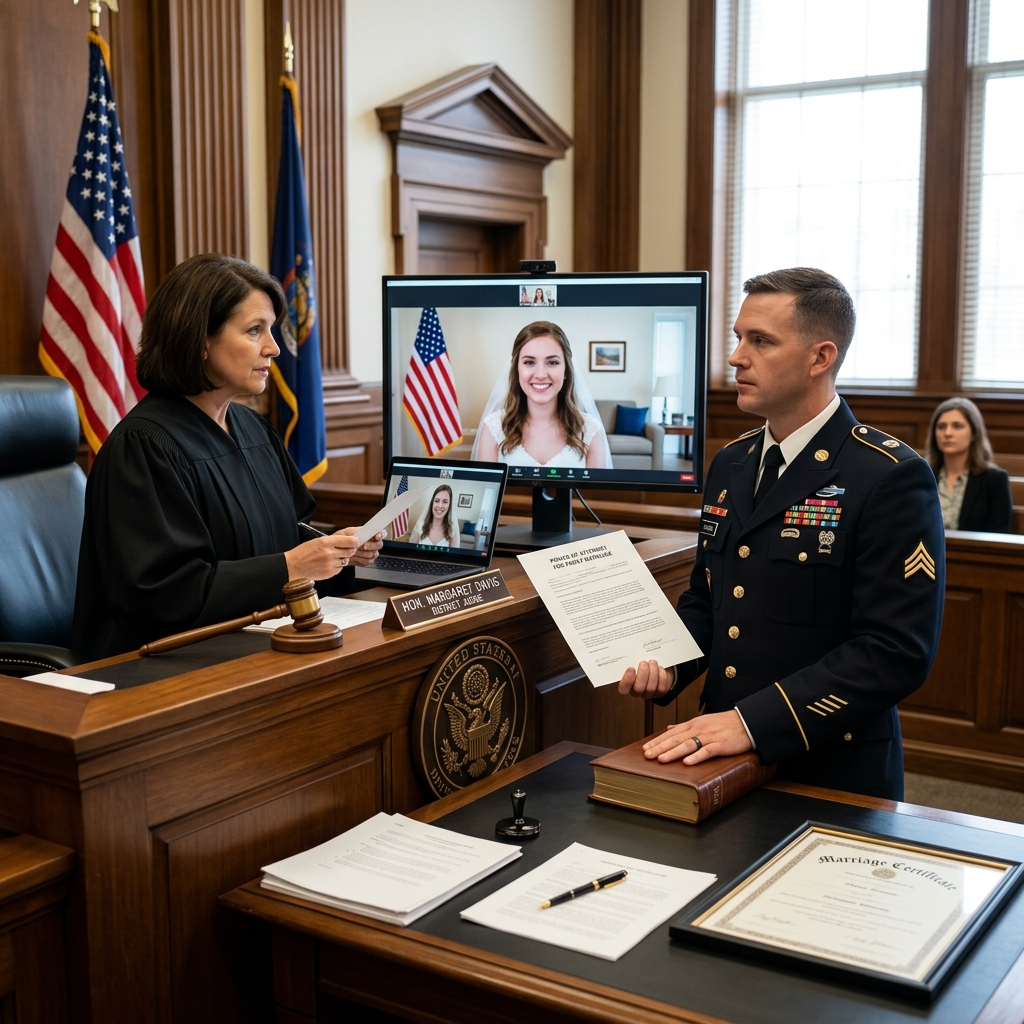
Proxy marriage is a highly specialized type of wedding used when one or both partners cannot attend the ceremony in person. It can solve real-world problems involving military deployment, incarceration, or international travel barriers, but it raises complex legal questions that couples must examine carefully.
What Is a Proxy Marriage?
A proxy marriage is a legally recognized marriage ceremony in which one or both parties are absent and represented by a stand‑in, known as a proxy. The proxy participates in the ceremony, recites vows, and signs documents on the absent partner’s behalf, acting under legally authorized permission or power of attorney.
In most jurisdictions, the expectation is that both spouses personally appear before the officiant and witnesses, but proxy marriage is a narrow exception used when physical presence is impossible or extremely difficult.
Single Proxy vs. Double Proxy Weddings
- Single proxy marriage: Only one spouse is absent. The other spouse attends in person, and a proxy stands in for the missing partner.
- Double proxy marriage: Both spouses are absent. Two proxies stand in for each partner at the ceremony. This is permitted in very few places, notably Montana in the United States.
These categories matter because some states allow single proxy marriage in limited situations, while double proxy weddings are usually prohibited or recognized in only one jurisdiction.
Why Couples Use Proxy Marriages
Most couples never need a proxy marriage. It is typically reserved for specific situations where travel or physical appearance is not possible, but the legal need to marry is urgent.
- Military deployment: Service members stationed overseas or in combat zones may be unable to travel home for a ceremony. Several states allow proxy marriages for military personnel to ensure spouses can access benefits and legal protections.
- Incarceration: An incarcerated individual may wish to marry but cannot leave the facility. Depending on state law, a proxy may be used or the ceremony may be conducted within the institution.
- Immigration and cross-border issues: Couples living in different countries may face visa delays or travel restrictions. Proxy marriage can sometimes offer a way to create a valid legal marriage before the couple is able to reunite.
- Medical or mobility constraints: Severe illness or disability might make travel impossible or unsafe, creating the need for a proxy arrangement if no local ceremony is available.
Even in these scenarios, proxy marriage is not automatically available. Couples must satisfy specific legal conditions in the jurisdiction where the ceremony occurs.
Where Proxy Marriage Is Legal in the United States
Under modern U.S. law, most states require both parties to be physically present at the wedding ceremony. Only a minority allow some form of proxy marriage, usually with strict limits.
| State | Type of Proxy Allowed | Typical Conditions |
|---|---|---|
| California | Single proxy in limited military cases | Absent party in U.S. Armed Forces; stationed overseas; power of attorney required. |
| Colorado | Single proxy | One party generally must be a state resident; usually linked to military deployment; notarized affidavit required. |
| Montana | Single and double proxy | Specific application, notarized authorization, and state residency or military ties; county clerk involvement. |
| Texas | Single proxy | Often limited to absent military members; standard marriage requirements plus documentation. |
Outside these states, proxy marriages will generally not be performed or recognized. Couples must treat proxy marriage as an exception, not a default option.
Virtual Weddings vs. Proxy Marriages
Recent developments have allowed some form of virtual marriage ceremony, where participants and officiants connect by video conference rather than meeting physically. This differs from proxy marriage:
- In a virtual wedding, both spouses are present through real-time video and can personally give consent.
- In a proxy wedding, one or both spouses are legally represented by another person who acts on their behalf during the ceremony.
For example, Utah has allowed fully online ceremonies where parties appear remotely but are personally involved in the vows. That is distinct from proxy marriage, though both alternatives try to solve similar practical problems of distance and access.
Legal Requirements and Documentation
Despite their flexibility regarding physical presence, proxy weddings must still comply with standard marriage requirements plus extra safeguards to verify consent and identity.
Core Legal Elements of a Marriage
- Capacity: Each party must be legally able to marry, meaning they meet age requirements and are not already married to someone else.
- Consent: Both parties must clearly and voluntarily agree to the marriage. Forced or coerced marriages are invalid.
- License and officiant: A valid marriage license and a legally authorized officiant (such as a judge, religious leader, or civil official) are typically required.
Additional Requirements for Proxy Marriages
- Written authorization: The absent party usually must sign a written proxy authorization or power of attorney giving the stand‑in authority to participate and sign documents on their behalf.
- Notarization: Authorization documents and affidavits confirming identity and consent are often notarized to reduce fraud and ensure authenticity.
- Residency or status conditions: Some states require that at least one party be a resident or be serving in the military to qualify for a proxy marriage.
- Clerk or court review: County clerks or similar officials may need to approve the marriage application and verify all legal criteria are met before issuing a license.
These safeguards are designed to ensure that a proxy marriage provides the same level of protection and seriousness as a traditional ceremony, despite the absence of one or both spouses.
Recognition of Proxy Marriages Across Jurisdictions
One major concern for couples is whether a proxy marriage performed in one jurisdiction will be treated as valid elsewhere. Under traditional principles of private international law, a marriage that is valid where celebrated is usually recognized in other places, but there are exceptions.
Domestic Recognition Within the United States
A proxy marriage validly performed and recorded in a state that permits it will typically be recognized by other states, especially for routine matters such as marital status, inheritance, and divorce. However, states that strongly disfavor proxy marriages might scrutinize such unions and could refuse recognition under limited circumstances, particularly where public policy conflicts.
International and Immigration Implications
Proxy marriages can have important consequences for immigration applications. Under U.S. immigration rules, a marriage performed by proxy is not automatically recognized unless the couple has consummated the marriage after the ceremony through physical relations.
Consummation must occur after the proxy wedding; prior intimacy or shared children typically cannot substitute for proof of consummation for immigration purposes. Couples are encouraged to keep evidence of meeting in person after the ceremony, such as travel records, photographs, or written statements, to demonstrate the authenticity of the marriage if questioned.
Advantages and Risks of Proxy Marriage
Proxy marriages can be powerful tools when other options are unavailable, but they carry meaningful legal and practical risks.
Potential Benefits
- Overcoming distance and deployment: Enables couples separated by military service or geography to secure legal marital status without waiting for reunion.
- Access to benefits sooner: Spouses may become eligible for health, housing, immigration, and survivor benefits more quickly once legally married.
- Flexibility during emergencies: Proxy arrangements can help in urgent situations, such as medical crises, where time-sensitive legal rights depend on marital status.
Key Risks and Limitations
- Limited availability: Because only a few states allow proxy marriage and often under narrow conditions, some couples may discover the option is unavailable after significant effort.
- Recognition issues: Another state or country may refuse to recognize the marriage, potentially affecting divorce, inheritance, or immigration outcomes.
- Complex documentation: The need for notarized authorizations, affidavits, and careful recordkeeping can make the process more complex than a conventional wedding.
- Possibility of misunderstanding: If the absent party’s wishes are not clearly documented or communicated, disputes can arise about whether they truly consented.
Practical Steps for Couples Considering Proxy Marriage
Couples exploring a proxy marriage should treat it as a legal project rather than a simple ceremony. Careful planning can prevent costly mistakes.
Initial Planning
- Confirm that at least one eligible jurisdiction permits the type of proxy marriage you need (single or double) and that you meet any residency or status requirements.
- Determine whether the primary purpose involves military benefits, immigration, or domestic rights, as this may change the best approach.
- Consult with a family law or immigration attorney in the relevant state to understand any additional local nuances or risks.
Preparing Legal Documents
- Obtain and complete a valid marriage license application in the jurisdiction where the ceremony will be held.
- Prepare a written authorization or power of attorney for the proxy, clearly granting authority to participate in the ceremony and sign documents in your name.
- Gather identification documents, such as government-issued IDs and proof of residency, and provide notarized affidavits if required.
Coordinating the Ceremony and Aftermath
- Work with the officiant and clerk’s office to schedule the ceremony and ensure all necessary witnesses and documents are available.
- Clarify with the proxy what statements will be made during the ceremony so that the absent party’s intentions are accurately represented.
- After the ceremony, verify that the marriage certificate has been properly executed and recorded with the appropriate authority.
- For immigration-related marriages, plan an in-person visit after the ceremony and maintain evidence of consummation and cohabitation.
Frequently Asked Questions About Proxy Marriage
Is a proxy marriage legally the same as a traditional marriage?
When validly performed under state law, a proxy marriage generally carries the same legal consequences as a traditional marriage, including rights and duties related to property, support, and divorce. However, some external bodies, such as immigration authorities, may impose extra conditions for recognition.
Can anyone use a proxy marriage just for convenience?
Usually not. States that allow proxy marriage typically restrict it to situations where physical presence is impossible or extremely difficult, such as military deployment. Convenience alone is rarely enough to qualify.
Are double proxy marriages widely available?
No. Double proxy weddings, where both spouses are absent, are very rare. In the United States, Montana is often cited as the single state that permits double proxy marriage under specific conditions.
What happens if my home state does not allow proxy marriage?
If you marry by proxy in a state that legally permits it, your home state will usually recognize the marriage as long as it does not violate strong public policy. Nonetheless, couples should verify this with local authorities or legal counsel, especially before relying on the marriage for major decisions.
Does U.S. immigration automatically accept proxy marriages?
No. For immigration benefits, a proxy marriage must not only be valid where celebrated, but it must also be consummated after the ceremony before it qualifies for most immigration categories. Evidence of in-person contact and a genuine relationship is typically required.
Do I still need witnesses in a proxy marriage?
Generally yes. State laws that allow proxy marriage still require standard procedural safeguards, which commonly include witnesses at the ceremony and a duly authorized officiant.
References
- Proxy marriage — Wikimedia Foundation (summary of legal concept, citing multiple primary legal sources). 2024-03-18. https://en.wikipedia.org/wiki/Proxy_marriage
- Proxy Marriage Definition — Merriam-Webster Dictionary. 2024-01-10. https://www.merriam-webster.com/dictionary/proxy%20marriage
- What Is Proxy Marriage, and Is It Allowed in California? — Blasser Law. 2021-06-15. https://www.blasserlaw.com/proxy-marriage-in-california/
- What is a Proxy Marriage? Are they Valid for Immigration? — Boundless Immigration. 2023-02-20. https://www.boundless.com/blog/proxy-marriage
- How Proxy Marriage Works: Essential Guide — NotaryLive. 2023-08-01. https://notarylive.com/blog/how-proxy-marriage-works
- What is a Proxy Marriage? — Butler Law, PC. 2022-01-12. https://www.butler.law/blog/2022/01/what-is-a-proxy-marriage/
- Legalizing Proxy Marriages — Duke Law Scholarship Repository (faculty scholarship). 1966-01-01. https://scholarship.law.duke.edu/cgi/viewcontent.cgi?article=5439&context=faculty_scholarship
Similar Articles








Read full bio of Sneha Tete


