
The Legal Journey of Same-Sex Marriage in the United States
Explore how same-sex marriage evolved from criminalization and civil unions to nationwide constitutional protection under U.S. law.
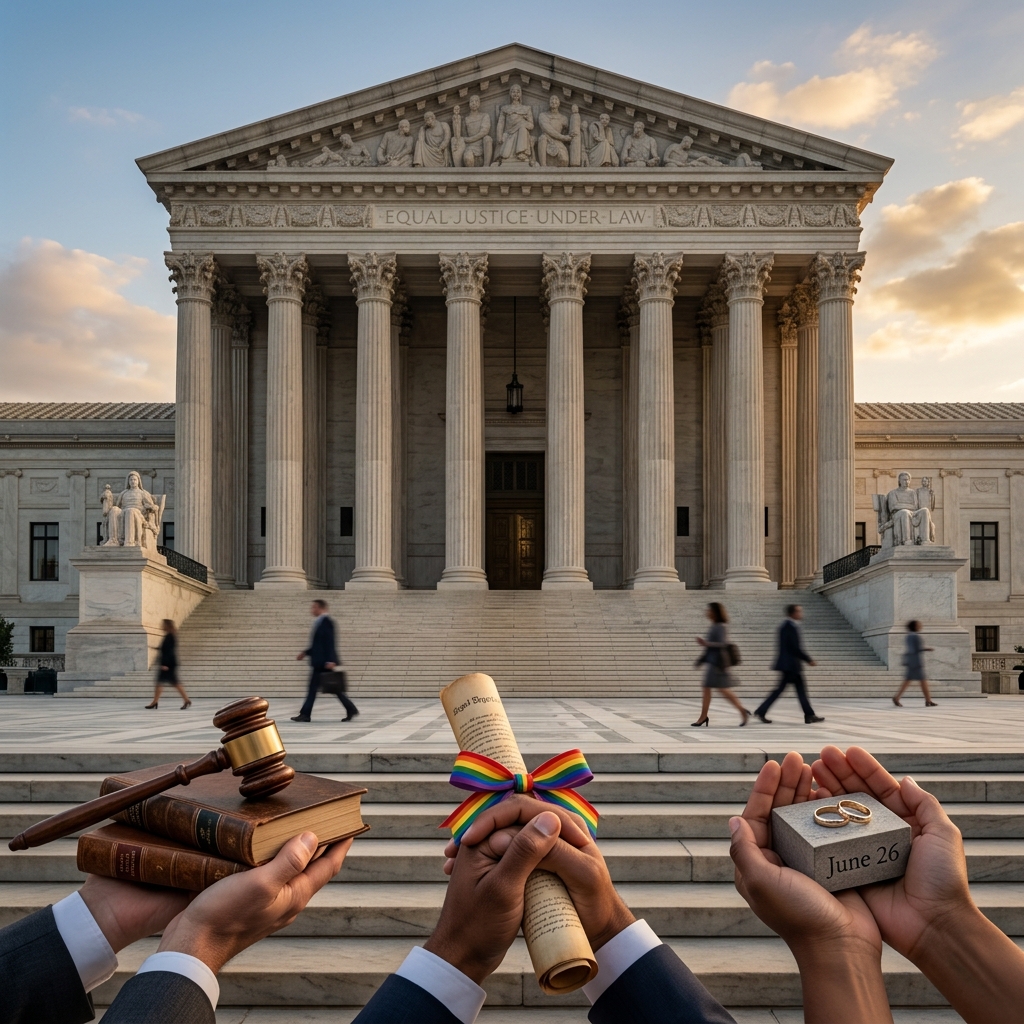
Same-sex marriage in the United States has moved from legal prohibition and widespread social stigma to nationwide recognition protected by constitutional law in just a few decades. This article traces that legal journey, focusing on major court decisions, legislative milestones, and their impact on LGBTQ couples and families.
From Criminalization to Early Marriage Claims
Modern debates about same-sex marriage grew out of a broader struggle over the legal status of lesbian, gay, bisexual, transgender, and queer people, especially the effort to dismantle laws that criminalized same-sex intimacy. These early legal reforms laid the groundwork for later claims that same-sex couples should be able to marry on equal terms with different-sex couples.
The role of sodomy laws
For much of U.S. history, many states enforced sodomy laws that criminalized private, consensual sexual conduct between adults. These statutes made LGBTQ people vulnerable to arrest, discrimination, and social exclusion, and they were often cited as justification for denying legal recognition to same-sex relationships.
- Police and prosecutors used these laws to target gay men and, in some instances, lesbian women.
- Sodomy laws reinforced the idea that same-sex relationships were inherently immoral or illegitimate.
- Advocates saw repeal or invalidation of these laws as a prerequisite for any broader legal recognition of LGBTQ rights, including marriage.
A critical turning point came when the U.S. Supreme Court struck down state criminal bans on same-sex intimacy, concluding that adults have a constitutional liberty interest in private consensual sexual conduct. This decision removed a key legal barrier and shifted the conversation toward equal treatment of relationships, including the question of marriage.
Early same-sex marriage lawsuits
Long before nationwide recognition, same-sex couples began challenging marriage restrictions in court, arguing that excluding them from civil marriage violated state and federal constitutional guarantees of equality and due process.
Several early lawsuits in the 1970s and 1990s laid the foundation for later success:
- Couples applied for marriage licenses and, when refused, filed constitutional challenges, often without support from major national organizations.
- Most early cases failed, with courts dismissing arguments for equality as speculative or unprecedented.
- Despite these setbacks, these lawsuits introduced key legal theories, including the idea that limiting marriage to different-sex couples discriminated based on sex and sexual orientation.
One influential early case occurred in Hawaii, where the state supreme court held that excluding same-sex couples from marriage was presumptively unconstitutional under the state’s equal protection principles, unless the government could justify the restriction under heightened scrutiny. The case raised national awareness and prompted legislative responses in many states and at the federal level.
The Rise of Civil Unions and Domestic Partnerships
In the 1990s and early 2000s, many jurisdictions adopted civil unions or registered partnerships as a compromise between full marriage equality and complete exclusion. These institutions were designed to provide some or many of the legal benefits of marriage without using the term “marriage”.
Vermont and the civil union model
In December 1999, the Vermont Supreme Court ruled that same-sex couples were entitled to the same rights, privileges, and benefits as married different-sex couples under the state constitution. The court left it to the legislature to decide whether to open marriage to same-sex couples or create an equivalent status.
In response, Vermont enacted a civil union statute in 2000, becoming the first U.S. state to officially grant comprehensive recognition and equal state-level rights to same-sex couples through a separate legal status.
- Civil unions provided access to state-level benefits such as property rights, hospital visitation, and certain tax advantages.
- However, they did not confer any federal marriage benefits, because federal law at the time defined marriage as between one man and one woman.
- Advocates criticized civil unions as creating a “separate but equal” regime that symbolically and legally treated same-sex relationships as inferior.
International developments and registered partnerships
Globally, several countries created registered partnerships or similar institutions for same-sex couples before adopting full marriage equality. For example, Denmark recognized registered partnerships for same-sex couples in 1989, granting most rights of married different-sex couples, though not all parental rights.
These international developments informed debates in the United States, offering models for incremental recognition and highlighting questions about whether separate institutions could ever truly match the status and social meaning of marriage.
| Feature | Civil Union / Partnership | Civil Marriage |
|---|---|---|
| Federal benefits (U.S., pre-2015) | Generally not available to civil union partners | Available to married couples once recognized under federal law |
| State-level rights | Often similar or identical to marriage in the same state | Full state-level rights as defined by marriage statutes |
| Symbolic status | Viewed as separate, sometimes unequal institution | Long-standing, socially recognized institution of family formation |
| Interstate recognition | Inconsistent; many states refused recognition | Post-2015, same-sex marriages must be recognized nationwide |
Defense of Marriage Act and Federal Non-Recognition
While some states experimented with civil unions and early same-sex marriage recognition, Congress enacted the Defense of Marriage Act (DOMA) in 1996. DOMA defined marriage for federal purposes as the union of one man and one woman and allowed states to refuse recognition of same-sex marriages performed in other jurisdictions.
DOMA had far-reaching consequences:
- Same-sex couples legally married in states like Massachusetts were treated as unmarried under federal law.
- They were denied access to more than a thousand federal benefits and responsibilities linked to marriage, including Social Security spousal benefits, immigration sponsorship, and favorable tax treatment.
- States could decline to recognize marriages from other states, creating a patchwork where a couple’s rights changed at the state line.
At the same time, many states passed their own “mini-DOMA” statutes or constitutional amendments explicitly defining marriage as between a man and a woman and barring recognition of same-sex marriages. This created substantial legal uncertainty and unequal treatment across the nation.
State-Level Breakthroughs: Massachusetts and Beyond
The early 2000s saw major breakthroughs at the state level, where courts and legislatures began to recognize same-sex marriage itself rather than creating separate institutions.
Massachusetts and Goodridge
In 2003, the Supreme Judicial Court of Massachusetts issued a landmark decision in Goodridge v. Department of Public Health, holding that denying civil marriage to same-sex couples violated the state constitution. The court rejected the idea that civil unions or similar arrangements could adequately substitute for marriage, describing them as second-class citizenship.
As a result:
- Massachusetts became the first U.S. state to issue marriage licenses to same-sex couples in 2004.
- The decision influenced advocacy strategies, encouraging litigation and legislative campaigns in other states.
- Opponents responded with constitutional amendments and referendums seeking to limit marriage to different-sex couples.
Expansion to other states
Following Massachusetts, other states recognized same-sex marriage through court rulings, legislation, and popular votes.
By mid-2015, before nationwide recognition, same-sex marriage was already legal in most U.S. states through a combination of:
- State court decisions in jurisdictions such as California, Connecticut, Iowa, and others.
- Legislative enactments in states like Vermont, New York, Washington, and Maryland.
- Popular referendums and initiatives in which voters approved marriage equality or rejected bans.
This evolving landscape led to a situation where, by the time of the final Supreme Court ruling on marriage equality, more than two-thirds of states and the District of Columbia already recognized same-sex marriage, while a minority maintained bans.
Key Federal Court Decisions: Windsor and Obergefell
Two major Supreme Court decisions — United States v. Windsor and Obergefell v. Hodges — transformed the legal status of same-sex marriage under federal constitutional law.
United States v. Windsor: Striking down DOMA’s federal definition
In 2013, the Supreme Court decided United States v. Windsor, holding in a 5–4 decision that the federal government could not treat state-recognized same-sex marriages differently from other marriages without violating the Constitution.
The Court invalidated the section of DOMA that defined marriage for federal purposes, which had denied federal benefits to same-sex spouses.
- After Windsor, married same-sex couples became eligible for federal marital benefits wherever their marriages were legally recognized at the state level.
- The decision signaled a shift in constitutional doctrine, emphasizing the dignity and equality of married same-sex couples.
- It prompted a wave of litigation in states that still barred same-sex marriage, as couples challenged the remaining bans and refusals to recognize out-of-state marriages.
Obergefell v. Hodges: Nationwide recognition
The decisive nationwide change came in 2015 with the Supreme Court’s ruling in Obergefell v. Hodges. In another 5–4 decision, the Court held that same-sex couples have a fundamental right to marry and that states must both license same-sex marriages and recognize such marriages performed in other states.
The Court grounded its decision in two key constitutional principles:
- Due Process Clause of the Fourteenth Amendment: Marriage was affirmed as a fundamental liberty interest, and denying access to it without sufficient justification is unconstitutional.
- Equal Protection Clause: Excluding same-sex couples from civil marriage violates equality guarantees by imposing stigma and denying material benefits without valid justification.
As a result of Obergefell:
- Same-sex marriage became legal in all 50 states and U.S. territories.
- States were required to honor marriage licenses issued to same-sex couples elsewhere, eliminating the prior patchwork of recognition.
- Same-sex spouses gained full access to state and federal marital rights and responsibilities, including inheritance protections, parental presumptions, and tax benefits.
Post-Obergefell Developments and Federal Protection
Although Obergefell secured nationwide marriage equality, subsequent legal and legislative developments have continued to shape the landscape.
Respect for Marriage Act
In 2022, Congress repealed DOMA and enacted the Respect for Marriage Act, providing statutory protection for same-sex and interracial marriages under federal law and in interstate relations.
The Respect for Marriage Act:
- Requires federal and state authorities to recognize marriages validly performed in any state, regardless of the sex or race of the spouses.
- Removes the lingering federal statutory definition of marriage as between a man and a woman.
- Seeks to secure marriage equality against potential future changes in constitutional interpretation by embedding recognition in statutory law.
Continuing challenges
Despite legal recognition of marriage, same-sex couples still face issues such as discrimination in housing, employment, and public accommodations, as well as conflicts involving religious objections. In addition, debates continue around parental rights, adoption, and the relationship between state family laws and federal constitutional principles.
Impact on Couples, Families, and Society
The legalization of same-sex marriage has both practical and symbolic effects on couples and families, as well as broader social and legal systems.
Practical benefits of marriage equality
Marriage equality provides same-sex couples access to the same legal structure for family formation as different-sex couples.
- Recognition of spouses for purposes of inheritance, wrongful death claims, and medical decision-making.
- Eligibility for employer-based health insurance, survivor benefits, and retirement plans.
- Tax filing options and Social Security spousal and survivor benefits under federal law.
- Presumptions of parentage in many states when children are born into a marriage.
These protections reduce vulnerability and legal uncertainty for same-sex couples and their children, aligning their family status more closely with long-standing expectations for married couples.
Symbolic and social implications
Beyond legal benefits, marriage equality carries important symbolic weight. Recognizing same-sex marriage on equal terms with different-sex marriage affirms LGBTQ relationships as fully legitimate and worthy of respect.
Research and public opinion data show that support for gay and lesbian rights, including nondiscrimination protections and marriage equality, has grown substantially over recent decades. Legal recognition both reflects and reinforces shifts in societal attitudes about LGBTQ people and families.
FAQs: Same-Sex Marriage Law in the United States
Is same-sex marriage legal in every U.S. state?
Yes. Following the Supreme Court’s decision in Obergefell v. Hodges in 2015, same-sex marriage is legal nationwide, and states must license and recognize same-sex marriages on the same terms as different-sex marriages.
Do states still have individual marriage laws?
States continue to regulate marriage through their own statutes, including age requirements, procedures, and certain rights, but their laws must comply with constitutional rulings that protect marriage as a fundamental right for both same-sex and different-sex couples.
What happened to the Defense of Marriage Act (DOMA)?
DOMA’s federal definition of marriage was struck down by the Supreme Court in United States v. Windsor in 2013. In 2022, Congress formally repealed DOMA and replaced it with the Respect for Marriage Act, ensuring federal recognition of same-sex marriages.
Are civil unions still available?
Some states continue to offer civil unions or domestic partnerships, often open to both same-sex and different-sex couples, while others have phased them out or converted existing unions into marriages. Where they exist, they may confer many of the same state-level benefits as marriage, but they are not universally equivalent under federal law.
Does marriage equality affect religious institutions?
Civil marriage laws govern government-issued marriage licenses and related legal benefits. Religious institutions retain the freedom to decide which marriages they will solemnize according to their beliefs; they are not legally required to perform same-sex weddings.
References
- Same-sex marriage in the United States — Wikipedia (summary of U.S. legal history, citing primary sources). 2024-03-10. https://en.wikipedia.org/wiki/Same-sex_marriage_in_the_United_States
- The Journey to Marriage Equality in the United States — Human Rights Campaign.
- The Improbable Victory of Marriage Equality — Brennan Center for Justice. 2015-06-29. https://www.brennancenter.org/our-work/analysis-opinion/improbable-victory-marriage-equality
- Same-Sex Marriage — EBSCO Research Starters. https://www.ebsco.com/research-starters/law/same-sex-marriage
- How Same-Sex Marriage Came to Be — Harvard Law School. 2013-03-27. https://hls.harvard.edu/today/how-same-sex-marriage-came-to-be/
- Obergefell v. Hodges: Marriage Equality at the Supreme Court — GLAD. https://www.gladlaw.org/cases/obergefell-v-hodges/
- Same-sex marriage — Wikipedia (global context and civil unions; cites primary national legal sources). 2024-02-02. https://en.wikipedia.org/wiki/Same-sex_marriage
Similar Articles








Read full bio of medha deb


