
Using Federal Tax Refunds to Cover Past-Due Child Support
Learn how the federal tax refund offset program works when you owe back child support, including eligibility rules, timelines, and your rights.
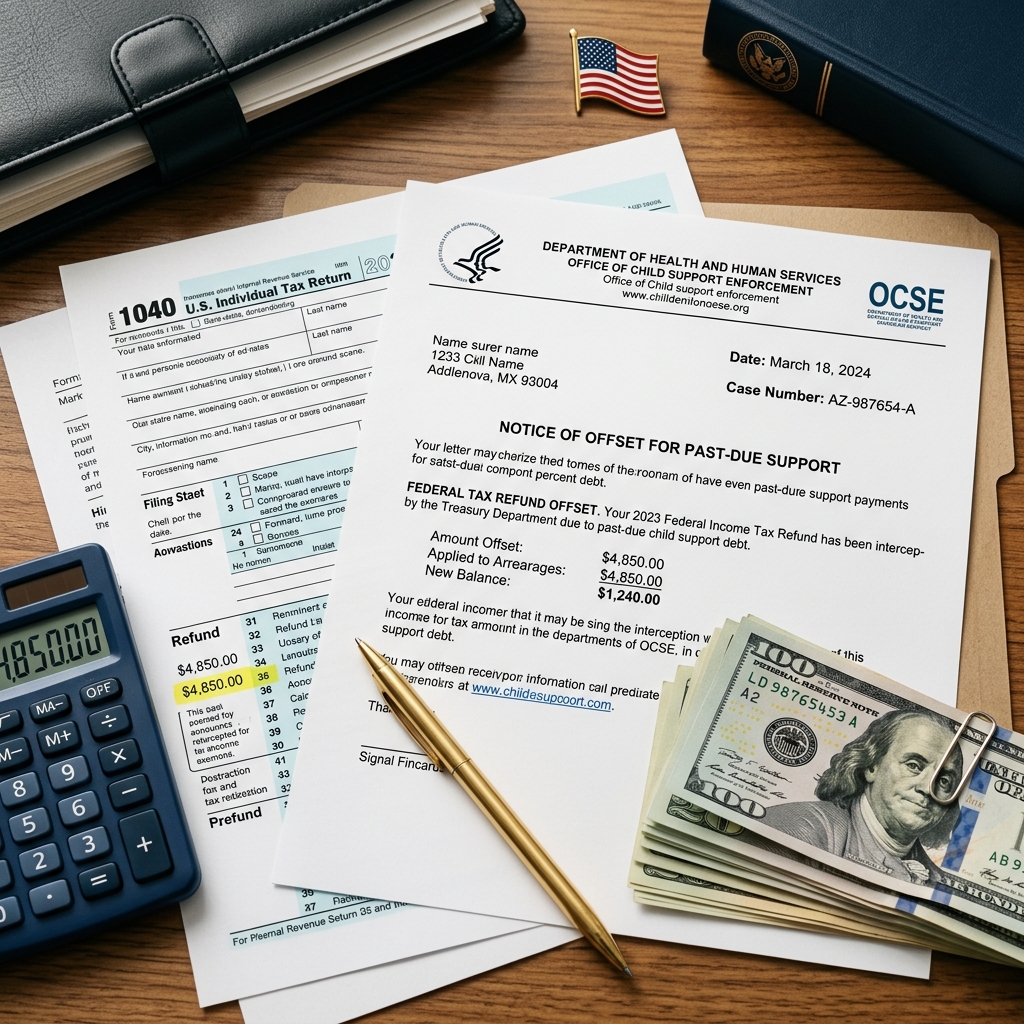
Parents who fall behind on child support often wonder whether their federal tax refund can be used, or taken, to pay those overdue amounts. In many cases, the answer is yes: federal and state agencies have legal authority to intercept tax refunds and apply them to child support arrears through what is commonly known as the federal tax refund offset program.
This article explains how that process works, the rules that determine who is eligible, how much can be taken, the types of notices you will receive, and what options both paying and receiving parents have if they disagree with an offset.
Child Support and Tax Refunds: The Big Picture
Child support is a court-ordered financial obligation intended to cover a child’s basic needs, including housing, food, health care, and education. When a parent does not pay as ordered, unpaid amounts accumulate as arrears. To enforce these obligations, state child support agencies use several collection tools, including wage garnishment, bank levies, and the interception of federal income tax refunds.
The federal tax refund offset program allows the government to:
- Match a taxpayer’s expected federal refund against records of past-due child support.
- Intercept part or all of that refund before it is paid out to the taxpayer.
- Forward the intercepted amount to the appropriate state child support agency, which then disburses funds according to federal and state rules.
As a result, tax season can be a critical moment for families struggling with unpaid child support—both for parents who owe support and for those waiting to receive it.
How the Federal Tax Refund Offset Program Works
The federal tax refund offset process involves coordination among several agencies. At the center is the U.S. Department of the Treasury, through the Treasury Offset Program (TOP), which collects delinquent debts owed to government agencies, including child support.
Step-by-Step Overview
Although details vary by state, the general sequence looks like this:
- 1. State child support agency identifies arrears. When a parent is behind on court-ordered child support, the agency tracks the past-due amount and determines whether it meets federal criteria for offset.
- 2. Case submitted to federal database. State agencies send information about eligible cases to the federal Office of Child Support Services (OCSS), including the parent’s name, Social Security number, and total arrears.
- 3. Pre-offset notice issued. Before any interception occurs, the parent who owes support typically receives a pre-offset notice explaining that the case has been submitted for federal tax refund offset and showing the amount of past-due child support.
- 4. IRS processes tax return. When the parent files a federal tax return and is due a refund, the IRS sends refund information to Treasury’s Bureau of the Fiscal Service (BFS).
- 5. Refund matched and intercepted. BFS compares the refund against records of debts in TOP. If there is a qualifying child support debt, BFS intercepts some or all of the refund and applies it toward the arrears.
- 6. Notice of offset. BFS sends a Notice of Offset to the taxpayer informing them that all or part of their federal tax refund has been used to pay child support.
- 7. Payment sent to state agency. The offset amount is forwarded to the state child support office, generally arriving within two to three weeks after interception.
- 8. Disbursement to the custodial parent or state. The state agency distributes the money, following federal rules that determine whether the funds go first to reimburse public assistance or directly to the parent owed support.
Throughout this process, the taxpayer remains entitled to certain notices and, in some cases, review or appeal rights if they believe the offset was incorrect.
Eligibility Thresholds for Tax Refund Interception
Not every past-due child support case automatically qualifies for federal tax refund offset. Federal law sets minimum arrears thresholds, and states may add their own criteria.
Federal Minimums
Under long-standing federal guidance, the offset program generally applies when:
- The child’s household has received Temporary Assistance for Needy Families (TANF)$150.
- The custodial parent has not received TANF, and the noncustodial parent’s arrears are at least $500.
These threshold amounts are reflected in multiple state-level descriptions of the program and help determine when a case can be submitted for federal offset.
Example State Criteria
States can refine these rules further. For instance, one state’s child support office explains that federal tax refund offset may be used when arrears surpass both a minimum dollar amount and at least one month of court-ordered support:
- $500 or more owed to the custodial parent in non-assistance cases.
- $150 or more owed to the state in cases involving public assistance.
The common theme is that the government generally reserves offset for cases with significant and documented arrears, rather than minor or short-term delinquencies.
Eligibility Table
| Case Type | Minimum Arrears for Offset | Who Can Receive Intercepted Funds |
|---|---|---|
| Public assistance (TANF) involved | Typically at least $150 in past-due support | First to state/federal government to reimburse assistance, then to custodial parent |
| No public assistance | Typically at least $500 in arrears | Primarily to custodial parent to cover unpaid child support |
| Arrears-only cases | Similar thresholds, often $150–$500 depending on who is owed | State agency follows same priority rules for distribution |
How Much of Your Refund Can Be Taken?
Once a case qualifies and is submitted, the Treasury Offset Program can intercept part or all of a federal tax refund to pay child support arrears.
Partial vs. Full Offset
When BFS processes the refund, it compares the refund amount to the outstanding child support debt record:
- If the refund is smaller than the arrears, the full refund may be intercepted and applied to the child support debt.
- If the refund is larger than the arrears, only the amount needed to cover the qualifying debt is intercepted, and any remaining refund is paid to the taxpayer.
According to official IRS guidance, federal tax refunds may be reduced not only for child support, but also for other debts such as overdue federal agency obligations and state income tax, meaning a single refund could be subject to multiple offsets.
Priority of Payments
When child support arrears involve both money owed directly to the custodial parent and amounts owed to the state or federal government (for example, to reimburse public assistance), federal law sets a payment order:
- First, arrears owed to state and federal governments are paid.
- Next, arrears owed directly to the custodial parent are covered.
- Any remaining refund amount is returned to the parent who owes support.
This order ensures that public assistance programs are reimbursed while still directing funds to the parent who has been waiting for unpaid child support.
What Notices You Will Receive
Parents whose refunds are intercepted are not supposed to be caught by surprise. Federal rules and state procedures require a series of notices.
Pre-Offset Notice
Before a case is certified for offset, the parent who owes support typically receives a pre-offset notice. This notice explains:
- That the case has been submitted to the federal tax refund offset program.
- The total amount of past-due support at the time of certification.
- Any rights to request a review or contest the calculated arrears.
- What may happen if the parent does not make payment arrangements or resolve the delinquency.
Notice of Offset from Treasury
After BFS intercepts a tax refund, it sends a formal Notice of Offset informing the taxpayer that part or all of their refund has been applied to child support.
According to IRS guidance on reduced refunds, taxpayers who see an unexpected decrease in their refund and do not receive a notice are instructed to contact the Bureau of the Fiscal Service using published phone numbers to request information.
State-Level Confirmation
Once the state child support office receives the offset funds—usually within two to three weeks—it may send additional communications to the custodial parent, confirming receipt and explaining when disbursement is expected.
Timing and Holding Periods
Timing is significant for both sides of a child support case. Parents who owe support want to know when funds will be taken; parents who are owed support want to know when they will receive payments.
Official federal guidance indicates:
- State child support offices typically receive offset funds within two to three weeks after interception.
- For refunds based on a non-joint tax return, states must generally disburse the offset amount within 30 days of receipt, absent special circumstances like a pending appeal.
- For refunds from a joint tax return, states may hold the offset for up to six months in order to address possible injured spouse claims and ensure the correct allocation of funds.
These timeframes help manage complex situations where multiple debts, tax filers, or appeals are involved.
Your Rights If You Disagree With an Offset
Although federal tax refund offsets are authorized by law, parents retain certain rights if they believe the offset is wrong or the arrears amount has been miscalculated.
Disputing the Debt
The IRS explains that taxpayers who disagree with a reduced refund decision may dispute the action by following instructions provided in the notice. In child support matters, this usually involves contacting the state child support agency that submitted the case, rather than the IRS directly.
Common issues that may justify a review include:
- Mistakes in the total arrears recorded by the state agency.
- Payments that were made but not properly credited.
- Questions about whether the case met federal thresholds for offset.
- Situations where the taxpayer believes they are not the correct person associated with the debt.
Injured Spouse Relief for Joint Returns
If a couple files a joint tax return and the refund is reduced to pay one spouse’s child support debt, the other spouse may be entitled to recover their share of the refund through an injured spouse claim.
In this scenario:
- The non-debtor spouse files the appropriate injured spouse form with the IRS.
- The IRS reviews the claim, determines what portion of the refund belongs to the injured spouse, and may issue a separate payment for that portion.
States may hold joint refund offsets for several months to allow time for these claims, which helps protect innocent spouses from losing their share of tax refunds due to child support debts they do not owe.
Impact of Policy Changes on Collection
The federal tax refund offset program is subject to policy and administrative changes that can affect how efficiently states collect and disburse child support.
For example, recent congressional commentary has highlighted concerns about an Internal Revenue Service policy change that limits the ability of states to use private contractors to access the offset program. Many states rely on contractors to administer enforcement systems and connect to federal databases; restrictions on these arrangements could make it more difficult to gather child support from tax refunds without additional state investment and planning.
Parents should be aware that such changes may influence the timing and consistency of offset-based payments, especially in states that depend heavily on contracted services for their child support programs.
Practical Tips for Parents Who Owe Child Support
If you are behind on child support and expecting a federal tax refund, it is important to understand how the offset program might affect you and what you can do to manage the situation.
- Check your arrears balance with your state child support agency before tax season. Knowing your status can help you anticipate whether an offset is likely.
- Review any pre-offset notices promptly. These notices explain the amount of arrears and inform you of your right to request corrections or reviews.
- Consider payment arrangements or modification requests if your financial situation has changed significantly. While this will not erase past arrears, it may help prevent further accumulation.
- Plan for a reduced refund if you meet federal thresholds for offset. Avoid relying on your entire refund for major expenses if you know you have significant past-due child support.
- Discuss joint filing implications with your spouse if you owe child support. Make sure they are aware that part of a joint refund could be intercepted and that injured spouse relief may be available.
Practical Tips for Parents Waiting on Child Support
For parents who are owed child support, tax refund offsets can provide a meaningful lump sum that helps cover overdue expenses for children.
- Confirm your case is open and in full-service status with your state child support agency, as some jurisdictions require an active enforcement case to distribute offset funds.
- Ask whether your case meets thresholds for federal offset, especially if you believe arrears exceed $500 or involve public assistance reimbursements.
- Monitor communications from the child support office around tax season, as they may notify you when an offset payment has been received and when it will be disbursed.
- Plan for variable timing. While funds usually reach state agencies within a few weeks, disbursement timeframes depend on whether the refund was joint or non-joint and whether any appeals or injured spouse claims are pending.
Frequently Asked Questions
Can I choose to send my federal tax refund directly to child support instead of having it intercepted?
Parents may voluntarily pay child support arrears using any funds, including a tax refund. However, the federal tax refund offset is a government-run process that occurs automatically once a case meets eligibility criteria and is certified. Sending voluntary payments does not stop offset unless the arrears are fully resolved and the state updates its records before the refund is processed.
Will every tax refund I receive be intercepted until my child support is current?
If your case remains eligible and is not withdrawn from the offset program, future federal tax refunds can continue to be intercepted until arrears are paid. The amount taken each year depends on both your refund and the remaining debt.
Are state tax refunds also subject to child support offsets?
Many states operate their own state tax refund offset programs that can intercept state income tax refunds for child support, but the rules vary by jurisdiction. The federal offset program discussed here applies specifically to federal income tax refunds.
Can stimulus or other federal payments be intercepted for child support?
Certain federal payments, including some past stimulus checks, have been subject to child support offset, while others have been protected by specific legislation. Rules differ based on the type of payment and the law in effect at the time, so parents should consult current guidance from their state child support agency or the IRS.
What if I never received a notice but my refund was reduced?
Official IRS instructions state that if you do not receive a notice but your refund is reduced, you should contact the Bureau of the Fiscal Service at the published phone numbers to find out which agency requested the offset and for what amount. You can then contact that agency—often your state child support office—to seek clarification or correction.
References
- Federal Income Tax Refunds and Child Support — Florida Department of Revenue Child Support Program. 2023-05-01. https://floridarevenue.com/childsupport/compliance/Pages/collections_income_tax_refunds.aspx
- Intercepting Tax Refunds for Child Support — LouisianaLawHelp.org. 2022-03-15. https://louisianalawhelp.org/resource/intercepting-tax-refunds-for-child-support
- How Does a Federal Tax Refund Offset Work? — U.S. Office of Child Support Services (ACF). 2021-08-10. https://acf.gov/css/faq/how-does-federal-tax-refund-offset-program-work
- Your Child Support, the Federal Stimulus Payments and Tax Returns — Texas Attorney General Child Support Division. 2021-03-30. https://www.texasattorneygeneral.gov/child-support/your-child-support-federal-stimulus-payments-and-tax-returns
- Federal Tax Refund Offset — Minnesota Department of Children, Youth, and Families. 2023-02-20. https://dcyf.mn.gov/federal-tax-refund-offset
- Reduced Refund — Internal Revenue Service. 2023-01-05. https://www.irs.gov/refunds/reduced-refund
- Treasury Offset Program — U.S. Bureau of the Fiscal Service, Debt Management Services. 2022-11-01. https://fiscal.treasury.gov/debt-management/treasury-offset-program-top
Similar Articles








Read full bio of medha deb


