
Understanding New York Criminal Trespass Laws
A practical guide to New York trespass and criminal trespass charges, penalties, and legal defenses for property-related offenses.
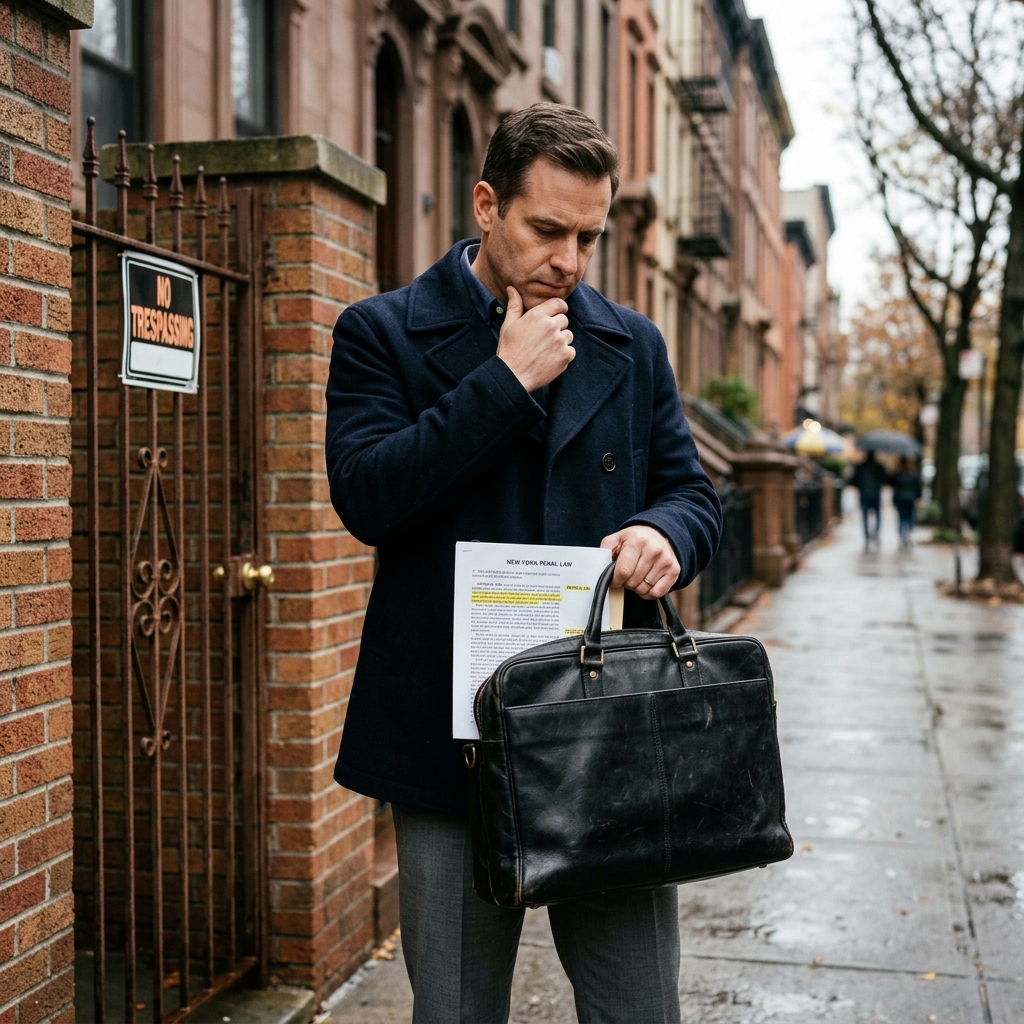
New York treats trespass and criminal trespass as important nonviolent property offenses that can lead to arrest, prosecution, and a permanent criminal record. While these charges may seem minor compared to violent crimes, they often carry jail exposure, fines, and serious long-term consequences for employment, housing, and immigration.
This guide explains how New York law defines trespass, the different degrees of criminal trespass, what counts as “unlawful” entry or remaining, the typical penalties, and common defense strategies. It is based primarily on New York Penal Law Article 140 and related official materials, translated into practical terms for non-lawyers.
Overview of Trespass vs. Criminal Trespass in New York
New York divides property entry offenses into two broad categories:
- Simple trespass (NY Penal Law § 140.05) – a lower-level offense classified as a violation, not a crime.
- Criminal trespass (NY Penal Law §§ 140.10, 140.15 and related sections) – higher-level offenses classified as misdemeanors, with three degrees based on the type of property and circumstances.[10]
All of these offenses share a core idea: a person knowingly enters or stays on premises where they do not have legal permission, also called being there “unlawfully.”
Key Legal Concepts Under Article 140
Before looking at each degree of trespass, it is helpful to understand some recurring terms that appear throughout New York Penal Law Article 140.
Unlawfully Entering or Remaining
Across trespass statutes, the person must enter or remain “unlawfully” on the property. New York law uses this word to describe being on property without license or privilege
Permission can come from:
- The owner or lawful occupant
- A lease or rental agreement
- A public right of access (for example, open public parks within posted hours)
- Specific written or posted rules that allow entry
If someone is invited, has a right to be on the property, or is otherwise authorized, their presence is generally not “unlawful.” Conversely, ignoring posted rules or a clear request to leave can turn otherwise lawful presence into trespass.
Knowingly: Mental State Requirement
All New York trespass crimes require that the person acts knowingly. This means they are aware of their conduct—entering or staying—and aware of the circumstances that make it unlawful, such as locked fences, posted signs, or explicit instructions not to enter.
Situations that may raise questions about this mental state include:
- Mistaken belief that they had permission to be there
- Confusion about property boundaries, especially in rural or multi-unit buildings
- Language barriers preventing someone from understanding warnings or signs
In court, prosecutors must prove this “knowing” element beyond a reasonable doubt.
Premises vs. Building vs. Dwelling
New York law uses several property-related terms, each with different consequences:
- Premises – a broad term that can include land, buildings, and other property.
- Building – any structure, not limited to homes; could include schools, offices, stores, and public housing.[10]
- Dwelling – a building used for lodging, typically a place where someone resides overnight, such as a house or apartment.
Trespass involving a dwelling is treated more seriously than trespass on open land or other buildings because it affects where people live and sleep.
Simple Trespass: NY Penal Law § 140.05
Trespass under NY Penal Law § 140.05 is the most basic form of the offense. A person is guilty when they knowingly enter or remain unlawfully in or upon premises.
Classification and Penalties
Simple trespass is classified as a violation, not a misdemeanor or felony. Violations are lower-level offenses under New York law, similar to noncriminal infractions.
Typical maximum penalties for violations in New York include:
- Up to 15 days in jail
- Modest fines (often up to a few hundred dollars)
- Conditional discharge or community-based sentences instead of jail
Although this is the least serious trespass charge, it can still result in a record and may appear in background checks.
Examples of Simple Trespass
Common scenarios that may lead to a simple trespass charge include:
- Walking on private property after being told to leave
- Remaining in a business after closing time when asked to exit
- Entering posted private areas in an apartment complex or office building without authorization
When property falls into special categories—such as fenced land, schools, railroad yards, or housing projects—the facts may support a criminal trespass charge instead.
Criminal Trespass in the Third Degree: NY Penal Law § 140.10
Criminal trespass in the third degree is the lowest criminal level of trespass and is defined in NY Penal Law § 140.10.[10] A person commits this offense when they knowingly enter or remain unlawfully in a building or on real property that meets specific conditions.
Situations Covered by Third Degree Criminal Trespass
Third degree criminal trespass applies when the property is:
- Fenced or enclosed in a way designed to keep intruders out, such as locked gates or perimeter fencing.[10]
- Used as an elementary or secondary school or certain camps, where entry violates conspicuously posted rules or regulations.
- A public housing project, where entry or remaining violates posted rules or a direct request from authorized personnel to leave.
- Certain railroad yards, which are restricted for safety and security reasons.
In many of these situations, the law specifically mentions either posted rules or a personally communicated request to leave. Ignoring these notices or requests can transform a simple trespass into a criminal trespass charge.
Penalties for Third Degree Criminal Trespass
Criminal trespass in the third degree is a class B misdemeanor under New York law.[10] Class B misdemeanors generally carry:
- Up to 90 days in jail
- Potential fines
- Probation or conditional discharge instead of jail time in many cases
A conviction at this level creates a criminal record, which can affect future job applications, licensing, and other opportunities.
Criminal Trespass in the Second Degree: NY Penal Law § 140.15
Criminal trespass in the second degree is more serious than third degree and focuses primarily on trespass in dwellings and certain cases involving registered sex offenders and schools.
Core Definition
Under NY Penal Law § 140.15, a person is generally guilty of criminal trespass in the second degree if they:
- Knowingly enter or remain unlawfully in a dwelling; or
- In certain circumstances, as a level 2 or 3 sex offender, enter a school attended by their victim without legitimate justification.
New York defines a dwelling as a building used for lodging—essentially a place where people live, such as houses or apartments, and sometimes shared living structures.
Why Dwelling Trespass Is Treated More Harshly
Trespassing in a dwelling is treated more seriously because it directly affects the privacy and security of people’s homes. Even if no other crime occurs, entering a home without permission can be highly intrusive and frightening for residents.
Penalties for Second Degree Criminal Trespass
Criminal trespass in the second degree is a class A misdemeanor. New York class A misdemeanors carry:
- Up to one year in jail
- Possible fines
- Probation (often up to three years) as an alternative to jail in some cases
Because this is a higher-level misdemeanor, conviction can have substantial collateral consequences, including problems obtaining housing, professional licenses, or certain government benefits.
Comparison of New York Trespass Offenses
The table below compares three key trespass-related offenses under New York law.
| Offense | Statute | Type of Property | Classification | Max Jail Exposure |
|---|---|---|---|---|
| Simple Trespass | NYPL § 140.05 | Premises (general) | Violation | Up to 15 days |
| Criminal Trespass 3rd Degree | NYPL § 140.10 | Fenced/enclosed land, schools, camps, railroad yards, public housing | Class B misdemeanor | Up to 90 days |
| Criminal Trespass 2nd Degree | NYPL § 140.15 | Dwelling; certain school situations involving sex offenders | Class A misdemeanor | Up to 1 year |
Defenses Commonly Raised in New York Trespass Cases
Every trespass case turns on its specific facts, but several recurring defense themes appear in New York practice.
Lack of Unlawful Status
One major defense is that the defendant was not on the property unlawfully. This may involve showing that:
- They had permission from the owner, tenant, or person in charge.
- They were an invited guest who had not clearly been asked to leave.
- They had a legal right to be there, such as an easement, lease, or job assignment.
Evidence might include text messages, emails, building access records, or witness testimony confirming consent.
Lack of Knowledge or Intent
Because trespass charges require that the person acted knowingly, a defense may focus on the absence of that mental state. For example:
- The person reasonably believed the area was open to the public.
- Signs or fences were not clearly visible or understandable.
- Someone else assured them they were allowed to enter.
These arguments challenge whether the prosecution can prove awareness of unlawful entry beyond a reasonable doubt.
Challenging Property Classification
In criminal trespass cases, the specific type of property often determines the degree of the charge. Defense lawyers may argue that:
- A building is not a dwelling as defined by law (for example, it is vacant or not used for lodging).
- Land is not properly fenced or enclosed in a way “designed to exclude intruders.”[10]
- A structure does not qualify as a school or camp under the relevant statutes.
Successfully challenging property classification can reduce a charge from a more serious degree to a less serious one, or occasionally lead to dismissal.
Compliance with Requests and Rules
Many third-degree trespass cases hinge on whether a person ignored conspicuously posted rules or a direct request to leave. Evidence that the person:
- Left promptly when asked
- Was not clearly told to leave
- Did not see or reasonably could not see posted rules
may support dismissal or reduction of charges.
Practical Tips to Avoid Trespass Charges in New York
Staying informed and cautious can greatly reduce the risk of trespass accusations. Practical steps include:
- Observe signs and barriers – Respect “No Trespassing,” “Private Property,” and similar warnings, as well as locked gates and fences.
- Ask for permission – When in doubt, seek explicit permission from owners or staff before entering restricted areas.
- Leave when requested – If a property owner, security officer, principal, or housing authority asks you to leave, comply promptly.
- Understand building rules – Many schools, public housing complexes, and transit facilities have specific entry rules posted on-site.
Frequently Asked Questions (FAQ)
Is simple trespass in New York a crime?
No. Simple trespass under NY Penal Law § 140.05 is a violation, not a misdemeanor or felony. However, it is still enforceable and can lead to arrest and short jail sentences.
What is the difference between trespass and criminal trespass?
Both involve entering or remaining unlawfully, but criminal trespass applies in more serious situations—such as fenced property, schools, railroad yards, public housing, or dwellings—and is charged as a misdemeanor. Simple trespass is a lower-level violation affecting more general premises.[10]
Does ignorance of posted rules protect me from criminal trespass charges?
Not necessarily. While lack of knowledge may be a defense in some cases, New York courts often treat clearly visible and conspicuously posted rules as adequate notice. Whether you “knowingly” violated those rules depends on the particular facts.
How serious is criminal trespass in the second degree?
Second degree criminal trespass is a class A misdemeanor, punishable by up to one year in jail and possible probation. Because it generally involves dwellings or sensitive circumstances, courts treat it more seriously than lower degrees.
Should I speak to a lawyer if I am charged with trespass?
Yes. Even violation-level charges can have long-term consequences, and misdemeanor convictions create a criminal record. A licensed New York criminal defense lawyer can assess the evidence, explain your options, and help protect your rights.
References
- New York Penal Law § 140.05 Trespass — New York State Senate. Accessed 2024-05-01. https://www.nysenate.gov/legislation/laws/PEN/140.05
- New York Penal Law § 140.10 Criminal Trespass in the Third Degree — New York State Senate. Accessed 2024-05-01. https://www.nysenate.gov/legislation/laws/PEN/140.10
- New York Consolidated Laws, Penal Law § 140.10 — FindLaw. Updated 2023-08-10. https://codes.findlaw.com/ny/penal-law/pen-sect-140-10/
- NY Penal Law § 140.15: Criminal Trespass in the Second Degree — 1800nynylaw.com. Accessed 2024-05-01. https://criminaldefense.1800nynylaw.com/new-york-penal-code/new-york-penal-law-140-15-criminal-trespass-in-the-second-degree/
- NY Penal Law § 140.10: Criminal Trespass in the Third Degree — 1800nynylaw.com. Accessed 2024-05-01. https://criminaldefense.1800nynylaw.com/new-york-penal-code/new-york-penal-law-140-10-criminal-trespass-in-the-third-degree/
- New York Trespassing Crimes (NY PL 140.10, 140.15) — Saland Law PC. Accessed 2024-05-01. https://www.new-york-lawyers.org/practice-areas/ny-state-criminal-defense/non-violent-property-crimes/new-york-trespassing-crimes-ny-pl-140-10-140-15/
- New York Penal Law § 140.05 – Trespass — Tilem & Associates, PC. Accessed 2024-05-01. https://www.tilemlawfirm.com/new-york-crimes-by-penal-code/new-york-penal-law-140-05-trespass/
Similar Articles








Read full bio of medha deb




