
Illegal Worker Hiring: Employer Rules and Risks
A practical overview of employer obligations, penalties, and worker rights under U.S. hiring law.
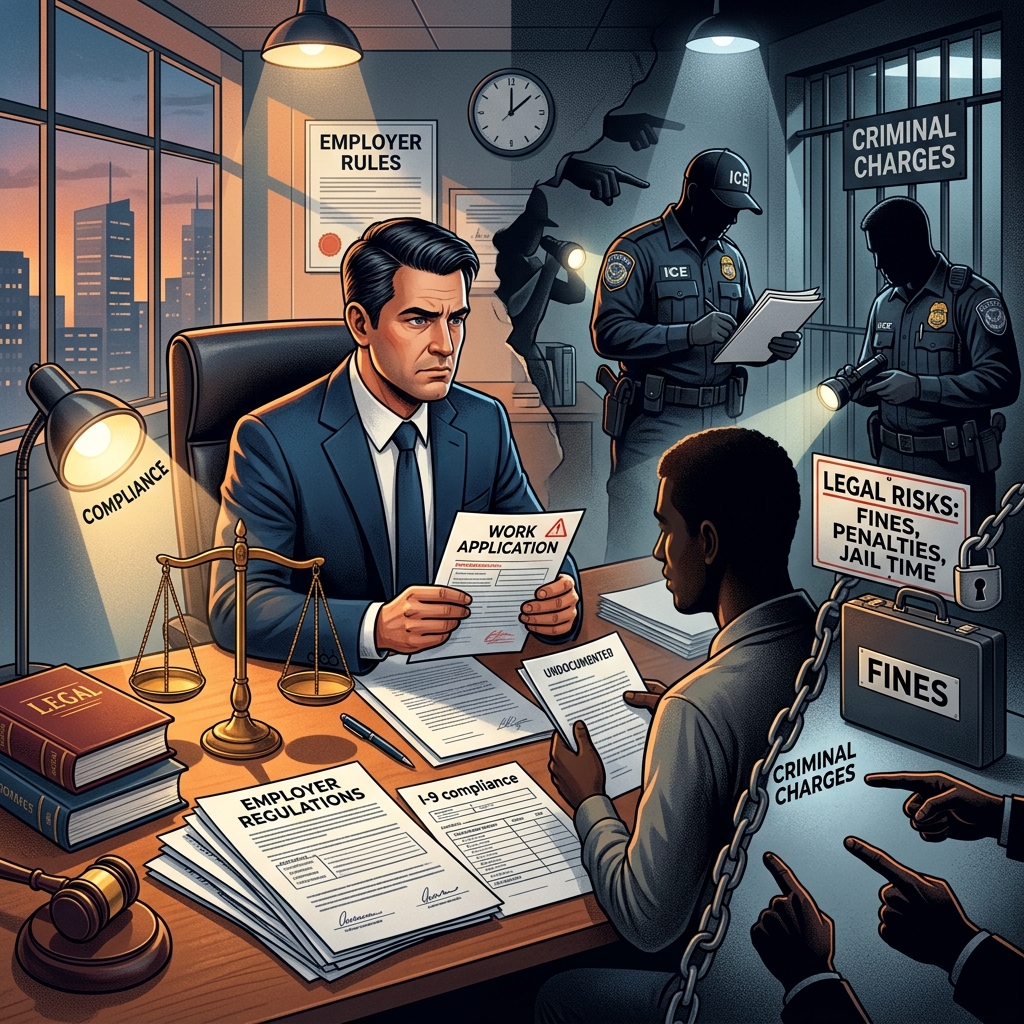
U.S. employment law places strong limits on hiring workers who are not authorized to work, but it also places clear responsibilities on employers during the hiring and verification process. The legal system does not treat immigration status as the only issue in the workplace; wage laws, anti-discrimination rules, and retaliation protections may still apply even when a worker lacks proper authorization. Federal law also creates significant civil and criminal exposure for employers who knowingly hire or continue to employ unauthorized workers.
This article explains the core rules that govern hiring, the verification steps employers are expected to follow, the consequences of noncompliance, and the workplace rights that may remain available to undocumented workers. It is intended as a practical overview rather than legal advice.
What the law generally prohibits
Federal law makes it unlawful for a person or business to hire, recruit, or refer for employment an alien knowing that the person is not authorized to work in the United States. The same law also prohibits an employer from continuing to employ a worker after learning that the worker is unauthorized. In other words, the legal duty is not limited to the day of hiring; it can also arise later if the employer learns that the employee is no longer permitted to work.
The legal standard matters. A violation is typically tied to knowledge, not mere suspicion. That is why employers are expected to follow the federal employment verification process carefully and in good faith.
How employers verify work authorization
At the start of employment, employers must complete the federal Form I-9 process to confirm identity and work authorization. The worker must attest, under penalty of perjury, that they are a U.S. citizen, a lawful permanent resident, or otherwise authorized to work. The form may be completed with a handwritten or electronic signature.
For employers, the practical goal is to review documents that reasonably appear to be genuine and relate to the person presenting them. Common examples include a passport, permanent resident card, employment authorization document, or a combination of documents establishing identity and work eligibility.
- Employers should complete the I-9 for each new hire.
- Employers should examine documents in a consistent manner.
- Employers should avoid requesting more documents than the law requires.
- Employers should keep I-9 records organized and available for inspection if needed.
Good-faith compliance with the verification rules can matter a great deal if an employer is later investigated. Under federal law, compliance with the employment verification system can serve as an affirmative defense in certain situations.
Paperwork problems versus knowing violations
Not every hiring mistake is treated the same way. Some violations involve paperwork errors rather than proof that the employer knowingly hired an unauthorized worker. Those errors can still result in civil fines, but the penalties are usually different from penalties for intentional misconduct.
Federal enforcement distinguishes between the failure to properly complete or retain employment verification records and the act of knowingly employing a person who is not authorized to work. This distinction is important because the government may impose lighter penalties for paperwork violations while reserving steeper sanctions for employers who ignored the law or acted with actual knowledge.
| Type of problem | General legal focus | Possible consequence |
|---|---|---|
| Paperwork mistake | Form completion or recordkeeping failure | Civil fines per affected worker |
| Knowing hire | Employer knew worker lacked authorization | Higher civil penalties and possible criminal exposure |
| Pattern or practice | Repeated or systematic violations | Enhanced penalties and potential imprisonment |
Possible civil penalties for employers
Employers who violate federal hiring rules may face civil penalties that vary depending on the nature of the violation and the employer’s history. Fines for knowingly hiring unauthorized workers can increase based on repeat offenses. In some situations, penalties for paperwork violations are lower but still significant.
The precise amount depends on the statute, the number of affected workers, and whether the conduct is part of a repeated or systematic practice. Because fines may be adjusted and enforcement can evolve, employers should treat compliance as an ongoing obligation rather than a one-time administrative task.
When criminal liability can apply
Criminal liability is reserved for more serious conduct, especially when the government can prove actual knowledge and a broader pattern of unlawful hiring. Federal law states that a person or entity engaging in a pattern or practice of violations may face fines and imprisonment. For certain crimes tied to knowingly hiring at least 10 unauthorized workers during a 12-month period, the penalties can include up to five years in prison.
This is a much higher threshold than a simple documentation error. Prosecutors must prove the required mental state, and in criminal cases the standard is proof beyond a reasonable doubt. That higher burden reflects the seriousness of the accusation and the potential for incarceration.
Do undocumented workers have any workplace rights?
Yes. Immigration status does not erase all workplace protections. Multiple legal sources note that undocumented workers generally retain many of the same basic labor rights as other workers, including wage protections and anti-discrimination safeguards.
That means an employer usually cannot use undocumented status as a reason to ignore minimum wage obligations, refuse legally required pay, or engage in prohibited discrimination. Workers may still have the right to complain about unpaid wages, unsafe conditions, or discrimination based on protected traits.
- Wage and hour laws may still apply.
- Anti-discrimination rules may still apply.
- Retaliation for asserting rights may be unlawful.
- Some remedies may be limited by the worker’s immigration status.
What rights may be limited by immigration status
Although many workplace protections remain available, immigration status can affect certain remedies. For example, some sources explain that workers without authorization may not be entitled to back pay after unlawful termination, and they may not be able to be reinstated to a position that requires valid work authorization. Unemployment benefits may also be unavailable where the worker is not legally able to work and therefore not considered available for work under the applicable agency rules.
These limits do not mean the worker has no rights at all. Instead, they show that employment remedies in immigration-related disputes can be narrower than in ordinary wrongful termination cases.
Employer caution: verification must not become discrimination
Employers must verify work authorization, but they also must avoid discriminatory hiring practices. Federal rules prohibit unfair treatment based on protected characteristics, including national origin and citizenship status in certain contexts. Overly aggressive document demands, selective scrutiny, or different treatment based on a worker’s accent, appearance, or ancestry can create separate legal problems.
In practice, the safest approach is to apply the same document-review procedures to every new hire and to avoid asking for extra immigration information unless the law specifically requires it. Employers should not treat the I-9 process as permission to pry into a worker’s immigration history.
Practical compliance steps for employers
Employers reduce risk by building a consistent onboarding process and training managers who handle hiring. A lawful process is usually more effective than a reactive one, because many enforcement problems arise from weak recordkeeping or uneven treatment rather than from a single obvious violation.
- Train hiring staff on acceptable I-9 procedures.
- Use the same onboarding checklist for every new employee.
- Review documents only to the extent the law allows.
- Fix errors promptly when they are discovered.
- Keep internal records secure and organized.
- Seek legal review before terminating a worker based on suspected status issues.
Employers should also remember that continued employment can become unlawful if they later learn a worker is unauthorized. A process that was acceptable at hiring can become problematic if the employer ignores new information.
Common questions about illegal worker hiring
Can an employer hire someone before checking immigration documents? No. Employers are expected to complete the federal verification process after hiring and within the time allowed by law.
Must an employer immediately fire a worker who is found to be unauthorized? If the employer has authoritative evidence that the worker is not authorized to work, federal law may require the employer to stop employing that person. Employers should handle this carefully because discrimination and retaliation issues can also arise.
Can undocumented workers sue for unpaid wages? In many cases, yes. Workers may still pursue wage claims and other labor protections, depending on the facts and the forum.
Is a paperwork mistake the same as knowingly hiring an unauthorized worker? No. The law treats those problems differently, and intentional knowledge generally creates more serious exposure.
Can an employer ask for more documents just to be safe? Not indiscriminately. The verification process must be handled consistently and without unnecessary document requests that could become discriminatory.
Why this issue matters for both employers and workers
Hiring rules involving unauthorized workers sit at the intersection of immigration enforcement, employment compliance, and workplace rights. Employers face penalties if they ignore verification duties or knowingly hire unauthorized workers, but workers may still have protections against wage theft, discrimination, and retaliation. That combination makes the topic more nuanced than a simple yes-or-no rule about whether someone can be employed.
For employers, the main lesson is that compliance must be systematic. For workers, the main lesson is that lack of work authorization does not necessarily erase every legal remedy. The law draws a line between the right to work and the right to be treated lawfully while working.
References
- Civil and Criminal Penalties for Hiring Illegal Workers — Federal Lawyer. 2025-01-01. https://federal-lawyer.com/civil-and-criminal-penalties-for-hiring-illegal-workers/
- 8 U.S.C. § 1324a: Unlawful employment of aliens — U.S. House of Representatives, Office of the Law Revision Counsel. 2026-07-10. https://uscode.house.gov/view.xhtml?req=granuleid:USC-prelim-title8-section1324a&num=0&edition=prelim
- Employment Rights of Undocumented Workers — Texas Law Help. 2025-01-01. https://texaslawhelp.org/article/employment-rights-of-undocumented-workers
- 11.8 Penalties for Prohibited Practices — U.S. Citizenship and Immigration Services. 2026-07-10. https://www.uscis.gov/i-9-central/form-i-9-resources/handbook-for-employers-m-274/110-unlawful-discrimination-and-penalties-for-prohibited-practices/118-penalties-for-prohibited-practices
- Employment Rights of Undocumented Workers — Legal Aid at Work. 2025-01-01. https://legalaidatwork.org/factsheet/employment-rights-of-undocumented-workers/
- Your Rights as an Undocumented Worker — Fresno State Career Center. 2024-10-21. https://careercenter.fresnostate.edu/blog/2024/10/21/your-rights-as-an-undocumented-worker/
- Protecting Workers — National Employment Law Project. 2026-07-10. https://www.nelp.org/explore-the-issues/immigrant-workers/
Similar Articles








Read full bio of Sneha Tete




