
Understanding Contract Breaches: Key Questions Answered
Clear answers to common questions about contract breaches, types, defenses, and remedies for businesses and individuals.
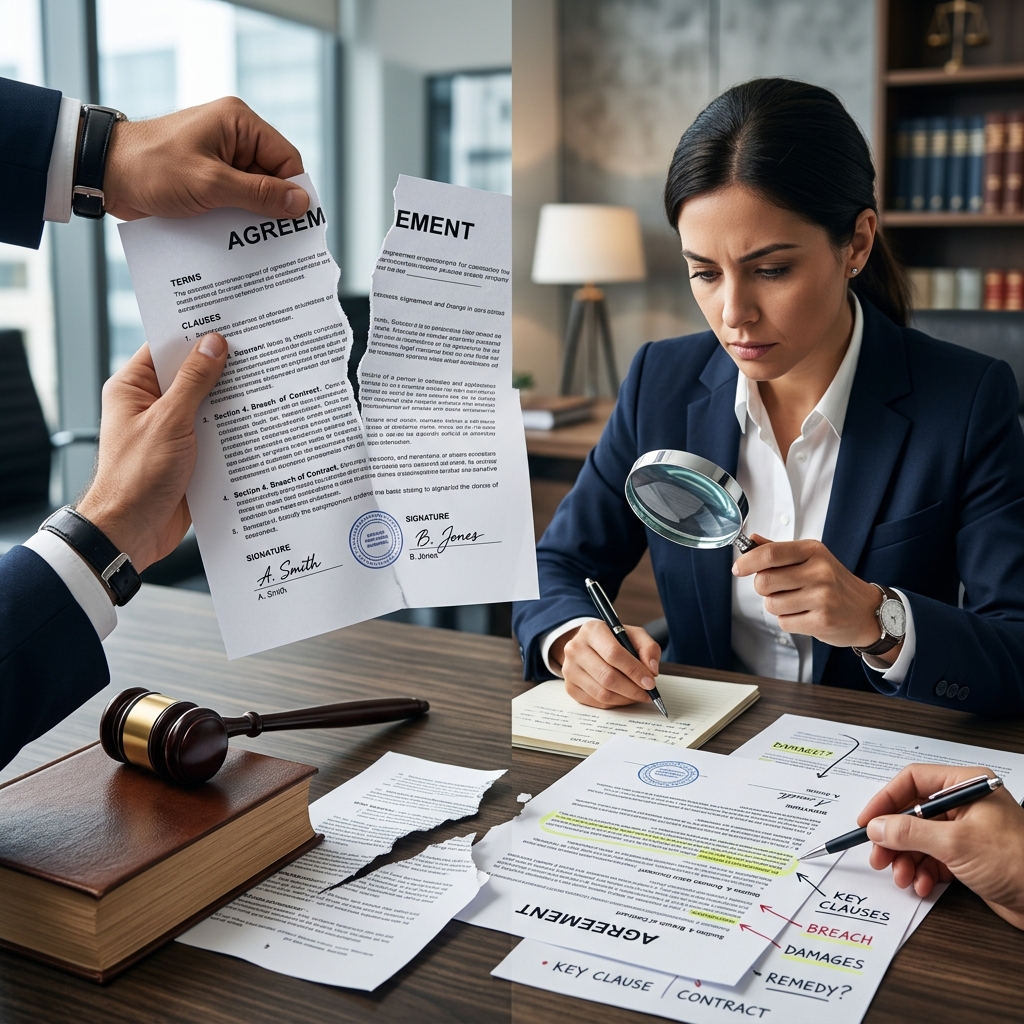
Contracts are meant to bring clarity and predictability to agreements. When one party fails to live up to what was promised, a breach of contract may occur, opening the door to negotiation, formal dispute resolution, or litigation. This article answers common questions about contract breaches, explains the major types of breach, and outlines defenses and remedies so you can better understand your rights.
1. What Is a Breach of Contract?
A breach of contract happens when a party fails to perform a duty required by a valid, enforceable agreement, without a legal excuse, and the other party suffers harm as a result. That failure can involve not doing the promised work, doing it late, doing it poorly, or refusing to pay for goods or services.
For a breach claim to make sense, there generally must be:
- A valid contract with an offer, acceptance, and consideration (an exchange of value).
- Failure to perform a contractual obligation without justification.
- Actual harm or damages suffered by the non-breaching party.
Absent these elements, you may have a business dispute or poor performance, but not necessarily a legally actionable breach.
2. Core Elements of an Enforceable Contract
Before discussing breach, it helps to understand what makes an agreement enforceable in court. According to state court guidance, a contract usually needs several basic elements to be legally binding.
- Mutual agreement: Both parties must agree to be bound by the same essential terms.
- Offer and acceptance: One party makes a clear offer; the other clearly accepts it.
- Consideration: Each side gives or promises something of value (money, services, goods, or a forbearance).
- Legal capacity: Parties must have the legal ability to contract (for example, not be minors or mentally incompetent).
- Legal purpose: The contract must not require illegal actions or violate public policy.
If any of these are missing or seriously defective, the alleged contract may be void or voidable, and a breach claim can fail.
3. Types of Contract Breach Explained
Not all breaches are equal. The law distinguishes several types, which affect what remedies may be available and whether the non-breaching party must continue performing.
3.1 Material vs. Minor Breach
| Type of Breach | Definition | Typical Impact |
|---|---|---|
| Material breach | A serious failure that undermines the core purpose of the contract. | Non-breaching party may stop performance and seek full remedies, including damages or termination. |
| Minor (partial) breach | A less significant deviation from the terms that does not destroy the essence of the bargain. | Contract typically continues; non-breaching party may recover limited damages for the shortfall. |
A missed minor deadline that causes no real harm is often treated as a minor breach. Nonpayment, delivery of entirely different goods, or refusal to perform key services may be considered material.
3.2 Anticipatory vs. Actual Breach
Breaches are also distinguished by timing:
- Actual breach: The deadline or performance date arrives, and a party fails to perform as promised.
- Anticipatory breach: Before performance is due, a party signals it will not perform, or takes actions making performance impossible. The non-breaching party may treat this as a breach and pursue remedies once the repudiation is clear.
Anticipatory breach can occur through explicit statements (“We will not deliver”), or conduct that clearly shows performance will not happen.
3.3 Mutual Rescission and Contract Exit
Sometimes both sides decide to unwind the agreement instead of fighting about breach. Mutual rescission is a situation where both parties agree to cancel the contract and release each other from further obligations. In effect, they “agree not to agree” and may also settle any outstanding issues in the same document.
4. Common Real-World Breach Scenarios
Breaches can arise in many contexts. Some frequently seen patterns include:
- Failure to perform services: A contractor never starts work or abandons the project midstream.
- Defective or incorrect goods: Delivered goods do not match contract specifications or quality standards.
- Late performance: Work is completed after the deadline where timing was critical to the agreement.
- Nonpayment: A customer fails to pay for services or goods within the agreed time frame.
- Violation of specific terms: A party ignores confidentiality provisions, non-compete clauses, or other key promises.
Identifying the precise obligation that was violated is crucial. Courts look closely at the language of the contract and the surrounding circumstances to determine whether a breach occurred and whether it was material.
5. How Do You Prove a Breach of Contract?
If a dispute escalates to court, the party claiming breach must prove each element of their cause of action. Typical elements include:
- The existence of a valid contract (written or oral), including essential terms.
- Your own performance or valid excuse for nonperformance (e.g., the other party’s prior material breach).
- The other party’s failure to perform a contractual duty.
directly caused by the breach.
Court systems emphasize the importance of collecting evidence, such as the contract text, invoices, email communications, pictures of defective work, and witness statements, to support each element.
6. Common Defenses to Breach of Contract Claims
The accused party may raise defenses that challenge either the existence of a valid contract or the allegation of breach. Some widely recognized defenses include:
- No breach occurred: The defendant argues that they did perform as required or that the plaintiff misunderstood the agreement.
: The plaintiff materially breached first, excusing the defendant’s performance. - Indefinite or incomplete terms: The contract is too vague to enforce, or essential terms were never agreed upon.
- Lack of capacity: One party lacked legal ability to contract (e.g., because of minority or serious mental impairment).
- Fraudulent inducement: The defendant was tricked into signing by misrepresentations.
- Unconscionability: The terms are so one-sided and harsh that enforcement would be unjust.
- Illegality: The contract involves conduct that is illegal or violates public policy, making it void.
- Statute of limitations: The lawsuit was filed after the legally prescribed deadline, so the claim is time-barred.
Each jurisdiction’s rules differ, so the viability of these defenses depends on local law and the specific facts.
7. Statutes of Limitations: How Long Do You Have to Sue?
The statute of limitations sets the maximum time after a breach occurs during which a lawsuit may be filed. Missing the deadline can result in dismissal of the case even if the underlying claim is strong.
Time limits vary by state and by whether the contract is written or oral. For example:
- In one large state court system, written contract claims generally must be filed within four years, and oral contract claims within two years of the breach.
- In many commercial contexts, written contracts may have longer limitation periods than verbal agreements, but exact rules depend on local statutes.
These references illustrate that limitation periods are jurisdiction-specific; consulting the statute in your state or a local attorney is essential.
8. Legal Remedies for Breach of Contract
If a breach is proven, the law provides several remedies. The goal is generally to place the non-breaching party in the position they would have been in had the contract been properly performed.
8.1 Damages (Financial Compensation)
Damages are the most common remedy in breach of contract cases. Major categories include:
- Compensatory damages: Money to cover direct losses and costs caused by the breach, restoring the expected benefit of the bargain.
- Consequential damages: Additional losses that flow from the breach, such as lost profits from a collateral contract, if these were reasonably foreseeable.
- Liquidated damages: A specific amount stated in the contract to be paid if breach occurs, enforceable when reasonable and not a penalty.
- Punitive damages: Damages meant to punish wrongdoing; these are rare in contract cases and typically reserved for egregious conduct, such as bad faith by an insurer.
8.2 Equitable Remedies
Sometimes money is inadequate to fix the harm. Courts may award equitable remedies where appropriate:
- Specific performance: A court order requiring the breaching party to perform the contract as promised, often used when the subject matter is unique (e.g., real estate).
- Rescission: Canceling the contract and restoring the parties to their pre-contract positions, often used where there was misrepresentation or fundamental problems with the agreement.
- Restitution: Returning benefits unjustly retained by the breaching party, ensuring they are not enriched at the other party’s expense.
9. Practical Steps If You Suspect a Breach
Whether you are a business or an individual, taking structured steps can protect your rights and improve your position if a breach occurs.
- Review the contract thoroughly: Confirm the obligations, deadlines, and any clauses about notice, dispute resolution, or limitations of liability.
- Document everything: Keep emails, letters, invoices, photos, and notes of conversations. Strong documentation is crucial evidence if the dispute proceeds.
- Send formal notice of breach: Many contracts require written notice and an opportunity to cure before legal action. A clear letter can also spur settlement.
- Consider negotiation or mediation: Informal resolution is often faster and less expensive than litigation.
- Consult a lawyer: An attorney can evaluate the strength of your claim or defenses, explain local law, and help you decide whether to sue or settle.[10]
10. Frequently Asked Questions (FAQs)
10.1 Is every broken promise a breach of contract?
No. A breach requires a valid, enforceable contract and a failure to perform a contractual duty. Casual statements or agreements without essential elements like consideration or definite terms may not be enforceable.
10.2 Can an oral contract be breached?
Yes. Oral agreements can be enforceable if they meet contract requirements, though proving their terms is often harder. Statutes of limitations for oral contracts are typically shorter than for written contracts.
10.3 What if both sides agree to end the contract?
If both parties voluntarily agree to cancel the contract, this is mutual rescission. The parties generally release each other from future obligations, and disputes may be resolved in the rescission agreement itself.
10.4 Do I always have to go to court?
No. Many breach disputes are resolved through direct negotiation, mediation, or arbitration, especially when contracts contain alternative dispute resolution clauses. Litigation is usually a last resort due to time and cost.
10.5 How do courts calculate damages?
Courts typically aim to put the injured party in the financial position they would have occupied if the contract had been properly performed. They consider direct losses, foreseeable consequential damages, and any agreed liquidated damages, subject to legal limits.
10.6 When should I contact a breach of contract lawyer?
You should consider legal advice if the alleged breach involves substantial money, affects your business operations, concerns complex terms, or if you have received a demand letter or lawsuit. Lawyers can also help you evaluate whether you have strong defenses and what remedies are realistic.[10]
References
- When a contract is broken (breach of contract) — Judicial Branch of California. 2023-06-01. https://selfhelp.courts.ca.gov/civil-lawsuit/breach-contract
- Breach of Contract: Causes & How to Respond — Keough Law. 2024-02-15. https://www.keough-law.com/blog/common-causes-of-breach-of-contract-and-how-to-address-them
- The 4 Types of Breach of Contract: Explained with Examples — Sirion. 2023-10-10. https://www.sirion.ai/library/contract-management/types-of-breach-of-contract/
- Breach of Contract in Business & Commercial Collection Cases — SAI Law & Consulting. 2022-09-20. https://www.sai-legal.com/commercial-collections/breach-of-contract/
- Common Contract Questions & FAQ — USLegal. 2021-05-01. https://contracts.uslegal.com/most-frequently-asked-questions/
- Common Defenses in Breach of Contract Cases — New York City Bar Association. 2022-03-01. https://www.nycbar.org/get-legal-help/article/business-and-corporate-law/contract-litigation/common-defenses-breach-contract-cases/
Similar Articles








Read full bio of medha deb


