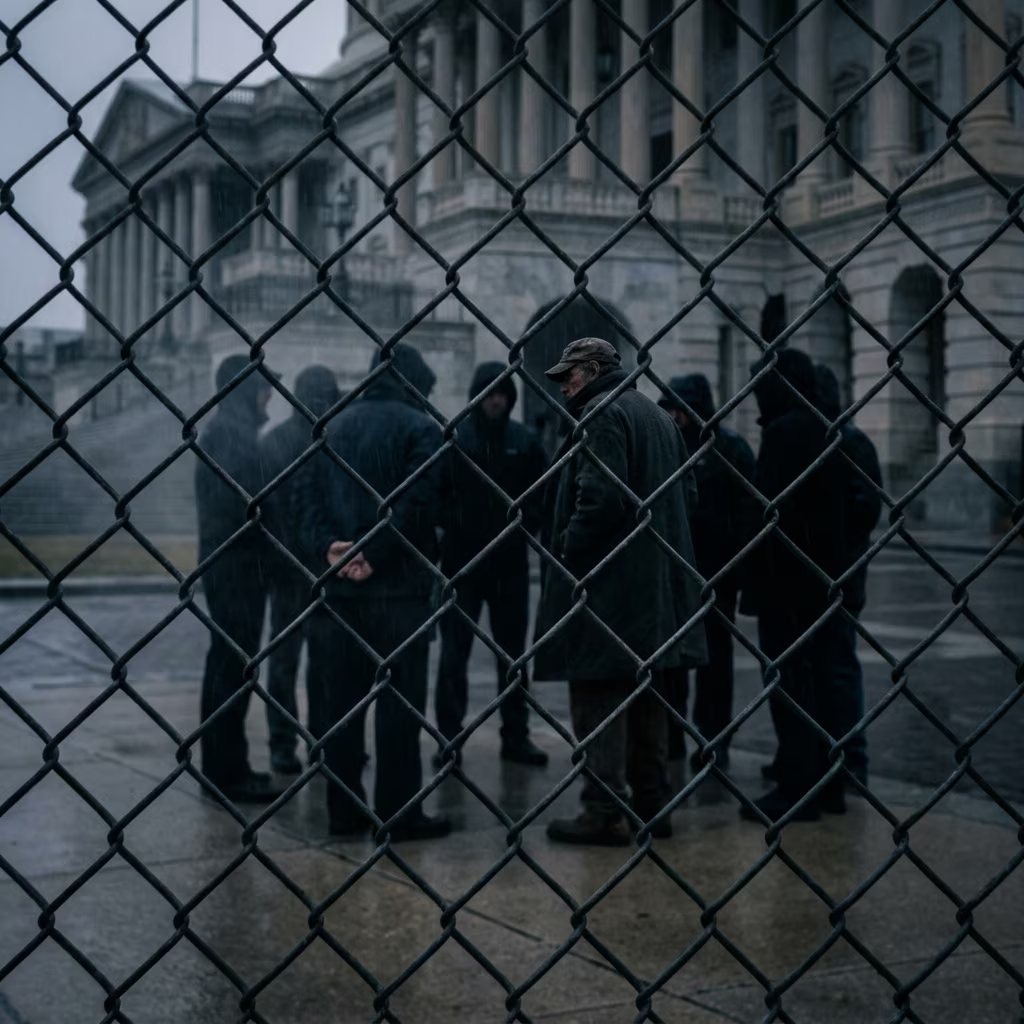
In the United States, expressing strong political views is protected by the First Amendment, but that protection stops where threats of violence begin. Threatening the President, the Vice President, or other government officials is a serious federal crime, even if the threat is never carried out. Understanding when heated rhetoric becomes a prosecutable threat can help people stay within the law while still exercising their constitutional rights.
Why Threats Against Public Officials Are Treated So Seriously
Democratic government depends on public officials being able to perform their duties without fear of violence or intimidation. When officials are threatened, the impact goes beyond the individual target:
- Personal safety risk for the official and their family
- Chilling effect on decision-making and willingness to serve
- Intimidation of the public who may rely on those officials
- Potential destabilization of institutions that rely on impartial judgment
These concerns have driven Congress to enact specific crimes for threatening federal officials, including laws focused on the President and Vice President.
Key Federal Statutes on Threatening Government Officials
Threats against public officials can be prosecuted under several provisions of federal law, depending on the target and the circumstances. Some of the most important statutes include:
Threats Against Federal Officials and Their Families: 18 U.S.C. § 115
18 U.S.C. § 115 makes it a crime to threaten, assault, kidnap, or murder certain federal officials, federal law enforcement officers, judges, or their immediate family members when the person acts with the intent to influence, impede, intimidate, or retaliate against those officials because of their official duties. The statute also covers former federal employees when threats are made in retaliation for their past official actions.
To trigger this law, two basic elements must be present:
- A threat or act of violence such as assault, kidnapping, or murder, or a threat to commit those acts
- Directed at a protected person (certain federal officials or their immediate family) with intent to interfere with or retaliate for official duties
Protection of the President and Vice President: 18 U.S.C. § 1751
While several provisions can apply to threats against the President, 18 U.S.C. § 1751 specifically addresses offenses involving the President, Vice President, and certain other high-level officials. It makes it a federal offense to kill, kidnap, or assault – or to attempt or conspire to kill or kidnap – those protected individuals. Threats aimed at the President may also be prosecuted under other statutes where the communication itself is criminal.
Threats Sent by Mail or Interstate Channels
Beyond statutes focused on particular offices, federal law also criminalizes threats communicated through certain means. For example:
- 18 U.S.C. § 876 prohibits mailing communications that contain threats to kidnap or injure another person, with enhanced penalties when public officials are targeted.
- 47 U.S.C. § 223 covers interstate communications, including phone and online communications, that contain certain abusive or threatening content.
These provisions can apply whether the target is a public official or a private person, but threats against officials are often treated with special seriousness and may involve overlapping statutes.
How the Law Distinguishes Threats from Protected Speech
Many people worry that criticizing government officials might expose them to legal risk. Federal law and Supreme Court doctrine draw a clear line between protected political speech and unprotected threats of violence.
Core First Amendment Principles
The First Amendment broadly protects the right to criticize government and public officials, to advocate for policy change, and to express even deeply unpopular views. However:
- Violent or unlawful conduct is not protected, even if it carries a political message.
- Speech that incites imminent lawless action can be restricted and punished.
- True threats of violence fall outside First Amendment protection.
Legal authorities have repeatedly emphasized that attempts to intimidate or coerce people through threats of violence or stalking are not shielded by free speech rights.
What Counts as a “True Threat”?
While definitions can vary among courts, a “true threat” generally involves a serious expression of an intent to commit an act of unlawful violence against a particular individual or group. Important considerations include:
- Whether a reasonable person would interpret the statement as serious rather than joking or hyperbolic
- Context, including prior behavior and whether the statement is accompanied by actions that suggest preparation or intent
- The targeted nature of the threat (e.g., naming a specific official or family member)
When threats are aimed at officials and clearly connected to their performance of official duties, they are more likely to be treated as criminal under statutes like 18 U.S.C. § 115.
Penalties for Threatening Federal Officials
Federal law imposes significant penalties for threats and violence against officials. The exact punishment depends on the nature of the conduct and the harm inflicted.
Penalties Under 18 U.S.C. § 115
| Conduct | Maximum Federal Penalty |
|---|---|
| Simple assault (no serious injury, limited contact) | Up to 1 year imprisonment and/or fine |
| Assault involving physical contact or intent to commit another felony | Up to 10 years imprisonment and/or fine |
| Assault resulting in bodily injury | Up to 20 years imprisonment and/or fine |
| Assault involving serious bodily injury or use of a dangerous weapon | Up to 30 years imprisonment and/or fine |
| Threatened assault (no physical act) | Up to 6 years imprisonment and/or fine |
| Threats to kidnap or murder | Up to 10 years imprisonment and/or fine |
Separate statutes govern punishment for completed kidnapping or murder, which can involve extremely long prison terms or, in some cases, life imprisonment.
Other Federal Consequences
In addition to imprisonment and fines, a conviction for threatening the President or other federal officials can lead to:
- Federal supervision after release (probation or supervised release)
- Loss of certain civil rights, such as firearm possession under federal law
- Long-term impacts on employment and professional licensing
- Immigration consequences for non-citizens, including removal or denial of naturalization
Threats, Elections, and Public Officials: A Growing Problem
Recent data show that threats against public officials are increasing. Research reviewing federal charges over ten years found that average annual charges for threats to public officials rose sharply in the late 2010s and early 2020s. Ideologically motivated threats — often anti-government or identity-based — account for a significant portion of these cases.
Threats are not limited to national figures. A study of state and local officeholders reported that more than 40 percent of state legislators experienced threats or attacks in a recent three-year period, and more than 18 percent of local officeholders reported similar experiences in the past 18 months. When less severe harassment like stalking and insults is included, the share of officials reporting abuse rises dramatically.
In the context of elections, federal authorities note that multiple statutes may apply to threats directed at election workers and officials, including 18 U.S.C. § 115 and laws governing mailed and online threats. These protections aim to ensure that those administering elections can do their jobs without fear of violence or reprisal.
Examples of Conduct That May Lead to Federal Charges
While each case depends on its specific facts, the following types of behavior often draw attention from federal law enforcement when directed at the President or other officials:
- Sending an email or social media message that clearly states an intent to kill, injure, or kidnap a named official
- Mailing a letter that includes a detailed threat of violence or references weapons or plans
- Calling an office and describing a specific plan to attack the official or their family
- Posting repeated, targeted threats that coincide with stalking or attempts to locate the official’s home or family members
- Communicating threats tied to particular official actions, such as votes, investigations, or policy decisions, with language suggesting retaliation
On the other hand, general political statements such as “I hate what this official is doing” or “They should be voted out” are typically protected speech, provided they do not cross into specific, credible threats of physical harm.
Frequently Asked Questions
Is it always illegal to say something violent about the President?
Not every harsh statement about the President is a crime. Casual or clearly joking expressions lacking a serious intent to act, and not reasonably interpreted as real threats, may remain protected by the First Amendment. However, statements that convey a serious, targeted intent to commit unlawful violence can be prosecuted as true threats, especially when directed at specific officials.
Do online threats count the same as in-person threats?
Yes. Threats communicated online, by text, or by phone can be treated similarly to in-person threats. Federal statutes explicitly cover threats sent through interstate communications such as internet and telephone channels, and threats sent by mail are separately criminalized. The method of communication may affect how prosecutors prove intent and seriousness, but the legal risk is significant in all formats.
Can I be charged even if I never meant to follow through?
The government does not need to prove that you actually intended to carry out a violent act in order to charge and convict you for communicating a threat. What matters is whether the statement is a serious expression of intent to cause harm and whether it falls within statutes like 18 U.S.C. § 115 or provisions governing mailed or interstate threats. Jokes that are reasonably perceived as serious can still create criminal exposure.
Are threats against local or state officials covered by federal law?
Threats against state and local officials may be prosecuted under state criminal statutes and, in some circumstances, under federal law. When threats involve interference with federal elections, civil rights, or interstate communications, federal authorities may rely on statutes such as 18 U.S.C. §§ 115, 241, 876, and others. State law often adds additional protections, so liability can exist at both levels of government.
Does criticizing an official’s policies ever become a crime?
Criticism of government policies, even harsh and strongly worded criticism, is generally protected by the First Amendment. The boundary is crossed when the expression turns into a serious threat of unlawful violence or incitement to imminent lawless action. Keeping commentary focused on ideas and outcomes rather than personal violence against individuals is the safest way to remain within constitutional protection.
References
- 18 U.S.C. § 115 – Influencing, impeding, or retaliating against a Federal official — U.S. House of Representatives, Office of the Law Revision Counsel. 2024-01-01. https://uscode.house.gov/view.xhtml?req=granuleid:USC-prelim-title18-section115
- Justice Manual 9-65.000: Protection of Government Officials — U.S. Department of Justice. 2020-03-01. https://www.justice.gov/jm/jm-9-65000-protection-government-officials
- Overview of Federal Criminal Laws Prohibiting Threats and Harassment of Election Officials — Congressional Research Service. 2022-01-25. https://www.congress.gov/crs/pdf/LSB10781
- Fact Sheet on Threats and Incitement to Violence Related to the Election — Institute for Constitutional Advocacy and Protection, Georgetown Law. 2020-12-01. https://www.law.georgetown.edu/icap/wp-content/uploads/sites/32/2020/12/Fact-Sheet-on-Threats-Related-to-the-Election.pdf
- Rising Threats to Public Officials: A Review of 10 Years of Federal Data — Combating Terrorism Center at West Point. 2024-06-01. https://ctc.westpoint.edu/rising-threats-to-public-officials-a-review-of-10-years-of-federal-data/
- Intimidation of State and Local Officeholders — Brennan Center for Justice. 2023-09-20. https://www.brennancenter.org/our-work/research-reports/intimidation-state-and-local-officeholders