
Supreme Court Split on Unconscious Blood Draws
Exploring the divided U.S. Supreme Court decision on warrantless blood tests for unconscious drivers in DUI cases.
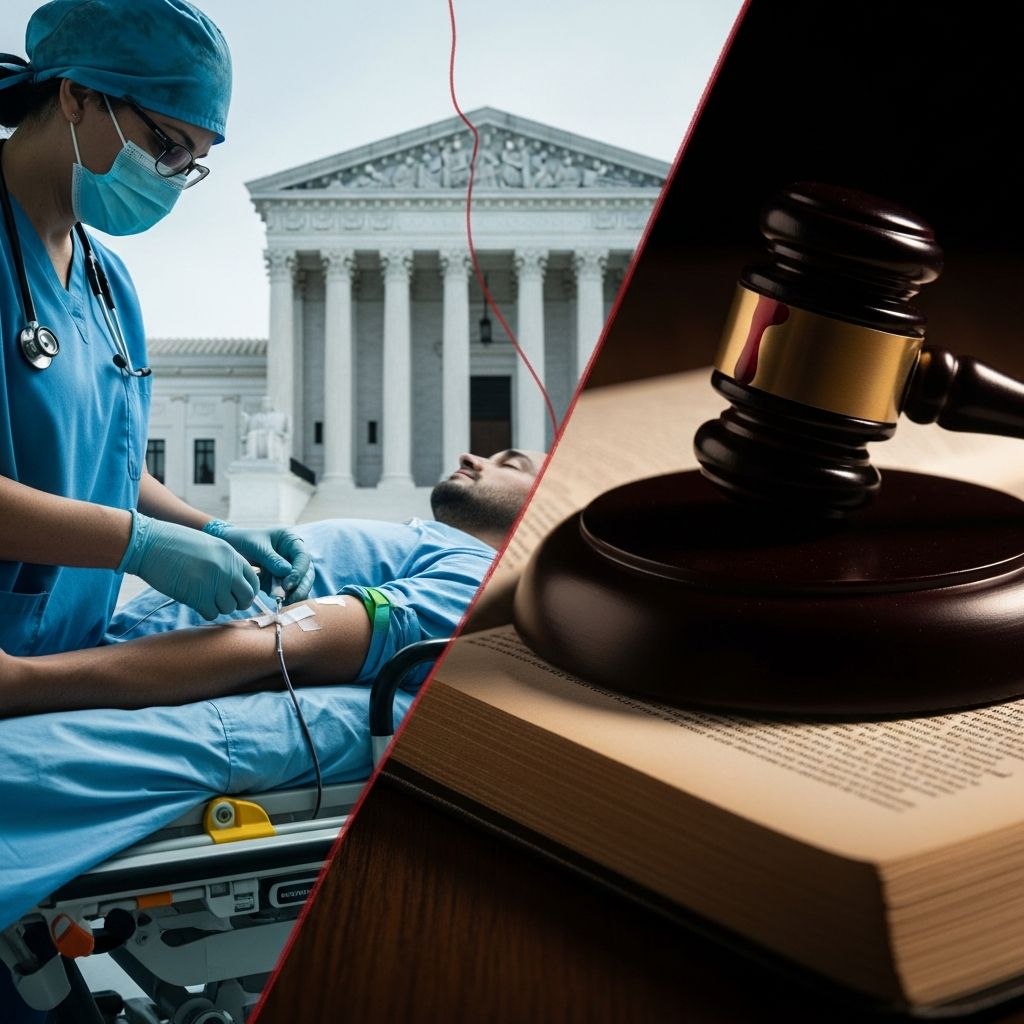
The U.S. Supreme Court’s handling of warrantless blood draws from unconscious drivers marks a pivotal moment in Fourth Amendment jurisprudence, particularly in driving under the influence (DUI) contexts. In a closely divided 5-4 decision, the Court ruled that police may sometimes draw blood without a warrant from suspects too incapacitated to consent or provide a breath sample, but only when specific exigent circumstances exist. This ruling navigates the tension between rapidly dissipating evidence like blood alcohol content (BAC) and the constitutional protection against unreasonable searches.
Historical Foundations of Blood Draw Challenges
The legal framework for blood draws in DUI cases traces back decades, evolving through landmark Supreme Court precedents. In 1966, Schmerber v. California established that blood tests constitute searches under the Fourth Amendment, requiring probable cause and, typically, a warrant. However, the Court upheld a warrantless draw in that case due to unique factors: a fresh accident scene, the driver’s immediate hospitalization, and the natural dissipation of alcohol in the bloodstream creating true exigency.
Nearly five decades later, Missouri v. McNeely in 2013 refined this doctrine. The Court rejected a blanket ‘per se’ exigency rule for all DUI blood draws, emphasizing that the metabolization of alcohol alone does not automatically justify skipping a warrant. Instead, courts must evaluate the totality of circumstances on a case-by-case basis, considering factors like the time needed to secure a warrant, the availability of breath tests, and any ongoing emergencies.
These cases set the stage for examining scenarios where suspects are unconscious, unable to blow into a breathalyzer—the less intrusive alternative repeatedly endorsed by the Court.
The Mitchell v. Wisconsin Case at the Core
The flashpoint case, Mitchell v. Wisconsin (2019), involved a driver found slumped over his truck’s steering wheel after erratic driving. Officer Jaeger observed signs of intoxication: slurred speech, the smell of alcohol, and an open whiskey bottle. Mitchell refused field sobriety tests and was arrested. En route to the hospital, he fell unconscious, prompting officers to draw his blood without a warrant or consent.
Wisconsin courts initially suppressed the evidence, citing McNeely. But the Supreme Court vacated and remanded, holding in a 5-4 opinion that unconsciousness can heighten exigency, akin to Schmerber’s medical emergency. Justice Alito’s plurality opinion noted that blood is the only viable test option for unconscious individuals, and BAC dissipates by the minute. Additional police duties—like securing the scene and aiding medical responders—further justify prompt action without bureaucratic delay.
However, the decision was fragmented. Justice Breyer’s concurrence, joined by two others, stressed that warrants remain the default; exigency must be assessed fact-specifically, not presumed from unconsciousness alone.
Key Factors Determining Exigency in Practice
Post-Mitchell, lower courts have dissected what constitutes sufficient exigency. Here’s a breakdown:
- Impossibility of Breath Test: Unconsciousness eliminates breath testing, making blood draws the sole chemical option.
- Rapid Evidence Loss: Alcohol and drugs metabolize quickly, potentially vanishing before a warrant arrives.
- Scene Management: Officers often juggle crash investigations, traffic control, and victim aid, delaying warrant applications.
- Medical Urgency: If unconsciousness signals a health crisis, immediate testing aligns with life-saving priorities.
- Warrant Feasibility: Advances in telephonic and electronic warrants reduce delays, undermining exigency claims if ignored.
Courts weigh these against alternatives. For instance, if time allows a quick warrant via phone or app—as increasingly common—no exigency exists.
State Variations and Post-Ruling Applications
| State/Case | Ruling | Key Rationale |
|---|---|---|
| Wisconsin (Mitchell) | Uphheld warrantless draw | Combined unconsciousness, dissipation, and officer duties created exigency. |
| California (People v. Alvarez, 2023) | Suppressed evidence | Driver conscious initially; ample time for warrant despite fatalities; no true emergency. |
| General Post-McNeely | Case-by-case | No per se rule; totality governs. |
Different jurisdictions interpret Mitchell variably. Some states mandate warrants absent clear emergencies, while others lean toward exigency in unconscious cases. Defense attorneys now routinely challenge draws by highlighting warrant accessibility.
Implied Consent Laws and Their Boundaries
Most states have implied consent statutes: driving equates to agreeing to chemical testing. Refusal triggers penalties like license suspension. But Mitchell clarified these do not authorize non-consensual, warrantless draws from unconscious drivers as a ‘forfeiture’ of rights. The Court in Birchfield v. North Dakota (2016) limited implied consent to breath tests, not blood, reinforcing warrant needs for invasive procedures.
Arguments that ‘drinking to unconsciousness forfeits rights’ have been rebuffed, as they ignore Fourth Amendment primacy over state statutes.
Technological Advances Impacting Warrants
Modern tools have transformed warrant processes. Electronic warrant systems, available in many areas, allow judges to review affidavits remotely within minutes. Apps and video teleconferencing further expedite approvals. McNeely explicitly noted these innovations erode traditional exigency excuses.
In unconscious driver scenarios, officers must document why these options were infeasible. Failure to do so risks suppression motions succeeding.
Defense Strategies in Suppression Hearings
For accused drivers, challenging warrantless blood draws involves:
- Motion to Suppress: File promptly, citing McNeely and Mitchell’s warrant preference.
- Attack Exigency: Prove warrant was feasible; highlight delays in transport or testing that negate urgency.
- Breath Alternative: Argue if consciousness flickered, breath was possible.
- Chain of Custody: Question lab handling or test accuracy.
- Expert Testimony: Use toxicologists to show dissipation rates don’t always demand immediacy.
Success hinges on dissecting the ‘totality’—a blueprint McNeely provided for rigorous hearings.
Frequently Asked Questions
Can police always draw blood from unconscious DUI suspects?
No. Exigency must be proven case-by-case; warrants are preferred and often feasible with modern tech.
What if a breath test was possible earlier?
Courts may suppress if unconsciousness wasn’t total or if time allowed prior testing.
Do implied consent laws override warrants?
No, they supplement but don’t eliminate Fourth Amendment protections for blood draws.
How has technology changed outcomes?
Electronic warrants make skips harder to justify, favoring suppression in non-emergencies.
What are penalties for warrantless draws found unconstitutional?
Evidence suppression, potentially dismissing charges if no other proof exists.
Broader Implications for Public Safety and Rights
This jurisprudence balances deterrence of impaired driving—responsible for thousands of annual fatalities—with safeguarding bodily integrity. Critics argue exigency rulings risk abuse, enabling fishing expeditions. Supporters highlight real-world chaos at DUI scenes, where delays could let evidence evaporate.
Future cases may refine Mitchell, especially as warrant tech proliferates. For now, unconscious drivers occupy a gray zone: not automatic warrant exceptions, but presumptively exigent absent countervailing facts.
Legal practitioners must stay vigilant, as state courts diverge. Defendants benefit from experienced counsel dissecting specifics to vindicate rights.
References
- Supreme Court Petition in Mitchell v. Wisconsin — Supreme Court of the United States. 2019-03-04. https://www.supremecourt.gov/DocketPDF/18/18-6210/90588/20190304170730016_190301%20e-filing.pdf
- The Supreme Court Says No To Warrantless, Non-Consensual Blood Draws — Public Defenders US. 2013 (post-McNeely analysis). https://publicdefenders.us/blogs/the-supreme-court-says-no-to-warrantless-nonminusconsensual-blood-draws/
- Constitutional Policing Update: Warrantless Blood Draw of an Unconscious Driver — Orange County Sheriff’s Department. 2024-11. https://www.ocsheriff.gov/sites/ocsd/files/2024-11/Bulletin%2024-09%20Constitutional%20Policing%20Update%20-%20Warrantless%20Blood%20Draw%20of%20an%20Unconscious%20Driver_1.pdf
- Missouri v. McNeely, 569 U.S. 141 — Supreme Court of the United States. 2013-04-17. https://www.supremecourt.gov/opinions/12pdf/11-1425_0pm1.pdf
- Mitchell v. Wisconsin, 588 U.S. ___ (2019) — Supreme Court of the United States. 2019-06-27. https://www.supremecourt.gov/opinions/18pdf/18-6210_6jfl.pdf
Similar Articles








Read full bio of Sneha Tete




