
Supreme Court Delays Transgender Bathroom Policy Clash
Both advocates and states push for swift Supreme Court action on transgender bathroom access in schools amid ongoing legal battles.
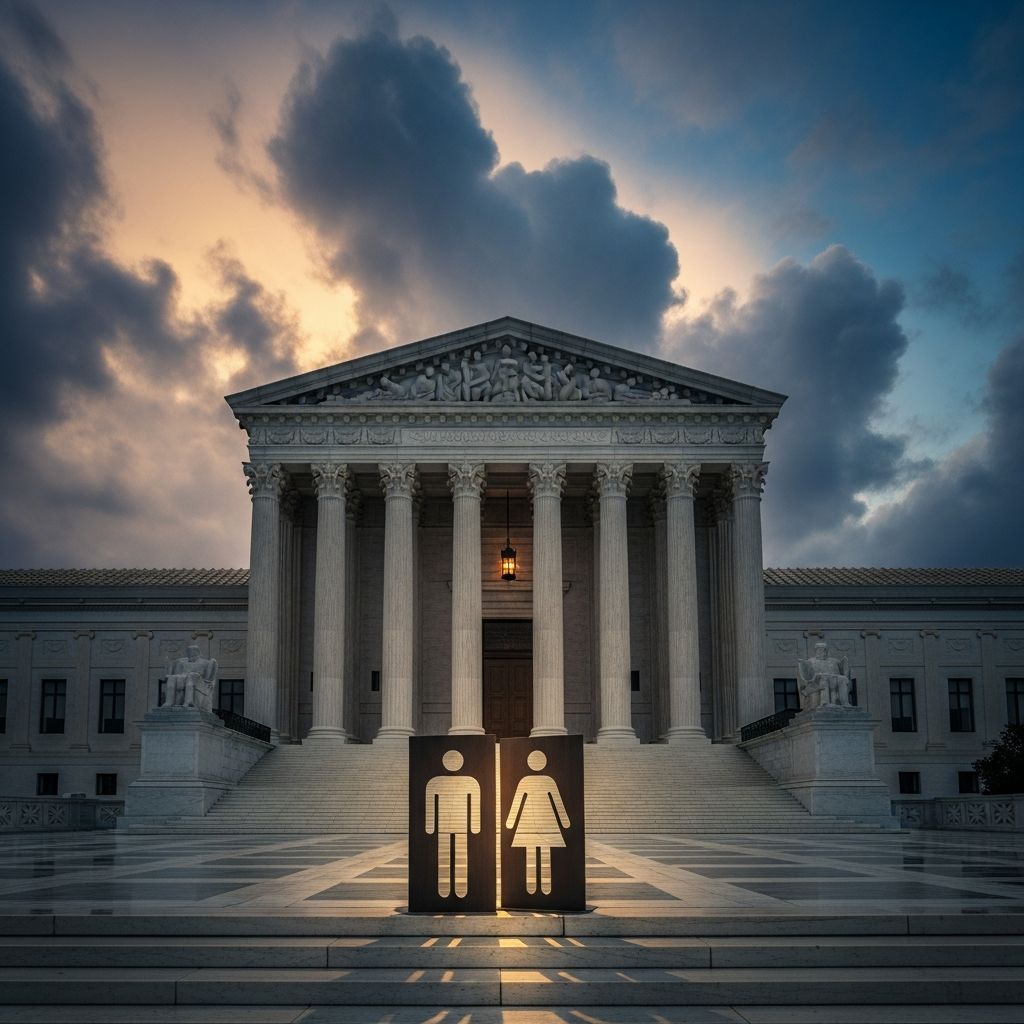
In a landscape marked by intense legal contention, the U.S. Supreme Court has repeatedly navigated emergency applications related to transgender students’ access to school bathrooms matching their gender identity. Recent rulings, particularly from September 2025, highlight a cautious judicial stance, denying states’ urgent pleas while litigation unfolds in lower courts. This approach balances immediate student needs against broader policy concerns, drawing arguments from constitutional protections, federal statutes, and state interests.
Background of the South Carolina Dispute
The controversy in South Carolina centers on a state budget proviso enacted in July 2024, which threatens a 25% funding cut to public K-12 schools allowing transgender students to use bathrooms aligned with their gender identity rather than biological sex at birth. This measure emerged amid national debates on gender identity policies in education. A transgender teenage boy, identified pseudonymously as John Doe from Berkeley County School District, challenged the policy after his middle school suspended him for using boys’ restrooms.
Doe’s lawsuit asserts violations of Title IX—a federal law prohibiting sex discrimination in education programs receiving federal funds—and the Fourteenth Amendment’s Equal Protection Clause. These claims argue that bathroom restrictions discriminate based on gender identity, treating transgender students differently from cisgender peers in similar situations.
Lower Court Interventions and Escalation
Federal courts have issued pivotal orders shaping the dispute’s trajectory. Initially, a district court paused proceedings following the Supreme Court’s acceptance of a related case, West Virginia v. B.P.J.. However, on August 12, 2025, the U.S. Court of Appeals for the 4th Circuit intervened decisively, blocking enforcement of the state law. The 4th Circuit drew on its 2020 precedent in Grimm v. Gloucester County School Board, ruling that denying transgender boys access to boys’ restrooms constitutes sex-based discrimination under Title IX and the Constitution.
- Key 4th Circuit Rationale: Policies enforcing biological sex-based bathroom use discriminate on the basis of sex, as they impose unique burdens on transgender individuals.
- State’s Dilemma: South Carolina described schools as caught in a ‘rock and hard place,’ facing funding penalties without policy enforcement.
- Student Accommodations: Alternatives like single-stall restrooms were proposed for Doe, but the appeals court prioritized boys’ multi-occupancy facilities during litigation.
Supreme Court’s Emergency Docket Response
South Carolina urgently petitioned the Supreme Court to stay the 4th Circuit’s order, citing irreconcilable tensions with the Court’s June 2025 6-3 decision upholding Tennessee’s restrictions on gender-affirming care for minors. The state argued for immediate intervention to avert ‘ongoing material harms’ to schools and students.
On September 10, 2025, the Supreme Court issued a brief, unsigned order denying the request. Justices Clarence Thomas, Samuel Alito, and Neil Gorsuch dissented without explanation, signaling conservative divisions. The majority emphasized that denial rested on emergency relief standards—assessing irreparable harm and equities—not the case’s merits.
“It is based on the standards applicable for obtaining emergency relief from this Court.” — Supreme Court Order, September 10, 2025
Contrasting Perspectives in the Debate
| Stakeholder | Core Argument | Supporting Precedent |
|---|---|---|
| Transgender Advocates (e.g., ACLU) | Bathroom bans violate Title IX and equal protection by discriminating on sex and gender identity. | Grimm v. Gloucester (4th Cir. 2020); A.C. v. Metropolitan School District (7th Cir. 2023) |
| State Officials | Policies protect privacy and safety; align with recent SCOTUS rulings on youth gender care. | United States v. Skrmetti (SCOTUS 2025, Tenn. case) |
| School Districts | Trapped between state mandates and federal injunctions, risking funding and compliance issues. | N/A |
This table illustrates the multifaceted tensions, where advocates celebrate continued access as a rights victory, while states decry policy paralysis.
Historical Context: Evolving Supreme Court Stance
The Court’s shadow docket—handling emergency applications without full briefing—has become a battleground for transgender rights. Earlier instances include the 2017 denial of certiorari in Doe v. Boyertown Area School District, allowing a Pennsylvania policy permitting gender-identity bathroom use. The 3rd Circuit had upheld it against privacy claims from cisgender students.
In 2024, the Court declined review of Metropolitan School District of Martinsville v. A.C., affirming a 7th Circuit ruling favoring a transgender boy’s Title IX claim against an Indiana restroom policy. These patterns suggest reluctance to grant emergency stays favoring restrictions, prioritizing lower court processes.
Implications for Schools and Students Nationwide
Pending Supreme Court merits review, school districts navigate patchwork policies. South Carolina’s denial ensures Doe uses boys’ restrooms, offering relief to transgender youth but fueling state frustrations over funding threats.
Broader Ramifications:
- Educational Funding: Provisos like South Carolina’s tie compliance to budgets, pressuring districts financially.
- Student Privacy: States argue multi-occupancy facilities require biological sex alignment for safety.
- Federal Preemption: Title IX interpretations increasingly incorporate gender identity protections post-Bostock v. Clayton County (2020).
- Circuit Splits: Variations among appeals courts invite potential SCOTUS consolidation.
Potential Paths Forward for Resolution
Both sides express urgency for Supreme Court clarity. Transgender rights groups hail interim wins as hopeful precedents, while states seek merits dockets to align bathroom rules with medical care restrictions.
- Full Briefing: South Carolina may refile after lower proceedings.
- Related Cases: Ties to West Virginia v. B.P.J. could accelerate review.
- Legislative Shifts: Post-2024 elections influence state-federal dynamics.
Advocates anticipate decisions providing ‘hope to other trans students,’ underscoring emotional stakes.
Frequently Asked Questions
What was the South Carolina bathroom policy?
The policy, via a 2024 budget proviso, cut school funding by 25% if transgender students used gender-identity-aligned bathrooms instead of biological sex-based ones.
Why did the Supreme Court deny the stay?
The Court applied emergency standards, finding insufficient evidence of irreparable state harm to justify pausing the 4th Circuit’s order.
How does Title IX factor in?
Title IX bars sex discrimination in federally funded education; courts like the 4th Circuit extend it to gender identity via precedents like Grimm.
Who dissented in the Supreme Court order?
Justices Thomas, Alito, and Gorsuch noted dissent without opinions.
What happens next in the case?
Litigation continues in lower courts, with potential for future Supreme Court petitions on merits.
Stakeholder Reactions and Future Outlook
Lambda Legal celebrated the ruling: “Our client will continue to be able to use boys’ restrooms… providing hope to other trans students.” Conversely, state attorneys warn of compliance chaos without intervention.
With circuits divided and societal debates intensifying, the Supreme Court looms as arbiter. Its measured shadow docket use preserves deliberation, but delays impact real lives daily. As of 2026, these cases underscore enduring tensions between individual rights and communal standards in public education.
References
- Supreme Court denies South Carolina’s emergency request to enforce anti-transgender school bathroom policy — Politico. 2025-09-10. https://www.politico.com/news/2025/09/10/supreme-court-south-carolina-transgender-ruling-00556514
- Transgender student’s bathroom case comes to Supreme Court on emergency docket — SCOTUSblog. 2025-08. https://www.scotusblog.com/2025/08/transgender-student-bathroom-case-comes-to-supreme-court-on-emergency-docket/
- Supreme Court leaves order in place allowing transgender student to use boys’ bathroom — SCOTUSblog. 2025-09-10. https://www.scotusblog.com/2025/09/supreme-court-leaves-order-in-place-allowing-transgender-student-to-use-boys-bathroom/
- Supreme Court Rejects Case On Transgender Bathrooms. Here’s Why It’s Still A Huge Issue — The Heritage Foundation. N/A. https://www.heritage.org/gender/commentary/supreme-court-rejects-case-transgender-bathrooms-heres-why-its-still-huge-issue
- U.S. Supreme Court Declines to Hear Challenge to Title IX Victory for Transgender Rights — ACLU. 2024-01-16. https://www.aclu.org/press-releases/u-s-supreme-court-declines-to-hear-challenge-to-title-ix-victory-for-transgender-rights
Similar Articles








Read full bio of medha deb




