
Supreme Court Precedents & Online Free Speech
How landmark legal battles reshape First Amendment rights on the internet.
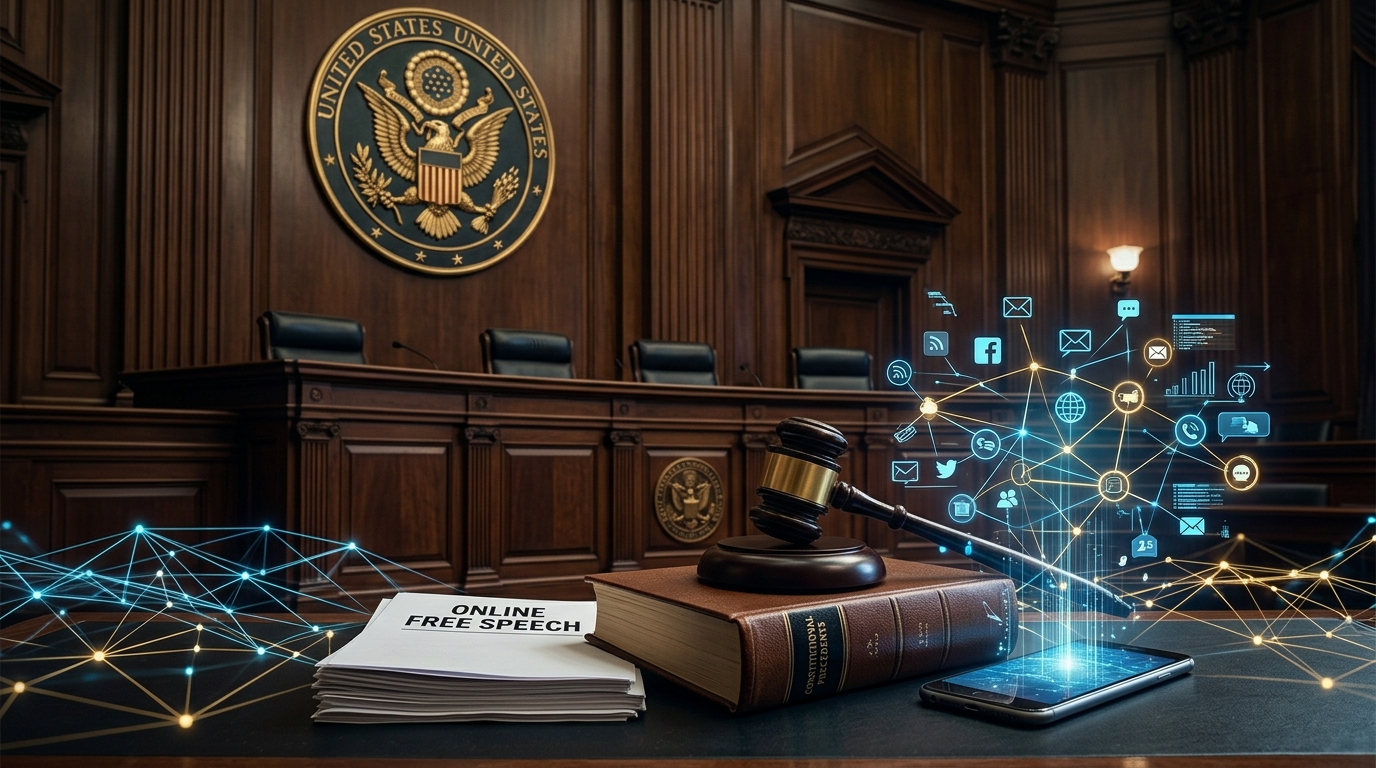
The Catalyst: A New Era of Digital Regulation
The internet, once envisioned as a decentralized utopia of free expression, has steadily evolved into a highly curated ecosystem heavily reliant on a handful of corporate giants. As these massive digital platforms have grown, so too has their role in shaping public discourse, political elections, and cultural movements. Consequently, a fierce and highly polarized debate has emerged regarding who exactly should hold the power to moderate this digital public square. This fundamental question lies at the heart of recent high-stakes legal battlesmost notably, the Supreme Court cases involving state laws passed in Florida and Texas aimed at seizing control of online content moderation.
At the core of these massive legal disputes is a delicate balancing act involving the First Amendment of the United States Constitution. On one side are state governments claiming they must intervene to protect everyday users and political figures from ideological censorship by technology monopolies. On the opposing side are the technology platforms themselves, asserting their constitutional right to exercise editorial judgment over the user-generated content they host. The final outcome of this ongoing legal saga will not merely dictate the operational parameters of today’s social media companies; it will establish a foundational legal precedent for how free speech is defined, protected, and regulated in the digital age for decades to come.
The genesis of this monumental legal confrontation can be traced back to the turbulent political climate that crested in early 2021. Following a series of high-profile content moderation decisions by major social media networksincluding the widespread deplatforming of prominent political figures and the aggressive algorithmic flagging of disputed medical and election informationseveral state legislatures took decisive, retaliatory action. Florida and Texas led the charge, enacting sweeping laws designed to strictly limit how large technology companies could manage user-generated content on their digital premises.
Legislative Overreach and the Attack on Editorial Discretion
Floridas Senate Bill 7072 was explicitly crafted to penalize social media platforms that banned political candidates or journalistic enterprises. The legislation imposed heavy financial fines and mandated incredibly burdensome transparency requirements, essentially forcing platforms to justify their moment-to-moment moderation decisions to the state’s absolute satisfaction. Shortly thereafter, Texas passed House Bill 20, a statute that broadly prohibited social media companies with more than 50 million monthly active users from removing, demonetizing, or restricting content based on the viewpoint of the user.
Proponents of these ambitious legislative efforts argued that major platforms had effectively become modern-day “common carriers,” akin to telecommunications companies, public utilities, or train systems. In their view, because these massive platforms are absolutely essential to modern public discourse and civic engagement, they should not be permitted to discriminate against users based on political ideology. However, these laws immediately triggered a legal firestorm. Civil liberties organizations and tech industry trade groups urgently warned that giving state governments the authority to dictate online speech policies represented a grave, unprecedented threat to First Amendment liberties.
To understand the gravity of the legal clash, one must examine the First Amendment principles that have historically governed media and speech in the United States. For decades, the Supreme Court has explicitly recognized that private publishers possess an inherent constitutional right to editorial discretion. In the landmark 1974 case concerning print media, the Court struck down a state law that required newspapers to provide political candidates with equal space to reply to published criticism. The justices ruled definitively that the government simply cannot compel a private entity to publish content it deems objectionable.
The Constitutionality of Content Moderation
Technology companies, represented by digital trade associations in these lawsuits, rely heavily on this well-established precedent. They argue that social media platforms, while technologically distinct from traditional print newspapers, are fundamentally engaged in a modern form of editorial curation. By carefully designing algorithms, establishing community guidelines, and actively removing hate speech, spam, or dangerous misinformation, these companies are exercising their First Amendment rights to cultivate specific digital environments tailored to their distinct target audiences.
Conversely, the states defending their newly minted laws invoke different legal traditions, specifically the historical regulation of common carriers and public accommodations. They forcefully argue that social media platforms do not function like traditional newspapers, which have strictly limited physical space and exercise rigorous pre-publication review of every word printed. Instead, platforms host virtually infinite amounts of unreviewed third-party content. Drawing on historical cases where the Court held that a state could require a privately owned physical shopping center to allow free speech activities, Texas and Florida contend that the government can rightfully compel massive digital platforms to serve as completely neutral conduits for public expression.
While mainstream concerns about the unchecked power, immense wealth, and vast influence of major technology corporations are entirely valid and warrant serious regulatory attention, the specific remedy proposed by state-mandated content moderation presents a cure that may be profoundly worse than the underlying disease. If state laws were legally permitted to force digital platforms to host all legally permissible speech without discretion, the fundamental architecture of the internet would radically transformand not for the better.
The Dangers of Compelled Speech Online
First and foremost, removing a private platform’s ability to selectively moderate content based on viewpoint would inevitably lead to a rapid proliferation of highly toxic, damaging material. The First Amendment broadly protects a vast array of offensive and controversial speech, including vile hate speech, extremist political propaganda, and medically dangerous disinformation. Without the legal ability to aggressively filter, downrank, or demonetize this content, mainstream platforms would quickly become chaotic, hostile, and utterly unusable for the average consumer. The very digital tools that platforms currently use to protect vulnerable users from coordinated harassment and organized abuse would be legally compromised.
Second, direct government interference in private content moderation creates an alarming and immediate chilling effect on commerce and communication. If social media companies face immense, potentially business-ending financial liabilities merely for enforcing their own community standards, they may choose to alter their business models entirely to mitigate legal risks. A major platform might decide to ban all political discussion outright to avoid running afoul of ambiguous state laws, or they might deploy complex geofencing technologies to withdraw entirely from states with aggressively restrictive regulations, thereby depriving those citizens of valuable digital services.
Furthermore, intentionally empowering the government to dictate the intricate rules of digital speech completely flips the traditional First Amendment on its head. The Constitution is specifically designed to protect private entities and ordinary individuals from heavy-handed government overreach. When a state successfully dictates what a private company must publish, it establishes a dangerous mechanism for state-sponsored propaganda and strict ideological enforcement. This opens a treacherous door for future political administrations to manipulate the digital public square to heavily favor their own political advantage.
The Supreme Court’s Nuanced Intervention
The intense legal battle over these ambitious state laws eventually culminated in the summer of 2024 when the United States Supreme Court issued a highly anticipated, closely watched ruling on the core cases. However, rather than delivering a definitive, sweeping mandate that struck down the state laws entirely on their face, the Court opted for a much more measured, procedurally focused, and technically precise approach.
In a pivotal and unanimous decision, the Supreme Court effectively vacated the conflicting lower court rulings from the federal appellate circuits and remanded the complex cases back to the lower courts for further review. Writing the majority opinion, the Court heavily emphasized that the technology groups had brought “facial challenges” against the Florida and Texas state laws. A facial challenge is widely considered a notoriously difficult legal maneuver in American jurisprudence, as it strictly requires the plaintiffs to definitively prove that a specific law is unconstitutional in all or nearly all of its theoretical applications, not just in a few specific, isolated instances.
The Supreme Court carefully determined that the lower federal courts had not sufficiently analyzed the full, comprehensive scope of the Texas and Florida laws. Because these pieces of legislation were drafted incredibly broadly, they could potentially apply to a massive, diverse range of digital services far beyond traditional social media feedssuch as direct messaging applications, backend payment processors, specialized hobbyist forums, or even collaborative software tools. The Supreme Court strictly instructed the lower courts to conduct a much more granular, rigorous fact-finding analysis to determine precisely how these sweeping laws truly burden the distinct First Amendment rights of specific types of digital platforms.
Securing Editorial Rights in the Digital Age
Despite the highly procedural nature of the remand, the Supreme Court’s written opinion offered a massive, unmistakable victory for digital free speech advocates and technology platforms alike. The Court strongly and clearly reaffirmed the core constitutional principle that the government simply cannot override a private entity’s editorial judgment merely because lawmakers happen to disagree with how that specific judgment is exercised. The ruling sent a crystal-clear signal to ambitious state legislatures that the fundamental, bedrock architecture of the First Amendment remains incredibly robust and fully applicable to the modern digital age. This severely undercut the core arguments of the states, which claimed they could legally seize total control of online content moderation in the elusive name of political neutrality.
As these monumental cases inevitably continue to work their intricate way through the lower federal courts, the broader, long-term implications for the global internet are becoming increasingly clear to legal scholars and technologists alike. The Supreme Court’s direct intervention has temporarily stalled the aggressive legislative momentum of states seeking to forcefully impose localized, fragmented speech regulations on massive global platforms. However, the profound underlying cultural issues that initially sparked these lawsincluding widespread, bipartisan distrust of technology monopolies, the troubling opacity of algorithmic content amplification, and deep concerns about digital data privacyremain largely unresolved.
Relying on chaotic, state-by-state legislation to govern the foundational rules of the internet is an inherently flawed strategy. The internet naturally operates across porous state and national borders; a confusing, contradictory patchwork of conflicting state-level speech laws makes corporate compliance nearly impossible and severely fragments the digital experience for everyday users. Instead of aggressively trying to commandeer the private editorial processes of technology companies, federal policymakers who are genuinely concerned about the immense power of Big Tech should smartly pivot their focus toward alternative, constitutionally sound regulatory frameworks.
Comprehensive federal data privacy legislation, vastly more robust antitrust enforcement to spur digital competition, and mandated algorithmic transparency requirements would highly effectively address the systemic, structural harms of the modern digital economy without recklessly trampling on vital First Amendment rights. By purposefully empowering users to deeply control their personal data and clearly understand exactly how digital content is actively served to them, forward-thinking lawmakers can create a significantly healthier, more resilient digital ecosystem without ever resorting to aggressively dictating what can or cannot be spoken online.
Frequently Asked Questions (FAQs)
- What exactly are the NetChoice legal cases currently moving through the courts?
These pivotal legal challenges involve prominent trade associations representing major technology companies suing state governments. The lawsuits forcefully argue that recent state laws attempting to heavily regulate how private social media platforms moderate user-generated content are strictly unconstitutional under the First Amendment’s free speech protections. - Does the First Amendment apply to private social media companies?
Yes, it does. The First Amendment strictly prevents the government from infringing on free speech. Because social media companies are entirely private entities and not government actors, they inherently possess their own distinct First Amendment rights. This robust protection critically includes the editorial discretion to freely decide what content they will host, algorithmically promote, or permanently remove on their digital properties. - Why did the Supreme Court explicitly send the cases back to the lower courts in 2024?
The Supreme Court remanded the specific cases because the tech companies strategically mounted a “facial challenge,” which demands rigorously proving a law is unconstitutional in almost all its conceivable applications. The Supreme Court wisely ruled that the lower federal courts urgently needed to conduct a much more thorough, fact-based analysis to determine exactly which specific digital services the broad laws applied to before striking them down entirely. Crucially, however, the Court strongly reaffirmed that private editorial discretion remains fully protected. - What is the “common carrier” argument used by the states?
Supporters of the controversial state laws aggressively argue that major social media platforms are so absolutely essential to modern human communication that they should be legally treated like legacy telephone companies, public utilities, or traditional common carriers. Under this novel legal theory, digital platforms would be strictly required to provide entirely equal access to all internet users and would be expressly prohibited from discriminating based on the specific viewpoints expressed in the uploaded content. - How would state-mandated content moderation directly affect the average internet user?
If massive digital platforms are legally barred by state governments from removing content based on its viewpoint, they would be utterly unable to effectively filter out toxic hate speech, extreme fringe content, and organized digital harassment. This would instantly make the everyday digital environment significantly more hostile and dangerous. Alternatively, cautious platforms might abruptly stop hosting any political content altogether to totally avoid massive state-imposed fines, thereby massively reducing the internet’s immense utility as a vital space for civic engagement and democratic debate.
Conclusion
The complex, highly fraught intersection of immense state power, sweeping corporate influence, and fundamental individual liberty is undoubtedly the defining legal battleground of the modern internet era. The ongoing legal battles over state-level social media laws acutely highlight the profound, existential risks of allowing ambitious government entities to forcibly usurp the private editorial autonomy of technology platforms. While the Supreme Court’s highly procedural remand slightly prolongs the tactical legal fight, the Court’s underlying philosophical message remains resolutely clear: the sacred First Amendment is absolutely not a convenient tool for the government to mandate ideological neutrality online. As society continues to navigate the immense complexities of the digital age, fiercely protecting the vital right of private platforms to autonomously curate their digital environments is absolutely essential to preserving a free, dynamic, and fundamentally safe online world. Effectively addressing the highly genuine issues of technology monopolies requires deeply thoughtful, unified national legislation strictly focused on consumer privacy and corporate transparency, rather than fundamentally compromising our nation’s foundational, bedrock free speech protections.
References
- Moody v. NetChoice, LLC, 144 S. Ct. 2383 Supreme Court of the United States. 2024-07-01. https://www.supremecourt.gov/opinions/23pdf/22-277_d18f.pdf
- NetChoice v. Paxton, No. 21-51178 United States Court of Appeals for the Fifth Circuit. 2024-11-07. https://law.justia.com/cases/federal/appellate-courts/ca5/21-51178/21-51178-2024-11-07.html
- Moody v. NetChoice & NetChoice v. Paxton Knight First Amendment Institute at Columbia University. 2023-12-07. https://knightcolumbia.org/cases/moody-v-netchoice-netchoice-v-paxton
- MOODY v. NETCHOICE The Foundation for Individual Rights and Expression (FIRE). 2024-07-01. https://www.thefire.org/supreme-court/moody-v-netchoice
Similar Articles








Read full bio of Sneha Tete


