
Restitution vs. Crime Victim Compensation
Understand the difference between restitution and crime victim compensation so you can use every available option to recover crime-related losses.
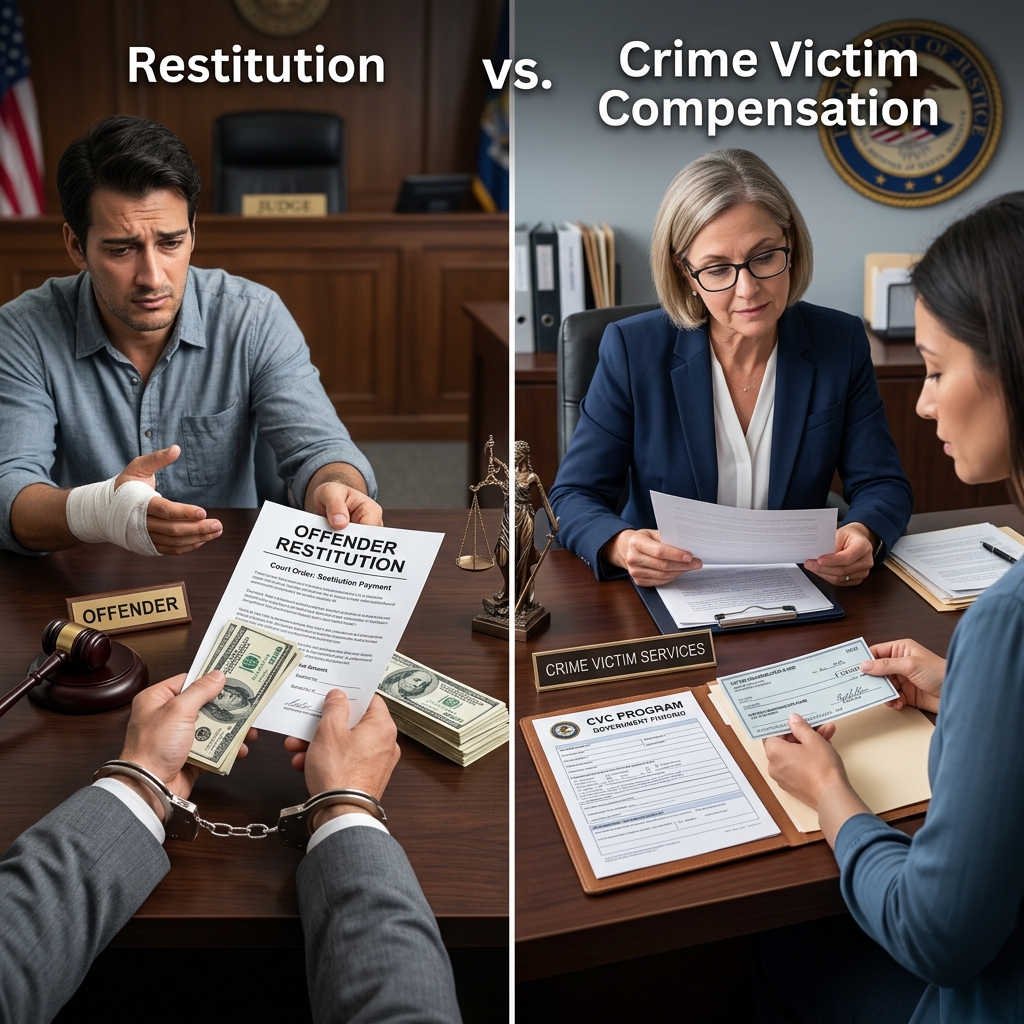
When a crime causes physical, emotional, or financial harm, victims are often left wondering how they will pay medical bills, replace damaged property, or make up for lost income. Two major tools exist in U.S. law to address these losses: restitution and crime victim compensation programs. Although both can provide money for crime-related expenses, they operate very differently and serve distinct purposes.
This guide explains how each system works, how they differ, and how you can use them together to maximize your financial recovery after a crime.
Big Picture: How Victims Can Get Financial Help
In many cases, victims may have access to multiple sources of financial assistance after a crime:
- Restitution ordered by a criminal court and paid by the offender.
- Crime victim compensation funded by the state and federal government.
- Insurance benefits (health, auto, homeowners, workers’ compensation).
- Civil lawsuits for damages such as pain and suffering (separate from the criminal case).
Restitution and compensation interact with these other sources in specific ways. Most compensation programs act as a payer of last resort, meaning they pay only after insurance and other benefits have been applied. Restitution, by contrast, is focused on making an offender repay the victim or any entity that already covered the loss.
What Is Restitution in a Criminal Case?
Restitution is money that a judge orders a convicted offender to pay for losses directly caused by their crime. It is part of the criminal sentence and is separate from any fines paid to the government.
Key Features of Restitution
- Source of payment: The convicted offender, not the government.
- Purpose: To compensate victims and hold offenders directly accountable for the harm they caused.
- Legal basis: State laws and court rules that authorize judges to order restitution in criminal cases.
- Connection to conviction: Typically available only if someone is convicted or formally takes responsibility through a plea.
Courts generally calculate restitution by determining the victim’s economic loss that is directly tied to the crime, then ordering the offender to repay that amount over time.
Common Expenses Covered by Restitution
While specific rules vary by state, restitution often covers measurable financial losses such as:
- Medical and dental bills related to the injury
- Mental health counseling fees
- Repair or replacement of damaged or stolen property
- Lost wages or loss of business income
- Funeral and burial expenses in homicide cases
- Costs related to security measures (for example, new locks)
Most states do not include non-economic damages like pain and suffering in restitution. Victims who want compensation for pain and suffering usually need to consider a separate civil lawsuit.
Who Receives Restitution?
Restitution can be paid to different recipients depending on who ultimately bore the loss:
- Individual victims directly harmed by the crime
- Family members of a deceased victim
- Service providers (hospitals, therapists) if they have not been paid yet
- Insurance companies or state victim funds that already paid the victim for the same expense
In many jurisdictions, if a victim compensation fund pays certain costs first, the court may later order restitution to be paid back to that fund rather than directly to the victim.
What Is Crime Victim Compensation?
Crime victim compensation is a government-run program that reimburses victims and their families for specific crime-related expenses when they meet statutory eligibility criteria. Every U.S. state, as well as several territories, operates such a program with support from federal funds.
Key Features of Compensation Programs
- Source of payment: State and federal funds, not the offender personally.
- Purpose: To help victims with essential expenses, especially when the offender cannot or does not pay restitution.
- Availability without conviction: In most states, compensation may be available even if there is no arrest, no identified suspect, or no prosecution.
- Payer of last resort: Programs often pay only costs not covered by insurance or other benefits.
Compensation is a separate administrative process. Victims must file an application with their state’s compensation program and provide documentation of the crime and their losses.
Eligible Expenses Under Compensation Programs
Although each state sets its own rules and caps, common eligible costs include:
- Emergency and ongoing medical and dental treatment
- Mental health counseling
- Lost wages or support
- Funeral and burial costs
- Some relocation or safety-related expenses (such as temporary housing)
- Child care in some states
Many programs do not pay for property losses or pain and suffering, focusing instead on essential out-of-pocket economic costs. Each state program has specific rules and maximum award amounts.
Typical Eligibility Requirements
While criteria differ across states, victims usually need to meet several basic conditions:
- Report the crime to law enforcement or another qualifying authority within the required time frame.
- Cooperate with law enforcement and prosecution efforts.
- File a compensation claim within the program’s deadline.
- Be an innocent victim (not significantly responsible for the crime or their injury).
Some programs provide compensation to certain categories of victims even if there was no physical injury, such as victims of specific stalking, domestic violence, or trafficking offenses.
Restitution vs. Compensation: Side-by-Side Comparison
The table below highlights the core differences between restitution and crime victim compensation.
| Feature | Restitution | Crime Victim Compensation |
|---|---|---|
| Who pays? | Convicted offender as part of a criminal sentence. | Government-run program using state and federal funds. |
| When available? | Generally only after conviction or plea in a criminal case. | Often available even if no arrest, prosecution, or conviction. |
| Primary purpose | Hold offender financially accountable and compensate victim’s direct losses. | Provide financial relief to victims for essential expenses when other resources are insufficient. |
| Types of expenses | Medical, counseling, lost wages, property repair or replacement, funeral costs, other direct losses. | Medical, counseling, lost wages, funeral costs, some safety expenses; usually not property loss. |
| Requires an application? | Victim may provide information, but court orders restitution as part of sentencing. | Yes. Victim or family must submit a claim with documentation. |
| Relation to insurance | Restitution can reimburse insurers or victim funds that paid the victim. | Generally pays only after insurance and other benefits are applied (payer of last resort). |
| Pain and suffering | Typically not covered; may require a civil lawsuit. | Generally not covered by compensation programs. |
How Restitution and Compensation Work Together
Restitution and compensation are not mutually exclusive. Victims often can use both, but not for the same dollar of loss.
Avoiding Double Recovery
Most systems have rules that prevent a victim from being paid twice for the same expense. Common approaches include:
- If a compensation program pays an expense first, later restitution may be directed to reimburse that program instead of going directly to the victim.
- Victims may be required to repay compensation funds if they later recover the same costs through restitution or a civil lawsuit.
- Compensation programs review all known sources of payment (insurance, restitution, benefits) before issuing an award.
This coordination aims to make victims financially whole without overpaying for the same loss.
Practical Sequence for Many Victims
In a typical case, a victim might proceed in this general order:
- Seek emergency medical care and file a police report.
- Use insurance benefits when available (health, auto, etc.).
- Apply for crime victim compensation to cover uncovered medical, counseling, or funeral expenses.
- Ask the prosecutor or court for restitution in the criminal case to address remaining economic losses and to reimburse any programs that helped.
- Consider a civil lawsuit for additional damages, including pain and suffering, if appropriate.
Because restitution often depends on the offender’s ability to pay, compensation can be especially important when the offender has limited resources or cannot be located.
Steps Victims Can Take to Protect Their Rights
Victim rights laws give many victims a voice in the criminal justice process and access to financial help, but these rights are not automatic. Taking proactive steps greatly improves the chances of receiving restitution or compensation.
1. Report the Crime Promptly
Timely reporting is crucial for both systems:
- Compensation programs often require that the crime be reported to law enforcement or another authority within a short timeframe.
- Prompt reporting improves the chances of identifying and successfully prosecuting the offender, which is necessary for restitution.
2. Keep Detailed Records and Receipts
Both courts and compensation programs need proof of losses. Victims should try to preserve:
- Medical and counseling bills and statements
- Invoices or receipts for property repair or replacement
- Pay stubs and employer statements documenting lost wages or time off
- Funeral and burial invoices
- Correspondence from insurers, victim assistance programs, or government agencies
Good documentation helps courts set an accurate restitution amount and assists compensation programs in processing claims more quickly.
3. Communicate With the Prosecutor About Restitution
In most states, prosecutors are responsible for presenting restitution information to the court during sentencing. Victims can support this process by:
- Informing the prosecutor early that they want restitution
- Providing all bills and proof of loss before sentencing
- Updating the prosecutor if new expenses arise (for example, ongoing medical treatment)
Some states require judges to consider restitution in every case and to explain on the record if they choose not to order it.
4. Apply for Crime Victim Compensation
Victims should contact their state’s compensation program as soon as possible to learn about eligibility, deadlines, and covered expenses. Many programs:
- Provide application forms online or through local victim assistance offices
- Offer help completing forms and gathering documents
- Allow claims from family members and dependents of deceased victims
The U.S. Office for Victims of Crime maintains information about state programs and victim assistance resources.
Common Challenges and Limitations
Although restitution and compensation are powerful tools, victims often face obstacles.
Challenges With Restitution
- Offender cannot pay: Many offenders have limited income or assets, so collecting restitution can take years or may never be completed.
- Scope of losses: Courts usually limit restitution to direct, provable economic damages and do not include pain and suffering.
- Case outcome: If no one is convicted, restitution generally cannot be ordered.
Challenges With Compensation Programs
- Eligibility criteria: Strict deadlines or reporting requirements can bar otherwise deserving victims.
- Coverage limits: Many programs impose maximum award caps or exclude property losses.
- Documentation burden: Victims must submit substantial paperwork to prove eligibility and expenses.
Despite these limitations, using both restitution and compensation—along with insurance and civil remedies—often provides the most complete financial recovery available under the law.
Frequently Asked Questions (FAQs)
Is restitution the same as crime victim compensation?
No. Restitution is money ordered by a criminal court and paid by the offender, while crime victim compensation is paid by a government program funded by public money.
Can I receive both restitution and compensation for the same crime?
Yes, but not for the same dollar of loss. Compensation programs are usually the payer of last resort and may require repayment if you later receive restitution for the same expenses.
What if the offender is never caught?
If there is no arrest or prosecution, restitution will generally not be available because there is no convicted offender. However, you may still qualify for crime victim compensation if you meet your state’s reporting and eligibility requirements.
Do these programs cover pain and suffering?
In most states, neither restitution nor compensation covers pain and suffering. These non-economic damages are usually pursued through a separate civil lawsuit against the offender or other responsible parties.
How do I find my state’s victim compensation program?
You can usually find your state program by searching for the official victim compensation office for your state or by visiting the U.S. Office for Victims of Crime website, which lists state program contacts. Local victim/witness assistance programs and prosecutors’ offices can also provide referrals.
Do I need a lawyer to ask for restitution or compensation?
Victims do not usually need a private lawyer to request restitution in a criminal case or to apply for victim compensation, though legal advice can be helpful in complex situations. Prosecutors and victim assistance staff can often explain the process and help gather documentation.
References
- Restitution for Victims in Criminal Law — Justia. 2023-01-01. https://www.justia.com/criminal/restitution-for-crime-victims/
- Victim Compensation vs. Restitution (Glendale, Colorado) — City of Glendale, Colorado. 2018-01-01. https://glendale.co.us/DocumentCenter/View/20/Victim-Compensation-vs-Restitution
- In Brief: Victim Compensation Programs and Restitution — Council of State Governments Justice Center. 2017-01-13. https://csgjusticecenter.org/publications/in-brief-victim-compensation-programs-and-restitution/
- Victim Compensation and Restitution: Legislative Alternatives — University of Wyoming College of Law (Law Review). 1983-01-01. https://scholarship.law.uwyo.edu/cgi/viewcontent.cgi?article=1658&context=land_water
- Victim Compensation — Office for Victims of Crime, U.S. Department of Justice. 2022-08-01. https://ovc.ojp.gov/topics/victim-compensation
- Restitution | Victims’ Rights: Overview — Crime Victims Legal Help New York. 2021-06-01. https://crimevictimshelpny.org/rights/victims/item.9003-Restitution
- Information for Crime Victims — New Jersey Courts. 2020-05-01. https://www.njcourts.gov/courts/adult-probation-supervision/victims
Similar Articles








Read full bio of medha deb




