
How Business Bankruptcy Can Affect a Spouse
What happens to a spouse’s credit, shared debts, and property when a business bankruptcy is filed.
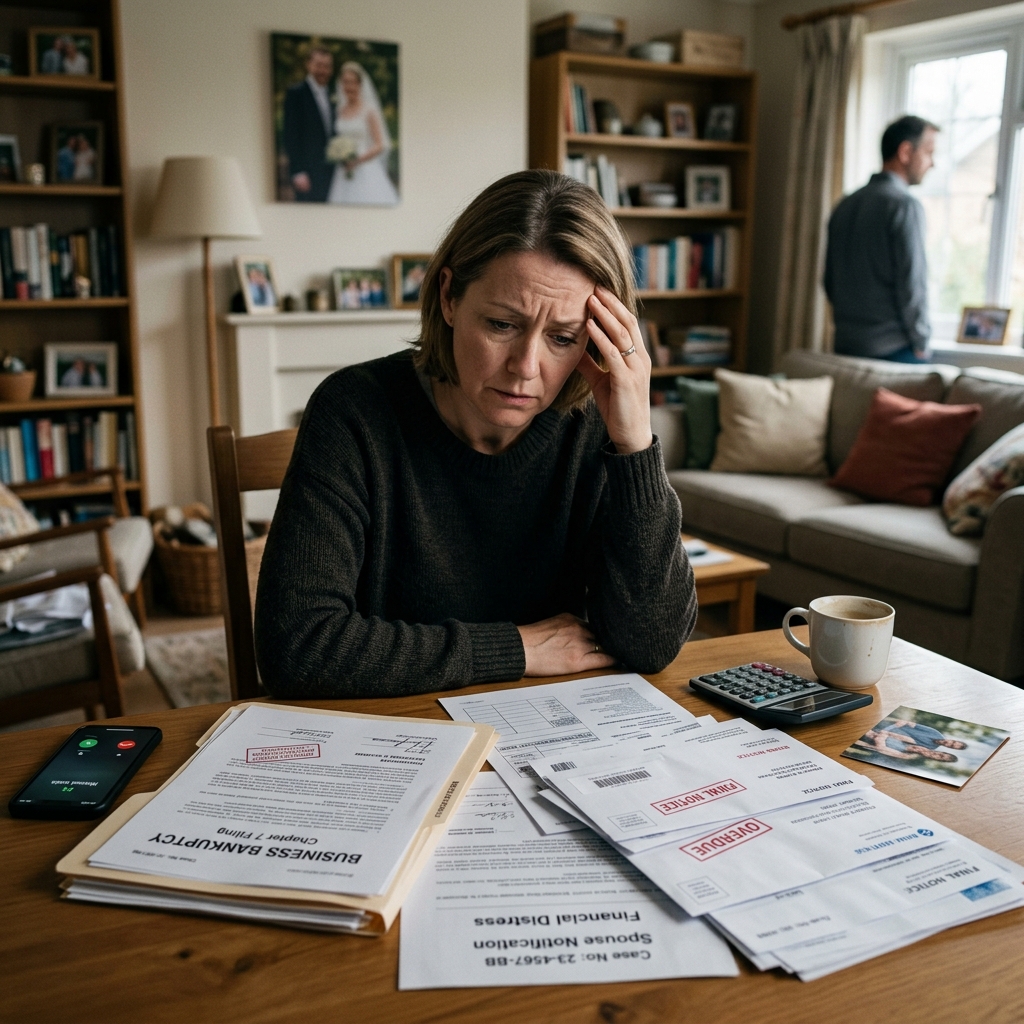
A business bankruptcy is usually filed by one legal entity or one individual, not by an entire marriage. That means a spouse is not automatically dragged into the case, and the filing does not usually appear on the non-filing spouse’s credit report. Still, the real-world impact can be wider than many couples expect because joint debts, shared property, and state property rules can create indirect consequences.
The most important question is not whether a spouse is married to the filer, but whether the couple shares debt, assets, or liability for the business obligations. Where those financial links exist, the bankruptcy can affect both partners even if only one name is on the petition. Official bankruptcy guidance and consumer-credit sources consistently note that the bankruptcy itself is personal to the filer, while joint obligations may continue to matter for the spouse who did not file.
When a spouse’s credit is usually not affected
In the ordinary case, a spouse’s credit file is separate. If the filing spouse has a sole-proprietor business, or if the business debt is tied only to that person, the non-filing spouse generally does not receive a bankruptcy notation on their own credit report.
- The spouse did not co-sign the debt.
- The spouse is not a joint account holder.
- The spouse did not personally guarantee the obligation.
- The debt is not treated as jointly owed under local property law.
This separation is important because many people assume marriage alone creates shared credit liability. In most states, that is not true. Marriage may connect finances in practice, but it does not automatically merge both spouses’ credit histories into one record.
How joint debts can create exposure
Shared debts are the most common reason a spouse feels the effect of a business bankruptcy. If both spouses signed for a business line of credit, equipment loan, lease, credit card, or commercial guarantee, the creditor can still pursue the spouse who did not file.
That happens because bankruptcy can discharge the filer’s personal responsibility, but it does not erase the separate promise made by another borrower or co-signer. In practical terms, the lender may lose one source of repayment and turn to the other.
| Type of obligation | Typical effect on non-filing spouse |
|---|---|
| Debt in filer’s name only | Usually no direct credit impact unless local law or shared property changes the result |
| Joint credit card or loan | Creditor may seek payment from the spouse who did not file |
| Cosigned business financing | Cosigner may remain liable for the unpaid balance |
| Joint lease or equipment contract | Spouse may face collection efforts if the contract is not fully resolved |
Even where the spouse’s own credit score does not fall immediately, the household may still suffer if a lender reports missed payments, accelerates the debt, or closes shared accounts. That can make future borrowing more difficult for both partners.
The role of community property law
Whether a business bankruptcy affects a spouse also depends heavily on where the couple lives. In community property states, debts and assets acquired during marriage are often treated differently than in common law states. That can broaden the reach of a bankruptcy filing beyond the person whose name appears on the petition.
In a community property system, creditors may have access to property classified as marital or community property when one spouse files. This does not mean a spouse automatically becomes a debtor in the case, but it can mean that property owned or acquired during the marriage is more vulnerable to creditor claims than many couples expect.
- Jointly acquired assets may be available to satisfy certain claims.
- Income that is treated as community property may be affected in some situations.
- State law can change how a creditor enforces a debt after bankruptcy.
Because state rules vary, a couple facing a business bankruptcy should look closely at local property law before assuming that one filing spouse can shield all household assets.
What happens to jointly owned property
Joint property is another area where the spouse may feel the impact. A bankruptcy trustee’s powers can reach property interests that the filing spouse owns, including a share of jointly held assets. Depending on the chapter filed and the type of asset, the trustee may seek to sell the filer’s interest, negotiate a buyout, or otherwise administer the property for creditors.
That does not mean the non-filing spouse loses everything. In many cases, the spouse keeps their own ownership interest, and some property is protected by exemption rules or by the form of title. But if an asset is jointly owned, it is important to understand that the filing spouse’s share may become part of the bankruptcy estate.
Examples of property that can raise questions include:
- a home owned together by both spouses
- a vehicle titled in both names
- business equipment purchased with marital funds
- bank accounts held jointly
Some forms of ownership may offer stronger protection than others. For instance, certain states recognize tenancy by the entirety for married couples, which can limit how creditors reach property. The strength of that protection depends on state law and the kind of debt involved.
Why the spouse’s credit report may still feel the strain
Even when the bankruptcy does not appear on the non-filing spouse’s credit file, the couple may still see credit-related consequences. Lenders look at the household’s overall financial picture, not just one report. If the business filing reduces available income, closes shared credit lines, or creates uncertainty around repayment, future applications may be harder to approve.
There is also a practical issue with shared reporting. Some lenders may note that a debt is involved in bankruptcy even when the account remains current, and that notation can sometimes appear in a way that affects both spouses’ borrowing prospects.
Common indirect effects include:
- higher scrutiny on mortgage applications
- lower borrowing limits on joint credit cards
- stricter terms for auto or business financing
- difficulty refinancing a home loan
Chapter 7 and Chapter 13 in a family context
The type of bankruptcy matters. In Chapter 7, the filer seeks a discharge of qualifying debts after the liquidation process, while in Chapter 13 the filer proposes a repayment plan over time. Those differences can change how long the household feels the effect and whether certain assets stay in place.
For a spouse, Chapter 7 can be more disruptive when there are nonexempt assets or jointly owned property that must be addressed. Chapter 13 may offer more room to keep property while catching up on payments, which can reduce immediate pressure on the household. But neither chapter automatically protects the spouse from joint obligations or state-law consequences.
| Bankruptcy type | General household effect |
|---|---|
| Chapter 7 | May move faster and create sharper questions about property and joint debt |
| Chapter 13 | Uses a repayment plan and may help preserve assets while debts are reorganized |
What a spouse can usually keep
A non-filing spouse normally keeps property that belongs solely to them, including earnings, savings, and items owned independently. Bankruptcy law does not let creditors automatically take one spouse’s separate belongings to pay the other spouse’s business debt.
That said, the distinction between separate property and marital property is not always obvious. If funds were mixed together, if an asset was bought with shared money, or if both spouses benefited from the business, the ownership question can become complicated. Careful recordkeeping matters because the burden often falls on the family to show what belongs to whom.
Practical steps before filing
Couples usually benefit from mapping out their finances before the bankruptcy case begins. A clear picture can reduce surprises and help preserve as much stability as possible.
- List every debt and identify whose name is on each account.
- Separate joint debts from individual obligations.
- Review title documents for home, vehicle, and bank assets.
- Check whether any loans were personally guaranteed by a spouse.
- Confirm whether the state follows community property rules.
- Gather recent statements and payment records for shared accounts.
These steps do not eliminate risk, but they make it easier to identify which obligations may continue after the filing and which assets need special attention.
Frequently asked questions
Will my spouse’s credit score drop if I file business bankruptcy?
Not automatically. If your spouse did not file and did not sign for the debt, the bankruptcy usually does not appear on their credit report. The more common risk is indirect harm through joint accounts, shared liabilities, or future lending decisions.
Can creditors go after my spouse for my business debts?
Yes, if your spouse is jointly liable, co-signed the debt, or lives in a jurisdiction where community property rules apply in a way that expands creditor remedies. If the debt is only in your name and your spouse never assumed responsibility, the creditor usually cannot treat your spouse as personally liable.
Does filing as an individual protect household property?
Sometimes, but not always. Property owned only by the non-filing spouse is generally safer, while jointly owned assets may still be reviewed in the case. Protection depends on title, exemptions, local law, and the structure of the debt.
Is a business bankruptcy the same as a personal bankruptcy for a spouse?
No. A business filing may have fewer direct consequences for a spouse than a personal filing, but the effect can still be serious if the business and household finances overlap. The key issue is not the label on the case but the actual web of ownership and liability behind it.
When legal advice becomes especially important
Bankruptcy becomes more complicated when a couple owns a home, operates a family business, uses shared credit, or lives in a community property state. In those situations, small details about title, guarantees, and payment history can change the outcome for both spouses.
A bankruptcy lawyer can help identify which debts are truly individual, which assets may be exempt, and whether filing separately or jointly makes more sense. That kind of planning is often the difference between a manageable reset and a financial problem that spreads through the household.
References
- How Bankruptcy Affects Your Spouse — Steven C. Frazier Law. 2025. https://stevencfrazierlaw.com/blog/how-bankruptcy-affects-your-spouse/
- How does bankruptcy affect a spouse? — The Gazette. 2024. https://www.thegazette.co.uk/all-notices/content/103414
- How will my bankruptcy affect my spouse’s credit? — American Bankruptcy Institute. 2024. https://www.abi.org/feed-item/how-will-my-bankruptcy-affect-my-spouse%E2%80%99s-credit
- Does Bankruptcy Affect Your Spouse and Their Credit? — Debt.org. 2025. https://www.debt.org/bankruptcy/does-bankruptcy-affect-your-spouse/
- How Bankruptcy Can Affect Your Spouse — National Debt Relief. 2025. https://www.nationaldebtrelief.com/es/blog/debt-guide/bankruptcy/how-bankruptcy-can-affect-your-spouse/
- Joint debts and belongings if your partner is bankrupt — Citizens Advice. 2024. https://www.citizensadvice.org.uk/debt-and-money/debt-solutions/bankruptcy/partners-and-bankruptcy/joint-debts-and-belongings-if-your-partner-is-bankrupt/
Similar Articles








Read full bio of medha deb




