The Unfulfilled Promise of Equal Justice
The American criminal justice system rests upon an adversarial framework—a structure that theoretically relies on the balanced contest between the prosecution and the defense to uncover the truth. Yet, for millions of individuals facing criminal charges each year, this balance remains entirely theoretical. More than six decades after the Supreme Court issued a landmark ruling guaranteeing the right to an attorney for those who cannot afford one, the promise of equal justice under the law remains unfulfilled. Today, the nation’s public defense infrastructure is buckling under the weight of chronic underfunding, staggering caseloads, and deep-seated structural inequities.
The Foundation: A Constitutional Mandate for Legal Representation
To understand the current crisis, one must first look back at the constitutional watershed that redefined American legal representation. In 1963, the United States Supreme Court handed down its unanimous decision in Gideon v. Wainwright. The case centered around Clarence Earl Gideon, a Florida man with a limited education who was charged with felony breaking and entering. When Gideon appeared in court without funds and asked the judge to appoint counsel for him, his request was denied, as Florida law at the time only provided appointed counsel in capital cases. Forced to represent himself, Gideon was swiftly convicted and sentenced to prison.
From his prison cell, Gideon drafted a handwritten petition to the Supreme Court, arguing that his trial was fundamentally unfair because he lacked legal representation. The Court agreed. In a ruling that permanently altered the landscape of American jurisprudence, the Justices held that the Sixth Amendment’s guarantee of counsel is a fundamental right essential to a fair trial, and therefore applies to the states through the Due Process Clause of the Fourteenth Amendment.
The Gideon decision established that lawyers in criminal courts are “necessities, not luxuries.” It created an unequivocal mandate: any person haled into court who is too poor to hire a lawyer cannot be assured a fair trial unless counsel is provided for them. While this decision was a monumental victory for civil rights, it carried a massive logistical and financial burden. The Court mandated that states provide lawyers for the indigent, but it did not provide a blueprint—or federal funding—for how to accomplish this colossal task. As a result, the implementation of Gideon was left to the individual states, leading to a patchwork of systems that vary wildly in quality, resources, and effectiveness.
The Harsh Reality: Chronic Underfunding and Structural Inequities
The most pervasive obstacle to fulfilling the Sixth Amendment’s mandate is the chronic and severe underfunding of public defense systems. Unlike the federal court system, which has a unified and relatively well-resourced federal defender program, the vast majority of criminal prosecutions occur at the state and local levels. Because the Supreme Court left the administration and financing of public defense to the states, the quality of representation a defendant receives often depends entirely on their zip code.
In many jurisdictions, the burden of funding indigent defense is passed down from the state to individual counties. This localized funding model creates extreme disparities. Affluent counties can afford to maintain robust public defender offices with adequate support staff, investigators, and resources. In contrast, poorer counties—often the very places where crime rates and the need for public defenders are highest—are forced to rely on underfunded systems. Some jurisdictions utilize flat-fee contract systems, where private attorneys are paid a fixed amount to handle an unlimited number of cases, creating a perverse financial incentive to spend as little time as possible on each client’s defense.
Furthermore, these structural inequities extend beyond state lines into specialized jurisdictions. For example, American Indians facing prosecution in tribal courts operate under different mandates and do not have a constitutional right to counsel provided at the tribe’s expense, highlighting another massive gap in the nationwide application of indigent defense.
The Caseload Crisis: When Quality Defense Becomes Impossible
Perhaps the most visible symptom of this systemic neglect is the overwhelming caseload shouldered by the average public defender. Legal representation requires far more than simply standing next to a client during a court hearing. Effective defense involves conducting independent investigations, interviewing witnesses, reviewing massive amounts of discovery (including hours of police body-camera footage), negotiating with prosecutors, researching complex legal issues, and preparing for trial.
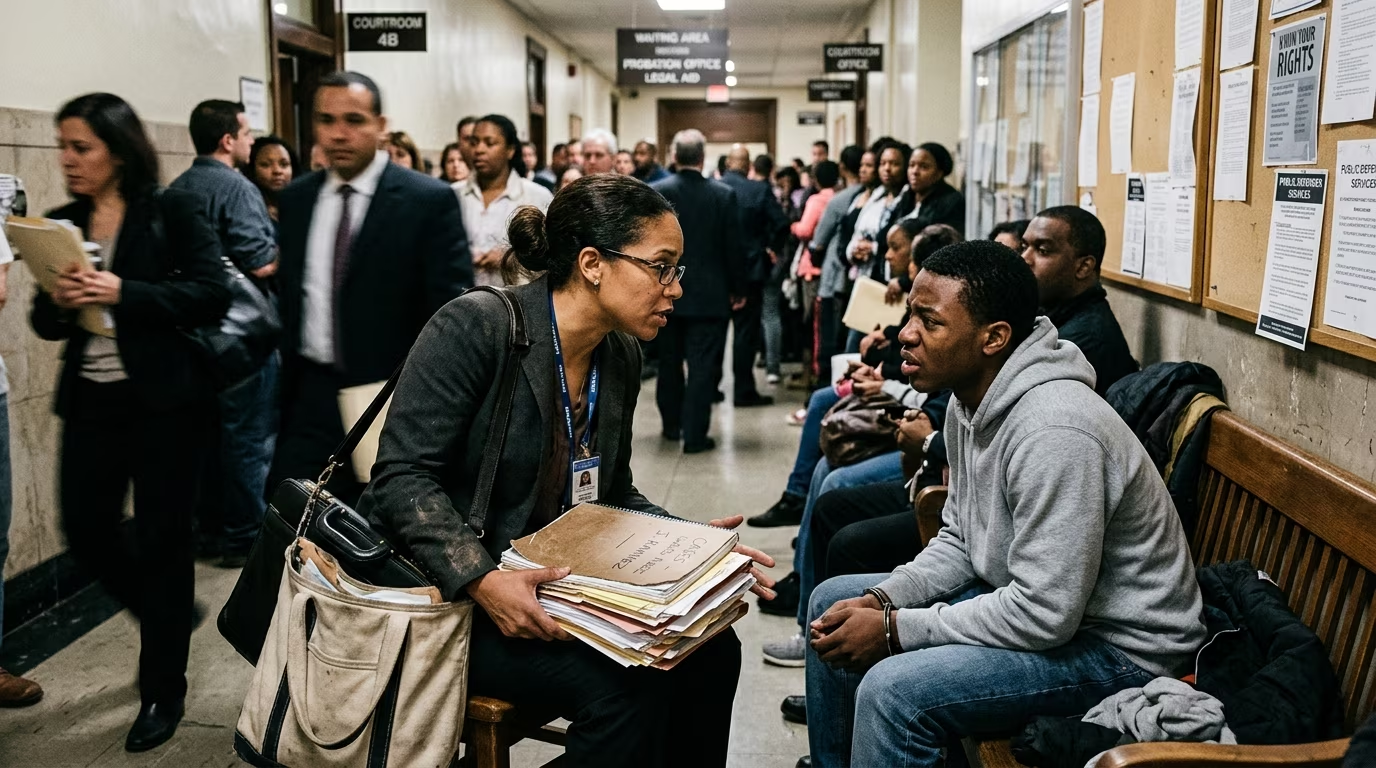
When public defenders are assigned hundreds of cases simultaneously, performing these essential tasks becomes a physical impossibility. Across the country, it is not uncommon for public defenders to juggle caseloads that far exceed recommended national standards. When lawyers are stretched too thin, triage becomes the default strategy. Attorneys are forced into a “meet and plead” system, where they meet their clients for the first time in the courthouse hallway for mere minutes before advising them to accept a plea deal.
Recognizing the severity of this crisis, some states are beginning to take drastic action. For example, the Washington State Supreme Court recently acknowledged that excessive public defender caseloads inherently jeopardize the quality of legal representation. In response, they have moved to adopt new, mandatory caseload limits. Starting in 2026, felony defenders in Washington will eventually be capped at handling no more than 47 cases per year, a stark reduction designed to ensure that every defendant actually receives the thorough defense guaranteed by the Constitution.
The Consequences of an Asymmetrical Justice System
The public defense crisis operates within an adversarial system where the opposing side is heavily armed. There is a glaring asymmetry in resources between the prosecution and the defense in the United States. Police departments and district attorneys’ offices have access to state-funded crime labs, extensive databases, squads of detectives, and specialized expert witnesses. Public defenders, on the other hand, often have to beg for funds just to hire a single investigator or an independent forensic expert.
This power imbalance tilts the scales of justice heavily toward conviction. It forces public defenders to rely almost exclusively on the evidence gathered by law enforcement—the very entity trying to secure a conviction against their client. This lack of independent investigation is a leading cause of wrongful convictions. Without the time or resources to challenge the state’s narrative, innocent people are routinely pressured into pleading guilty to avoid the draconian mandatory minimum sentences that often accompany taking a case to trial and losing.
The consequences of this asymmetrical system fall disproportionately on marginalized communities, particularly Black and Hispanic individuals, who are more likely to be arrested, more likely to rely on public defenders, and more likely to face harsher sentencing. The inability of the state to provide an adequate defense perpetuates cycles of poverty and mass incarceration, devastating families and entire neighborhoods.
Redefining Representation: The Holistic Defense Model
As the limitations of the traditional public defense model have become undeniable, a new paradigm has emerged: holistic defense. Traditional public defense operates reactively, focusing almost exclusively on the criminal charge at hand and navigating the courtroom procedures until a disposition is reached. Holistic defense, however, recognizes that a criminal charge is rarely an isolated incident; it is often the symptom of deeper, systemic issues such as untreated mental illness, substance abuse disorders, housing instability, or extreme poverty.
Holistic defense employs an interdisciplinary, team-based approach. Under this model, a client is represented not just by an attorney, but by a coordinated team that includes social workers, housing advocates, immigration specialists, and mental health professionals. The goal is twofold: to aggressively defend the client against the immediate criminal charges and to address the underlying circumstances that led to their involvement with the criminal justice system in the first place.
A rigorous, large-scale evaluation of holistic defense programs in the Bronx, analyzing over half a million cases, demonstrated the model’s profound impact. The study found that while holistic defense does not significantly alter conviction rates, it successfully reduced the likelihood of a custodial sentence by 16% and shortened sentence lengths by 24%. By prioritizing treatment and stability over incarceration, holistic defense not only achieves better outcomes for clients but also saves millions of taxpayer dollars by reducing jail and prison populations.
A Blueprint for Meaningful Systemic Overhaul
Fixing America’s public defense crisis requires more than piecemeal reforms; it demands a systemic overhaul backed by significant political will and financial investment. Legal scholars and advocacy groups have identified several crucial pillars necessary to stabilize the system and ensure the Sixth Amendment is upheld.
- Mandatory Workload Standards: Workload metrics must be established and rigorously enforced nationwide. Jurisdictions must follow the lead of proactive states by legally capping the number of cases a defender can handle, ensuring they have the necessary time to provide effective counsel. When public defender offices reach capacity, they must be empowered to decline new cases without facing judicial contempt or political retribution.
- Resource Parity: Resource parity between the prosecution and the defense is non-negotiable. Public defender offices must be funded at levels commensurate with district attorneys’ offices. This includes not only equal pay for attorneys to prevent crippling turnover rates, but also equal access to funding for investigators, social workers, and expert witnesses.
- Political Independence: Public defense systems must be granted complete independence from political and judicial interference. In many jurisdictions, public defenders serve at the pleasure of county commissioners or judges, creating an inherent conflict of interest. Independent oversight commissions should be established to insulate defense attorneys from political pressure.
Conclusion
The promise of Gideon v. Wainwright was a noble and transformative ideal: that justice in America should not be a commodity available only to those who can afford it. Yet, sixty years later, the realities of underfunded, overwhelmed, and fundamentally unequal public defense systems threaten to render that promise a hollow legal fiction. Reforming the system is not merely a matter of administrative efficiency; it is a fundamental moral imperative. Until society guarantees that every individual—regardless of their wealth or background—receives robust, effective, and holistic legal representation, the American legal system will continue to fall short of its most basic constitutional commitments.
Frequently Asked Questions (FAQs)
What did Gideon v. Wainwright establish?
Gideon v. Wainwright (1963) is a landmark Supreme Court case that ruled states must provide legal counsel to indigent defendants charged with serious crimes, establishing that the right to an attorney is a fundamental necessity for a fair trial under the Sixth Amendment.
What is a public defender’s average caseload?
While the American Bar Association previously recommended no more than 150 felony cases per attorney per year, many public defenders routinely handle between 200 and 400 cases simultaneously. Some states are now passing strict rules to cap felony caseloads at much lower levels to ensure adequate representation.
What is holistic defense?
Holistic defense is an interdisciplinary approach to legal representation where attorneys work alongside social workers, housing advocates, and mental health professionals to address both the client’s criminal charges and the underlying socioeconomic issues that contributed to their arrest.
Why is the public defense system underfunded?
Because the Supreme Court mandated the right to counsel but did not provide federal funding to pay for it, the financial burden falls on state and local governments. In many places, this relies on county-level budgets, leading to severe resource disparities between affluent and low-income areas.
References
- The Legacy of Gideon v. Wainwright — Department of Justice. 2018-10-24. https://www.justice.gov/archives/atj/legacy-gideon-v-wainwright
- Gideon at 60 — National Institute of Justice. 2023-11-15. https://nij.ojp.gov/topics/articles/gideon-60
- Supreme Court Issues Order Regarding Adoption of Public Defense Caseload Standards — Washington State Office of Public Defense. 2024-03-21. https://opd.wa.gov/news/supreme-court-issues-order-regarding-adoption-public-defense-caseload-standards
- The Effects of Holistic Defense on Criminal Justice Outcomes — Harvard Law Review. 2019-01-10. https://harvardlawreview.org/print/vol-132/the-effects-of-holistic-defense-on-criminal-justice-outcomes/