
The Pioneers of Prehospital Care: Pittsburgh’s Freedom House
How a Black-led ambulance service in the 1960s revolutionized emergency medicine and public safety.
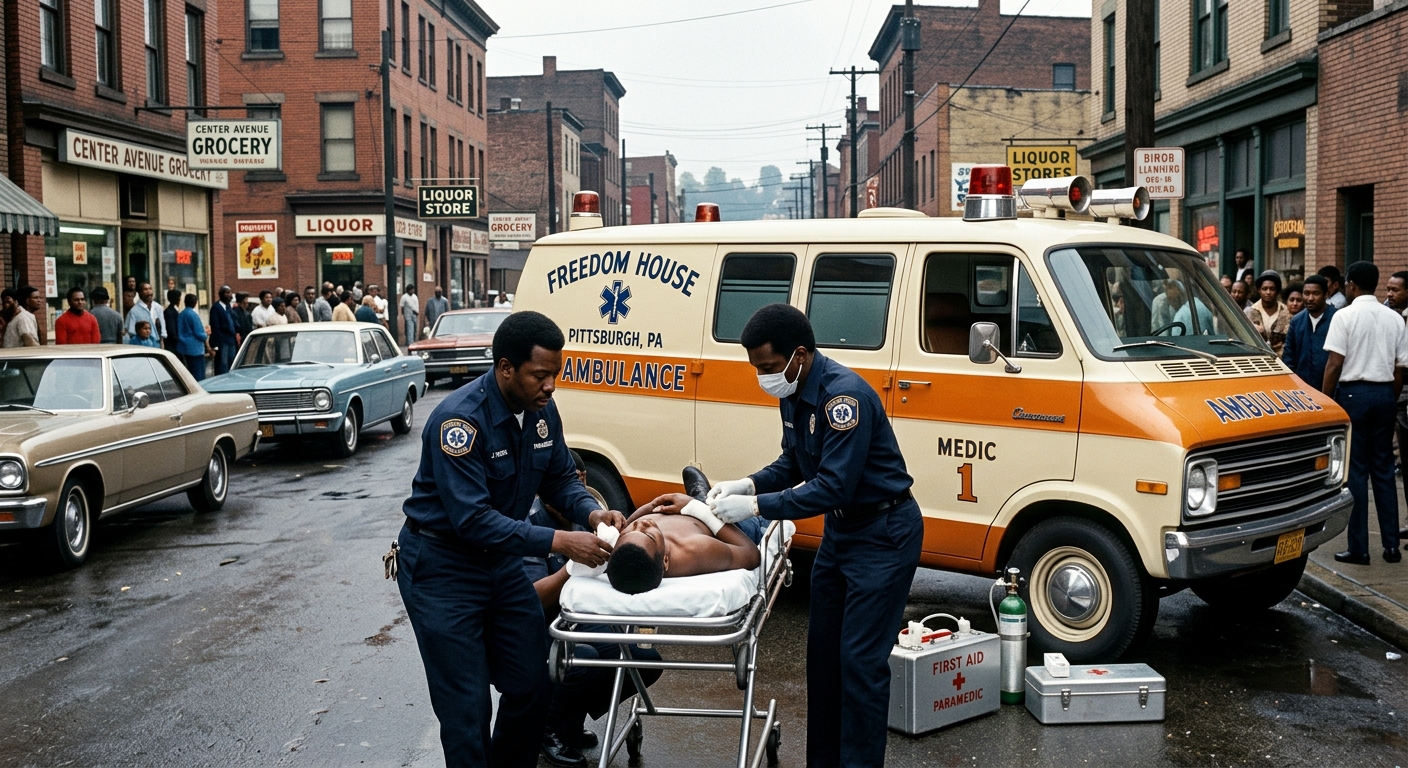
The Forgotten Architects of Emergency Medical Services
Imagine a medical emergency today. You dial 911, and within minutes, a specialized ambulance arrives, staffed by highly trained paramedics equipped with advanced life-support technology. This expectation of rapid, professional prehospital care is a cornerstone of modern public health. However, half a century ago, this system simply did not exist in the United States. The blueprint for modern Emergency Medical Services (EMS) was crafted in a highly unexpected place. In 1967, amid intense civil rights struggles and systemic inequality, a group of Black men in Pittsburgh’s Hill District launched the Freedom House Ambulance Service.
Operating at the intersection of racial justice and medical innovation, they became America’s first true paramedics. Their story is a triumph of medical history and a profound lesson in community empowerment, demonstrating the absolute necessity of compassionate, specialized crisis response. Understanding their legacy requires looking back at the chaotic state of emergency care before they arrived and acknowledging how their revolutionary approach continues to shape modern conversations around equitable public safety.
The Pre-EMS Era: An Era of Hearses and Handcuffs
Before the late 1960s, emergency medical transportation in the United States was largely unregulated and highly perilous. The landmark 1966 federal report, Accidental Death and Disability: The Neglected Disease of Modern Society, noted that up to 50,000 Americans died annually due to inadequate prehospital care. There were virtually no national standards for ambulance design, and transport personnel possessed minimal medical training. Often, local funeral homes provided ambulance services purely because hearses were the only vehicles large enough to transport a patient lying down.
In major cities like Pittsburgh, emergency transport was routinely delegated to the police. Sick or injured individuals were frequently placed in the back of police paddy wagons, unaccompanied by any medical attendants, and rushed to hospitals without any stabilizing care.
For marginalized populations, particularly Black communities, this system was doubly harmful. In Pittsburgh’s predominantly Black Hill District, reliance on police for medical emergencies was fraught with immense tension. The relationship between the police force and the community was characterized by deep mistrust rooted in systemic racism and neglect. When a medical crisis occurred, residents hesitated to call for help, fearing an armed law enforcement response could escalate into violence or an unwarranted arrest. When police did arrive, they completely lacked the clinical skills to stabilize patients suffering from cardiac arrest, severe trauma, or respiratory distress. The need for a health-focused, community-led alternative to police intervention was glaringly apparent.
The Birth of a Visionary Project
The creation of Freedom House Ambulance Service resulted from a unique, powerful coalition among community activists and forward-thinking medical professionals. James McCoy Jr., a prominent civil rights leader and founder of Freedom House Enterprises, recognized the dire need for reliable medical transport in the Hill District. Simultaneously, Philip Hallen, director of the Maurice Falk Medical Fund, sought effective ways to address the escalating public health crisis in Pittsburgh’s underserved Black neighborhoods.
Crucial clinical expertise came from Dr. Peter Safar, a renowned anesthesiologist at the University of Pittsburgh widely recognized as the pioneer of cardiopulmonary resuscitation (CPR). Driven by his deeply held medical philosophy and the tragic death of his 11-year-old daughter from an asthma attack, Safar fiercely believed that bringing intensive care directly to the streets could save countless lives. When Hallen formally connected Safar with McCoy, the visionary triad was formed.
Together, they conceived a radical social and medical experiment: they would train the residents of the Hill District to provide state-of-the-art emergency medical care to their own community, transforming emergency response from a strictly punitive police matter into a life-saving public health initiative.
From “Unemployable” to Medical Pioneers
The recruitment strategy for Freedom House was as groundbreaking as its overarching medical objectives. The program explicitly sought out individuals from the Hill District who had been systematically excluded from the mainstream economy. Many of these recruits were considered “unemployable” by the rigid societal standards of the era; some were returning Vietnam War veterans struggling with post-traumatic stress and substance use, while others had limited formal education or previous encounters with the criminal justice system. They were individuals looking for a second chance to serve.
Under the rigorous tutelage of Dr. Safar and Dr. Nancy Caroline, who later served as the project’s dedicated medical director, these recruits underwent an incredibly intensive 300-hour training program. The curriculum went far beyond basic first aid. It covered advanced anatomy, physiology, complex airway management, electrocardiogram (EKG) interpretation, and intravenous (IV) therapy. This highly robust training eventually formed the foundational basis for the very first national paramedic curriculum adopted by the federal government.
The Freedom House paramedics fiercely defied the low expectations placed upon them by a racially biased society. Operating out of Presbyterian-University Hospital, they manned customized ambulances explicitly designed to Safar’s exact specifications. These distinct vehicles were essentially mobile intensive care units equipped with defibrillators, intubation kits, and specialized medications previously only available inside sterile hospital emergency rooms.
Transforming the Crisis Response Model
The deployment of Freedom House Ambulance Service profoundly altered the dynamic of crisis intervention in the Hill District. When residents called for urgent help, they were met not by armed officers in paddy wagons, but by highly trained, compassionate medical professionals from their own neighborhood. This fundamental shift replaced criminalization with clinical expertise, establishing a deep level of mutual trust that was previously impossible under the outdated police-run model.
The clinical achievements of the Freedom House paramedics were unprecedented in the history of American medicine. They were the first in the nation to successfully intubate patients in the field and among the first to administer life-saving medications outside of a hospital environment. Notably, they spearheaded the use of naloxone to rapidly reverse opioid overdoses out in the community. By carefully titrating naloxone into IV bags, they saved countless lives during severe urban drug epidemics.
Beyond their technical medical prowess, they provided a vital psychological sanctuary for their patients. They treated individuals with inherent dignity, carefully listening to their complex medical histories and forcefully advocating for them upon arrival at the hospital. This community-based approach significantly reduced mortality rates and demonstrated unequivocally that empowering marginalized communities to care for their own yields remarkable public health outcomes.
Institutional Pushback and the Erasure of Pioneers
Despite its undeniable success in establishing the national gold standard for prehospital care, Freedom House faced nearly insurmountable systemic barriers. The sheer excellence of the Black-led ambulance service glaredly highlighted the deep inadequacies of the city’s police-run transport system that operated in predominantly white neighborhoods. As the modern EMS concept gained significant traction and substantial federal funding became available, Pittsburgh’s city administration sought to aggressively consolidate all emergency services into a singular city-run agency.
Rather than integrating the highly trained Freedom House paramedics into leadership roles within this new infrastructure, the administration systematically marginalized them. The city heavily restricted their operating zones, delayed essential funding, and imposed arbitrary bureaucratic hurdles designed to stall operations. In 1975, facing manufactured economic constraints and immense political pressure, Freedom House was abruptly disbanded.
While the city eventually absorbed some Freedom House paramedics into its new EMS department, the transition was extraordinarily hostile. The pioneering Black paramedics were frequently subjected to overt racist treatment, demoted in rank, or forced to retrain under far less experienced white supervisors. Their groundbreaking contributions were largely erased from the official narrative of American emergency medicine for decades. This erasure serves as a stark, sobering reminder of how institutional racism can efficiently dismantle successful, community-led initiatives and casually discard the brilliant innovators who built them.
Modern Echoes: The Resurgence of Alternative Emergency Response
The profound legacy of Freedom House is highly relevant in today’s public policy discourse. A nationwide reckoning with police violence and the counterproductive criminalization of mental health and substance use disorders has sparked urgent demand for alternative emergency response models. Cities across the United States are finally recognizing what the residents of the Hill District knew in 1967: that a vast majority of 911 calls require a medical or social intervention, not an armed law enforcement response.
Modern programs like CAHOOTS (Crisis Assistance Helping Out On The Streets) in Eugene, Oregon, have gained well-deserved national attention for dispatching unarmed medics and crisis workers to behavioral health emergencies instead of traditional police units. These contemporary models closely echo the foundational philosophy of Freedom House: decoupling emergency care from law enforcement to provide safe, compassionate, and highly specialized assistance.
When behavioral health specialists and paramedics respond to non-violent crises, data consistently shows it drastically reduces the likelihood of the use of force, prevents unnecessary jail admissions, and effectively connects vulnerable individuals with essential healthcare resources. The modern movement to boldly reimagine public safety owes a massive debt to the Black pioneers of Pittsburgh, who proved half a century ago that community-led crisis response is vastly superior.
Comparative Analysis of Emergency Response Models
| Feature | Pre-1960s Model (Police/Hearse) | Freedom House Model (1967-1975) | Modern Alternative Response (e.g., CAHOOTS) |
|---|---|---|---|
| Primary Responders | Police officers or local funeral home staff. | Community-based, highly trained Black paramedics. | Unarmed medics, social workers, and trained crisis counselors. |
| Training Level | Basic first aid, if any medical training at all. | Advanced life support, intubation, EKG interpretation, IV therapy. | De-escalation tactics, behavioral health assessment, basic medical triage. |
| Approach to Crisis | Often resulted in criminalization, unwarranted arrest, or severe neglect. | Compassionate, health-focused, and highly dignified community care. | Harm reduction, resource connection, and psychiatric support without force. |
| Patient Transport | Police paddy wagons or hearses without any medical attendants present. | Specially designed mobile intensive care units built for life support. | Specialized mobile units focused heavily on psychiatric stabilization and safe transport. |
Frequently Asked Questions (FAQ)
- What was Freedom House Ambulance Service?
Freedom House Ambulance Service was the first emergency medical service in the United States to be staffed by paramedics with advanced medical training. Founded in 1967 in Pittsburgh, Pennsylvania, the organization was predominantly staffed by Black men from the city’s Hill District. They revolutionized prehospital care by bringing advanced emergency room techniques directly to the streets. - Who were the key figures behind Freedom House?
The visionary initiative was a collaborative effort involving James McCoy Jr., a prominent local civil rights leader; Philip Hallen, a philanthropic leader who provided crucial early funding; and Dr. Peter Safar, a renowned anesthesiologist known globally as the pioneer of CPR, who designed the rigorous medical training curriculum. - Why was Freedom House ultimately disbanded?
Despite setting the national gold standard for paramedic care, Freedom House faced intense systemic racism and political pushback. In 1975, the city of Pittsburgh decided to create its own centralized EMS department. The city administration deliberately withheld funding and created heavy bureaucratic obstacles, ultimately absorbing the service while maliciously marginalizing its highly trained Black paramedics. - How did Freedom House influence modern EMS?
The highly rigorous 300-hour training curriculum developed for Freedom House paramedics became the foundational blueprint for the first national paramedic training standards adopted by the U.S. government. They also pioneered critical field techniques, such as out-of-hospital intubation and the administration of life-saving medications like naloxone. - What are alternative emergency response models?
Alternative emergency response models are modern frameworks that deliberately dispatch healthcare professionals, social workers, or crisis counselors to specific 911 calls—such as mental health crises or substance use emergencies—instead of armed police officers. These models are heavily inspired by the compassionate, non-punitive approach first demonstrated by Freedom House in the 1960s.
A Legacy That Endures
The remarkable story of Freedom House Ambulance Service is a profoundly vital chapter in American history, beautifully illustrating the intersection of advanced medical innovation and grassroots civil rights. The Black paramedics of Pittsburgh’s Hill District completely revolutionized emergency medicine, setting high-quality clinical standards that continue to save lives every single day across the globe. Although their institution was tragically dismantled by systemic racism and complex political maneuvering, their courageous legacy firmly endures within the modern EMS system and in the ongoing national fight to create equitable, compassionate public safety models. Honoring their immense contributions is not merely a long-overdue act of historical correction; it serves as a powerful, enduring inspiration for future generations striving to build community-based systems of care that uplift, protect, and heal communities without the threat of criminalization.
References
- Pittsburgh’s Freedom House Ambulance Service: The Origins of Emergency Medical Services and the Politics of Race and Health — Oxford University Press / PubMed. 2019-10-01. https://pubmed.ncbi.nlm.nih.gov/31593598/
- The Formation of the Emergency Medical Services System — American Journal of Public Health / PMC. 2006-03-01. https://www.ncbi.nlm.nih.gov/pmc/articles/PMC2672225/
- A Conversation with John Moon — National Institutes of Health (NIH) / PMC. 2023-12-15. https://www.ncbi.nlm.nih.gov/pmc/articles/PMC10788647/
- The Case for Non-Police Response to Behavioral Health Crises — Petrie-Flom Center, Harvard Law School. 2021-04-01. https://blog.petrieflom.law.harvard.edu/2021/04/01/non-police-response-behavioral-health-crisis/
Similar Articles








Read full bio of medha deb


