
Online Contract Wraps: Lessons from a Tablet Fire Sale
How shrinkwrap, clickwrap, and browsewrap agreements collide in modern e‑commerce and what recent Ninth Circuit guidance means for enforceability.
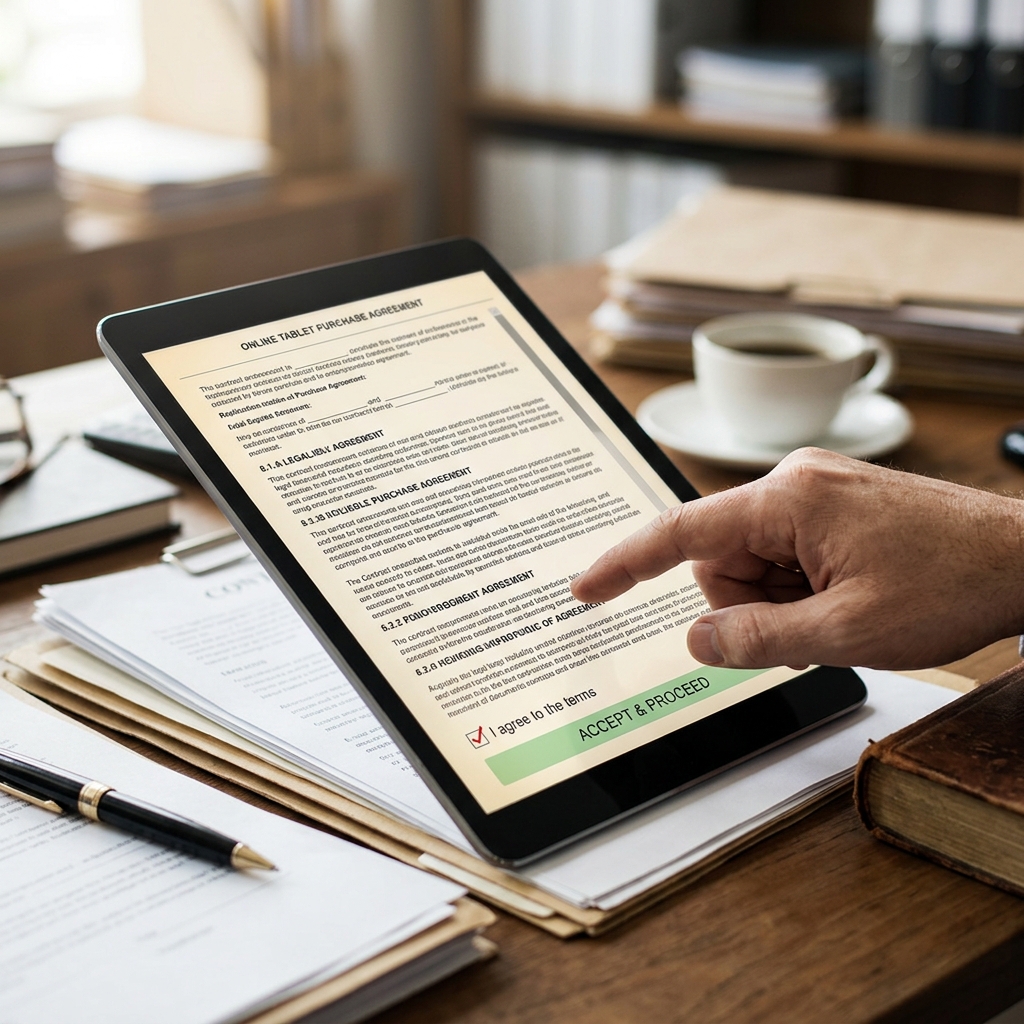
Digital commerce relies on a range of contract forms that look very different from paper agreements or ink signatures. A high-volume tablet “fire sale”—where thousands of customers rushed to buy discounted devices—highlighted just how confusing these online contracts can be when companies mix shrinkwrap, clickwrap, and browsewrap mechanisms in a single transaction.[10]
When disputes arise over issues like mandatory arbitration or warranty limitations, courts have to untangle how a consumer actually agreed to the terms. Recent guidance from the U.S. Court of Appeals for the Ninth Circuit underscores that enforceability turns on two elements: whether the user received reasonably conspicuous notice of the contract terms, and whether they provided unambiguous assent to those terms.
From Boxes to Buttons: What Are “Wrap” Contracts?
Modern software and online services commonly rely on license agreements that are delivered in nontraditional ways. Legal scholars often group these agreements into three categories: shrinkwrap, clickwrap, and browsewrap.
| Type of “wrap” | Where the terms appear | How assent is typically shown | Typical enforceability |
|---|---|---|---|
| Shrinkwrap | Inside or on the packaging of a physical product | Opening the box or using the product is treated as acceptance | Often enforceable when notice is clear and users can return the product |
| Clickwrap | On a screen, linked or displayed near a button or checkbox | Clicking an “I agree” button or checking a box | Routinely upheld as enforceable in U.S. courts |
| Browsewrap | Hyperlinked terms, often at the bottom of a webpage | Continued use of the website is said to imply acceptance | Skeptically viewed; rarely enforced without strong notice |
Shrinkwrap: Contracts You Don’t See Until You Open the Box
Shrinkwrap agreements emerged in the software era, when license terms were printed inside boxes or on inserts. The idea is simple: by opening the packaging or installing the software, the buyer accepts the license governing use of the product.
Court decisions have been mixed, but many have upheld shrinkwrap licenses where:
- Customers are told on the outside of the package that terms are inside.
- The terms inside clearly state that opening or using the product equals acceptance.
- Consumers have a realistic chance to reject the terms (for example, by returning the product).
In the tablet fire sale scenario, shrinkwrap terms may apply to the software running on the devices, separate from the online ordering process. That layering adds complexity when courts must decide which terms govern particular disputes.[10]
Clickwrap: Explicit Online Assent through a Click
Clickwrap agreements present users with terms—often via a link next to a checkbox or button—and require an affirmative action such as clicking “I agree” before proceeding.
Typical features of enforceable clickwrap include:
- A clearly visible link to the terms of service or license.
- Language stating that clicking the button indicates agreement.
- An interface that prevents the user from completing the transaction without clicking to accept.
Because clickwrap demands a clear, recorded act of consent, courts “routinely” find these agreements enforceable. In the tablet sale dispute, any properly implemented clickwrap—such as agreeing to online store terms before checkout—will carry significant weight when courts evaluate whether consumers agreed to arbitration clauses or other restrictions.[10]
Browsewrap: Passive Notice at the Bottom of the Page
Browsewrap agreements rely on the premise that users accept website terms simply by using the site, without clicking a specific assent button.
Browsewrap commonly looks like this:
- A hyperlink titled “Terms of Use” or “Conditions” placed in a footer.
- A statement that continued use of the site means acceptance of those terms.
- No requirement that users open, read, or affirmatively confirm the terms.
Courts have grown increasingly skeptical of browsewrap, emphasizing that implied consent through mere use is rarely sufficient on its own. A recent analysis of litigation found that browsewrap terms succeed in only a small fraction of cases, largely because they fail to provide conspicuous notice or collect clear assent.
The Ninth Circuit has reinforced this skepticism. In a notable decision, it held that online terms are enforceable only when the website provides reasonably conspicuous notice and the consumer takes some action that unambiguously signifies assent—conditions that many pure browsewrap implementations fail to meet.
The Tablet Fire Sale: When Multiple Wraps Collide
The tablet fire sale that sparked debate about shrinkwrap, clickwrap, and browsewrap contracts involved an online retailer unloading devices quickly at deep discounts.[10] Thousands of consumers raced through a checkout process that layered several different sets of terms:
- Online store terms of use (likely presented via clickwrap or browsewrap).
- Manufacturer software licenses inside the tablet packaging (shrinkwrap).
- Supplemental documents or emails linking to additional policies or arbitration agreements.[10]
When a dispute arose—particularly over whether customers were bound to arbitrate rather than sue—the court had to determine which agreement governed and whether consumers had actually agreed to the relevant clauses.[10]
Key Legal Questions Raised by the Fire Sale
The case raised several questions that matter far beyond tablet sales:
- Which contract applies? Does the retailer’s online terms control, or do the device manufacturer’s shrinkwrap terms govern the dispute?
- How was assent captured? Did consumers click an explicit “I agree” box, or were terms only linked at the bottom of the page?
- Is an arbitration clause enforceable? Arbitration provisions are often challenged on the ground that users were not properly informed or did not meaningfully agree to them.[10]
The Ninth Circuit’s broader jurisprudence on online contracts guided the analysis. It confirmed that courts focus on notice and assent rather than simply accepting the presence of a hyperlink as sufficient.
Ninth Circuit Guidance: Notice and Assent in Practice
In recent decisions, the Ninth Circuit has outlined a framework for evaluating whether online terms create an enforceable contract. Unless a user has actual knowledge of the terms, enforceability generally requires two conditions:
- Reasonably conspicuous notice of the terms to which the consumer will be bound.
- Unambiguous assent through an action indicating agreement, such as clicking a button or checking a box.
Apply this to the tablet fire sale:
- If arbitration was tucked into a browsewrap footer link with no special highlight, courts are unlikely to treat it as binding.
- If customers were forced to click a clearly labeled “I agree to the terms, including arbitration” box before purchase, enforceability is much more likely.
- If shrinkwrap terms included arbitration clauses but buyers had no clear warning and no realistic way to reject them, courts may scrutinize those provisions closely.
Designing Enforceable Online Terms: Practical Lessons
Businesses can draw several practical lessons from the tablet dispute and surrounding case law. The goal is not only to secure legal enforceability, but also to respect consumer expectations and reduce the risk of costly litigation.
Prefer Clickwrap over Pure Browsewrap
Legal and compliance guidance increasingly recommends clickwrap as the default mechanism for binding users to online terms.
- Clickwrap directly addresses the courts’ demands for clear notice and affirmative assent.
- Browsewrap by itself is widely regarded as fragile and often unenforceable.
- Using clickwrap at critical points—account creation, checkout, subscription renewal—helps ensure that key clauses (like arbitration or limitations of liability) are backed by clear consent.
Make Terms Conspicuous and Contextual
Courts examine how prominently terms are displayed and whether users had a realistic chance to see them. To strengthen enforceability:
- Place the terms link immediately adjacent to the assent button or checkbox.
- Use readable font size and contrasting colors so the link stands out.
- Include a brief summary or notice explaining that the user’s click signifies agreement to specified terms, including important clauses.
- Highlight particularly impactful provisions (e.g., arbitration, class-action waivers) in plain language.
These design choices can help demonstrate that users received reasonably conspicuous notice, a crucial element in the Ninth Circuit’s framework.
Align Shrinkwrap and Online Terms
Where products come with both packaging-based terms and online agreements, inconsistencies can create confusion:
- Ensure the shrinkwrap license and online store terms do not contradict each other on key issues, such as dispute resolution or warranty scope.
- State clearly which agreement governs particular aspects of the relationship (for example, hardware defects vs. subscription access).
- Consider referencing the shrinkwrap license in the online checkout flow, so consumers understand there are additional physical terms they will receive.
These steps reduce the risk that courts will have to pick between conflicting agreements or conclude that none were clearly accepted.
Common Pitfalls and How to Avoid Them
The tablet fire sale dispute illustrates some frequent mistakes in the implementation of online contracts.
- Hidden terms in footers: Relying solely on a small footer link to impose critical obligations, such as arbitration, is risky. Courts often refuse to enforce such provisions.
- Ambiguous interface design: If the “I agree” checkbox is optional, or if it is pre-checked without clear notice, assent may be deemed ambiguous.
- Overly complex terms: Dense, hard-to-understand language can undermine the claim that users meaningfully agreed to the contract.
- Failure to capture evidence: Without logs showing that users clicked to accept, it is difficult to prove assent in litigation.
Mitigating these risks requires careful collaboration between legal teams, designers, and engineers to build interfaces that both comply with contract law and respect user expectations.
FAQs: Shrinkwrap, Clickwrap, and Browsewrap Explained
Is browsewrap ever enforceable?
Browsewrap can be enforced in limited circumstances, particularly when the user has repeated exposure to conspicuous terms or actual knowledge of them. However, recent court decisions emphasize that passive notice at the bottom of a page rarely suffices; clear notice and some form of affirmative action are preferred.
Do I need users to scroll through my terms for them to be valid?
Courts do not generally require users to scroll through or read every word of the terms. What matters is that the terms are reasonably accessible and that users take an action understood to signify agreement, such as clicking “I agree.” That said, excessively hidden or misleading terms may face scrutiny.
How do arbitration clauses fit into wrap contracts?
Arbitration clauses often appear as part of broader online or shrinkwrap agreements. To enforce them, businesses must show that users had notice of the clause and assented to the underlying agreement. Courts scrutinize whether the arbitration provision was highlighted, clearly explained, and connected to a meaningful act of assent.
Can a product’s shrinkwrap license override online store terms?
Whether shrinkwrap terms override online store terms depends on how the agreements are drafted and presented. If the store’s clickwrap explicitly governs the transaction and the shrinkwrap license is limited to software use, courts may treat them as addressing different aspects of the relationship. Conflicts between the two will be resolved by contract interpretation rules and, in some cases, may weigh against enforcement of unclear provisions.
What is the safest approach for my website?
The safest approach is to implement a clear, well-designed clickwrap system at all critical transactional points, with conspicuous links to terms and explicit language that the user’s click indicates agreement. Avoid relying solely on browsewrap for important obligations, and ensure any shrinkwrap or offline licenses are harmonized with your online terms.
References
- Browsewrap vs. Clickwrap — TermsFeed. 2019-06-18. https://www.termsfeed.com/blog/browsewrap-clickwrap/
- An overview of licenses: shrink-wrap vs. click-wrap vs. browse-wrap — Odin Law & Media. 2017-05-08. https://odinlaw.com/overview-licenses-shrink-wrap-vs-click-wrap-vs-browse-wrap-licenses/
- Clickwrap vs. Browsewrap: What’s the Difference? — Ironclad, Inc. 2022-04-20. https://ironcladapp.com/journal/contracts/clickwrap-vs-browsewrap
- “Clickwrap” v. “Browsewrap”: Recent 9th Circuit Decision Illustrates That Enforceability of Website Terms and Conditions Lies in the Details — Maddin, Hauser, Roth & Heller, P.C. 2022-03-23. https://www.maddinhauser.com/clickwrap-v-browsewrap-recent-9th-circuit-decision-illustrates-that-enforceability-of-website-terms-and-conditions-lies-in-the-details/
- Clicking and Cringing: Making Sense of Clickwrap, Browsewrap and Shrinkwrap Licenses — Nancy S. Kim, California Western School of Law. 2010-01-01. https://scholarlycommons.law.cwsl.edu/fs/52/
- Shrinkwrap, clickwrap and browsewrap contracts — Cambridge University Press (chapter excerpt). 2007-01-01. https://resolve.cambridge.org/core/services/aop-cambridge-core/content/view/5C1C59D7D184DB14924223221F2DF458/9780511818400c4_p66-73_CBO.pdf/shrinkwrap-clickwrap-and-browsewrap-contracts.pdf
Similar Articles








Read full bio of medha deb


