
Minnesota Trespass Law: What To Know About Charges & Penalties
A practical guide to when entry becomes trespass, what penalties may apply, and how Minnesota treats posted land, refusals to leave, and protected property.
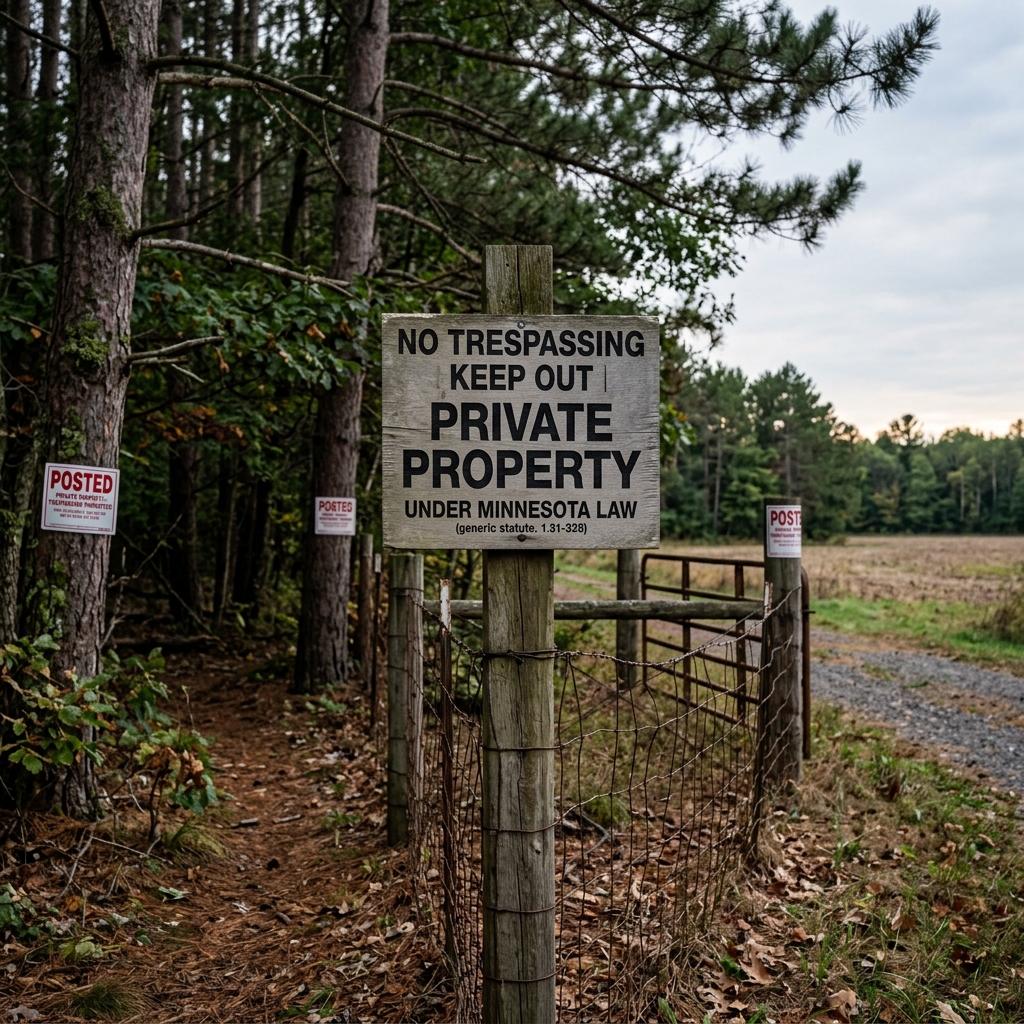
In Minnesota, trespass is not limited to breaking into a building or sneaking onto land at night. A person can violate the law by entering or staying on property without permission, especially after receiving a clear warning, seeing lawful posted signs, or being told to leave. The exact charge and penalty depend on where the conduct occurred and how the person entered or remained on the property.
This article explains how Minnesota criminal trespass works in everyday terms. It covers the basic rule, the difference between misdemeanor and gross misdemeanor treatment, the role of warning signs and notices, and the most common situations that lead to charges. It also reviews defenses and answers common questions about landowners, visitors, and outdoor recreation.
What counts as trespass in Minnesota?
At its core, trespass means being on another person’s property without legal permission. That can happen in several ways:
- Entering private property without consent
- Remaining on property after permission has been withdrawn
- Ignoring a lawful notice not to enter
- Crossing onto posted land that clearly warns people away
Under Minnesota law, the act does not have to involve damage, theft, or another separate crime. The unlawful entry or continued presence can be enough by itself when the facts meet the statute’s requirements.
Why permission matters so much
Consent is the dividing line between lawful presence and trespass. A person may initially enter property legally, such as a guest, customer, contractor, or visitor. But once the owner or lawful occupant revokes permission and asks the person to leave, staying behind can turn into a criminal issue.
That is why many trespass cases begin with a dispute over notice. If someone was invited, the invitation does not last forever. If someone was never invited in the first place, the absence of permission may be enough to support a trespass charge depending on the property and circumstances.
When the offense is a misdemeanor
Most basic trespass violations in Minnesota are treated as misdemeanors. A misdemeanor conviction can carry up to 90 days in jail and a fine of up to $1,000. The law focuses on unauthorized entry or remaining on another person’s land, especially when the person ignores a warning to leave or enters property that has been properly marked.
Simple misdemeanor trespass often involves one of these situations:
- A person walks onto private land without asking
- A visitor refuses to leave after being told to depart
- A person stays on premises after permission expires
- Someone enters an area that has been clearly posted against trespass
When trespass becomes a gross misdemeanor
Minnesota law increases the seriousness of some trespass conduct. A gross misdemeanor may apply when a person knowingly ignores posted signs, trespasses after being personally notified not to trespass, or has prior qualifying violations within a three-year period. A gross misdemeanor can carry up to one year in jail and a fine of up to $3,000.
This higher level of punishment reflects the idea that some trespass is more deliberate than casual or mistaken entry. A clear sign or direct warning gives the person notice, and ignoring that notice can lead to harsher consequences.
How posted land rules work
Posted signs are central to many trespass cases in Minnesota. Property owners, tenants, and other lawful occupants may use signs to place the public on notice that entry is prohibited. For certain land, especially outdoor or agricultural property, the statute and related regulations describe how signs should be placed so they are visible and effective.
In general, a lawful posting must be conspicuous enough to warn a reasonable person. The exact posting requirements can vary depending on the type and size of the property. On larger tracts, signs may need to appear at regular intervals and at access points or corners so the warning is not hidden or uncertain.
| Situation | Why it matters | Possible result |
|---|---|---|
| Private land with no permission | Entry may be unauthorized even if no confrontation occurs | Possible misdemeanor trespass |
| Posted land with visible warning signs | Ignoring the warning shows notice | Possible gross misdemeanor |
| Personal notice to leave or stay out | Direct notice can establish intent | Possible misdemeanor or gross misdemeanor |
| Repeated violations | Prior conduct can increase the charge level | Enhanced penalties may apply |
Special rules for schools and other sensitive locations
Some places receive special treatment because of safety concerns. Schools are one example. Minnesota law includes separate rules for being in school buildings without a lawful reason, which can lead to criminal liability even when the conduct might not fit a generic trespass scenario. The law is designed to protect students, staff, and educational operations from unauthorized presence.
Other secure or restricted locations may also create stronger trespass exposure if access barriers, signs, or security controls make it obvious that entry is prohibited. In these settings, even a short intrusion may have serious consequences because the location itself is protected by heightened rules.
What happens on agricultural and outdoor property?
Minnesota treats outdoor recreation and farmland carefully because these spaces are often used for hunting, fishing, trapping, hiking, camping, and commercial animal production. The law recognizes that landowners have a strong interest in controlling access to fields, pastures, and posted recreational land.
People who ignore posted agricultural land or enter without permission may face criminal penalties. In some cases, the law can be stricter when domestic animals or commercial agricultural uses are involved. The policy goal is to protect livestock, prevent disruption, and respect the landowner’s right to exclude others.
Outdoor users should also understand that a lack of obvious structures does not mean the land is open to the public. A field, woodlot, or grazing area can still be private property. If signs are posted or permission has not been granted, entering the property may be unlawful.
Common situations that lead to trespass charges
Trespass cases often arise from ordinary conduct that crosses a legal line. Typical examples include:
- Cutting across private land as a shortcut
- Entering a business after being ordered to leave
- Staying on a neighbor’s property to protest, argue, or wait for someone
- Ignoring a gate, fence, or sign that clearly restricts access
- Entering land used for livestock or crop production without approval
These cases often turn on evidence that the person knew or should have known that the property was off limits. Witness statements, security footage, signs, fences, written notices, and prior warnings can all matter.
Does the law require damage or criminal intent?
Not necessarily. Trespass is primarily an offense about unauthorized presence, not property destruction. A person does not have to break windows, damage equipment, or steal anything to face a charge. Likewise, some forms of trespass can be proven even if the person claims they were just passing through or did not realize they were not allowed.
That said, intent can still matter in practice. A person who knowingly ignores signs or a direct warning is more likely to face a stronger case than someone who entered by honest mistake. The surrounding facts often determine whether a prosecutor treats the matter as minor or more serious.
Possible defenses to a trespass allegation
Every case depends on the facts, but several defenses are commonly raised in Minnesota trespass matters:
- Permission: The person had consent to be there.
- Ambiguous boundaries: The property line or access restriction was not reasonably clear.
- Lack of notice: No valid sign or direct warning was given.
- Mistake of fact: The person reasonably believed the area was open to the public.
- Necessity: An emergency justified entry, such as seeking safety or preventing immediate harm.
These defenses are not automatic. For example, a person who says they did not see a sign may still face liability if the sign was plainly visible. But in a close case, evidence of consent, unclear markings, or emergency circumstances may significantly weaken the prosecution’s case.
Practical steps for property owners
Property owners can reduce trespass problems by making access rules obvious and documenting warnings. Helpful steps include:
- Posting signs in visible locations
- Using fences, gates, or other physical barriers where appropriate
- Giving direct notice when a person must leave or stay away
- Keeping records of prior warnings or incidents
- Contacting law enforcement when a trespasser refuses to depart
Clear communication is important because criminal cases are often stronger when the property owner can show that the individual had unmistakable notice. Even where a sign alone might be enough, combining a sign with a direct warning often creates a stronger record.
Frequently asked questions
Can someone be charged if they did not know the land was private?
Yes. Lack of knowledge is not always a complete defense. If the land was posted, the person was told to leave, or the property was otherwise clearly restricted, a charge may still be possible.
Is trespass only a problem if the person enters a building?
No. Entering or remaining on land can be enough. In many cases, the law applies before a person ever reaches a structure.
What if a person was invited earlier in the day?
Permission can be revoked. Once the owner or lawful occupant tells the person to leave, the original invitation may no longer protect continued presence.
Are all trespass cases treated the same?
No. Minnesota law distinguishes between basic trespass and more serious conduct involving posted land, personal notice, repeated violations, school property, and other protected settings.
Can outdoor recreation lead to trespass liability?
Yes. Hunting, fishing, hiking, trapping, camping, and similar activities can create trespass problems if a person enters posted or restricted land without permission.
Why trespass charges matter beyond the fine
A trespass conviction can affect more than jail time or a monetary penalty. It may also affect future interactions with property owners, outdoor licensing in certain circumstances, and the way prosecutors view later conduct. For repeated incidents, the consequences can become more serious over time.
Because the line between lawful presence and criminal trespass can depend on signs, notices, and consent, people should pay close attention to boundaries before entering land that is not obviously open to the public. When in doubt, the safest approach is to ask first and leave immediately if permission is denied.
References
- Sec. 609.605 Minnesota Statutes — Revisor of Statutes. 2026-07-10. https://www.revisor.mn.gov/statutes/cite/609.605
- Sec. 97A.315 Minnesota Statutes — Revisor of Statutes. 2022-01-01. https://www.revisor.mn.gov/statutes/2022/cite/97A.315
- Trespass law — Minnesota Department of Natural Resources. 2026-07-10. https://www.dnr.state.mn.us/hunting/trespass-law.html
- Trespass procedures — Hennepin County. 2026-07-10. https://www.hennepincounty.gov/government/about/policies/trespass-procedures
- NOTICE OF TRESPASS FORM — Brown County, Minnesota. 2026-07-10. https://www.browncountymn.gov/DocumentCenter/View/511
Similar Articles








Read full bio of Sneha Tete




