
Limits on Cell Phone Searches After an Arrest
How the Fourth Amendment and modern Supreme Court rulings restrict police access to cell phone data during and after an arrest.
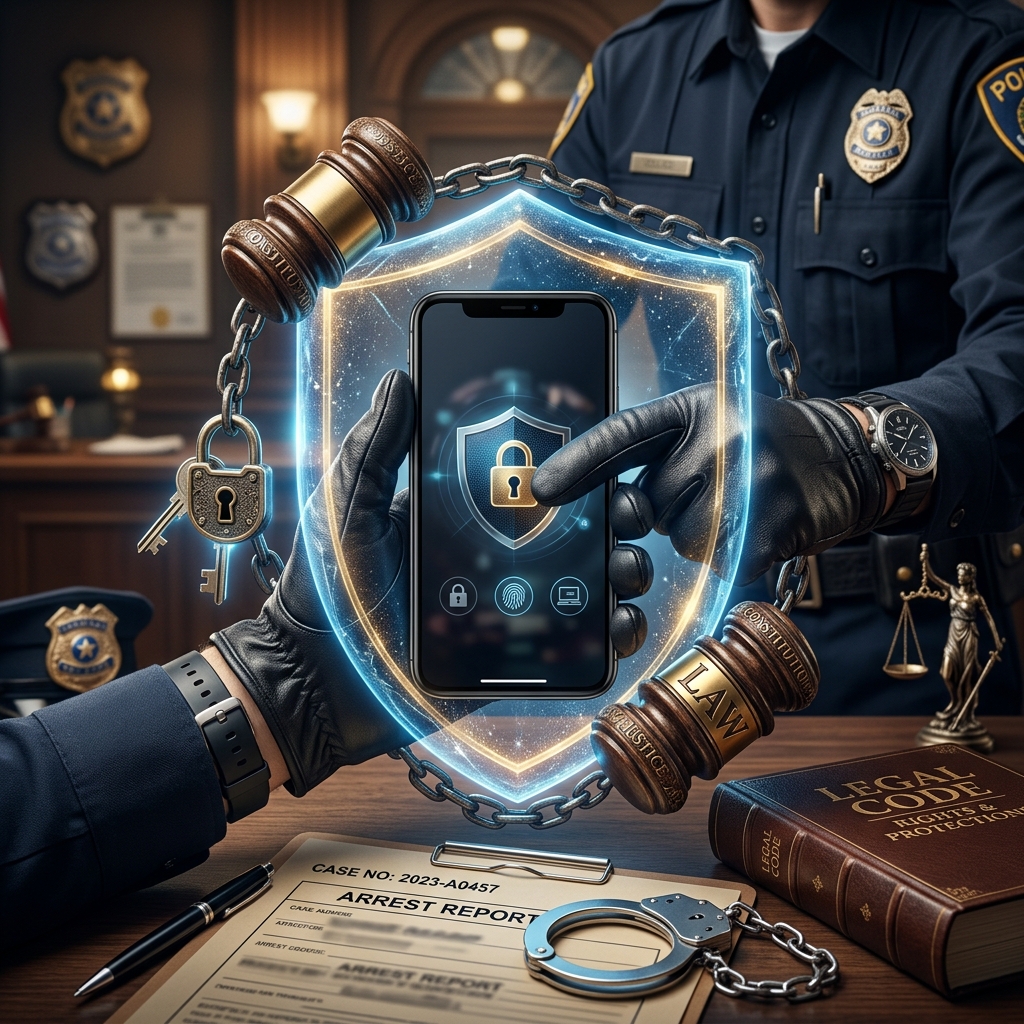
The rise of smartphones has forced courts to rethink long-standing rules about what police may search without a warrant when someone is arrested. Under modern Fourth Amendment doctrine, officers generally must obtain a warrant before searching the digital contents of an arrestee’s cell phone, subject to a few narrow and case-specific exceptions.
Understanding the Fourth Amendment Framework
The starting point for analyzing cell phone searches is the text and history of the Fourth Amendment to the United States Constitution.
- Protection against unreasonable searches and seizures — The Fourth Amendment prohibits government agents from conducting searches or seizures that are unreasonable.
- Warrant requirement — As a general rule, a search that intrudes on a reasonable expectation of privacy must be authorized by a warrant supported by probable cause and particularity.
- Limited exceptions — Over time, the Supreme Court has recognized specific exceptions (such as searches incident to arrest and exigent circumstances) that allow warrantless searches in narrowly defined situations.
Historically, these principles were applied to physical spaces and tangible items like homes, vehicles, and paper documents. The challenge in the smartphone era has been adapting those concepts to digital data, which can reveal far more about a person than any single physical object.
The Traditional Rule: Searches Incident to Arrest
One of the most important exceptions to the warrant requirement is the search incident to lawful arrest. This doctrine allows officers to conduct a limited, immediate search without a warrant when they make a custodial arrest.
Under Supreme Court precedent, including Chimel v. California and later cases, a search incident to arrest is tied to two main justifications:
- Officer safety — Police may search the arrestee and areas within their immediate reach to ensure there are no weapons that could be used to cause harm.
- Preservation of evidence — Officers may also look for and secure physical evidence that could be quickly destroyed or concealed.
These searches have traditionally included:
- Pat-downs of the arrestee’s clothing and person
- Inspection of items carried on the person, such as wallets or containers
- Limited searches of nearby areas and, in certain circumstances, vehicles recently occupied by the arrestee
For many years, some courts treated cell phones like other physical items found on the person. That meant officers could, in some jurisdictions, search phone contents without a warrant as long as the device was seized incident to arrest.
Why Cell Phones Raise Unique Privacy Issues
Smartphones fundamentally changed the analysis because they combine the functions of multiple traditional objects—address books, diaries, photo albums, financial records, and more—into a single device.
Several characteristics make cell phone data especially sensitive:
- Massive storage capacity — Modern phones can store years of texts, emails, photos, videos, and app data in one place.
- Rich personal detail — A phone may contain health information, banking records, social media activity, location history, and intimate communications.
- Continuous tracking — Location data and other metadata can reveal a detailed record of a person’s movements and associations over time.
- Cloud integration — Phones often provide access to remote servers, meaning a search of the device can effectively open the door to vast online repositories of data.
Because of these features, courts have recognized that searching the contents of a phone is qualitatively different from inspecting a few physical items found in someone’s pockets. It implicates far broader privacy interests.
Riley v. California: The Turning Point
The Supreme Court addressed these issues directly in Riley v. California, a landmark case that consolidated two separate prosecutions involving cell phone searches incident to arrest.
In a unanimous decision, the Court held that police generally may not search the digital information on a cell phone seized from an arrestee without first obtaining a warrant.
| Issue | Pre-Riley Approach | Riley Holding |
|---|---|---|
| Authority to search phone data incident to arrest | Many courts allowed warrantless searches of phone contents if the device was lawfully seized during arrest. | Officers must generally get a warrant before reviewing digital information on the phone. |
| Justification based on officer safety | Some rulings treated phones like containers that could be searched for weapons or dangerous items. | Digital data cannot itself threaten officer safety in the same way; this justification does not support broad data searches. |
| Justification based on evidence preservation | Concerns about remote wiping or encryption sometimes used to support immediate access. | Court emphasized less intrusive alternatives and concluded that privacy interests outweigh generalized evidence concerns. |
Chief Justice Roberts summarized the rule with unusual clarity: for cell phone data searches incident to arrest, the answer to what police must do is simple—get a warrant.
Practical Effect: What Police May Still Do Without a Warrant
Although Riley sharply limited data searches incident to arrest, it did not eliminate all warrantless actions involving cell phones.
Officers may generally still:
- Seize the phone — Police may take physical control of a phone found on an arrestee as part of the booking process or to prevent destruction or concealment of evidence.
- Examine the physical device — Inspecting the exterior of the phone (e.g., brand, model, serial number) for identification or inventory does not ordinarily implicate the same privacy concerns as data access.
- Disable notifications or network connections — Basic steps to prevent remote wiping or incoming communications can often be taken without a warrant, as long as officers do not access the contents.
However, once officers go beyond these limited actions and begin to review texts, call logs, photos, app contents, or other data, the general rule is that a warrant is required.
Exigent Circumstances: The Main Remaining Exception
Riley explicitly left open the possibility that the traditional exigent circumstances exception to the warrant requirement could justify a warrantless phone data search in rare situations.
Exigent circumstances typically include scenarios such as:
- Imminent danger — When there is an immediate threat to life or serious injury, officers may act without a warrant if necessary to respond effectively.
- Risk of evidence destruction — If there is a concrete, time-sensitive risk that evidence will be destroyed before a warrant can practically be obtained, a narrow search may be allowed.
- Hot pursuit — During active pursuit of a suspect, rapid access to certain data may be needed to prevent escape or harm.
Under this approach:
- Courts look to the totality of the circumstances to decide whether a genuine exigency existed.
- The scope of any warrantless search must be closely tailored to addressing the emergency and cannot be used as a pretext for broad data access.
Riley emphasizes that such situations are the exception, not the rule. In most routine arrests, there is time for officers to secure the device and then seek a warrant before reviewing its contents.
Related Developments: Location Data and Beyond
The Supreme Court has applied similar reasoning in other cases involving cell phones and digital records. For example, in Carpenter v. United States, the Court held that police must obtain a warrant to access long-term historical cell-site location records because they reveal detailed information about a person’s movements.
This trend highlights a broader recognition that:
- Digital data often requires heightened Fourth Amendment protection due to its depth and scope.
- Traditional doctrines, such as the third-party doctrine and search incident to arrest, cannot simply be applied to new technologies without careful analysis of privacy implications.
State-level authorities, including courts and legislatures, have also adopted rules consistent with Riley, reinforcing that the default expectation is a warrant before accessing cell phone contents.
Implications for Defendants, Officers, and Practitioners
The modern framework for cell phone searches incident to arrest carries important consequences for different participants in the criminal justice system.
For Individuals and Defendants
- Expectation of privacy — People have a recognized privacy interest in the contents of their phones, which courts treat as significant under the Fourth Amendment.
- Potential suppression of evidence — If officers conduct a warrantless phone data search without a valid exception, defendants may move to have resulting evidence excluded.
For Law Enforcement Officers
- Need for training — Officers must be familiar with the limits imposed by Riley and related decisions to avoid unlawful searches.
- Use of technology tools — Agencies increasingly rely on digital forensic tools, but those tools typically must be deployed only after obtaining a proper warrant.
- Documentation of exigent circumstances — When relying on an exception, officers should carefully document the facts that made immediate action necessary.
For Defense Attorneys and Judges
- Scrutinizing warrants — Practitioners must analyze whether warrants for phone data satisfy probable cause and particularity requirements, given the breadth of information on devices.
- Applying narrow exceptions — Courts must evaluate claims of exigent circumstances or other exceptions in light of the strong privacy interests recognized in Riley.
Frequently Asked Questions
Do police always need a warrant to look through my cell phone after an arrest?
In ordinary circumstances, yes. After Riley v. California, officers who seize a phone incident to arrest generally must obtain a warrant before searching its digital contents, unless a recognized exception such as exigent circumstances applies.
Can officers take my phone when they arrest me?
Yes. The search incident to arrest doctrine permits police to seize items on the arrestee’s person, including a cell phone, to ensure safety and preserve evidence. The key limitation is on searching the data on the device without a warrant.
What counts as an exigent circumstance for a phone search?
Exigent circumstances are urgent situations where delaying a search to obtain a warrant would risk serious harm or the loss of critical evidence, such as an immediate threat to life or a concrete, imminent danger that data will be destroyed. Courts assess these claims case by case, based on all relevant facts.
Does the same rule apply to tablets and other digital devices?
Although Riley focused on cell phones, its reasoning about digital privacy and storage capacity has been applied by courts and commentators to other portable electronic devices, such as tablets and smartphones generally, because they raise comparable privacy concerns.
How does location tracking from my phone fit into these protections?
In Carpenter v. United States, the Supreme Court held that police need a warrant to obtain extended historical cell-site location records because they reveal detailed information about a person’s movements over time. This decision complements Riley by recognizing strong privacy interests in certain categories of digital data.
References
- Constitutional Limits to Cell Phone Searches Incident to Arrest — FindLaw / Thomson Reuters. 2023-05-01. https://www.findlaw.com/legal/practice/practice-guide/constitutional-limits-to-cell-phone-searches-incident-to-arrest.html
- Fourth Amendment — Electronic Privacy Information Center (EPIC). 2023-11-15. https://epic.org/issues/privacy-laws/fourth-amendment/
- Search Incident to Arrest :: Fourth Amendment — Justia. 2022-09-10. https://law.justia.com/constitution/us/amendment-04/15-search-incident-to-arrest.html
- Massachusetts Law About Cell Phone Searches — Massachusetts Government (Mass.gov). 2024-01-05. https://www.mass.gov/info-details/massachusetts-law-about-cell-phone-searches
- Do Warrantless Searches of Electronic Devices at the Border Violate the Fourth Amendment? — Congressional Research Service. 2022-08-01. https://www.congress.gov/crs-product/LSB10387
- Cell Phone Searches After Riley: Establishing Probable Cause and Particularity — Pace Law Review. 2016-01-01. https://digitalcommons.pace.edu/cgi/viewcontent.cgi?article=1931&context=plr
- Constitutional Restraints on Warrantless Cell Phone Searches — University of Miami Law Review. 2015-01-01. https://repository.law.miami.edu/cgi/viewcontent.cgi?article=3063&context=umlr
Similar Articles








Read full bio of medha deb




