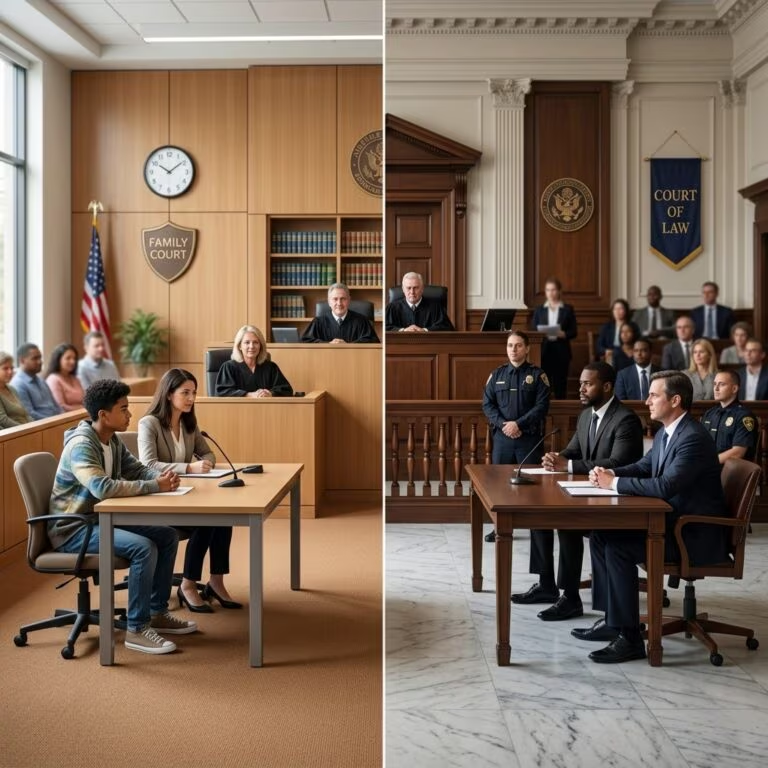
Grand theft allegations can lead to serious felony consequences, but a charge is not the same as a conviction. In every criminal case, the prosecution must prove the elements of the offense beyond a reasonable doubt, and there are multiple legal defenses that may prevent a conviction or reduce the severity of the charges.
This article explains the key concepts behind grand theft, common defense strategies, and what an accused person should understand when confronting these complex cases. It is educational in nature and does not substitute for advice from a licensed attorney.
Understanding Grand Theft: Legal Basics
Although laws vary by jurisdiction, grand theft generally refers to the unlawful taking of property with a relatively high value, making it more serious than petty or simple theft. The value threshold is set by statute in each state and often determines whether the offense is a misdemeanor or a felony.
- Value threshold: Many states distinguish grand theft from petty theft based on a statutory dollar amount. For example, Florida law currently uses a threshold of $750 or more for certain grand theft charges.
- Felony classification: When the value of property increases, the offense usually moves into higher felony categories, with longer potential prison terms and larger fines.
- Core elements: Prosecutors typically must prove that the accused took property, that the property belonged to someone else, and that the accused intended to permanently deprive the owner of it.
Because grand theft is a felony in many jurisdictions, a conviction can affect employment, professional licensing, immigration status, and civil rights. These stakes make a carefully planned defense strategy essential.
Core Principle: The Prosecution Bears the Burden of Proof
In all criminal cases in the United States, including grand theft, the prosecution has the burden of proving every element of the crime beyond a reasonable doubt. The defense does not have to prove innocence; instead, it aims to create reasonable doubt or demonstrate that legal requirements for conviction have not been met.
This burden of proof shapes how defense strategies are developed:
- Presumption of innocence: The accused is legally presumed innocent unless and until the prosecution proves guilt to the required standard.
- Reasonable doubt: Defense counsel focuses on weaknesses in the evidence and alternative explanations to show that the facts do not clearly support guilt.
- Element-by-element analysis: Common defenses often target specific elements such as intent, ownership, value of property, or consent.
Major Substantive Defenses to Grand Theft
Substantive defenses directly challenge whether the accused committed the crime as defined by law. Below are some of the most frequently raised defenses in grand theft prosecutions.
Lack of Criminal Intent
Intent is a central element of grand theft. Prosecutors generally must show that the accused intended to permanently deprive the owner of the property or to use it for personal gain without authorization.
A defense based on lack of intent argues that, even if the property was taken, the mental state required by the statute was not present.
- Accidental taking: The accused might have picked up the wrong item or taken property mistakenly, without realizing it belonged to someone else.
- Temporary use: In some situations, there may have been an intention to borrow the property and return it, not permanently keep it.
- Good faith belief: The accused may have reasonably believed that they had permission or a legal right to take the property.
When arguing lack of intent, defense counsel often relies on surrounding circumstances, witness testimony, and the accused’s behavior before and after the incident.
Claim of Right or Ownership
A claim of right defense asserts that the accused believed in good faith that the property belonged to them or that they had a legal interest in it. If the defendant had a legitimate ownership claim, the taking may not qualify as theft.
Examples of situations where this defense may arise include disputes over jointly owned property, misunderstandings regarding sales or gifts, or disagreements about repayment of debts using collateral.
Evidence supporting this defense often involves documentation such as receipts, contracts, titles, emails, or messages showing that the accused reasonably thought the property was theirs or that they were entitled to take possession.
Consent and Authorization
Another core element of theft is that the taking must be without the owner’s consent. If the owner or an authorized agent allowed the accused to take or use the property, the absence of consent may be impossible to prove.
- Explicit consent: Direct permission, written or oral, can negate the claim that the property was unlawfully taken.
- Implied consent: Ongoing practices or relationships may suggest that the accused had implied authorization, such as an employee routinely using equipment for work-related tasks.
- Scope of consent: Disputes sometimes center on whether the accused exceeded the permission given, which affects whether the conduct falls within the theft statute.
Mistake of Fact
Mistake of fact arises when the accused acted under a factual misunderstanding that, if true, would have made their conduct lawful. For example, taking a suitcase at an airport because it appears identical to one’s own can be framed as a mistake, not theft.
Courts examine whether the mistake was genuine and reasonable under the circumstances, and whether it directly relates to the element of knowledge that the property belonged to someone else.
Duress or Coercion
In a duress defense, the accused argues that they committed the act because they were forced to do so by threats of serious harm to themselves or others. The law recognizes that genuine coercion can undermine voluntary criminal responsibility.
- The threat must typically be immediate or imminent and of sufficient severity.
- The accused must demonstrate that they had no reasonable alternative but to comply.
- Duress does not usually excuse crimes committed for financial convenience alone; it is reserved for extreme situations involving safety or life threats.
Mistaken Identity and Alibi
Eyewitness errors, poor visibility, stress, and memory issues can lead to mistaken identification of suspects. Defense counsel may challenge identification procedures and highlight inconsistencies.
An alibi defense shows that the accused was somewhere else when the theft occurred. Supporting evidence can include time-stamped records, surveillance footage, or witness testimony.
Voluntary Abandonment (Withdrawal)
In some jurisdictions, the law recognizes that a person who voluntarily abandons a criminal attempt—before completion and without pressure from law enforcement—may use this as a partial or complete defense in certain inchoate offenses. In theft cases, voluntary abandonment might be relevant at the attempt stage, although its exact effect depends on local law.
Procedural and Evidentiary Defenses
Beyond questioning whether a theft occurred, defense strategies often target how evidence was obtained and whether it is admissible. Constitutional protections and criminal procedure rules can lead to suppression of evidence and weakening of the prosecution’s case.
Illegal Search and Seizure
The Fourth Amendment to the U.S. Constitution protects individuals from unreasonable searches and seizures by government agents. Evidence collected in violation of these protections may be excluded from trial.
- Lack of warrant or valid exception: If officers searched a vehicle, home, or personal belongings without a warrant or justified exception, key evidence might be suppressed.
- Overbroad warrants: Warrants that do not describe the place to be searched or items to be seized with sufficient particularity can be challenged.
- Unlawful stops: Improper traffic stops or detentions may render subsequent searches unconstitutional.
Challenging the Reliability of Evidence
A strong grand theft defense frequently involves scrutinizing the prosecution’s evidence piece by piece.
- Witness credibility: Defense counsel may highlight inconsistencies, bias, or limited perception affecting eyewitness reliability.
- Surveillance footage: Video may be unclear, incomplete, or poorly authenticated, creating room for doubt.
- Chain of custody: Gaps in documenting how evidence was handled can raise questions about tampering or contamination.
Challenging the Valuation of Property
The value of property is often critical in determining whether a theft is classified as grand theft or a lesser offense. Prosecutors typically must prove the fair market value of the property at the time of the alleged offense.
Defense strategies may involve:
- Arguing that the property is worth less than claimed, potentially reducing the charge to a lower-degree felony or petty theft.
- Using expert testimony or documentation (such as appraisals or depreciation data) to show a lower fair market value.
Disputes over value can have major sentencing implications, and careful analysis of market prices and property condition is often required.
Strategic Considerations in Building a Grand Theft Defense
Defending a grand theft case is not only about choosing legal defenses; it also involves broader strategic planning.
Case Assessment and Evidence Review
Defense attorneys typically begin by thoroughly reviewing all evidence disclosed by the prosecution, including police reports, witness statements, video recordings, and forensic analysis.
This review helps identify potential defenses, procedural violations, and gaps in the prosecution’s theory of the case.
Plea Negotiations and Charge Reductions
In some situations, pursuing a negotiated resolution may be in the accused’s best interest. Plea discussions can lead to reduced charges, such as conversion of grand theft to petty theft, or agreements limiting possible sentences.
The decision to accept or reject a plea offer depends on the strength of the evidence, the availability of defenses, and the long-term consequences of a conviction.
Mitigating Factors
Even when evidence of guilt is strong, presenting mitigating circumstances can influence sentencing. Factors such as lack of prior criminal history, restitution to the victim, cooperation with authorities, and personal hardships may persuade the court to impose a less severe penalty.
Illustrative Comparison of Key Grand Theft Defenses
| Defense Type | Main Legal Focus | Typical Evidence Used |
|---|---|---|
| Lack of Intent | Challenges mental state required for theft | Testimony about misunderstanding, conduct before/after incident, communications |
| Claim of Right | Argues belief in ownership or legal entitlement | Contracts, receipts, titles, messages about sales or loans |
| Consent/Authorization | Disputes absence of owner permission | Written permissions, policy documents, witness statements about consent |
| Mistaken Identity | Challenges accuracy of suspect identification | Alibi witnesses, surveillance footage, expert testimony on identification reliability |
| Duress | Asserts coercion by threats of serious harm | Witness accounts of threats, communications showing coercion |
| Illegal Search & Seizure | Targets constitutional violations in evidence gathering | Police reports, warrant documents, officer testimony |
Practical Steps If You Are Accused of Grand Theft
Anyone facing grand theft allegations should take immediate steps to protect their legal position. While each case is unique, the following general actions can be helpful:
- Exercise the right to remain silent: Avoid giving detailed statements to law enforcement without legal representation present; unguarded comments can be used against you in court.
- Seek qualified legal counsel: Consult a criminal defense attorney experienced in theft cases who can advise on local law and evaluate potential defenses.
- Preserve evidence: Keep any documentation, messages, receipts, or photographs that may support claims of ownership, consent, or lack of intent.
- Identify witnesses: Make a list of individuals who may have seen events, can confirm an alibi, or know about agreements regarding the property.
- Follow legal advice: Decisions about plea offers, testimony, and litigation strategy should be made in consultation with counsel, considering long-term consequences.
Frequently Asked Questions About Grand Theft Defenses
Does returning the property automatically defeat a grand theft charge?
Returning property can be a mitigating factor and may influence plea negotiations or sentencing, but it does not automatically erase a theft charge. Courts focus on the intent at the time of the taking, not solely on later actions.
Can a misunderstanding over a loan or repayment be treated as grand theft?
Disputes over loans or repayment sometimes lead to criminal allegations, but if the accused had a reasonable belief in a right to the property—such as collateral or repayment—this can support a claim of right defense. The specific facts and documentation will be crucial.
Is every high-value theft charged as grand theft?
Not necessarily. Prosecutors have discretion and may file lesser charges depending on evidence, local policies, or plea negotiations. However, statutes typically require grand theft charges when certain value thresholds and other elements are met.
What if the police searched my car without a warrant?
Whether a warrant was required depends on circumstances such as probable cause and recognized exceptions to the warrant requirement. If a search was unconstitutional, your attorney may seek suppression of the resulting evidence.
Do I need a lawyer if I plan to plead guilty?
Legal advice is important even when considering a guilty plea. Counsel can explain collateral consequences, negotiate for reduced charges or sentences, and ensure you understand the rights you are waiving.
References
- Understanding Grand Theft Crime: Charges, Consequences and Defenses — Meltzer & Bell, P.A. 2023-06-15. https://www.browardcriminalteam.com/news/understanding-grand-theft-crime-charges-consequences-and-defenses/
- Defense Strategies for Grand Theft and Embezzlement Cases — The Sombathy Law Firm. 2022-09-20. https://www.thesombathylawfirm.com/defense-strategies-for-grand-theft-and-embezzlement-cases/
- Building a Strong Defense Strategy in Theft Crime Cases: Key Considerations — Alpert Schreyer, LLC. 2021-11-08. https://andrewalpert.com/blog/building-a-strong-defense-strategy-in-theft-crime-cases-key-considerations/
- What Are Common Defense Strategies for Automobile Theft? — Eric G. Johnson, Attorney at Law. 2022-04-05. https://www.ericgjohnsonlaw.com/blog/what-are-common-defense-strategies-for-automobile-theft/
- Florida Petit Theft and Grand Theft: Understanding Outcomes and Defense Strategies — Rossen Law Firm (YouTube). 2021-03-10. https://www.youtube.com/watch?v=VySQWWJViBY
- Sanford Grand Theft Defense Lawyer — The Law Office of Ryan Yadav. 2020-08-12. https://www.yadavlaw.com/practices/criminal-defense/grand-theft/