
When Kids Buy Virtual Goods: Facebook, Ninja Saga, and Parents’ Legal Rights
How a parent’s lawsuit over Ninja Saga credits on Facebook highlights the legal risks of kids’ in‑app and virtual currency purchases.
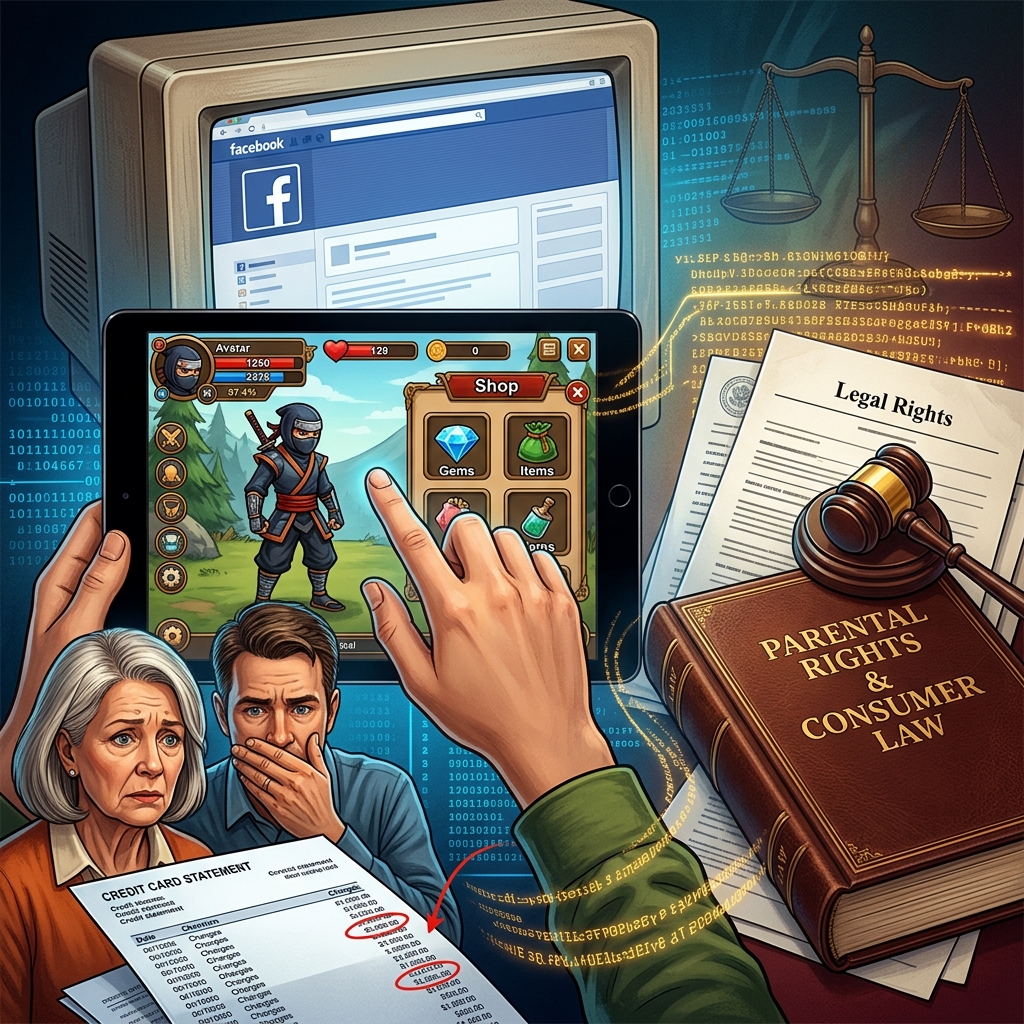
Social networks and mobile games have turned virtual swords, gems, and credits into a multibillion‑dollar business. One early flashpoint in this trend involved Facebook Credits, the company’s former virtual currency, and a game called Ninja Saga, where a child reportedly ran up hundreds of dollars in charges without a parent’s informed consent. That dispute led an Arizona parent to sue Facebook after the platform allegedly refused to provide a refund for her child’s purchases.
That case is part of a much broader legal and policy conversation about what happens when minors buy digital goods—and when parents discover the bill after the fact. Courts, regulators, and consumer advocates have since examined whether platforms like Facebook adequately disclosed the nature of in‑game purchases, whether children could meaningfully consent, and when parents are entitled to refunds.
The Background: Virtual Currency, Ninja Saga, and Facebook Credits
Before Facebook pivoted to other monetization models, it used a proprietary virtual currency called Facebook Credits that users bought with real money and spent inside games hosted on its platform. Games such as Angry Birds, PetVille, and Ninja Saga relied on these credits to sell virtual items and power‑ups.
According to reporting and court filings, parents began to complain that children were making large numbers of purchases inside these games using payment methods saved on their parents’ Facebook accounts or linked cards. In the Ninja Saga dispute covered by FindLaw, the parent alleged that her son bought hundreds of dollars’ worth of virtual currency through Facebook Credits, then sought a refund when she discovered the charges, but Facebook refused.
How the Purchase Flow Typically Worked
- Parents or users added a credit card, debit card, or other payment method to a Facebook account.
- Facebook Credits were purchased and stored as a digital balance on the platform.
- Games like Ninja Saga offered virtual items and upgrades purchasable with these credits.
- Children, often using a parent’s device or account, could spend credits or authorize additional purchases, sometimes without understanding that real money was involved.
This sequence raised hard questions about who bears responsibility: the platform, the game developer, the payment processor, the parent, or the child.
The Lawsuit: Parent vs. Facebook Over Ninja Saga Purchases
In the case that inspired this article, an Arizona mother sued Facebook, arguing that the company effectively sold virtual currency to children without proper safeguards and then declined to refund the resulting charges. The complaint fit into a wave of challenges to how Facebook handled minors’ purchases and refunds.
Separate litigation later evolved into a class‑action lawsuit over Facebook’s refusal to refund parents for children’s purchases using Facebook Credits. A federal court allowed claims by minors to go forward in part, analyzing issues such as capacity to contract and the enforceability of terms with underage users.
| Issue | What Parents Alleged | Legal Questions Raised |
|---|---|---|
| Consent | Children did not understand they were spending real money. | Can minors meaningfully consent to digital purchases under platform terms? |
| Disclosure | Pricing and refund rules were unclear or confusing. | Were disclosures adequate under consumer protection laws? |
| Refunds | Requests for refunds of minors’ charges were denied or restricted. | Must companies refund transactions initiated by minors or made without parental knowledge? |
| Design | Game mechanics encouraged repeated, impulsive spending by kids. | Do design choices cross the line into unfair or deceptive practices? |
Minors, Contracts, and the Right to Disaffirm
One of the central legal doctrines in these disputes is the rule that minors generally have limited capacity to contract. In many U.S. jurisdictions, contracts entered into by minors are considered “voidable,” meaning the minor may disaffirm (cancel) the agreement, with certain exceptions such as for necessities.
In litigation about Facebook Credits, courts were asked to decide whether minors could disaffirm their transactions and seek refunds for virtual currency and in‑game purchases. That required analyzing:
- Who actually agreed to Facebook’s terms of use: the child, the parent, or both.
- Whether a minor’s use of a parent’s payment method was authorized by the parent.
- To what extent digital goods purchased by minors should be refunded if the minor repudiates the agreement.
In one case, a federal court concluded that minors could pursue claims to disaffirm their Facebook Credit purchases, at least in part, despite Facebook’s contractual terms. This did not automatically guarantee refunds in every situation, but it opened the door for minors to argue that their purchases were legally voidable.
Allegations of Deceptive or Unfair Practices
Court documents unsealed in later litigation described internal Facebook communications suggesting that the company was aware of high chargeback rates and that many children were making purchases without parents’ knowledge. According to investigative reporting, some Facebook employees referred to kids spending on games as “friendly fraud,” acknowledging that significant revenue came from transactions later disputed by parents.
These revelations fueled claims that Facebook and game developers:
- Designed interfaces that made it easy for children to continue spending without re‑entering payment details.
- Allowed stored payment methods to be used repeatedly in games without clear prompts or parental confirmation.
- Were slow to implement internal tools to flag or limit suspicious high‑volume spending by minors.
Regulators worldwide have increasingly scrutinized such practices under consumer protection laws that prohibit unfair or deceptive acts or practices. In the U.S., for example, the Federal Trade Commission (FTC) has brought several cases against major technology companies regarding unauthorized in‑app purchases by children, leading to refunds and stricter consent mechanisms.
Parental Responsibility vs. Platform Duties
These cases naturally raise a difficult question: where does parental responsibility end and platform responsibility begin? Parents control access to their devices, passwords, and payment methods, but platforms design the ecosystem in which children can make purchases.
Typical Arguments from Parents
- They did not knowingly authorize the specific transactions made by their children.
- They were unaware that a stored card could be used repeatedly without fresh consent.
- The interface did not clearly distinguish between game play and paid purchases.
- The child did not understand the real‑money consequences of clicking “buy.”
Typical Arguments from Platforms
- Parents accepted terms of use that governed payments and refunds.
- Devices and passwords were under parents’ control, so use by a child was effectively authorized.
- Disclosures and confirmation screens were sufficient to put users on notice.
- Virtual items are non‑refundable once consumed or used in the game.
Courts have struggled to balance these positions, sometimes distinguishing between charges that are clearly unauthorized (for example, when a child uses a parent’s card without any permission) and charges that occur when a parent knowingly gives a child access to a device or account but underestimates the potential for large in‑app spending.
Lessons for Parents: Reducing the Risk of Surprise Bills
While litigation can clarify legal rights, most families would prefer to avoid the problem entirely. The Ninja Saga dispute illustrates how easy it is for a child to rack up charges in a matter of minutes. Parents can take several practical steps to reduce the risk:
- Turn on purchase authentication: Require a password, PIN, or biometric confirmation for every purchase in app stores and platforms.
- Use child or teen accounts: Many platforms now offer restricted profiles with tighter spending controls and parental approval workflows.
- Disable one‑click payments: Avoid storing payment methods directly in game environments where kids play.
- Talk openly about virtual money: Explain to children that buying digital items is equivalent to spending real money.
- Monitor billing statements: Regularly review card and bank statements for small, recurring digital charges that can add up.
These steps do not eliminate a platform’s legal obligations, but they can significantly reduce the odds of a high‑dollar surprise.
Industry and Regulatory Changes Since Early Facebook Credits Cases
High‑profile disputes over children’s in‑app purchases—including the Facebook Credits cases—contributed to a broader recalibration of industry norms. Major app platforms and regulators took action in several ways:
- Refund programs and settlements: Some companies have entered into settlements or refund programs addressing unauthorized in‑app purchases by minors, often following regulatory enforcement actions.
- Clearer labeling of in‑app purchases: App marketplaces introduced prominent labeling to warn users when an app includes in‑app purchases.
- Stricter consent flows: Many platforms now require explicit consent, device‑level passwords, or parental approvals for purchases on child accounts.
- Ongoing litigation over harms to children: Separate from payment issues, parents and school districts have filed lawsuits alleging that social media companies’ design choices harm children’s mental health and well‑being.
Although these mental‑health‑related cases are distinct from the Ninja Saga virtual‑credits dispute, they share a common theme: courts and policymakers are revisiting how much responsibility large platforms bear for the experiences and risks their design choices create for children.
Key Legal Takeaways for Minors’ Online Purchases
The Facebook and Ninja Saga controversies provide a useful lens for understanding how the law approaches minors’ online spending. A few high‑level points emerge:
- Minors’ capacity is limited: In many jurisdictions, minors can disaffirm contracts, which can support claims for refunds of digital purchases they made while underage.
- Terms of use aren’t always decisive: Even when platforms point to broad terms of service, courts may scrutinize whether minors can be bound by those terms.
- Design and disclosure matter: Poorly designed or confusing interfaces that facilitate unintended purchases can lead to allegations of unfair or deceptive practices.
- Regulatory bodies can intervene: Agencies like the FTC have authority to challenge practices that harm consumers, including families dealing with unauthorized in‑app purchases.
- Documentation helps: For parents seeking refunds, detailed records of the child’s age, how access was granted, and communications with the platform can be important.
Practical Steps if Your Child Makes Unwanted In‑Game Purchases
Parents confronted with an unexpected bill can take a series of structured steps that are informed by the lessons of the Facebook and Ninja Saga disputes:
- Gather evidence
Document the dates, amounts, and nature of the charges; take screenshots of account histories; and note the child’s age at the time of the purchases.
- Contact the platform quickly
Use official support channels to request a refund, explaining that the user is a minor and detailing how the purchases occurred.
- Reach out to your payment provider
If the platform refuses, some card issuers or banks may allow disputes for unauthorized or mistaken transactions, subject to their policies.
- Review local consumer protection rules
Consumer protection laws differ by jurisdiction, but many provide enhanced protections for minors or prohibit unfair sales practices.
- Consider legal advice for large sums
When the amounts are substantial, consulting an attorney familiar with consumer or technology law can help clarify available remedies.
FAQs About Children, Virtual Currency, and Legal Rights
1. Can my child legally agree to buy virtual currency on a platform like Facebook?
In many jurisdictions, minors have limited capacity to enter into binding contracts. While platforms often allow teens to create accounts, contracts made by minors are frequently voidable, meaning the minor may seek to disaffirm them, subject to local law and specific circumstances.
2. Am I automatically responsible if my child uses my card for game purchases?
Responsibility can depend on whether you authorized access to the device or account, how the platform’s terms are structured, and the laws in your jurisdiction. Some transactions may be considered unauthorized, while others may be treated as within the scope of your consent. Card issuer and bank policies also play a role.
3. Are companies required to refund all purchases made by minors?
There is no universal rule that every purchase made by a minor must be refunded. However, courts have allowed minors to pursue claims to disaffirm certain digital purchases, and regulators have pressured companies to refund clearly unauthorized charges and to improve their consent mechanisms.
4. What did the Facebook Credits lawsuits change?
The lawsuits helped spotlight the scale of minors’ spending in social games and led to increased scrutiny of platforms’ refund policies and interface design. They contributed to broader industry changes regarding in‑app purchase disclosures, parental controls, and refund practices.
5. How do newer cases about social media and child harm relate to virtual purchase disputes?
Recent suits against companies like Meta and YouTube focus more on alleged mental health harms and addictive product design than on payment disputes, but they share an underlying concern: that large platforms are not doing enough to protect children from foreseeable harms stemming from their product choices.
References
- Facebook Faces Class-Action Lawsuit Over Online Purchases by Kids — Time. 2014-03-26. https://time.com/3741644/facebook-online-purchases-kids-minors-lawsuit/
- Minors’ Suit Over Facebook Credits Survives in Part – I.B. v. Facebook — Eric Goldman. 2012-12-27. https://blog.ericgoldman.org/archives/2012/12/minors_suit_ove_1.htm
- Facebook knowingly duped game-playing kids and their parents out of money — Reveal from The Center for Investigative Reporting. 2019-01-24. https://revealnews.org/article/facebook-knowingly-duped-game-playing-kids-and-their-parents-out-of-money/
- Parent Sues Facebook for Selling Ninja Saga Virtual Credits to Kids — FindLaw Consumer Protection Blog. 2012-03-23. https://www.findlaw.com/legalblogs/consumer-protection/parent-sues-facebook-for-selling-ninja-saga-virtual-credits-to-kids/
- More than 1,800 U.S. parents and school leaders have sued Meta, TikTok, Snapchat and YouTube — ABC10 News (via Facebook post summarizing legal filings). 2024-06-26. https://www.facebook.com/ABC10News/posts/a-jury-found-both-meta-and-youtube-liable-in-a-first-of-its-kind-lawsuit-that-ai/1358215429670711/
Similar Articles








Read full bio of Sneha Tete


