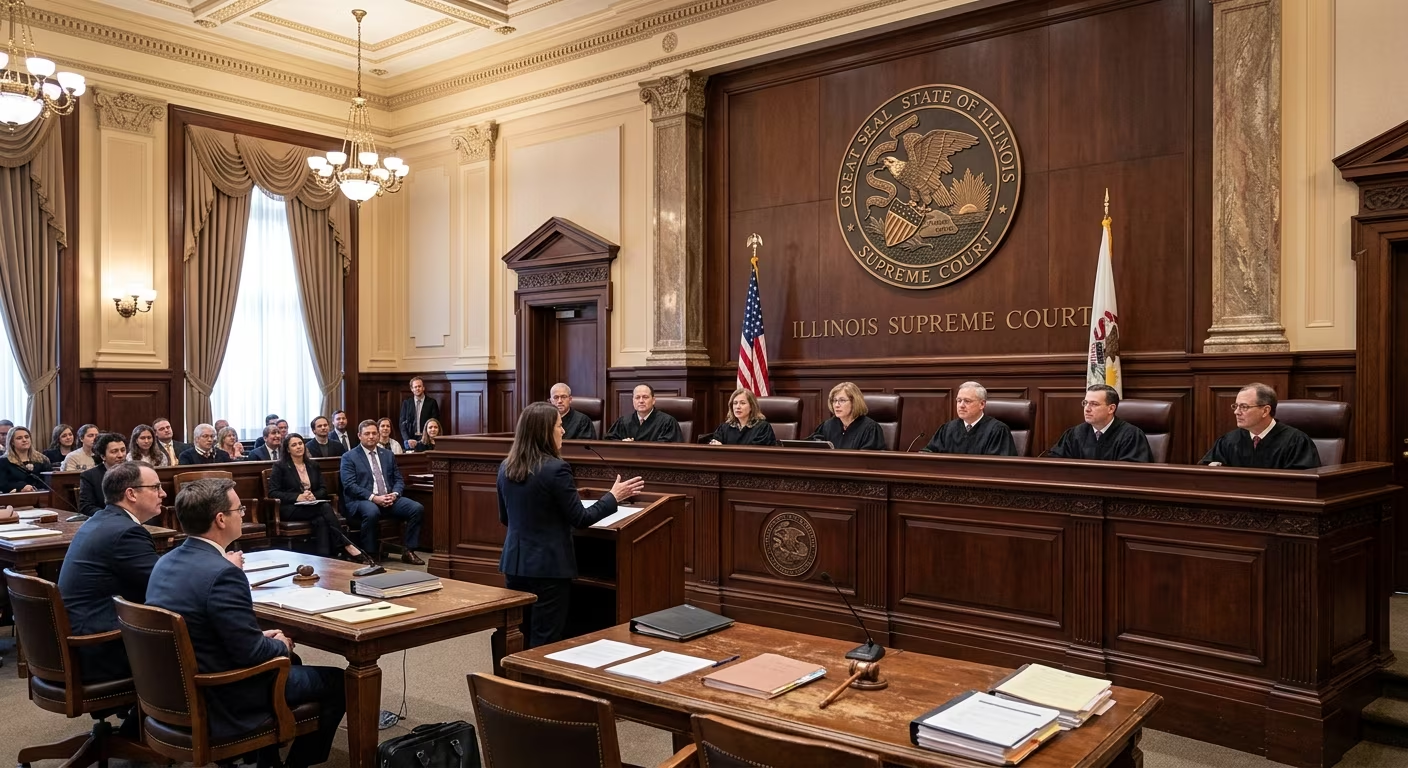
The End of an Era: Illinois Eliminates Cash Bail
On September 18, 2023, the State of Illinois cemented its place in American legal history by becoming the first state in the nation to completely eliminate cash bail as a condition for pretrial release. This monumental shift in criminal justice policy was not achieved without immense political and legal friction. The catalyst for this transformation was the Illinois Supreme Court’s landmark ruling in Rowe v. Raoul, a highly anticipated decision that ultimately upheld the constitutionality of the state’s Pretrial Fairness Act. By abolishing a monetary bail system that had been deeply entrenched in the legal framework for generations, the state opted to completely restructure how courts evaluate pretrial detention. Illinois has fundamentally altered the calculus from a wealth-based model to one strictly focused on evaluating tangible public safety risks and flight probabilities.
The implications of this historic decision extend far beyond the borders of Illinois. The state is currently serving as a critical, real-time testing ground for a nationwide movement aimed at dismantling justice policies that disproportionately impact economically disadvantaged communities. This comprehensive analysis explores the legislative origins of the new law, the fierce legal battles that sought to dismantle it in lower courts, the precise constitutional reasoning behind the state Supreme Court’s definitive ruling, and the day-to-day mechanics of this unprecedented pretrial justice framework.
The Legislative Genesis: Unpacking the Pretrial Fairness Act
The journey toward a cash bail-free jurisdiction was formally ignited with the passage of the Safety, Accountability, Fairness and Equity-Today (SAFE-T) Act in early 2021. Borne out of widespread social unrest and an intensified national dialogue regarding systemic inequalities within the criminal justice system, the SAFE-T Act was a sweeping omnibus bill designed to comprehensively reform policing standards, sentencing guidelines, and corrections procedures across the state. Nestled within this extensive legislative package was the Pretrial Fairness Act, arguably the most contentious and transformative component of the entire reform effort.
For decades, civil rights advocates and criminal justice reform researchers argued that the cash bail system functioned as a de facto penalty for poverty, rather than a legitimate or effective tool for ensuring public safety or guaranteeing court appearances. Under the traditional framework, two individuals charged with the exact same offense could experience drastically different pretrial outcomes based solely on the size of their bank accounts. A defendant with access to capital could seamlessly purchase their freedom and prepare for their trial from the comfort of their home, retaining their employment and supporting their family. Meanwhile, an indigent defendant would be forced to languish in a county jail for months or even years awaiting adjudication.
This pretrial incarceration often led to devastating collateral consequences. Research consistently showed that even a few days in jail could trigger the loss of employment, severe housing instability, loss of child custody, and exacerbated mental health crises. The systemic reliance on money bail fundamentally meant that liberty was a commodity available for purchase, heavily skewing justice against marginalized populations.
The Pretrial Fairness Act was explicitly designed to eradicate this toxic dynamic. The legislation abolished monetary bail entirely, establishing a baseline presumption that all defendants are inherently eligible for pretrial release. In place of a financial hurdle, the law mandated a comprehensive, evidence-based risk assessment to determine whether an individual poses a specific, articulable threat to a person or the community, or if they present a high likelihood of willful flight to avoid prosecution.
The Conservative Backlash and Lower Court Hurdles
Unsurprisingly, the passage of the Pretrial Fairness Act was met with immediate, organized, and fierce resistance from various law enforcement agencies, state prosecutors, and conservative legislators. The ideological and procedural divide culminated in a formidable legal challenge spearheaded by the state’s attorneys and sheriffs from more than sixty different Illinois counties. These plaintiffs filed a consolidated lawsuit in Kankakee County against Illinois Governor J.B. Pritzker, Attorney General Kwame Raoul, and other legislative leaders, arguing that the legislative elimination of cash bail blatantly violated the state’s constitution.
The crux of the plaintiffs’ legal argument hinged on their interpretation of a specific clause within the Illinois Constitution of 1970, which stated that “all persons shall be bailable by sufficient sureties,” except for certain capital offenses. The plaintiffs rigidly interpreted the phrase “sufficient sureties” as an explicit constitutional mandate requiring a monetary bail system. They argued that the legislature had severely overstepped its constitutional boundaries by statutorily eliminating the judicial branch’s ability to demand cash in exchange for release.
Furthermore, the lawsuit claimed that the law severely infringed upon the separation of powers by improperly dictating judicial procedures. Opponents insisted the legislature was improperly tying the hands of judges who are uniquely tasked with maintaining courtroom order, assessing defendant risk, and protecting local public safety.
In December 2022, mere days before the law was slated to take effect on January 1, 2023, a Kankakee County Circuit Court judge ruled in favor of the plaintiffs. The lower court declared the pretrial release provisions of the SAFE-T Act unconstitutional, agreeing with the premise that the General Assembly could not eliminate monetary bail without passing a formal constitutional amendment. Following this chaotic lower court decision, the Illinois Supreme Court immediately issued an emergency stay, effectively pausing the implementation of the Pretrial Fairness Act statewide while the justices prepared to hear the state’s expedited appeal.
The Supreme Court Weighs In: Analyzing Rowe v. Raoul
The entire fate of cash bail in Illinois rested on the shoulders of the state’s highest court. On July 18, 2023, the Illinois Supreme Court delivered a decisive 5-2 ruling in the landmark case of Rowe v. Raoul, overturning the Kankakee County judge’s decision and firmly affirming the constitutionality of the Pretrial Fairness Act.
Chief Justice Mary Jane Theis, authoring the opinion for the majority, delivered a meticulous constitutional and historical analysis that systematically dismantled the plaintiffs’ core arguments. The court focused heavily on the legal interpretation of the word “bailable” and the phrase “sufficient sureties.” Chief Justice Theis noted that historical context dictates that “sufficient sureties” does not inextricably command the exchange of monetary funds. Instead, the majority opined that the constitutional provision was intended to ensure a reliable pathway to pretrial release, not to mandate a specific financial mechanism to secure that freedom.
The court concluded that the Illinois Constitution creates a delicate, necessary balance between the individual liberty rights of defendants and the fundamental right of crime victims and the community to be protected from harm. The legislative shift to a system that evaluates safety rather than wealth was deemed perfectly aligned with this constitutional balance.
Moreover, the Supreme Court flatly rejected the argument that the legislature had violated the separation of powers doctrine. The court affirmed that the General Assembly possesses the explicit authority to regulate the criminal justice system and establish the procedural parameters within which judges operate. By doing so, the Supreme Court verified that the legislative branch was well within its rights to transition the state from a wealth-based detention system to a risk-based model. The ruling lifted the stay, setting a new effective date of September 18, 2023, giving jurisdictions a narrow window to finalize their administrative preparations for the new judicial reality.
Mechanics of the New Pretrial Detention Framework
With the legal hurdles permanently cleared, Illinois transitioned into an entirely new era of pretrial proceedings. The operational mechanics of the Pretrial Fairness Act require a fundamental recalibration of how prosecutors, defense attorneys, and judges approach the initial stages of every single criminal case in the state.
First and foremost, the new framework begins with a default presumption of release for all individuals charged with a crime. When a defendant makes their first appearance in court, the state can no longer passively rely on a judge to arbitrarily set a prohibitive bond amount that keeps the defendant incarcerated. Instead, if prosecutors firmly believe a defendant should remain behind bars pending trial, they must take affirmative action and file a formal, verified petition requesting pretrial detention.
The burden of proof now rests squarely on the shoulders of the prosecution. During a detention hearing, which must be held promptly (often within 24 to 48 hours of arrest), the state must present clear and convincing evidence to satisfy three distinct legal thresholds:
- Qualifying Offense: The proof is evident or the presumption is great that the defendant committed a qualifying “detainable” offense. The statute clearly enumerates these offenses, which primarily encompass violent felonies such as murder, sexual assault, armed robbery, and severe domestic violence cases, as well as certain serious firearms charges.
- Threat Assessment: The defendant poses a real and present threat to the physical safety of a specific, identifiable person, or to the community at large, based on articulable facts of the case.
- Mitigation Failure: There is no combination of release conditions—such as electronic monitoring, curfew restrictions, mandatory check-ins, or stay-away orders—that can adequately mitigate the identified risk to safety or the likelihood of willful flight.
If the judge determines that the prosecution has successfully met this rigorous burden, the defendant is remanded to custody without any option to pay for their release. Conversely, if the judge finds that the state failed to meet its burden, the defendant must be released. However, the court retains broad authority to impose strict, non-financial conditions of release to ensure compliance and monitor the defendant’s behavior. This new system inherently demands a more rigorous, evidence-based, and individualized evaluation of each case at the very outset of the judicial process.
Early Outcomes and the Future of Criminal Justice Reform
The implementation of the Pretrial Fairness Act was preceded by dire predictions from critics who warned of an impending spike in crime and mass chaos within the court system. However, early data analysis presents a much more nuanced, stable, and encouraging reality. Research monitored by institutions such as the Center for Criminal Justice at Loyola University Chicago indicates that while overall county jail populations have decreased, the drop has not been as precipitous as advocates hoped, nor as drastic as critics feared.
Interestingly, the rate of defendants being released pretrial has remained relatively consistent with pre-reform numbers. The primary difference lies in the mechanism and speed of release. Instead of languishing in custody for days or weeks while attempting to scrape together bail money from family members or predatory bail bondsmen, defendants are generally processed, evaluated, and released much faster. This efficiency limits the severe collateral damage of pretrial incarceration, allowing individuals to maintain their employment and familial stability while awaiting their day in court.
The Illinois model serves as a vital blueprint for the rest of the country. While jurisdictions like New Jersey and Washington D.C. have implemented sweeping bail reforms that severely limit the use of cash bail, Illinois is the first to eradicate the practice entirely through statewide statutory law. Legal scholars, policymakers, and civil rights advocates nationwide are closely monitoring the state’s progress, evaluating crime rates, court appearance data, and the operational efficiency of the risk-based system.
By successfully defending the Pretrial Fairness Act in Rowe v. Raoul, Illinois has fundamentally challenged the long-held assumption that financial leverage is a prerequisite for justice. The state has firmly established a new legal paradigm that prioritizes empirical risk over financial capacity, redefining the boundaries of liberty and public safety in the American legal system.
Frequently Asked Questions (FAQ)
What is the Pretrial Fairness Act?
The Pretrial Fairness Act is a specific legislative provision within the broader Illinois SAFE-T Act that officially abolished the use of monetary bail as a condition for pretrial release. It transitioned the state to a system where pretrial detention is based entirely on a judge’s assessment of public safety and flight risk, rather than a defendant’s ability to pay.
Did the Illinois Supreme Court ruling mean all defendants are automatically released?
No. The law establishes a presumption of release, but judges retain the explicit statutory authority to deny pretrial release entirely. If the defendant is charged with a qualifying serious offense and prosecutors can prove the individual poses a real, present threat to public safety or has a high likelihood of fleeing, the judge can order them detained until trial.
When did the elimination of cash bail take effect in Illinois?
The law was originally scheduled to take effect on January 1, 2023. However, due to legal challenges, it was stayed by the Illinois Supreme Court. Following the July 18, 2023 ruling in Rowe v. Raoul that upheld the law, the elimination of cash bail officially went into effect statewide on September 18, 2023.
Can individuals previously held on cash bail request release?
Yes. Following the implementation date in September 2023, individuals who were already being held in county jails solely because they could not afford their monetary bail were granted the right to petition the court for a review hearing under the newly established risk-based guidelines.
Conclusion
The abolition of cash bail in Illinois represents a seismic shift in American jurisprudence. By weathering fierce legislative opposition and securing a decisive victory at the state Supreme Court, the state has fundamentally rewritten the rules of pretrial detention. Rowe v. Raoul will undoubtedly be remembered as a cornerstone decision that reaffirmed the constitutional power of the legislature to modernize the justice system and eradicate wealth-based disparities. As the nation watches the ongoing implementation of the Pretrial Fairness Act, Illinois stands as a testament to the viability of a justice system that values public safety over financial extraction, setting a formidable precedent for future criminal justice reform across the United States.
References
- Rowe v. Raoul, 2023 IL 129248 — Illinois Supreme Court. 2023-07-18. https://illinoiscourts.gov/
- Public Act 101-0652 (SAFE-T Act / Pretrial Fairness Act) — Illinois General Assembly. 2021-02-22. https://www.ilga.gov/
- Illinois is first state to eliminate cash bail, a penalty affecting low-income communities most — Associated Press (AP). 2023-07-18. https://apnews.com/article/illinois-cash-bail-supreme-court-decision-b5a9df668600d98fbfa9b47cd2547b59
- Illinois Becomes First State to Abolish Cash Bail — Equal Justice Initiative. 2023-09-20. https://eji.org/news/illinois-becomes-first-state-to-abolish-cash-bail/