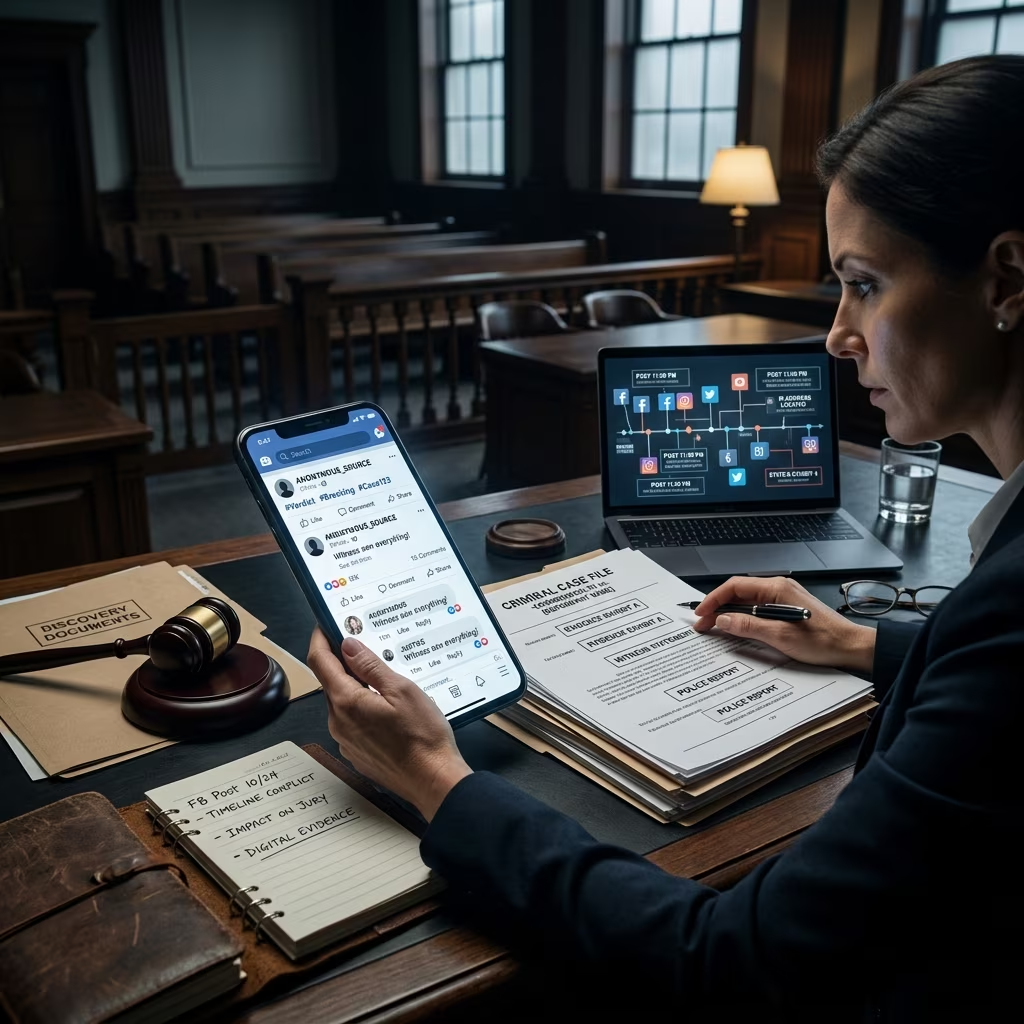
Social media has become one of the most important sources of digital evidence in modern criminal investigations. Posts, comments, photos, messages, and even deleted activity can help investigators build timelines, identify witnesses, or challenge a suspect’s version of events.
At the same time, online content can be misleading, incomplete, or taken out of context. That is why courts do not treat social media as automatically reliable. Before digital material can be used at trial, prosecutors generally must show that it is relevant, authentic, and legally obtained.
Why online activity matters in criminal law
People often treat social platforms as casual spaces, but investigators may view them as public records of conduct, relationships, and state of mind. A single post can reveal location, motive, threats, associations, or contradictory statements about an event.
Social media can matter in cases involving theft, assault, drug offenses, fraud, harassment, stalking, gang activity, and sexual offenses. It may also be used to find witnesses, corroborate alibis, or test whether a suspect’s account matches other evidence.
- Public posts can be saved, shared, and reviewed by investigators.
- Private messages may still become available through subpoenas, warrants, or recipient records.
- Photos and videos can place a person at a location or in the company of others.
- Comments, likes, and tags may help show relationships, intent, or knowledge.
Common ways prosecutors and police use social platforms
Law enforcement agencies increasingly use social media during both the early and later stages of a case. According to public-policy guidance, collection of social data should be tied to a legitimate investigative purpose, documented, and evaluated for reliability before being used as intelligence.
In practice, investigators may search profiles, review comments, examine friend networks, compare timestamps, or request platform records. They may also use content from witnesses, victims, or third parties who saved screenshots or forwarded messages.
| Type of content | Possible investigative use |
|---|---|
| Posts and captions | May show location, motive, threats, or admissions |
| Messages | May reveal planning, coordination, or intent |
| Photos and videos | May identify people, objects, vehicles, or timelines |
| Tags and mentions | May connect people, events, or group activity |
| Likes and follows | May help show associations or interests, though context matters |
Social media can also be used in broader pattern analysis. For example, public content may help investigators compare an online claim with physical evidence, surveillance footage, or witness statements.
What makes social media evidence usable in court
Digital evidence is only useful if a court accepts it. That usually means the evidence must meet standard evidentiary rules, including relevance and authenticity.
Relevance asks whether the material actually helps prove or disprove something important in the case. Authenticity asks whether the content is what the party claims it is and whether it can be linked to the person or event in question.
- Relevance: The content must relate to a disputed fact in the case.
- Authentication: The party offering the evidence must show it is genuine.
- Reliability: The record should be preserved in a way that supports trust in the data.
- Chain of custody: Screenshots, exports, and files should be tracked carefully from collection to court.
Courts may require supporting proof such as witness testimony, metadata, account records, or admissions connecting the post to the accused. A screenshot alone may not be enough if it cannot be tied to the right account or if there are signs of editing.
Privacy settings do not guarantee safety
Many people assume that private accounts are protected from criminal investigations. In reality, privacy settings can reduce public visibility, but they do not make content immune from legal process.
Messages can be obtained from recipients, screenshots can be saved by others, and platform records may be requested through lawful process when permitted by local rules. A post that disappears from a profile may still survive in cached data, device backups, or copies made by other users.
That is why courts and investigators often focus less on whether content was “private” and more on whether it can be lawfully collected and reliably linked to the case.
How defense lawyers challenge social media proof
Defense counsel often scrutinize online evidence closely because digital content can be easy to misread. A post may be sarcastic, quoted out of context, altered, taken from the wrong account, or posted by someone else using a stolen login.
Attorneys may challenge the evidence by questioning how it was obtained, whether it was altered, whether the account truly belongs to the accused, and whether the content is actually relevant to the charged conduct.
- Arguing that the post was taken out of context.
- Showing that an account was hacked, shared, or impersonated.
- Highlighting missing metadata or broken chain of custody.
- Seeking to exclude unfairly prejudicial material.
- Challenging searches that exceeded lawful scope.
When evidence is weakly connected to the accused, a defense lawyer may push to keep it from the jury entirely. Even if the evidence is admitted, counsel may argue that it proves little more than casual online behavior rather than criminal intent.
Risks of deleting or changing accounts
Deleting posts after an incident may seem like a practical way to reduce exposure, but it can create larger legal problems. If investigators believe content was removed to hide evidence, that conduct may be treated as obstruction, spoliation, or consciousness of guilt, depending on the jurisdiction and facts.
For that reason, people under investigation are often advised not to delete, edit, or “clean up” their accounts without speaking to a lawyer first.
- Stop posting about the incident or the people involved.
- Do not alter old captions, messages, or images.
- Preserve anything that may be relevant, even if it looks harmful.
- Tell your lawyer about questionable content before taking action.
Practical steps if your online activity may become evidence
If a criminal investigation is possible, digital caution matters. The safest approach is to assume that anything posted, shared, or forwarded may later be reviewed by law enforcement, opposing counsel, a judge, or a jury.
That does not mean every account must be deleted. It means people should avoid compounding risk by posting new material, contacting witnesses online, or trying to conceal earlier activity.
- Stop discussing the case on social media.
- Avoid messaging witnesses, complainants, or co-defendants online.
- Preserve devices and account access information for your lawyer.
- Review old posts only with legal guidance before taking any action.
- Assume screenshots, forwards, and downloads may already exist.
People should also be careful with location-sharing features, tagged photos, livestreams, and story posts. These often create timelines that investigators can compare against phone records, surveillance footage, and eyewitness accounts.
How courts think about fairness and context
One reason social media evidence is controversial is that it can be powerful without being precise. A single line of text may seem incriminating even if the surrounding conversation tells a different story. A photo may suggest presence at a scene without proving participation in a crime.
This creates a fairness problem: digital material can be persuasive to jurors even when it is incomplete or ambiguous. That is why judges must weigh whether the probative value of the evidence outweighs the risk of unfair prejudice.
In some cases, courts may allow the evidence but limit how it is presented. In others, they may exclude it entirely if the connection to the alleged offense is too weak or the collection method is too unreliable.
Frequently asked questions
Can social media posts be used as evidence in a criminal case?
Yes. Public posts, messages, photos, and related account records can be used if they are relevant and properly authenticated.
Do private messages stay private during a criminal investigation?
Not necessarily. Messages may be obtained through lawful process, from recipients, or from devices and records associated with the account.
Can a screenshot be enough to prove what was posted?
Sometimes, but not always. A screenshot is stronger when supported by metadata, account records, witness testimony, or other corroborating evidence.
Should I delete posts if I think they might hurt my case?
No. Deleting relevant content can create additional legal risk. Speak with a criminal defense lawyer before changing anything.
Can investigators use social media to find witnesses?
Yes. Investigators often use online networks, comments, and mutual connections to identify people who may have relevant information.
What should I do if someone else posted something harmful about me?
Preserve the post, save any context, and notify your lawyer. Even content written by another person may become important evidence.
Why legal guidance matters early
Because social media evidence can spread quickly and be difficult to control, early legal advice is important. A lawyer can assess whether a post is likely to matter, whether it was lawfully collected, and how it may be challenged or explained.
In many cases, the smartest response is not a public explanation but a carefully documented legal strategy. That strategy may involve preserving evidence, limiting online activity, and preparing to address the content in court if necessary.
References
- Social Media Evidence in Criminal Cases — Lichtman Law. 2026-07-10. https://lichtmanlaw.ca/social-media-evidence-in-criminal-cases/
- Social Media as Criminal Evidence: New Possibilities, Problems — American Sociological Association. 2016-06-01. https://www.asanet.org/footnotes-article/social-media-criminal-evidence-new-possibilities-problems/
- Principles for Social Media Use by Law Enforcement — Brennan Center for Justice. 2016-10-12. https://www.brennancenter.org/our-work/research-reports/principles-social-media-use-law-enforcement
- How Social Media Shapes Criminal Justice — American Bar Association. 2025-05-01. https://www.americanbar.org/groups/gpsolo/resources/magazine/2025-may-jun/how-social-media-shapes-criminal-justice/
- How Social Media Impacts Criminal Cases — Southern Oregon Defense. 2026-01-01. https://www.southernoregondefense.com/blog/how-social-media-impacts-criminal-cases/
- The Impact of Social Media on Criminal Cases — James Riotto Attorney. 2026-01-01. https://www.riottolaw.com/blog/the-impact-of-social-media-on-criminal-cases-what-you-should-know/