
Pumping At Work Rights: Employer Rules, Space, And Pay In 2025
A practical guide to federal pumping rights, employer duties, and how workers can respond when accommodations are denied.
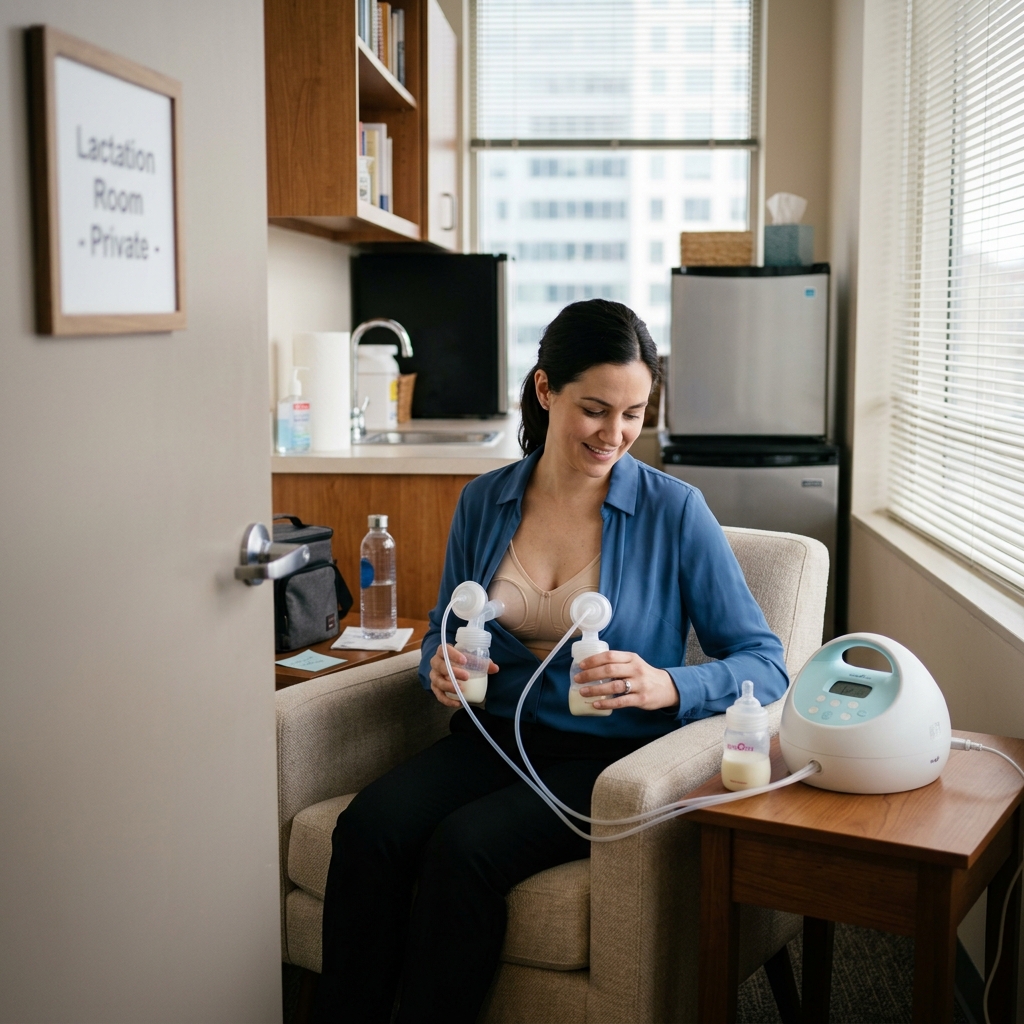
Employees who need to express breast milk during the workday have important federal protections. In general, covered workers are entitled to reasonable break time and a private place to pump that is not a bathroom, and these protections now reach far more workers than they did in the past. The law is designed to make it possible to keep working while also meeting the practical needs of lactation.
This article explains the basic rules, what an acceptable pumping space looks like, how pay is handled, which workers are covered, and what to do if an employer does not cooperate. It also addresses the growing role of state law, which may provide even stronger protections than federal law.
Why the law protects pumping at work
Breast milk expression is not a convenience; for many people, it is a medical and family need that continues after returning to work. Federal law recognizes that employees should not be forced to choose between keeping a job and feeding an infant. The modern legal framework therefore focuses on two core requirements: time to pump and a private location to do it.
These protections matter because work schedules, shared office space, and customer-facing jobs can make lactation difficult without a clear legal rule. By requiring employers to provide accommodation, the law reduces the risk that nursing workers will be pushed out of the workforce or pressured into unhealthy workarounds.
The main federal rules workers should know
Two federal laws form the foundation of workplace pumping rights. The Fair Labor Standards Act includes the basic break-time and space requirement, and the Pregnant Workers Fairness Act can require additional changes when a worker has a related limitation or need for accommodation. Together, these laws create a broader protection than many workers realize.
The Department of Labor explains that most nursing workers are entitled to reasonable break time and a private space to pump for up to one year after the child’s birth. The space must be shielded from view and free from intrusion, and it may not be a bathroom. The EEOC likewise states that employees and applicants may have rights under both the FLSA and the PWFA when they need time and a place to express milk at work.
| Legal issue | General federal rule |
|---|---|
| Break time | Reasonable break time as needed to express milk |
| Private space | A place other than a bathroom, shielded from view and free from intrusion |
| Time period | Generally up to one year after the child’s birth under federal law |
| Extra accommodations | May be required under the PWFA depending on the worker’s needs |
What counts as a lawful pumping space
Not every private room automatically qualifies. The law requires a location that is functional for pumping and protected from interruptions. The space must not be a bathroom, even if the bathroom has a lock or is rarely used. It must also be shielded from view and free from coworkers, clients, or the public walking in.
Official guidance also points to practical features that make the space usable. A worker should be able to sit comfortably, place a pump or personal items on a surface, and access electricity or another way to run a pump. Some states require even more, such as proximity to refrigeration and a sink with running water. In practice, a conference room, vacant office, or other temporarily reserved room may work if it meets the privacy and functionality requirements.
- The space must be private.
- The space must not be a bathroom.
- The space should be shielded from view.
- The space should be free from intrusion.
- The space should be usable for pumping, not just nominally available.
How much break time is reasonable?
Federal law does not set a single universal number of minutes or breaks for every worker. Instead, the standard is “reasonable” time based on the employee’s needs. That flexibility is important because some people may need only one brief session, while others may need multiple sessions spread through the day depending on supply, shift length, and travel demands.
Reasonable time usually means the amount of time needed to express milk and handle the basic related tasks, such as setting up equipment and storing milk. The key point is that the employer must allow time when needed; it cannot insist that pumping happen only during rigidly assigned break periods if that would not be workable.
Whether pumping time has to be paid
Payment rules are often misunderstood. The law does not automatically require employers to pay for all pumping time. In many situations, if a worker is already on paid break, that time may remain paid under the employer’s ordinary policy. But if pumping occurs outside paid breaks, federal law does not necessarily require compensation for that extra time.
That said, employers should apply their break rules consistently. If a workplace already pays employees for certain rest periods, a pumping employee should not be singled out for worse treatment simply because the break is used for lactation. State laws and company policies may also create more favorable pay rules, so the exact answer can depend on location and employer practice.
Who is covered by modern pumping protections?
Coverage under federal law is now much broader than it was in the past. The PUMP Act expanded access beyond many hourly workers and brought additional occupations under the law’s protection. As a result, workers in fields such as education, nursing, transportation, agriculture, and home care are more likely to be covered than they were before the expansion.
Coverage can still depend on the legal status of the worker and the facts of the workplace, but the practical takeaway is straightforward: most employees who need to pump at work now have a federal right to request time and space. The law is also not limited by gender identity, and guidance from worker advocacy organizations notes that the protections apply regardless of gender.
How the PWFA can help beyond the basic lactation rule
The Pregnant Workers Fairness Act may matter when a worker needs an accommodation connected to pregnancy, childbirth, or related medical conditions. The EEOC explains that the law requires covered employers to provide reasonable accommodations for such limitations, which can include work-related adjustments tied to breastfeeding or lactation.
That means a worker may have more than one legal route to support. For example, a person could rely on the FLSA/PUMP Act for the basic right to break time and space, and also request another accommodation under the PWFA if a related medical condition or limitation affects how pumping needs must be handled. The value of the PWFA is that it can address situations where the standard pumping rule alone is not enough.
What employers should do to stay compliant
Compliance is not just about saying a room is available. Employers should think about scheduling, privacy, communication, and logistics. A policy that simply states “use any empty room” may fail if the room is regularly booked, too far away, or not adequately private. A better approach is to create a clear process for requesting and reserving space, identify backup locations, and train supervisors not to interfere.
Employers should also keep in mind that a pumping worker may need flexibility at unpredictable times. Planning should account for actual use, not just a theoretical right. A workplace that supports lactation without friction is less likely to face conflict, complaints, or turnover.
- Designate a private, non-bathroom space.
- Create a simple request process.
- Train managers to respond consistently.
- Preserve confidentiality where possible.
- Review state and local laws for added obligations.
What to do if an employer refuses accommodations
If an employer does not provide a lawful place or reasonable time to pump, the worker should document the problem and raise it clearly. The EEOC advises that employees can provide their employer with information about applicable rights and then contact the agency if the problem continues. The Department of Labor also allows workers to seek help through the Wage and Hour Division, which can investigate FLSA-related concerns.
In some cases, workers may also have a direct right to sue. Advocacy guidance on the PUMP Act notes that employees can pursue legal remedies after giving the employer notice and an opportunity to comply. Potential remedies can include reinstatement, lost wages, monetary damages, attorney fees, and related relief, depending on the facts and the law involved.
State laws may provide stronger protection
Federal law sets the floor, not the ceiling. States can require more generous accommodations, longer coverage periods, additional room features, or broader anti-retaliation protections. California, for example, requires a private, non-bathroom space near the work area and includes detailed specifications about seating, electricity, and refrigeration access. Other states have similar laws that can go beyond federal minimums.
Because state rules vary, workers should not assume the federal standard is the whole story. A person who is denied pumping accommodations may have claims under both federal and state law, and the stronger rule often controls part of the analysis. That is why checking local law is essential before deciding how to respond.
Common workplace questions
Many disputes arise from practical misunderstandings rather than outright refusal. Some workers are told they may only use ordinary rest breaks, while others are offered a bathroom or a storage closet with no privacy. These responses usually do not satisfy the law. In other cases, the employer may technically provide a room but schedule it so inconsistently that the worker cannot actually use it when needed.
The law is intended to make pumping realistic. If the arrangement is too cramped, public, noisy, or unreliable, the accommodation may be inadequate even if the employer claims it has offered “a place.” The quality of the accommodation matters as much as the label attached to it.
Frequently asked questions
Does the law require a separate lactation room?
No. The law requires a private, functional space that is not a bathroom. A dedicated lactation room is one option, but a temporarily reserved office or other private location may also work if it meets the legal standards.
Can an employer make me pump in a restroom if it is private?
No. Federal guidance is clear that a bathroom does not qualify as the required pumping space, even if it has a lock or appears private.
Do I only have pumping rights for one year after birth?
Federal law generally guarantees break time and space for up to one year after the child’s birth. However, some state laws offer longer protection, so the answer may be different depending on where you work.
What if my schedule makes pumping difficult?
That may trigger a need for an accommodation. The employer may need to adjust schedules, locations, or break timing so the worker can realistically express milk during the day.
Can I be punished for asking to pump?
No. Retaliation for requesting or using legally protected pumping accommodations can create a separate legal problem for the employer.
Practical takeaways for workers
The most useful first step is to understand that the right exists before a conflict begins. Workers who plan ahead can identify where they might pump, how they will communicate with supervisors, and whether state law provides extra protection. If a problem arises, documentation is valuable: keep notes about requests, responses, schedules, and any unsuitable rooms offered by the employer.
For many employees, a calm written request is enough to resolve the issue. If not, federal agencies and, in some cases, the courts provide enforcement paths. The law’s purpose is to make work and lactation compatible, not to force workers into impossible choices.
References
- Time and Place to Pump at Work: Your Rights — U.S. Equal Employment Opportunity Commission. 2024-??-??. https://www.eeoc.gov/time-and-place-pump-work-your-rights
- FLSA Protections to Pump at Work — U.S. Department of Labor, Wage and Hour Division. 2024-??-??. https://www.dol.gov/agencies/whd/pump-at-work
- Breastfeeding and Returning to Your Workplace — Centers for Disease Control and Prevention. 2024-??-??. https://www.cdc.gov/infant-toddler-nutrition/breastfeeding/returning-to-your-workplace.html
- What the Law Says About Breastfeeding and Work — Office on Women’s Health, U.S. Department of Health and Human Services. 2024-??-??. https://womenshealth.gov/supporting-nursing-moms-work/what-law-says-about-breastfeeding-and-work
- The PUMP Act Explained — U.S. Breastfeeding Committee. 2024-??-??. https://www.usbreastfeeding.org/the-pump-act-explained.html
- Lactation Accommodation — California Department of Industrial Relations, Division of Labor Standards Enforcement. 2024-??-??. https://www.dir.ca.gov/dlse/Lactation_Accommodation.htm
Similar Articles








Read full bio of Sneha Tete




