
Understanding Wage Garnishment and Income Deduction
Learn how wage garnishment and income deductions work, what federal law allows, and the practical steps employees and employers can take to handle them.
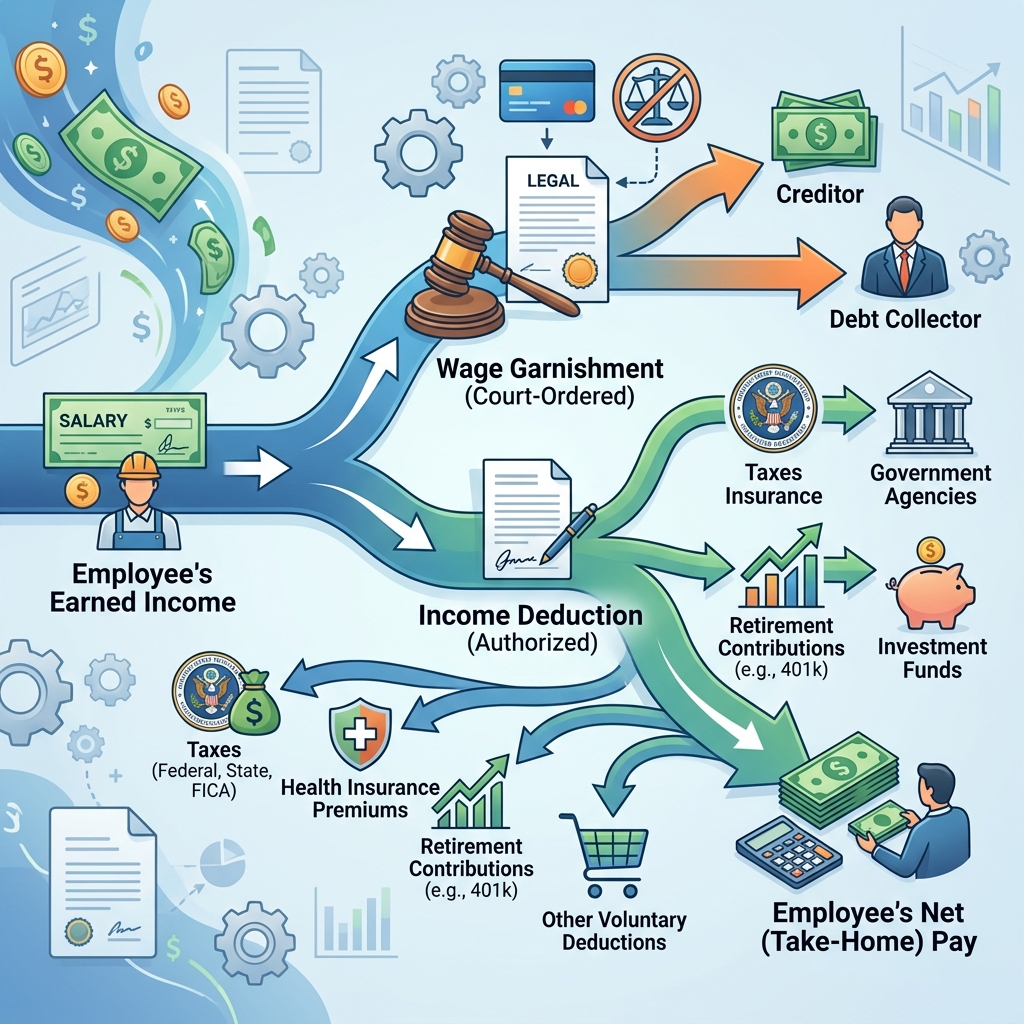
Wage garnishment and income deduction are powerful legal tools that allow creditors and government agencies to collect unpaid debts directly from a person’s paycheck. While the process can be stressful for employees and administratively complex for employers, federal and state laws impose clear limits and protections. This guide explains how wage garnishment works, what kinds of debts can lead to income deduction, how much of a paycheck can legally be taken, and what rights and obligations both employees and employers have.
What Is Wage Garnishment?
Wage garnishment is a legal process where a portion of a worker’s earnings is withheld by the employer and sent to a creditor or government agency to pay a debt. In most cases, garnishment is triggered by a court order issued after a creditor wins a judgment, but certain government debts can be collected without going to court.
Under federal law, wage garnishment applies broadly to personal earnings, including wages, salaries, commissions, bonuses, and some pension or retirement income. Tips are generally treated differently and are often not covered in the same way as regular earnings.
Key Features of Wage Garnishment
- Involves a legal or administrative order instructing the employer to withhold part of an employee’s pay.
- Targets disposable earnings—income left after legally required deductions such as federal and state taxes and Social Security.
- Subject to federal limits under Title III of the Consumer Credit Protection Act (CCPA) so workers retain enough income for basic living expenses.
- Can arise from different types of debts, including consumer debts, taxes, child support, alimony, and certain federal loans.
Income Deduction vs. Wage Garnishment
The terms wage garnishment and income deduction are often used together or interchangeably, but they can reflect different mechanisms for withholding pay.
- Wage garnishment typically refers to court-ordered or government-directed withholding to satisfy an unpaid debt.
- Income deduction may describe broader or automatic withholding arrangements, such as court-ordered child support, tax levies, or administrative offsets where a government agency can deduct money without a traditional court judgment.
In practice, both processes involve an employer receiving official instructions to remove a specified portion of the worker’s paycheck and forward it to the party owed.
Types of Debts That Can Lead to Garnishment
Not all debts are treated the same way. The source of the debt affects whether a court order is required, how much can be garnished, and which rules apply.
1. Consumer and Private Debts
Consumer debts include credit card balances, personal loans, medical bills, and similar obligations owed to private creditors. For these debts:
- Creditors usually must file a lawsuit and obtain a court judgment before garnishment can begin.
- Garnishment limits are generally capped under the CCPA at a percentage of disposable earnings (explained below).
2. Child Support and Alimony
Family support obligations are treated differently and often more aggressively under federal law. When an order for child support or alimony is in place, the maximum percentage of disposable earnings that can be garnished is higher than for ordinary consumer debts.
- Up to 50% of disposable earnings may be garnished if the worker supports another spouse or child.
- Up to 60% of disposable earnings may be garnished if the worker does not support another spouse or child.
- An additional 5% can be garnished if support payments are more than 12 weeks past due, bringing the potential total to 65% of disposable earnings in some cases.
3. Taxes and Government Debts
Federal and state tax authorities have special collection powers. They do not always need a court judgment to garnish wages.
- The Internal Revenue Service (IRS) and state tax agencies can initiate wage garnishment or levy directly for unpaid taxes.
- Federal agencies may use administrative garnishment procedures to collect non-tax debts such as defaulted federal student loans.
These government-initiated garnishments must still respect certain federal and sometimes state limits, though the specific rules differ depending on the type of debt and governing statute.
4. Federal Employee Pay
The pay of federal employees can be subject to garnishment under particular regulations. A federal employee’s pay may be garnished for debts other than alimony or child support through legal process issued by an appropriate authority. The rules for garnishing federal pay parallel, but do not always exactly match, general wage garnishment procedures.
How Much of a Paycheck Can Be Garnished?
Title III of the Consumer Credit Protection Act sets nationwide limits on how much of a worker’s disposable earnings can be taken through wage garnishment in each pay period. These limits apply regardless of how many garnishment orders an employer receives, although some debts like child support have separate higher caps.
Defining Disposable Earnings
Disposable earnings are the amount left after deducting mandatory withholdings such as federal, state, and local income taxes and Social Security contributions. Voluntary deductions—like health insurance premiums or retirement contributions chosen by the employee—do not reduce disposable earnings for garnishment calculations.
Federal Limits for Ordinary Debts
For most consumer or ordinary debts (those not involving support, bankruptcy, or taxes), the weekly amount that may be garnished is limited to the lesser of:
- 25% of the employee’s weekly disposable earnings, or
- The amount by which weekly disposable earnings exceed 30 times the federal minimum wage.
With the current federal minimum wage at $7.25 per hour, 30 times that amount equals $217.50. Under this formula:
- If weekly disposable earnings are $217.50 or less, no amount can be garnished.
- If disposable earnings are between $217.50 and $290, only the amount above $217.50 can be garnished.
- If disposable earnings are $290 or higher, up to 25% of disposable earnings may be garnished.
| Weekly Disposable Earnings | Maximum Garnishment Allowed |
|---|---|
| $217.50 or less | None (0%) |
| More than $217.50 but less than $290 | Amount above $217.50 |
| $290 or more | Up to 25% of disposable earnings |
Higher Limits for Support Obligations
As noted earlier, court orders for child support or alimony allow a greater portion of income to be garnished than ordinary consumer debts. In extreme cases, where support is significantly overdue, garnishment can reach 65% of disposable earnings.
Employee Protections Under Federal Law
Federal garnishment law does not just set caps on withholding; it also offers important protections for employees subject to wage garnishment.
Protection Against Job Loss
Under Title III of the CCPA, employers are prohibited from firing an employee simply because their wages are garnished for one debt. This protection applies regardless of how many deductions or levies are made to collect that single debt.
If an employee’s earnings are garnished for two or more separate debts, the law does not provide the same explicit protection against termination. However, other federal or state employment laws may still restrict discriminatory or retaliatory practices.
Retention of Minimum Income
By tying garnishment limits to 30 times the federal minimum wage and capping ordinary debt garnishment at 25% of disposable earnings, federal law ensures workers retain a substantial portion of their pay for essential living costs. States may enact stricter limits that protect even more income; where state law is more protective, the more restrictive rule generally applies.
Employer Responsibilities in Wage Garnishment
When an employer receives a garnishment order or notice, it must follow detailed procedures to comply with federal and applicable state laws.
Receiving and Reviewing the Order
- Employers are typically notified via a court order, government levy, or administrative directive specifying the amount to be withheld and the start date for deductions.
- The notice often includes instructions on where and how to remit payments, and may explain priority if multiple garnishments exist.
Calculating Withholding
- Employers must determine the employee’s disposable earnings by subtracting mandatory deductions only.
- They must then apply the correct federal limits—25% or the amount above 30 times the minimum wage for ordinary debts, or the higher percentages for support obligations.
- Employers also need to consider any stricter state limits on garnishment.
Processing Payments
- Withheld amounts are sent to the creditor or agency according to the order’s instructions, often on the same schedule as payroll or at specified intervals.
- Many employers note garnishment amounts on pay stubs so employees can see what was withheld.
Compliance and Recordkeeping
- Employers must comply with both federal law and any applicable state garnishment rules.
- They should keep detailed records of all garnishment calculations, payments, and correspondence to demonstrate compliance if questioned.
- Because federal law bars discharge due to a single debt’s garnishment, employers should train HR and payroll staff on employee protections.
Practical Steps for Employees Facing Garnishment
Wage garnishment can make it difficult to cover basic expenses, but employees have options before and after a garnishment begins.
Before Garnishment: Prevention and Negotiation
- Communicate early with creditors: Many creditors are willing to arrange payment plans if you reach out before default or lawsuit.
- Seek financial counseling: Nonprofit credit counseling agencies can help you create budgets, consolidate debts, and negotiate with creditors.
- Review notices carefully: If you receive a court summons or collection notice, respond promptly. Ignoring it can result in a default judgment and eventual garnishment.
After Garnishment Starts
- Confirm the calculation: Review your pay stub and garnishment order to ensure the amount withheld complies with federal and state limits.
- Consider challenging the order: If you believe a garnishment is unlawful or exceeds legal limits, you may seek legal advice and challenge it in court.
- Explore hardship options: For certain government debts, such as taxes or student loans, agencies sometimes offer hardship relief or alternative repayment arrangements.
- Adjust your budget: Update your expenses to reflect reduced income, prioritizing housing, utilities, food, and transportation.
Frequently Asked Questions (FAQs)
1. Can more than one creditor garnish my wages at the same time?
Multiple garnishment orders can be issued against the same employee. However, the total amount taken for ordinary debts in a single pay period cannot exceed the federal limits based on disposable earnings and 30 times the minimum wage. Child support and alimony orders operate under their own higher caps, which can significantly increase the total percentage of income withheld.
2. What happens if my disposable earnings are very low?
If your weekly disposable earnings are at or below the equivalent of 30 hours at the federal minimum wage (currently $217.50 per week), your wages are exempt from garnishment for ordinary consumer debts. Support and certain government obligations may still be subject to different rules.
3. Do I have to be notified before my wages are garnished?
For private debts, creditors typically must sue and obtain a court judgment, which gives you notice and an opportunity to respond. For taxes and some federal debts, agencies can initiate administrative garnishment or levy without a traditional court case, but they generally must still follow statutory notice procedures.
4. Can my employer fire me because my wages are being garnished?
Federal law prohibits an employer from firing an employee because their wages are garnished for a single debt. If wages are garnished for multiple debts, this specific federal protection does not apply in the same way, but other employment laws may offer broader protections, depending on the situation.
5. Do state laws change how garnishment works?
Yes. While the CCPA sets nationwide minimum protections, individual states can enact laws that offer greater limits or additional protections. If a state law is more protective than federal law, employers must follow the stricter standard.
References
- Fact Sheet #30: Wage Garnishment Protections of the Consumer Credit Protection Act — U.S. Department of Labor, Wage and Hour Division. 2023-05-01. https://www.dol.gov/agencies/whd/fact-sheets/30-cppa
- Federal Wage Garnishments — U.S. Department of Labor, Wage and Hour Division. 2022-11-10. https://www.dol.gov/agencies/whd/wage-garnishment
- Fact Sheet #30: The Federal Wage Garnishment Law, Consumer Credit Protection Act (Title III) — U.S. Department of Labor. 2020-01-01. https://www.sog.unc.edu/…/Federal%20Garnishment%20Law.pdf
- Dealing with Wage Garnishment — United Way Worldwide. 2021-06-15. https://www.unitedway.org/dealing-with-wage-garnishment
- What is Wage Garnishment? — Equifax. 2022-09-01. https://www.equifax.com/…/wage-garnishment/
- Garnishment Regulations — Administrative Office of the U.S. Courts. 2018-07-01. https://www.uscourts.gov/…/garnishment-regulations
Similar Articles








Read full bio of Sneha Tete




