
Police Dog Searches And The Law: What To Know In 2025 Explained
Learn when police dog sniffs are lawful, what triggers probable cause, and how privacy rights apply.
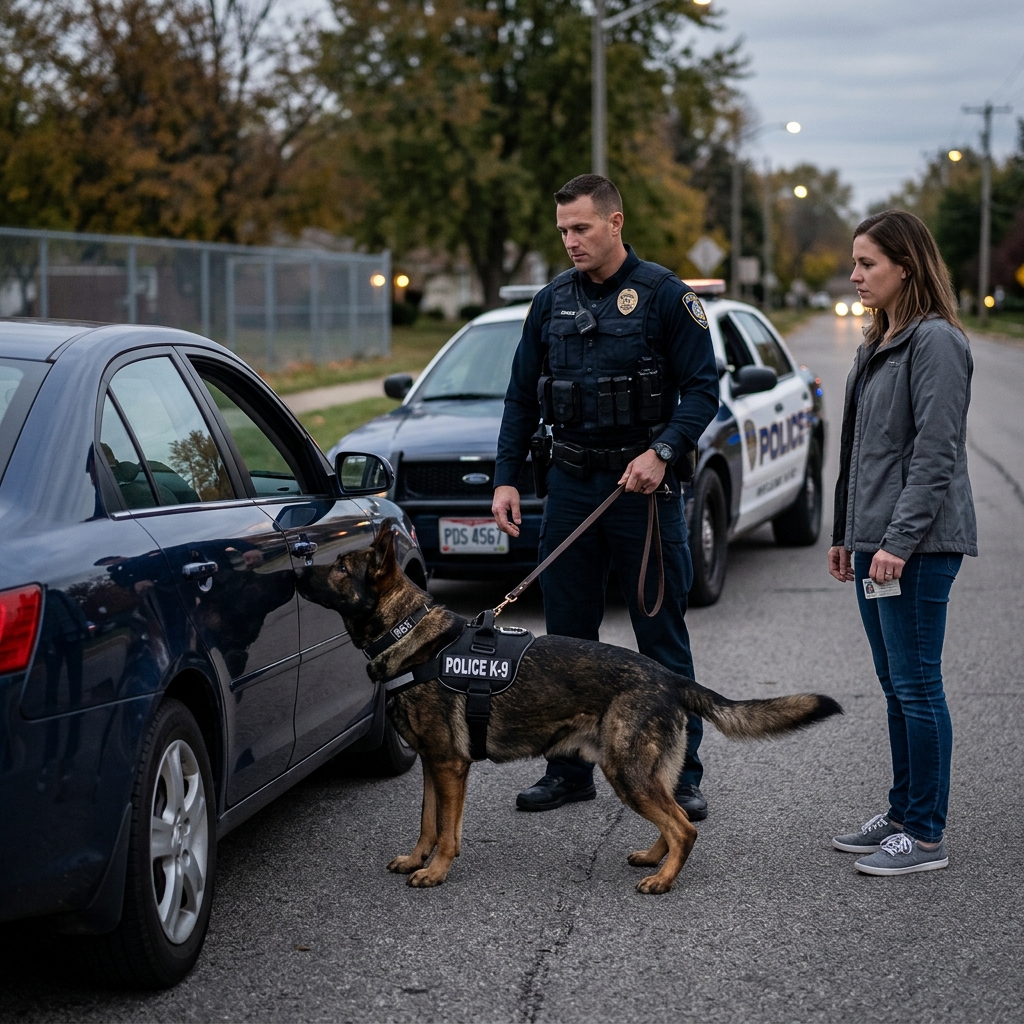
Police Dog Searches and the Law
Police dogs are widely used in law enforcement, but their use is not unlimited. In many situations, a trained dog sniffing the outside of a car or luggage is treated differently from a physical search of a person, home, or vehicle interior. The key legal questions are whether police had a lawful reason to stop or detain someone, whether the dog sniff was done in a public setting, and whether the police extended the encounter beyond what the law allows. Courts have long recognized that dog sniffs can play a role in investigations, but they also draw boundaries to protect privacy rights.
For drivers and passengers, the most important issue is often timing. If officers are still handling the original traffic stop and a dog arrives without delaying the encounter, the sniff may be allowed. If police hold someone longer only to wait for a dog, that can raise constitutional concerns. Different rules can also apply depending on whether the dog is sniffing a car, luggage in an airport, the area around a home, or a person’s belongings in a private space.
How the Fourth Amendment Fits In
The Fourth Amendment protects people from unreasonable searches and seizures. That protection does not mean every police contact requires a warrant, but it does mean law enforcement must stay within constitutional limits. Dog sniffs occupy a unique place in this framework because courts have often treated them as less intrusive than a full search when they are used in public areas and focused on detecting contraband.
In general, if police are in a place where they are lawfully allowed to be, and the dog sniffs only the exterior of a vehicle or other item exposed to the public, courts have often allowed that conduct without a warrant. However, the legal result can change when police move into areas that carry a stronger expectation of privacy, such as the curtilage of a home or the interior of a building. The fact that a dog is trained to detect illegal substances does not erase privacy protections.
When a Dog Sniff Is Usually Permitted
Dog sniffs are most commonly allowed in public settings where officers are already lawfully present. Common examples include the roadside during a traffic stop, airport baggage screening, or other public locations where the law treats the sniff as minimally invasive. In these settings, a trained dog may alert officers to the possible presence of contraband, which can then support further investigation.
- A dog sniff of the outside of a vehicle is often treated differently from a search inside the vehicle.
- A sniff in a public place is less likely to require a warrant.
- An alert may give officers grounds to investigate further, depending on the circumstances.
That does not mean officers may use a dog at any time or for any purpose. The officers must still be acting lawfully overall. A sniff cannot be used as a shortcut to create suspicion where none exists, nor can it be used to turn a routine encounter into a prolonged detention without legal justification.
Traffic Stops and Delays
Traffic stops are one of the most common settings for police dog searches. Officers may stop a vehicle for a traffic violation such as speeding, a broken taillight, or unsafe driving. Once the stop begins, police can take reasonable steps related to the reason for the stop, such as checking a driver’s license, registration, insurance, and writing a citation or warning.
The critical issue is whether the dog sniff adds time to the stop. Courts have generally disapproved of detaining a driver longer than necessary just to wait for a dog when officers do not have independent reasonable suspicion of another crime. If the dog is already on scene and the sniff occurs while the officer is still handling the traffic matter, the situation is treated more favorably. But if the stop is intentionally extended beyond its normal length, the added detention can become unlawful.
| Situation | Legal concern | General outcome |
|---|---|---|
| Dog arrives while ticket is being processed | Whether the stop was extended | Often allowed if no extra delay is created |
| Driver is held after paperwork is done | Unnecessary prolonging of the stop | May be unconstitutional without additional suspicion |
| Officers already have probable cause for another offense | Independent basis for search | Dog use may be less important because police already have grounds to search |
Reasonable Suspicion and Probable Cause
Two legal standards appear frequently in dog sniff cases: reasonable suspicion and probable cause. Reasonable suspicion is a lower standard than probable cause. It requires specific, objective facts that suggest criminal activity may be occurring. Probable cause is stronger and means there is a fair basis to believe evidence of a crime will be found.
Police may rely on a combination of factors to justify a dog sniff or continued detention. Nervous behavior, inconsistent answers, unusual travel patterns, visible contraband packaging, and other observations can matter when viewed together. A single innocent fact may not be enough, but the total picture can support police action. Even so, courts generally require more than a vague hunch.
- Reasonable suspicion may justify brief additional investigation.
- Probable cause may justify a broader search.
- Context matters, and courts look at the totality of the circumstances.
What an Alert by the Dog Means
When a trained dog alerts, officers may treat that alert as evidence that contraband could be present. In many cases, the alert becomes part of the probable cause analysis. That does not automatically mean every alert is perfect or that every alert leads to drugs. But in court, an alert from a properly used dog can be powerful evidence supporting a search.
Challenges often focus on whether the dog was properly trained, whether the handler influenced the alert, and whether the circumstances of the sniff were lawful. If the defense can show the dog search was conducted improperly or that the alert was unreliable, the evidence may be challenged. The existence of an alert alone does not erase questions about how the stop began or whether the detention was extended unlawfully.
Police Dogs and Homes
Homes receive the strongest constitutional protection. Courts are far less willing to approve dog sniffs at a residence without a warrant or another recognized exception. The front porch, doorway, and immediate area around a home may be treated as part of the protected area surrounding the house, often called the curtilage. That means officers generally cannot bring a dog to sniff around a home simply because they are curious.
If police want to use a dog near a residence, they typically need a warrant, valid consent, or a strong legal basis that fits a recognized exception. A sniff at the door of a home is much more likely to be contested than a sniff at a car during a traffic stop. The privacy interests at stake are simply higher.
Public Places, Airports, and Luggage
Airports and other public transportation hubs are another common location for drug detection dogs. In those places, police and security personnel may use trained dogs in ways that would not be acceptable at a private home. Luggage and travel areas are often subject to rules that reduce the expectation of privacy, especially where public safety concerns are significant.
That said, the legality of a dog sniff still depends on the setting and the purpose of the search. A sniff in a public baggage area is different from entering a private space or searching personal property that is not exposed to the public. The more the search resembles a private intrusion, the more likely constitutional limits apply.
Consent Matters
Police may ask for consent to search a car, bag, or person. If consent is freely given, officers may rely on it in many situations. But consent must be voluntary. A person does not have to agree just because an officer asks. Refusing consent is not the same as obstructing police, and the refusal itself does not create probable cause.
People should also understand that consent can be limited. Someone may agree to a limited search but not a broader one. If the officer goes beyond the scope of the permission given, the search may become unlawful. This is one reason the exact words used during a stop can matter later in court.
Common Defenses to an Improper Dog Search
When a police dog search leads to criminal charges, defense lawyers often examine the legality of the stop, the length of the detention, the dog’s training and reliability, and whether officers had a lawful basis to be where they were. Evidence obtained through an unconstitutional search may sometimes be suppressed, meaning it cannot be used against the defendant.
- Challenging the original reason for the stop
- Arguing that police unlawfully prolonged the detention
- Questioning whether the dog alert was reliable
- Asserting that the search invaded a protected private area
These issues are fact-specific. A small difference in timing, location, or officer conduct can change the legal analysis. That is why courts often examine the full sequence of events rather than looking at one fact in isolation.
Why These Cases Are Often Litigated
Police dog searches are frequently challenged because they sit at the intersection of privacy rights and law enforcement discretion. Officers may view a dog alert as a practical tool for detecting illegal drugs, while defense lawyers may view the same conduct as an overreach if the stop was extended or the dog was used in an improper place. Courts must balance these competing interests while applying constitutional standards that vary by setting.
For the public, the practical lesson is straightforward: the legality of a dog search depends heavily on where it happened, why police were already there, and whether the encounter lasted longer than it should have. A dog sniff is not automatically illegal, but it is also not a free pass for officers to search whenever they choose.
Frequently Asked Questions
Can police use a dog during a traffic stop? Yes, but usually only if the sniff does not unlawfully extend the stop or if officers have an additional lawful basis for the delay.
Do police need a warrant to use a dog on a car? Not always. In many public roadside situations, a warrant is not required for an exterior sniff, though later searching the vehicle may still require probable cause or another exception.
Can I refuse a dog search? You can refuse consent to a search. Refusing consent does not by itself create probable cause.
Are dog sniffs at homes treated differently? Yes. Homes and their surrounding areas generally receive stronger protection, so dog sniffs there are much more likely to require a warrant or a valid exception.
Does a dog alert automatically mean I am guilty? No. A dog alert may support probable cause, but it is not the same as proof of guilt.
Practical Takeaways
Police dog searches are lawful in many situations, but they must fit the Constitution. Exterior sniffs in public settings are often permitted, while searches involving homes, prolonged detentions, or private areas are much more restricted. The strongest legal questions usually focus on timing, location, and the officer’s basis for continuing the encounter.
If a dog search leads to charges, the details matter. Courts will look at the reason for the stop, how long the stop lasted, what the dog did, and whether officers exceeded the limits of lawful police conduct. Those facts often determine whether the evidence stays in the case or gets thrown out.
References
- Illinois v. Caballes — Supreme Court of the United States. 2005-01-24. https://supreme.justia.com/cases/federal/us/543/405/
- Florida v. Jardines — Supreme Court of the United States. 2013-03-26. https://www.supremecourt.gov/opinions/12pdf/11-564_4g15.pdf
- Rodriguez v. United States — Supreme Court of the United States. 2015-04-21. https://supreme.justia.com/cases/federal/us/575/348/
- United States v. Place — Supreme Court of the United States. 1983-06-20. https://supreme.justia.com/cases/federal/us/462/696/
- Massachusetts law about drug detection dogs — Mass.gov. 2024-01-01. https://www.mass.gov/info-details/massachusetts-law-about-drug-detection-dogs
- Police K-9’s and the Constitution: What Every Lawyer and Judge Should Know — National Association of Criminal Defense Lawyers. 2012-04-01. https://www.nacdl.org/Article/April2012-PoliceK-9sandtheConstitutionWh
Similar Articles








Read full bio of medha deb




