
Criminal Procedure: From Investigation to Appeal
A structured, plain‑language walkthrough of every major stage in the criminal process, from first police contact through trial, sentencing, and appeals.
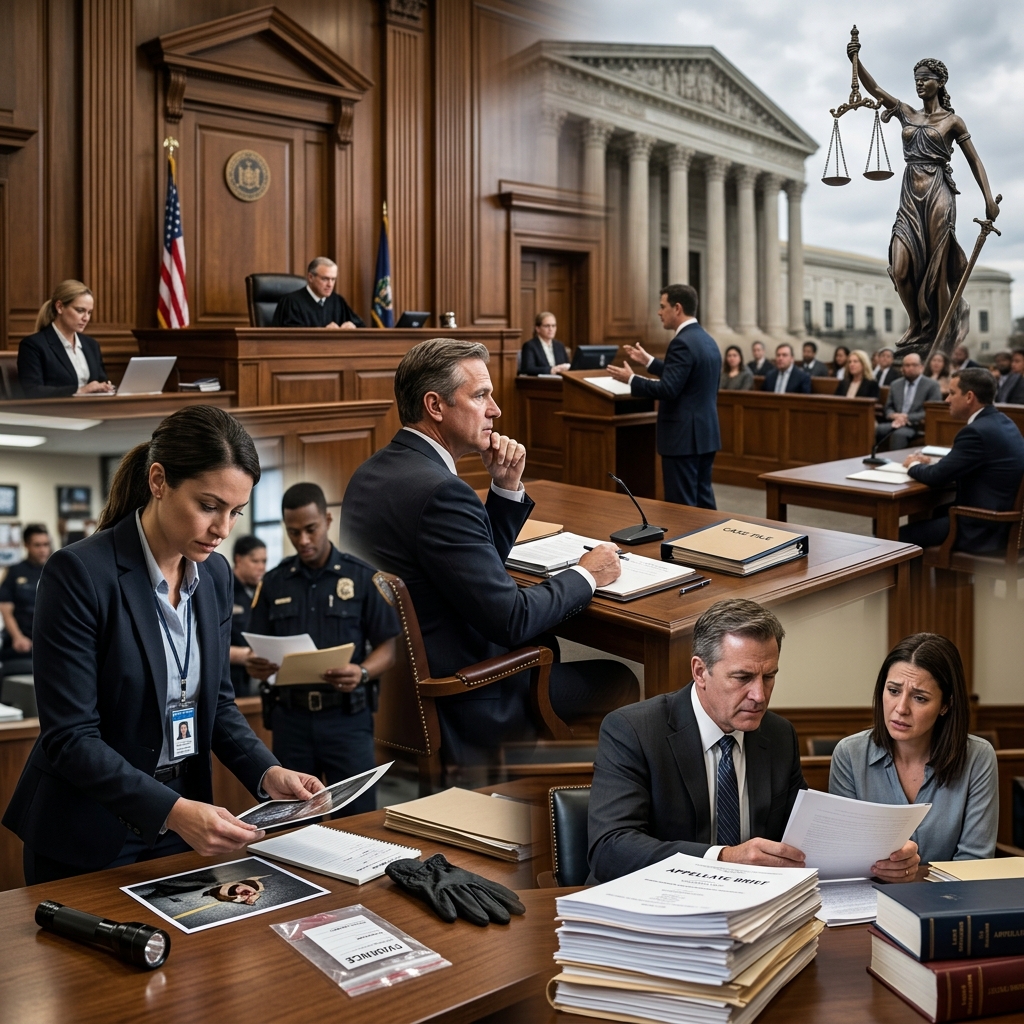
Criminal procedure is the body of rules that governs how the government investigates crime, brings charges, conducts trials, and imposes punishment while safeguarding individual rights such as due process and equal protection. These rules structure every step of a case, from the first police contact to the final appeal, and are essential to a fair and trustworthy justice system.
1. What Is Criminal Procedure and Why Does It Matter?
At its core, criminal procedure is about process: it dictates how the state enforces criminal law, not whether a particular act is a crime. Substantive criminal law defines offenses (for example, theft or assault), while criminal procedure describes the sequence of proceedings and the protections that apply as a case moves through the system.
- Definition: Criminal procedure is the framework of rules for investigating, prosecuting, adjudicating, and punishing crimes.
- Main goals:
- Ensure accurate fact‑finding and fair outcomes.
- Protect constitutional rights such as the right to counsel, due process, and freedom from unreasonable searches.
- Maintain public safety by allowing effective enforcement of criminal laws.
- Sources of procedure rules: Constitutions, statutes (for example, Title 18 of the U.S. Code for many federal crimes and procedural rules), court rules, and judicial decisions.
Every jurisdiction—federal, state, and local—has its own codes and court rules, so specific steps can differ, but the overall sequence is usually similar: investigation, arrest, charging, pretrial, trial, sentencing, and appeal.
2. The Investigation Stage: From Suspicion to Evidence
The process typically begins when law enforcement learns of a possible crime. Officers and investigators must gather information and evidence while respecting constitutional limits, such as the Fourth Amendment requirements for searches and seizures.
2.1 How Investigations Begin
Investigations may be triggered by citizen reports, victim complaints, observation by officers, or longer‑term proactive operations. During this stage, officials aim to determine whether a crime occurred, who is responsible, and what evidence supports that conclusion.
- Interviewing victims and witnesses.
- Collecting physical or digital evidence.
- Conducting surveillance or undercover operations.
- Applying for search warrants backed by probable cause.
2.2 Constitutional Constraints During Investigation
Investigators must comply with constitutional protections designed to prevent abuse and ensure reliability of the evidence:
- Search and seizure rules: Generally, searches of homes and personal property require a warrant based on probable cause, subject to limited exceptions recognized by courts.
- Custodial questioning: When a suspect is in custody, law enforcement often must provide warnings about the right to remain silent and the right to an attorney before interrogation.
- Exclusionary principle: Evidence obtained in violation of constitutional rules may be suppressed, meaning it cannot be used at trial, which can affect the entire case.
3. Arrest, Initial Detention, and First Court Appearances
Once investigators have sufficient grounds, the next major step is whether to arrest a suspect and bring the case formally into court.
3.1 Arrest and Warrants
An arrest occurs when law enforcement takes a person into custody to answer for a suspected crime. Officers may act with or without a warrant, depending on the circumstances and jurisdictional rules.
| Type of Arrest | Key Features |
|---|---|
| Warrant‑based arrest | Judge or magistrate authorizes the arrest after a showing of probable cause in written affidavits. |
| Warrantless arrest | Permitted in many jurisdictions if officers have probable cause and certain conditions are met (for example, crime committed in the officer’s presence). |
3.2 Booking, Bail, and Release Decisions
After arrest, the suspect is typically booked, which may include identification, fingerprinting, and recording of the alleged offense. A judge or magistrate then reviews whether the person should be held in custody or released, often at an initial hearing or bail hearing.
- Bail or bond: Financial or other conditions that allow temporary release while the case is pending.
- Detention: In some cases, the court may order that the accused be held without bail if certain legal standards are met, usually based on risk of flight or danger to the community.
- Conditions of release: Courts may impose rules such as travel restrictions, no‑contact orders, or supervision requirements.
3.3 Arraignment and the Defendant’s Plea
The arraignment is a crucial early hearing where the defendant is formally informed of the charges and of key rights.
- The court reads or provides a document listing the alleged offenses.
- The defendant is advised of rights, such as the right to counsel and the right to remain silent.
- The defendant enters a plea—usually not guilty, guilty, or in some jurisdictions, no contest (nolo contendere).
A not‑guilty plea moves the case forward toward pretrial procedures and possible trial. A guilty or no‑contest plea can lead more quickly to sentencing.
4. Charging, Screening, and Pretrial Proceedings
Prosecutors decide which charges to file and how to structure the case. Their decisions are influenced by the strength of evidence, legal standards, public interest, and office policies.
4.1 Formal Charging
Charges may be brought through different documents depending on the jurisdiction and seriousness of the offense:
- Complaint or information: A charging document filed by a prosecutor, often used in many state and local courts.
- Indictment: A formal charge issued by a grand jury after it hears evidence and determines there is probable cause to proceed.
- Citation or ticket: Used for minor offenses in some jurisdictions, requiring the person to appear in court at a later date.
4.2 Discovery: Exchanging Evidence
Discovery is the pretrial process through which the prosecution and defense share information about the case. This step is central to fairness because it allows each side to prepare and avoid surprise.
- Prosecution typically discloses police reports, witness statements, lab results, and other evidence it plans to use.
- Defense may be required to disclose certain evidence or witness information, depending on local rules.
- Both sides may file motions asking the court to compel or limit discovery.
4.3 Pretrial Motions and Hearings
Pretrial activities provide opportunities to narrow the issues, challenge aspects of the government’s case, or even dispose of the case before trial.
- Suppression motions: Requests to exclude evidence claimed to be unlawfully obtained.
- Motions to dismiss: Arguments that charges are legally defective or unsupported.
- Preliminary hearings: In many felony cases, a judge examines whether there is probable cause to believe the defendant committed the offense, often based on witness testimony and evidence.
- Scheduling and status conferences: Meetings to set timelines, resolve practical issues, and encourage resolution.
4.4 Plea Negotiations
Plea bargaining is one of the most common outcomes in criminal procedure: many cases end with a negotiated plea instead of a full trial.
- Charge bargaining: Defendant pleads guilty to reduced or fewer charges.
- Sentence bargaining: Agreement on a sentencing recommendation or range.
- Courts typically ensure that any plea is voluntary, informed, and factually supported before accepting it.
5. Trial: Testing the Case in Court
If there is no negotiated resolution and the case is not dismissed, it proceeds to trial. Trials can be held before a jury or, in some circumstances, a judge alone (a bench trial).
5.1 Burden of Proof and Presumption of Innocence
Criminal trials center on two core principles:
- Presumption of innocence: The defendant is considered innocent unless and until proven guilty in court.
- Burden of proof: The prosecution must prove each element of each charged offense beyond a reasonable doubt—a high standard reflecting the serious consequences of a criminal conviction.
5.2 Typical Trial Sequence
While details vary, most trials follow a recognizable structure.
- Jury selection (if applicable): Prospective jurors are questioned to ensure fairness, and both sides may challenge certain jurors.
- Opening statements: Each side outlines its theory of the case to the jury or judge.
- Presentation of evidence:
- Prosecution presents witnesses, documents, and physical evidence.
- Defense cross‑examines prosecution witnesses and may present its own evidence.
- Motions during trial: For example, defense may ask the court to acquit if it believes the prosecution’s proof is legally insufficient.
- Closing arguments: Each side summarizes the evidence and argues how the law should be applied.
- Jury instructions and deliberation: The judge explains the relevant law, and the jury retires to discuss and reach a verdict.
- Verdict: The jury (or judge in a bench trial) announces whether the defendant is guilty or not guilty on each count.
6. Sentencing: Determining Punishment
If the defendant pleads guilty or is found guilty, the case moves to sentencing. Here, the court decides the appropriate penalty, considering laws, guidelines, and the circumstances of the offense and offender.
6.1 Factors Courts Consider at Sentencing
Sentencing rules vary widely by jurisdiction, but judges typically evaluate a combination of legal and factual factors.
- Statutory ranges: Minimum and maximum penalties defined in statutes.
- Sentencing guidelines: In some systems, advisory or mandatory guidelines help promote consistency.
- Presentence reports: Background investigations prepared by probation officers describing the defendant’s history and relevant aggravating or mitigating factors.
- Victim impact statements: Input from victims about the harm experienced.
- Aggravating and mitigating circumstances: Elements that may increase or reduce the severity of the sentence (for example, use of a weapon, lack of prior record).
6.2 Types of Sentences
Common sentencing options include:
- Incarceration in jail or prison.
- Probation, allowing the defendant to remain in the community under supervision and conditions.
- Fines, restitution to victims, or financial penalties.
- Community‑based programs, treatment, or educational requirements.
- Suspended sentences, where incarceration is imposed but not immediately executed if conditions are met.
7. After Sentencing: Appeals and Post‑Conviction Options
Criminal procedure does not end with sentencing. Many systems provide mechanisms to review convictions and sentences and to address potential errors.
7.1 Direct Appeals
A defendant who has been convicted typically has the right to appeal to a higher court within a specified time frame.
- Appeals focus on legal issues, such as incorrect application of law, improper admission of evidence, or constitutional violations.
- Appellate courts review the record from the trial court, consider written briefs, and may hear oral argument.
- Outcomes can include affirming the conviction, reversing it, ordering a new trial, or modifying the sentence.
7.2 Post‑Conviction and Collateral Review
Beyond direct appeals, some systems offer additional avenues:
- Motions for a new trial based on newly discovered evidence or significant procedural errors.
- Post‑conviction petitions alleging constitutional violations, such as ineffective assistance of counsel.
- Requests to expunge or seal records for certain offenses or after specific periods, when permitted by law.
8. Roles of Key Participants in the Criminal Process
Understanding criminal procedure also requires knowing what each participant does and how they interact.
- Law enforcement: Investigate crimes, gather evidence, and make arrests within constitutional limits.
- Prosecutors: Decide which charges to bring, represent the government in court, and negotiate pleas.
- Defense counsel: Protect the defendant’s rights, challenge the prosecution’s case, and advise on strategy, including plea decisions.
- Judges: Ensure proceedings are fair and lawful, rule on motions, instruct juries, and impose sentences.
- Juries: In jury trials, act as fact‑finders to determine guilt or innocence based on the evidence presented.
- Victims: May participate by providing statements, attending hearings, and receiving updates, particularly in systems with victim‑rights laws.
9. Practical Tips for Defendants and Families
Although criminal procedure can be complex, a few practical principles can help defendants and their families navigate the process more effectively:
- Seek legal representation early: Consulting an attorney as soon as possible improves your ability to understand options and protect rights.
- Keep organized records: Maintain copies of charging documents, court notices, and any communication related to the case.
- Attend all scheduled hearings: Failing to appear can lead to additional charges, warrants, or revocation of bail.
- Respect conditions of release: Comply with court‑ordered rules to avoid further legal consequences.
- Ask about victim or defendant support services: Courts and government agencies often provide informational resources or referrals for assistance.
10. Frequently Asked Questions About Criminal Procedure
10.1 Do all criminal cases go to trial?
No. Many cases are resolved through plea agreements, dismissals, or diversion programs before reaching trial. In some systems, only a small fraction of filed criminal cases result in full trials.
10.2 What does “probable cause” mean?
Probable cause is a legal standard requiring enough facts and circumstances to lead a reasonable person to believe a crime has been committed and that the individual in question is responsible. It is the threshold often required for arrests and search warrants.
10.3 Can charges change after an arrest?
Yes. Prosecutors may adjust charges based on further investigation, legal analysis, or plea negotiations. Initial arrest charges do not always match the final charges presented in court.
10.4 What happens if evidence was obtained illegally?
If a court finds that evidence was collected in violation of constitutional rules—for example, through an unlawful search—it may exclude that evidence from trial. This exclusion can significantly weaken the prosecution’s case and, in some instances, lead to dismissal.
10.5 Is sentencing the same everywhere?
No. Sentencing practices differ across jurisdictions, and penalties can vary widely depending on local laws, guidelines, and judicial discretion. However, most systems consider statutory ranges, presentence reports, and aggravating or mitigating factors when deciding on a sentence.
References
- What is criminal procedure? — Thomson Reuters Legal Blog. 2022-04-12. https://legal.thomsonreuters.com/blog/criminal-procedure/
- Your Guide to Understanding Criminal Procedure — East Carolina University Online. 2023-03-01. https://onlineprograms.ecu.edu/blog/understanding-criminal-procedure/
- Criminal procedure — Legal Information Institute, Cornell Law School. 2021-09-15. https://www.law.cornell.edu/wex/criminal_procedure
- A Brief Description of the Federal Criminal Justice Process — Federal Bureau of Investigation. 2020-07-17. https://www.fbi.gov/how-we-can-help-you/victim-services/a-brief-description-of-the-federal-criminal-justice-process
- The Criminal Justice Process — Tennessee District Attorneys General Conference. 2019-11-05. https://www.tndagc.org/the-criminal-justice-process/
- Steps in the Federal Criminal Process — U.S. Department of Justice. 2018-05-24. https://www.justice.gov/usao/justice-101/steps-federal-criminal-process
- Criminal court overview — California Courts, Self Help Guide. 2022-06-10. https://selfhelp.courts.ca.gov/criminal-court/overview
Similar Articles








Read full bio of medha deb




