
First Amendment & True Threats: A Legal Paradigm Shift
How the Supreme Court redefined unprotected speech and digital communication in the modern era.
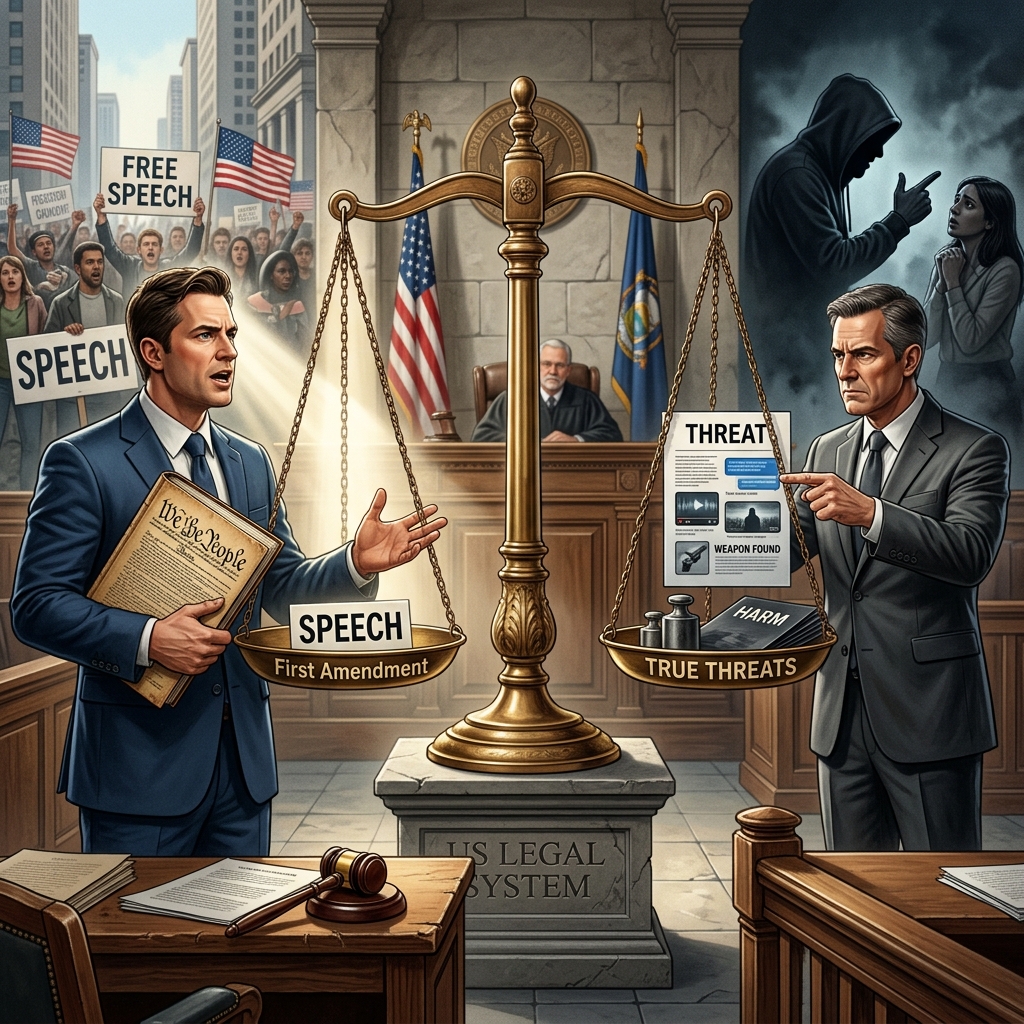
The Boundaries of American Free Expression
The First Amendment of the United States Constitution is widely celebrated as the bedrock of American democratic society, offering broad and robust protections for free speech, political discourse, and artistic expression. However, this constitutional shield has never been absolute. For decades, the judiciary has grappled with defining the exact boundaries of unprotected speech. While controversial political protests and deeply unpopular opinions are vehemently safeguarded by the courts, specific, narrow categories of speech—such as incitement to imminent lawless action, obscenity, fighting words, and “true threats”—fall entirely outside the First Amendment’s protective umbrella.
The legal ambiguity surrounding true threats—specifically, how to objectively or subjectively define them in a modern, hyper-connected digital world—recently culminated in a landmark ruling by the United States Supreme Court. In the 2023 decision of Counterman v. Colorado, the Supreme Court was tasked with resolving a deep jurisdictional split regarding the specific mental state required to convict an individual of making a true threat. The resulting ruling fundamentally reshaped American jurisprudence, abandoning a purely objective standard in favor of a subjective requirement that forces the legal system to peer into the mind of the speaker.
Understanding the “True Threat” Doctrine
To fully grasp the magnitude of recent legal developments, one must first understand what constitutes a “true threat.” Historically, the Supreme Court has held that the government can punish speech that frightens or intimidates individuals into believing they will be seriously harmed. The underlying rationale is that the state has a compelling interest in protecting its citizens not just from actual physical violence, but from the fear of violence and the severe disruption that such fear engenders in everyday life.
The origin of the modern true threat doctrine can be traced back to the 1969 case of Watts v. United States. During an anti-Vietnam War rally in Washington, D.C., an 18-year-old protester named Robert Watts stated that if the military forced him to carry a rifle, the first person he would get in his sights would be President Lyndon B. Johnson. Watts was initially convicted of threatening the President, but the Supreme Court reversed the decision. The Court ruled that Watts’s comments were mere “political hyperbole,” noting the conditional nature of his statement and the laughter it elicited from the crowd. This case cemented the principle that context is paramount, and that the First Amendment requires courts to distinguish between genuine expressions of intent to harm and heated, offensive, or hyperbolic rhetoric.
The Digital Dilemma: The Facts of Counterman v. Colorado
While the Watts case dealt with spoken words at a public rally, modern courts face the exponentially more complex task of evaluating digital communications. Social media platforms, direct messages, and text threads lack the physical context—such as tone of voice, facial expressions, and body language—that historically helped juries differentiate a joke from a genuine warning.
This digital dilemma was the focal point of Counterman v. Colorado. Between 2014 and 2016, Billy Raymond Counterman sent hundreds of unwanted Facebook messages to C.W., a local Colorado musician whom he had never met in person. C.W. never responded and actively blocked his accounts, but Counterman repeatedly created new profiles to bypass her boundaries. His messages ranged from bizarre and intrusive to deeply alarming, including statements like “Staying in cyber life is going to kill you” and “Die. Don’t need you.”
The barrage of messages severely upended the victim’s life. Suffering from intense anxiety and fear for her physical safety, she canceled musical performances, altered her daily routines, and lived in a constant state of hyper-vigilance. Counterman was subsequently arrested and charged under a Colorado stalking statute that criminalized repeated communications that would cause a “reasonable person” to suffer serious emotional distress.
Objective vs. Subjective Intent: A Constitutional Tug-of-War
At trial, Counterman’s defense argued that his messages, while deeply unsettling, were not “true threats” because he suffered from mental illness and did not subjectively intend to threaten C.W. The Colorado courts, however, applied an objective standard. They determined that a speaker’s actual, subjective intent was irrelevant. The only question that mattered was whether a “reasonable person” would view the statements as a threat of violence. Based on this objective framework, Counterman was convicted and sentenced to prison.
The case’s elevation to the Supreme Court centered entirely on this clash of standards. Civil liberties advocates argued that relying solely on an objective standard creates a dangerous “chilling effect” on free speech. If individuals fear that their poorly phrased jokes, sarcastic comments, or passionate political rants might result in criminal prosecution based on how an outside observer interprets them, they will inevitably self-censor.
Comparing the Legal Standards
| Legal Standard | Definition | Primary Focus | Risk to Free Speech |
|---|---|---|---|
| Objective Standard | Evaluates whether a hypothetical “reasonable person” would perceive the communication as a threat. | The listener’s reaction and the societal norm. | High. May penalize cultural misunderstandings, sarcasm, or poor phrasing without criminal intent. |
| Subjective Standard | Evaluates the actual mental state (mens rea) and intent of the individual speaking the words. | The speaker’s internal state of mind. | Low. Protects unintentional harm, but places a heavier burden on prosecutors to prove internal motives. |
The Supreme Court’s Ruling: Establishing the Recklessness Standard
On June 27, 2023, the Supreme Court handed down a decision that redefined First Amendment law. In a majority opinion authored by Justice Elena Kagan, the Court vacated Counterman’s conviction, ruling that the First Amendment requires the state to prove that a defendant had a subjective understanding of the threatening nature of their statements. The purely objective “reasonable person” test was deemed constitutionally insufficient for criminalizing true threats.
However, the Court did not require prosecutors to prove the highest level of intent—that the speaker specifically purposed to threaten the victim. Instead, the Court struck a middle ground by establishing a recklessness standard. In criminal law, acting recklessly means that a person consciously disregards a substantial and unjustifiable risk that their conduct will cause harm.
Under this new First Amendment framework, prosecutors must prove that the speaker was aware that their communications could be viewed as threatening violence, yet chose to deliver them anyway. This standard aims to provide “breathing room” for protected speech, ensuring that individuals are not thrown into prison for negligent mistakes or innocent miscommunications, while still holding abusers accountable when they consciously ignore the terror they are inflicting.
Dissenting Voices: The Argument for Public Safety
The decision was not unanimous, and the dissenting opinions highlighted the profound tension between speech rights and public safety. Justice Amy Coney Barrett, joined by Justice Clarence Thomas, authored a strong dissent. They argued that “true threats” have historically never enjoyed First Amendment protection, and that nearly every other category of unprotected speech—such as obscenity, fighting words, and defamation against private figures—is evaluated using an objective standard.
The dissenters expressed deep concern that injecting a subjective intent requirement into true threats cases gives an unwarranted layer of constitutional protection to dangerous individuals. They warned that the new recklessness standard will make it significantly harder to protect victims of stalking, domestic abuse, and cyber-harassment, as abusers can easily claim ignorance of how their terrifying words were received.
Implications for Digital Communication and Victim Advocacy
The ripple effects of this ruling are vast, particularly in the realm of digital communications. The internet is a breeding ground for hyperbole, anonymous vitriol, and rapid-fire discourse. By mandating a subjective recklessness standard, the Supreme Court has provided a crucial safeguard for online communities, ensuring that the inherent lack of context in a tweet, comment, or forum post does not automatically equate to criminal liability when misinterpreted by an outside observer.
Conversely, victim advocacy organizations and law enforcement agencies face a new, steeper evidentiary hill. Organizations dedicated to stalking prevention have noted that establishing a perpetrator’s subjective mindset requires prosecutors to delve into the defendant’s personal history, online behaviors, and private communications to prove they consciously disregarded the risk of their threats. While many state laws already utilized a subjective standard prior to this ruling, the federal mandate ensures that jurisdictions previously relying on objective tests must now overhaul their prosecutorial strategies.
Ultimately, the evolution of the true threats doctrine underscores the living nature of constitutional law. As technology continuously alters how humanity communicates, the judiciary is forced to recalibrate the delicate scales of justice—striving to preserve the fundamental liberty of free expression without abandoning the vulnerable to the very real psychological and physical dangers of modern intimidation.
Frequently Asked Questions (FAQs)
- What is a “true threat” under the First Amendment?
A true threat is a category of speech that is not protected by the Constitution. It encompasses statements where the speaker communicates a serious expression of an intent to commit an act of unlawful violence against a specific individual or group. Crucially, the speaker does not actually have to intend to carry out the violence; the threat itself, and the fear it causes, is the harm. - Why did the Supreme Court reject the “reasonable person” standard?
The Court reasoned that relying solely on how a “reasonable person” interprets a statement could inadvertently punish protected speech. If people are afraid of being criminally prosecuted for misunderstandings, political hyperbole, or poor jokes, it creates a “chilling effect” where citizens censor their own lawful expressions. - What does “recklessness” mean in a legal context?
In this context, recklessness is a specific mental state (mens rea). It means that an individual is aware of a substantial and unjustifiable risk that their words will be perceived as a threat of violence, but they consciously choose to disregard that risk and communicate the statement anyway. - Does this ruling mean online stalking is protected by free speech?
No. Stalking and harassment are still illegal. The ruling simply clarifies the burden of proof required in cases based primarily on speech. Prosecutors can still convict individuals of speech-based stalking, but they must now prove that the perpetrator was at least reckless regarding how their threatening words would be received.
References
- Counterman v. Colorado, 600 U.S. 66 — Supreme Court of the United States. 2023-06-27. https://www.supremecourt.gov/opinions/22pdf/22-138_43j7.pdf
- Amdt1.7.5.6 True Threats — Constitution Annotated, Congress.gov. 2023-06. https://constitution.congress.gov/browse/essay/amdt1-7-5-6/ALDE_00013807/
- Counterman v. Colorado — Oyez, Chicago-Kent College of Law. 2023-06-27. https://www.oyez.org/cases/2022/22-138
- Understanding the Counterman v. Colorado Supreme Court Decision — Stalking Prevention, Awareness, and Resource Center (SPARC). 2023-07. https://spark.aequitasresource.org/understanding-the-counterman-v-colorado-supreme-court-decision/
Similar Articles








Read full bio of medha deb


