
Federal Student Loan Defaults and Credit Reporting Rules
How federal student loan defaults interact with the Fair Credit Reporting Act and what borrowers need to know about their rights.
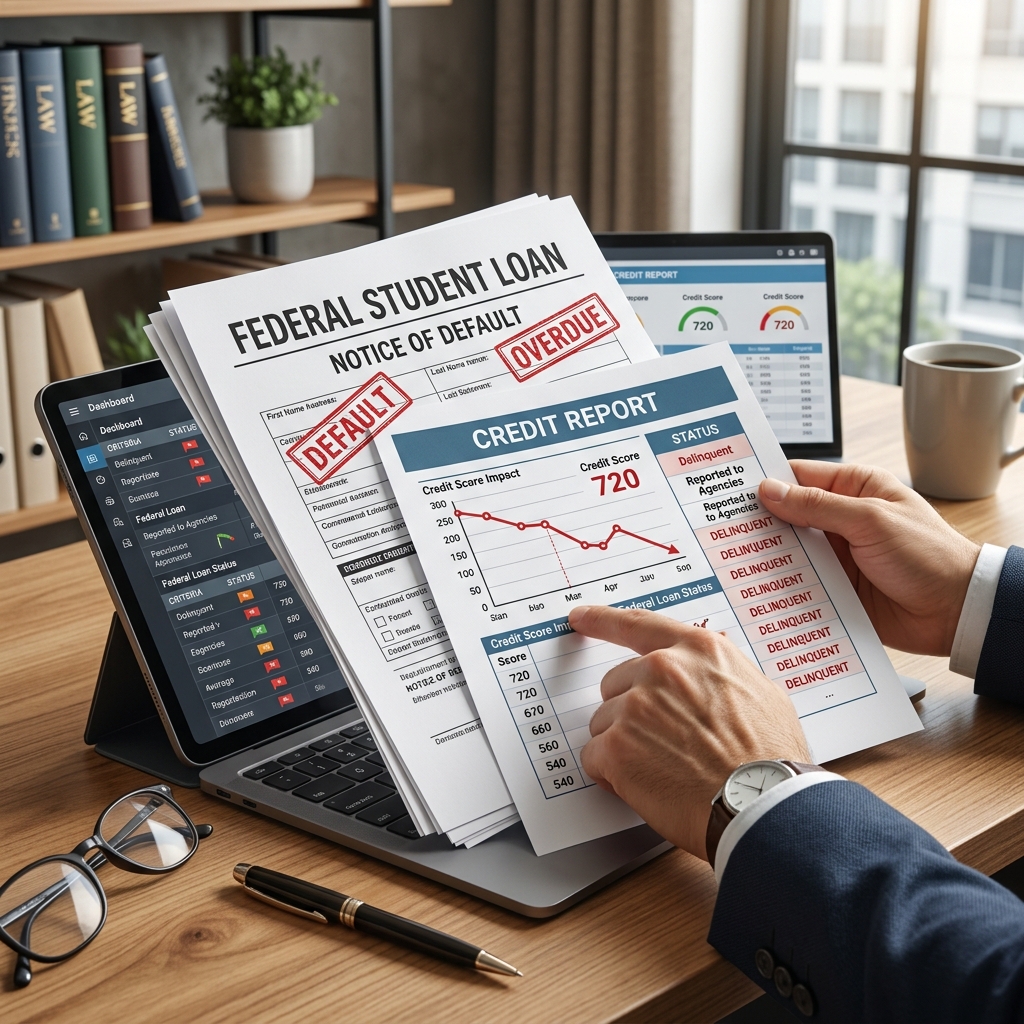
Federal student loans are governed by a complex interaction of laws, including the Fair Credit Reporting Act (FCRA) and the Higher Education Act (HEA). These statutes shape how defaults are reported to credit bureaus, how long negative information can stay on a credit report, and what rights borrowers have to correct errors.
This article explains that framework in practical terms: what happens when a federal student loan goes into default, how credit reporting agencies treat that default, and why a court case from the U.S. Court of Appeals for the Third Circuit matters for borrowers and educational institutions alike.
Understanding the Legal Framework
Two primary federal statutes govern how student loan information appears on your credit report:
- Fair Credit Reporting Act (FCRA) – a federal law that promotes accuracy, fairness, and privacy in consumer credit reports and imposes duties on creditors and credit reporting agencies regarding disputed information.[10]
- Higher Education Act of 1965 (HEA) – the main statute governing federal student aid programs, including specific requirements for reporting federal student loan information to credit bureaus.
While the FCRA generally limits how long negative information can remain on credit reports, the HEA creates special rules for federal education loans, including how and when they are reported and, in some situations, how long defaults can appear.
How Federal Student Loan Defaults Occur
Before exploring credit reporting, it is important to understand what a default is in the context of federal student loans. Federal loans typically move through three broad stages:
- In good standing – payments are made as required, or the borrower is in a valid deferment or forbearance period.
- Delinquency – payments are missed but the loan has not yet reached the threshold for default; late payments can be reported as negative information.
- Default – for most federal direct loans, default occurs after 270 days of non-payment, triggering collection activity and formal negative reporting.
Once a loan is in default, federal law requires guarantors and loan servicers to report that default status to national credit bureaus, which can significantly impact the borrower’s ability to obtain new credit.
What the FCRA Requires for Credit Reporting
The FCRA sets baseline rules for all consumer debts, including student loans:
- Credit reporting agencies must follow procedures that promote maximum possible accuracy in consumer reports.
- Companies that furnish information (such as schools, lenders, or servicers) have duties to provide accurate data and to investigate disputes.
- Negative information, like late payments and defaults, is generally subject to a seven-year limit from the date of first delinquency for how long it can appear on a report.
For private student loans and most other consumer debts, this seven-year “age-off” rule typically governs how long a default is visible in a credit report.
Special Treatment of Federal Student Loans Under the HEA
Federal student loans, however, are not treated identically to other consumer debts. The HEA imposes distinct requirements:
- Federal education loans must be reported to each national consumer reporting agency, ensuring they appear in borrowers’ credit histories.
- Certain federally guaranteed student loans are explicitly exempt from the ordinary FCRA age-off provision, meaning defaults may stay on credit reports beyond the standard seven-year period.
In practice, this means that for some federal loans, negative information can remain visible longer than it would for other debts, and the usual FCRA seven-year rule may not automatically remove a default record.
Who Controls When Information “Ages Off”?
A key question in litigation has been: who decides when a federal student loan default should stop appearing on the credit report?
In a case considered by the U.S. Court of Appeals for the Third Circuit, a borrower challenged how a university reported the default date of a federal loan. The borrower argued that reporting the original default date—rather than a later event—affected whether the default would be treated as too old to remain on the credit report under FCRA rules.
The Third Circuit held that the statutes clearly required the institution furnishing the data to report the accurate original default date, and that the decision about whether information should age off rests with the credit reporting agency, not with the furnisher (such as a school or servicer).
| Actor | Primary Role | Key Legal Duties |
|---|---|---|
| Loan furnisher (school, servicer, guarantor) | Provides loan and default information to credit bureaus | Must report accurate information, including correct default dates; must investigate disputes under FCRA. |
| Credit reporting agency (Equifax, Experian, TransUnion) | Maintains credit files and generates consumer reports | Determines when information ages off; must ensure accuracy and respond to disputes. |
| Borrower | Reviews credit reports and initiates disputes | May challenge inaccurate data, provide documentation, and seek corrections under FCRA. |
Accuracy Requirements and the Third Circuit’s Message
The Third Circuit’s analysis emphasized several points that matter beyond the particular case:
- Statutory clarity – when statutes like the FCRA and HEA specify how information must be reported, courts will enforce those requirements as written.
- Duty to report true dates – furnishers cannot adjust dates or other information to influence how long a default remains on a credit report; their obligation is to report what actually happened.
- Separation of responsibilities – credit reporting agencies, not schools or servicers, control how they apply age-off rules to information they receive.
For borrowers, this means that disputes over whether a default is too old to appear on a report generally involve the credit bureaus’ obligations and practices, rather than the reporting institution changing dates to alter the timeline.
Borrower Rights Under the FCRA
Despite the complex interplay of laws, borrowers retain important rights under the FCRA when federal student loan information is reported incorrectly:
- Right to access credit reports – borrowers can obtain free copies of their credit reports and review them for errors, including how federal loans are listed.
- Right to dispute inaccuracies – if a report shows a wrong balance, incorrect status (such as default instead of current), or an erroneous default date, the borrower may file a dispute with the credit bureau.
- Right to a reasonable investigation – credit bureaus must investigate disputes and contact the furnisher of information; if they cannot verify the disputed data, they must correct or remove it.
- Right to sue for damages – if inaccurate information persists and causes financial harm, the FCRA allows borrowers to seek statutory, actual, and potentially punitive damages, including attorney’s fees, from responsible parties.
These rights apply equally to federal student loans and other debts; however, they affect how information is reported, not whether the underlying loan must be repaid.
Collection of Defaulted Federal Student Loans
Separate from credit reporting, federal student loans have distinctive collection rules. There is generally no statute of limitations on the collection of defaulted federal student loans, meaning the government can pursue repayment indefinitely unless the borrower qualifies for discharge.
Collection tools can include:
- Administrative wage garnishment
- Tax refund offsets
- Offsets of certain federal benefits, such as Social Security, under the Treasury Offset Program
While the resumption of collection efforts does not change FCRA duties, it often makes accurate credit reporting more important, because errors can influence borrowing costs, employment opportunities, and housing applications.
How Long Defaults Can Stay on Credit Reports
For many debts, negative information remains for about seven years from the date of first delinquency, after which it must be removed under the FCRA. Federal student loans present two nuances:
- Standard negative information (such as late payments) on federal loans generally follows the seven-year period.
- Certain federally guaranteed loans are exempt from the typical age-off rule under the HEA, which can allow default information to remain for longer.
In all cases, the credit reporting agency is the entity that implements these age-off rules based on the data furnished, including the original default date. Furnishers cannot manipulate those rules by changing dates; they must report actual events accurately.
Practical Steps for Borrowers Facing Default
Borrowers concerned about federal student loan defaults and credit reporting can take several practical steps:
- Monitor credit reports regularly – obtain reports at least annually and after major events, such as loan rehabilitation or consolidation, to ensure changes are reflected accurately.
- Confirm default dates and statuses – check that the reported default date matches your loan records and that rehabilitation or repayment efforts are properly recorded.
- Use formal dispute procedures – if you identify an error, follow the FCRA dispute process with each credit bureau reporting the information, including in writing and attaching documentation.
- Seek legal advice for persistent errors – if a servicer or bureau fails to correct proven inaccuracies, consult a consumer law or student loan attorney to evaluate potential FCRA claims.
FAQs on Federal Student Loan Defaults and Credit Reporting
Does the FCRA limit how long my federal student loan default appears on my credit report?
For many loans, the FCRA’s general rule is that negative information can remain for about seven years from the date of first delinquency. However, the HEA exempts some federally guaranteed student loans from this age-off rule, meaning certain federal defaults may stay on reports longer. The credit bureau, not your school or servicer, decides how to apply these rules based on accurate data furnished.
Can a school or loan servicer change my default date to shorten or extend how long it shows up?
No. Under federal law and the Third Circuit’s interpretation, furnishers are obligated to report the true original default date and other accurate information. They do not control when information ages off; that decision is left to the credit reporting agency consistent with the FCRA and HEA.
What should I do if my federal student loan is incorrectly listed as in default?
If your loan is incorrectly shown as in default, you can file a dispute with each credit reporting agency that lists the error. The agency must conduct a reasonable investigation, often contacting the loan servicer, and correct or delete information that cannot be verified. If the error is not fixed and causes financial harm, you may consider legal action under the FCRA.
Does resolving a default remove it from my credit report immediately?
Resolving a default—through full repayment, rehabilitation, or consolidation—changes how the loan is reported, but it does not always erase the record of the default itself. Some programs may update the status to show current repayment or a paid collection, but the history of default can remain for a period based on FCRA and HEA rules.
Are federal student loans subject to a statute of limitations for collection?
Unlike many consumer debts, defaulted federal student loans generally do not have a statute of limitations for collection. Borrowers remain liable until the loan is paid in full or discharged under applicable federal programs. This collection framework is separate from FCRA rules on credit reporting but often interacts with them in practice.
References
- Fair Credit Reporting Act — Federal Trade Commission. 2022-06-30. https://www.ftc.gov/legal-library/browse/statutes/fair-credit-reporting-act
- Credit reporting — Federal Student Aid (Aidvantage). 2023-05-10. https://aidvantage.studentaid.gov/credit-reporting
- How Do Student Loans Affect Your Credit Scores? — Saving for College. 2023-04-01. https://www.savingforcollege.com/article/how-do-student-loans-affect-your-credit-scores
- Federal Student Loans and the Fair Credit Reporting Act — The Consumer Law Group. 2021-09-15. https://www.theconsumerlawgroup.com/library/federal-student-loans-and-the-fair-credit-reporting-act.cfm
- Default of Federal Student Loans Frequently Asked Questions — Illinois Student Assistance Commission. 2019-01-01. https://www.isac.org/students/after-college/documents/Default_FAQs_College.pdf
- The Federal Government Has Resumed Collection Efforts on Delinquent Student Loans — The Kim Law Firm LLC. 2025-06-10. https://thekimlawfirmllc.com/the-federal-government-has-resumed-collection-efforts-on-delinquent-student-loans-make-sure-your-credit-report-is-accurate/
Similar Articles








Read full bio of medha deb




