
Tax Violations and U.S. Visa Status: Essential Guide
How tax duties, violations, and IRS enforcement can impact your U.S. visa or green card—and what steps help protect your immigration status.
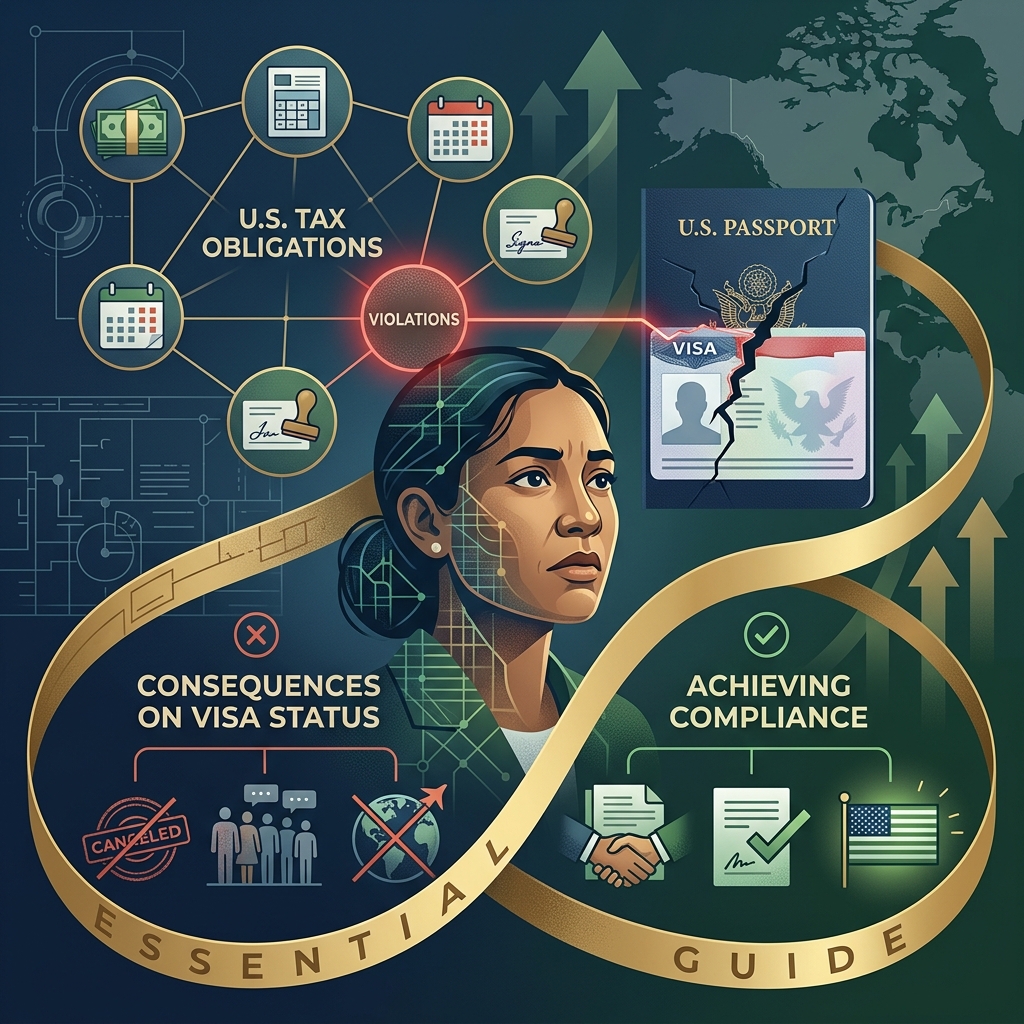
Foreign nationals living, working, or studying in the United States often focus heavily on immigration rules but overlook one critical issue: U.S. tax compliance. Tax obligations apply to many visitors and residents, and serious violations can have consequences that reach far beyond fines—potentially affecting immigration status in severe cases.
This guide explains how U.S. tax rules apply to visa holders and lawful permanent residents, what common tax problems look like, when those problems matter for immigration, and how to respond if you are facing tax enforcement or investigations.
Understanding Tax Residency: Who the IRS Considers a Taxpayer
U.S. tax law does not rely solely on your visa type to determine whether you must file taxes. Instead, the Internal Revenue Service (IRS) uses the concepts of resident alien and nonresident alien for tax purposes.
| Tax Status | How It Is Determined | Scope of Taxation |
|---|---|---|
| Resident alien | Green card holder, or meets the Substantial Presence Test based on days in the U.S. | Taxed on worldwide income similar to U.S. citizens. |
| Nonresident alien | No green card and does not meet Substantial Presence Test. | Taxed only on certain U.S.-source income and effectively connected income. |
Many visa holders—particularly those who stay long-term—become resident aliens for tax purposes even if they remain nonimmigrants under immigration law. That shift changes the scope of income they must report and can increase their exposure if they fail to file or underreport income.
Substantial Presence Test in Brief
While the precise calculation is technical, the basic idea of the Substantial Presence Test is that spending enough days in the U.S. over a three-year period can make you a tax resident even without a green card.
- As a rough rule, 183 or more qualifying days in a calendar year usually triggers tax residency.
- Days from prior years are counted in weighted form under a statutory formula.
- Certain visa categories and short visits may be treated as “exempt” days and not counted.
Once treated as a resident alien, your filing obligations resemble those of U.S. citizens, and tax violations can become more serious because they involve worldwide income.
Core Tax Obligations for Visa and Green Card Holders
Regardless of immigration status, individuals who are tax residents must comply with U.S. tax laws. New immigrants are explicitly advised by the IRS that they must report worldwide income and comply with federal tax rules.
Key Duties Commonly Applying to Foreign Nationals
- Determine tax residency: Identify whether you are a resident or nonresident alien for each tax year.
- File annual returns when required: Resident aliens typically file Form 1040; nonresident aliens use Form 1040-NR for U.S.-source income.
- Report worldwide income if you are a resident alien or green card holder, including wages, business income, investments, and rental income abroad.
- Report specified foreign assets and foreign bank accounts when thresholds are met, using forms such as FBAR or Form 8938.
- Pay any tax due by applicable deadlines and respond to IRS notices promptly.
Green card holders are treated as U.S. tax residents from the time permanent residence is granted and must report global income until the status is formally surrendered or terminated.
Common Tax Violations Among Visa Holders
Most problems arise not from intentional tax fraud but from misunderstandings or neglect. However, even unintentional errors can lead to significant financial consequences, and intentional evasion may trigger criminal enforcement.
Frequent Noncompliance Issues
- Failure to file tax returns when legally obligated to do so.
- Underreporting income, especially foreign wages, business income, or money in overseas accounts.
- Incorrect classification as nonresident and filing the wrong forms despite meeting the Substantial Presence Test.
- Ignoring foreign asset reporting rules such as FBAR and Form 8938 requirements.
- Improper use of tax treaty benefits without filing the necessary disclosures.
While the IRS differentiates between negligent errors and deliberate evasion, both scenarios can generate penalties. The more evidence of intentional concealment or falsification, the higher the risk of criminal investigation.
Examples of Risky Behavior
- Maintaining substantial foreign investment accounts and never reporting income or balances.
- Collecting freelance or consulting income through overseas platforms while living in the U.S. and omitting that income from returns.
- Using multiple bank accounts or nominees to hide taxable income or assets.
- Submitting false documents or fabricated deductions to reduce taxes owed.
Such actions may be interpreted as attempts to evade taxes, a form of tax fraud that can involve criminal charges under U.S. law.
Consequences of Tax Violations: Financial and Legal
Tax violations can trigger a range of outcomes—from automated IRS notices to audits, civil penalties, and, in serious cases, criminal prosecution. The primary consequences are financial, but they can also intersect with immigration enforcement.
Financial Penalties and Enforcement Tools
- Failure-to-file and failure-to-pay penalties: Added amounts based on how late the return or payment is.
- Accuracy-related penalties for substantial understatements or negligence.
- Civil fraud penalties when intentional misrepresentation is proven.
- Interest charges accumulating on unpaid tax and penalties over time.
- Liens and levies on property or bank accounts to collect unpaid tax.
These measures can significantly affect a foreign national’s financial stability, which may indirectly affect their ability to demonstrate self-sufficiency or meet certain immigration requirements, especially for future petitions.
Criminal Tax Enforcement
When the government believes that a taxpayer has deliberately evaded tax or engaged in fraud, cases may be referred for criminal investigation. Potential charges include tax evasion, filing false returns, or making false statements to the government.
- Criminal tax cases are generally reserved for serious or repeated misconduct.
- Convictions can result in fines, restitution, and imprisonment.
- Any criminal record can have substantial immigration consequences, including potential inadmissibility or removal.
While many visa holders will never face criminal tax charges, understanding the line between civil and criminal issues is important when responding to IRS inquiries.
Interaction Between Tax Issues and Immigration Status
Tax obligations are enforced by the IRS, whereas visa and green card matters are handled by immigration agencies. However, the two systems increasingly share data, and serious tax problems can echo into immigration proceedings.
Where Tax Compliance Matters for Immigration
- Applications for permanent residence or naturalization: Background checks may reveal outstanding tax debts or evidence of fraud, which can be weighed in discretionary decisions.
- Public charge and financial stability assessments: Large unresolved debts or liens may raise questions in certain cases.
- Criminal convictions: Tax-related convictions can form part of the record used in removal or inadmissibility determinations.
- Evidence of fraud: Coordinated investigations may examine patterns of misrepresentation that span both tax and immigration filings.
Merely owing tax is not, by itself, a ground for deportation. However, willful tax fraud or significant unpaid liabilities connected with other misconduct can reinforce government arguments that a person lacks good moral character or has engaged in fraud.
Green Card Holders: Special Considerations
Green card holders are treated similarly to U.S. citizens for tax purposes, including the obligation to report worldwide income. Persistent failure to comply can raise questions about respect for U.S. law and may become relevant when applying for naturalization or facing other enforcement actions.
- Tax noncompliance may complicate citizenship applications, which require a showing of good moral character.
- Long-term residents who later give up their green cards may face special exit tax rules or reporting obligations in certain circumstances.
- Green card holders residing abroad must still consider U.S. tax and reporting duties until status is formally relinquished.
Because immigration status is valuable, permanent residents have a strong incentive to resolve tax issues proactively rather than allowing them to escalate.
Responding If You Receive IRS Notices or Face Tax Investigations
Visa holders and immigrants sometimes ignore IRS letters due to fear or confusion, which almost always makes the situation worse. A structured response can limit penalties and show that you are acting in good faith.
Initial Steps When You Learn of a Problem
- Read all notices carefully to understand what tax years and issues are involved.
- Gather documents such as pay statements, bank records, and prior returns.
- Clarify your tax residency for the relevant years, including visa status and days in the U.S.
- Consult qualified professionals, ideally both a tax advisor and, when immigration concerns exist, an immigration attorney.
- Respond within deadlines, even if only to request more time or representation.
The IRS offers various compliance pathways, including amended returns, payment plans, and, in special circumstances, voluntary disclosure programs for taxpayers who have failed to report foreign assets or income.
Mitigating Risk for Immigration Purposes
- Document all efforts to correct errors and pay outstanding amounts.
- Maintain copies of correspondence and payment records for future immigration filings.
- Avoid making inconsistent statements in tax and immigration documents.
- Seek advice before travel or major status changes if serious tax enforcement is ongoing.
Demonstrating proactive compliance can help show that any past issues were mistakes rather than deliberate fraud, which may be important in discretionary immigration decisions.
Good Practices to Protect Both Tax and Immigration Status
Preventing tax problems is generally easier—and less expensive—than trying to fix them after the fact. The following practices can reduce risk for visa holders and permanent residents.
- Track days in the United States to know when you might become a tax resident.
- Keep thorough financial records, including income and expenses in all countries.
- Obtain a Social Security Number or ITIN as needed for tax filing.
- Learn basic U.S. tax concepts relevant to your situation, such as resident vs. nonresident treatment, and use reputable guidance.
- Consult advisors familiar with cross-border tax issues when you have income or assets outside the U.S.
- Coordinate tax planning with immigration planning, especially before long stays abroad or significant investment moves.
By combining careful record-keeping with professional advice, most foreign nationals can maintain compliance and reduce the chance that tax issues will disrupt their lives or jeopardize immigration goals.
Frequently Asked Questions
Do all visa holders have to file U.S. tax returns?
No. Filing depends on whether you are treated as a tax resident or nonresident and whether you have enough U.S.-source or worldwide income to trigger filing thresholds. However, immigration guidance generally expects that visa holders comply with all applicable U.S. laws, including tax rules.
Can unpaid taxes alone cause deportation?
Unpaid taxes by themselves do not automatically result in removal. The more serious concern is tax fraud or criminal convictions related to tax evasion, which can influence immigration decisions and, in some cases, form part of the grounds for inadmissibility.
Are foreign bank accounts and investments relevant to U.S. taxes?
Yes. U.S. tax residents must report income from foreign accounts and, above certain thresholds, disclose the accounts themselves using specific forms. Failure to do so can trigger significant penalties, especially in the case of intentional non-disclosure.
Does giving up a green card remove past tax obligations?
Relinquishing a green card may change future tax residency, but it does not erase past obligations or liabilities. Long-term residents may face special exit tax provisions and must follow IRS procedures for terminating tax residency.
What should I do if I realize I have not reported foreign income?
Do not ignore the problem. Consult a tax professional about filing amended returns and any applicable disclosure programs. Addressing the issue proactively can limit penalties and reduce the risk of more serious enforcement or immigration consequences.
References
- Taxation of Aliens by Visa Type and Immigration Status — Internal Revenue Service. 2024-02-05. https://www.irs.gov/individuals/international-taxpayers/taxation-of-aliens-by-visa-type-and-immigration-status
- Tax Information and Responsibilities for New Immigrants to the United States — Internal Revenue Service. 2023-03-15. https://www.irs.gov/individuals/international-taxpayers/tax-information-and-responsibilities-for-new-immigrants-to-the-united-states
- How Are Different Visa Types Taxed in the United States? — Greenback Tax Services. 2023-08-10. https://www.greenbacktaxservices.com/blog/visa-taxation-chart/
- Filing U.S. Taxes — Office of Visa and Immigration Services, Dartmouth College. 2022-01-20. https://ovis-intl.dartmouth.edu/taxes-legal/taxes/filing-us-taxes
- Do Green Card Holders Pay Taxes on Foreign Income? — Greenback Tax Services. 2024-05-12. https://www.greenbacktaxservices.com/blog/filing-taxes-abroad-green-card-holders/
- Green Card Tax Filing Requirements: Filing Rules and Obligations — 1040 Abroad. 2024-01-30. https://1040abroad.com/blog/green-card-us-taxes-filing-requirements-for-holders/
Similar Articles








Read full bio of medha deb




