
Estate Planning After Divorce: Complete Post-Divorce Checklist
A practical guide to rebuilding your estate plan after divorce so your wishes stay current and enforceable.
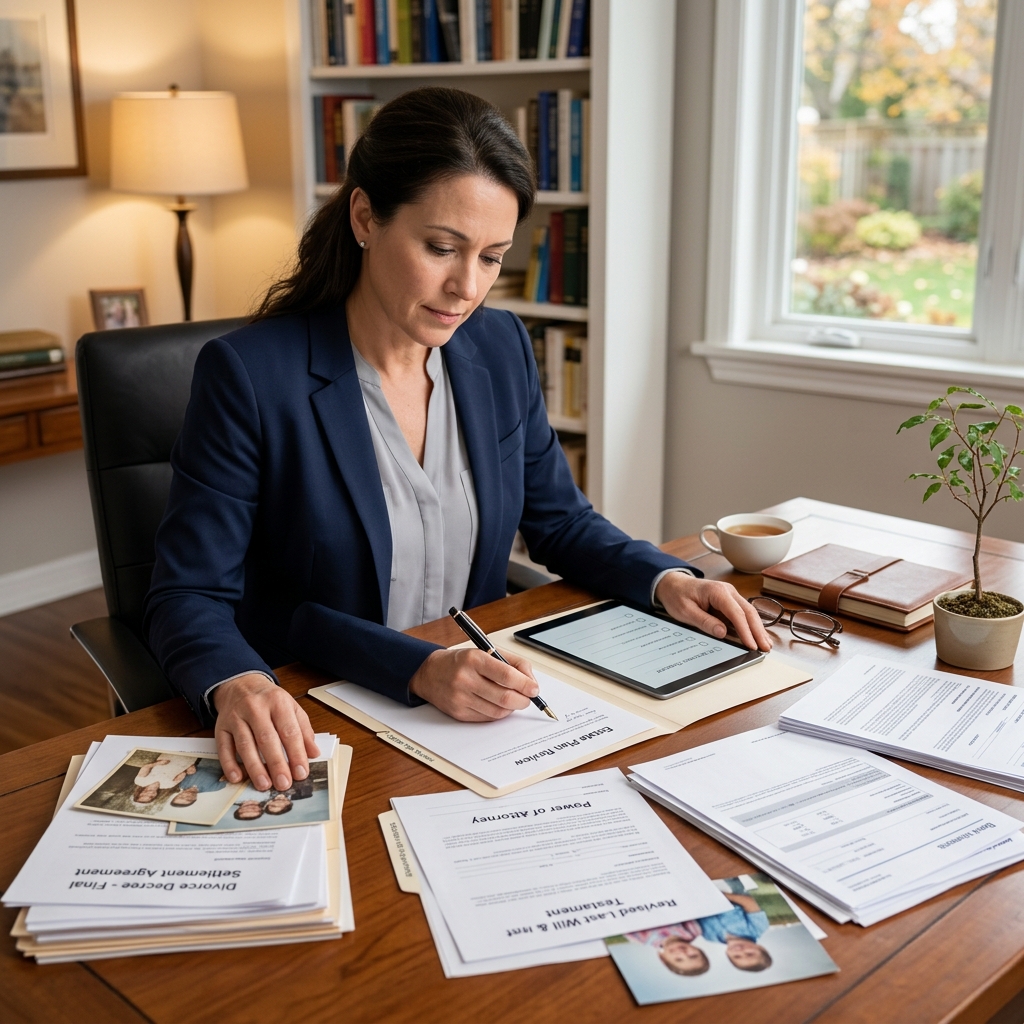
Divorce is not only a personal and financial reset; it is also a legal moment that can leave an old estate plan out of sync with your new life. Documents signed during marriage often remain partially effective unless they are updated, which means an ex-spouse may still appear in important roles or receive assets you no longer intend them to receive.
The safest approach is to review the entire plan as a connected system rather than changing one document at a time. That includes your will, trusts, beneficiary designations, powers of attorney, healthcare instructions, and the way property is titled after the divorce settlement.
Why divorce should trigger a full review
A divorce decree changes marital status, but it does not automatically fix every estate planning document. Several sources note that beneficiary forms and other account instructions can still control where assets go, even when the will says something different.
This is why a post-divorce review should focus on both the documents themselves and the records held by banks, retirement plan administrators, insurers, and title companies. If those records are inconsistent, the estate plan may not function the way you expect.
Rework your will so it reflects your new intentions
Your will is the most visible place to start because it often names a spouse as executor, beneficiary, or both. After divorce, those roles should be checked carefully and revised if they no longer fit your wishes.
A revised will can do more than remove an ex-spouse. It can also replace them with a trusted personal representative, update gifts to relatives or friends, and clarify how you want any remaining property to be distributed.
- Remove your former spouse as a beneficiary if that is no longer your intent.
- Replace your former spouse as executor or personal representative.
- Review any specific gifts that refer to shared property or marital arrangements.
- Confirm that backup beneficiaries are still appropriate after the divorce.
Update trusts before they create new problems
If you created a revocable living trust during marriage, it may still contain provisions that benefit your former spouse or rely on joint planning assumptions. Sources on post-divorce planning consistently recommend amending, restating, or revoking outdated trusts when necessary.
Trust updates are especially important when the trust was designed to hold jointly owned assets or to manage inherited property for a spouse and children. If the trust structure no longer matches the divorce agreement, it can create confusion for trustees and beneficiaries later on.
| Trust issue | Why it matters after divorce | Possible update |
|---|---|---|
| Former spouse named as trustee | That person may still control assets or distributions | Appoint a new trustee or successor trustee |
| Former spouse named as beneficiary | Trust assets may continue flowing to an unintended recipient | Revise beneficiary terms or restate the trust |
| Joint trust structure | Marriage-based planning may no longer fit individual ownership | Split into separate trusts if appropriate |
Change beneficiary forms everywhere they matter
Beneficiary designations are one of the most overlooked parts of post-divorce planning. They often control life insurance, retirement accounts, bank accounts with payable-on-death instructions, and similar assets, which means a form on file may override assumptions in a will.
Because of that, it is not enough to update your estate documents alone. You need to contact the institutions that hold the assets and replace any outdated forms with new ones that match your current wishes.
- Review life insurance policies and replace any outdated beneficiary names.
- Check retirement accounts such as 401(k)s and IRAs.
- Update bank accounts with payable-on-death or transfer-on-death instructions.
- Verify brokerage and investment accounts, especially if they were opened during marriage.
Replace powers of attorney and medical decision-makers
During marriage, many people name a spouse to handle financial and healthcare decisions if they become incapacitated. After divorce, that arrangement should be revisited so the authority sits with someone you trust now, not someone whose interests may no longer align with yours.
This includes durable powers of attorney, healthcare proxies, advance directives, and related authorization forms. Updating these records helps avoid conflict if an emergency occurs before you have had time to revisit the rest of the plan.
- Revoke old financial powers of attorney if they name your former spouse.
- Appoint a new agent to manage money, bills, and property matters.
- Replace healthcare proxies with someone who can make medical choices for you.
- Review HIPAA-style access forms and other medical authorization paperwork.
Revisit guardianship and planning for children
If you have minor children, your estate plan should clearly explain who would step in if you were not able to care for them. Even when a former spouse remains a natural parent, your documents can still address backup guardians, trust management, and distribution rules for inherited assets.
Divorce can make children’s inheritance planning more important, not less. A trust can help stage distributions, protect funds from mismanagement, and give you more control over how money is used for education, health, and support.
- Name a guardian for minor children if one is needed.
- Choose an alternate guardian in case the first choice cannot serve.
- Consider a trust to manage inherited assets for young beneficiaries.
- Review any language that assumes a two-parent household or shared administration.
Retitle property so ownership matches the divorce outcome
Estate planning works best when ownership records are accurate. After a divorce, assets awarded to one spouse should be retitled, and joint accounts or joint deeds should be cleaned up according to the settlement terms.
This step reduces the chance that property passes in a way that conflicts with the divorce agreement. It also helps keep future probate, transfer, and tax questions simpler because the ownership trail is clearer.
- Change deeds for real estate that was divided in the divorce.
- Retitle vehicles and other registered property where needed.
- Close or divide joint accounts when permitted by the settlement.
- Confirm that each account reflects the correct owner and beneficiary.
Keep your divorce terms and estate plan aligned
Your divorce agreement and your estate plan should tell the same story. If one document says one thing and another says something different, that mismatch can become expensive to sort out later.
For example, some settlements place conditions on support, insurance, or asset division that should be reflected in updated planning documents. Reviewing both sets of paperwork together helps reduce the risk of accidental conflicts or unintended gifts.
A simple post-divorce action checklist
Many people find it easier to work through a checklist than to think about the estate plan as a single large task. The items below capture the most common updates recommended across the sources reviewed.
- Gather your will, trust, beneficiary forms, powers of attorney, and healthcare directives.
- Identify every document or account that still names your former spouse.
- Revise the will and trust documents first so your core plan is current.
- Submit new beneficiary forms directly to financial institutions and insurers.
- Retitle property and close joint accounts as required by the divorce settlement.
- Update guardianship, trustee, and medical decision-maker choices.
- Store copies of all updated documents in a secure place and share them with the right people.
Common mistakes to avoid
One common mistake is assuming the divorce itself automatically updates everything. Another is forgetting that account forms can control asset transfers even when the estate plan says otherwise.
People also sometimes update only the will and forget the trust, or revise beneficiaries but leave powers of attorney untouched. A complete review is better than a partial one because each document serves a different legal function.
When professional help is useful
Although many post-divorce changes are straightforward, a lawyer can be especially helpful if your plan includes a trust, blended family concerns, business interests, or large retirement assets. The legal and financial details may require coordination so the new plan does not conflict with court orders or tax consequences.[10]
An attorney can also help confirm whether a document should be amended, replaced, or revoked entirely. That distinction matters because a patchwork of updates can sometimes be harder to administer than a clean revision.
FAQs
Does divorce automatically remove an ex-spouse from every document?
No. Several sources note that divorce may change some legal rights, but it does not reliably update every estate planning document or beneficiary form.
Should I make a new will after divorce?
That is often the cleanest approach because it lets you clearly state who should serve as executor and who should receive your property after the divorce is final.
Why are beneficiary forms so important?
Beneficiary designations often control retirement accounts, insurance proceeds, and similar assets, so they can override older expectations if they are not updated.
What should I do if I have young children?
Review guardianship choices, trust planning, and any instructions that affect how assets would be managed for your children if something happened to you.
How quickly should I update my plan?
The review should begin as soon as the divorce is final, and in some cases earlier planning may be possible for items not restricted by court orders or settlement terms.
References
- Estate Planning After Divorce: Why Updating Your … — DK Law Group. 2025. https://www.dklawmd.com/blog/the-intersection-of-estate-planning-and-divorce-law
- Fresh Start, Fresh Plan: Estate Planning After Divorce — Lommen Abdo. 2025. https://lommen.com/fresh-start-fresh-plan-estate-planning-after-divorce/
- Joint Estate Plan After Divorce in California Needs to be Updated — Sandiego Trust Lawyer. 2025. https://sandiegotrustlawyer.com/joint-estate-plan-after-divorce-california/
- Should I Update My Estate Plan After a Divorce in NY? — Lauter Law. 2025. https://www.lauterlaw.com/blog/should-i-update-my-estate-plan-after-a-divorce-in-ny/
- Navigating Estate Planning After a Divorce — Docr Law Offices. 2025. https://www.docrlaw.com/articles/navigating-estate-planning-after-a-divorce
- Estate Planning After Divorce: Protecting Your Assets in Colorado — Meurer Law Offices. 2025. https://meurerlawoffices.com/estate-planning-after-divorce-protecting-your-assets-in-colorado/
Similar Articles








Read full bio of Sneha Tete


