
How Educational Gag Orders Threaten Free Speech
Defending academic freedom against the rising tide of classroom censorship.
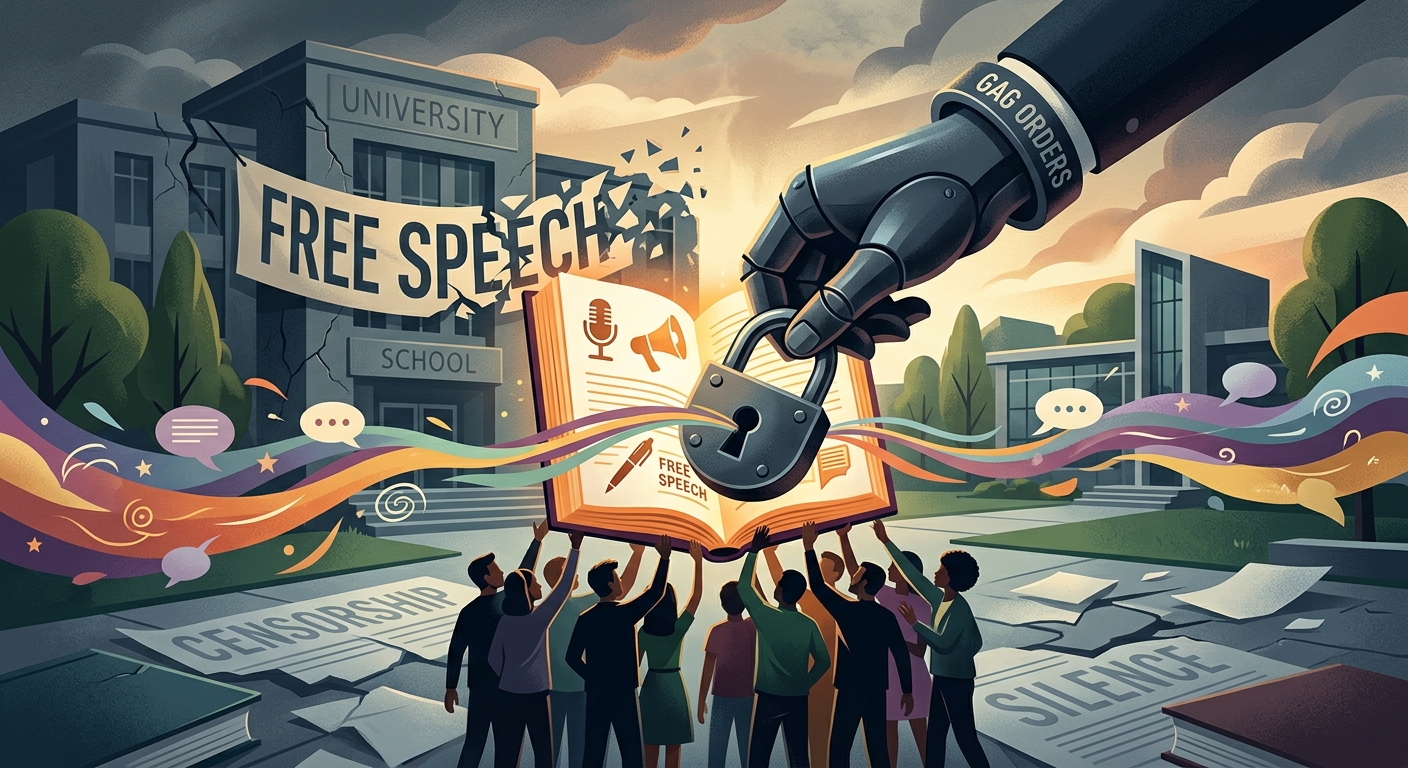
The Rise of Modern Classroom Censorship
The American classroom has long been idealized as a vibrant marketplace of ideas—a foundational space where young minds are introduced to the complexities of history, the diverse tapestry of the human experience, and the fundamental principles of civic engagement. However, in recent years, this democratic ideal has come under severe and coordinated attack. A sweeping movement aimed at controlling educational narratives has fundamentally altered the landscape of public education in the United States, replacing open inquiry and critical thinking with an atmosphere of fear, compliance, and suppression.
Through a rapidly expanding web of educational gag orders, politically motivated and sweeping book bans, and legislative intimidation tactics, certain lawmakers and advocacy groups are systematically attempting to silence necessary discussions about race, gender identity, sexual orientation, and systemic inequality. This growing wave of classroom censorship not only undermines the academic freedom of dedicated educators but also threatens the constitutional rights of students to receive a comprehensive, truthful, and inclusive education.
The Mechanics of the “Ed Scare”
At the heart of this modern censorship movement is what civil rights advocates and literary organizations have dubbed the “Ed Scare”—a nationwide campaign to foment anxiety about public education and restrict what can be taught in schools. The primary weapon in this crusade is the “educational gag order.” These are explicit legislative restrictions on the freedom to learn and teach. While initially branded as bans on “Critical Race Theory” (CRT), these laws are deliberately written with vague, sweeping language that creates a profound chilling effect on educators across the country.
In 2023 alone, lawmakers across the country introduced more than 110 educational gag orders, marking a dramatic escalation in efforts to police classroom speech. Furthermore, the scope of these bills has aggressively expanded. While earlier iterations focused almost exclusively on K-12 instruction regarding race and American history, newer legislation heavily targets higher education institutions and explicitly seeks to erase LGBTQ+ identities from school curriculums entirely. Because the text of these laws is often ambiguous, school administrators tend to over-enforce them out of an abundance of caution, leading to the preemptive cancellation of diversity programs, historical lectures, and inclusive literature assignments.
By the Numbers: The Unprecedented Surge in Book Bans
Classroom censorship extends far beyond verbal instruction; it has fundamentally compromised the shelves of school and public libraries. Book banning, a practice once thought to be a relic of the past, has experienced an explosive and deeply concerning resurgence. According to the American Library Association (ALA), the United States witnessed a staggering surge in censorship attempts recently. In 2023, an astronomical 4,240 unique book titles were targeted for censorship or removal—a 65 percent increase from the previous record set just a year prior.
These are not isolated incidents of concerned parents reviewing reading lists; they represent a highly organized, systemic effort by well-funded advocacy groups to remove vast quantities of literature from public access. The targets of these bans are overwhelmingly consistent. The vast majority of challenged books are written by or about people of color, or they feature LGBTQ+ characters and themes. By removing these texts, censors are effectively attempting to wipe entire communities and their lived experiences from the educational record. The library, traditionally a safe haven for intellectual exploration and personal discovery, is being transformed into an ideological battlefield where the fundamental freedom to read is being actively dismantled.
Understanding the Tactics of Educational Suppression
| Tactic | Definition | Primary Target | Intended Impact |
|---|---|---|---|
| Educational Gag Orders | Legislative restrictions that explicitly prohibit educational speech on specific topics, usually race, gender, and sexuality. | Educators, School Districts, Universities | Creates a chilling effect; forces teachers to self-censor to avoid losing licenses, facing fines, or losing school funding. |
| Book Bans | The removal or restriction of access to books in school and public libraries based on organized content objections. | Libraries, Students, Authors of Color, LGBTQ+ Authors | Erases marginalized voices from the public sphere and denies students access to diverse, representative perspectives. |
| Intimidation Bills | Laws expanding avenues for individuals to intervene in curricular decisions, often framed under the guise of “parental rights”. | School Boards, Curricular Planning Committees | Facilitates a hostile, hyper-policed climate by encouraging harassment, lawsuits, and surveillance of educators and administrators. |
The Professional and Economic Toll on Educators
Beyond the immediate impact on students, the relentless wave of educational gag orders is taking a devastating toll on the teaching profession itself. Across the nation, public school districts are already grappling with severe teacher shortages, a crisis that is being dramatically exacerbated by the intense politicization of the classroom. When educators are forced to navigate a minefield of vague, poorly defined censorship laws, the daily stress of their profession skyrockets. Teachers are finding themselves under intense surveillance from both state authorities and local community watchdogs who actively monitor their lesson plans, classroom libraries, and even their private social media accounts for any perceived violations.
The threat of professional ruin looms large. In many states where these gag orders have been enacted, the penalties for non-compliance are severe and personal. Educators face not only official reprimands but the potential revocation of their teaching licenses, massive financial fines, and immediate termination of employment. Consequently, a chilling effect permeates the educational system. Rather than risking their livelihoods to teach an accurate historical account of slavery or to provide a safe space for an LGBTQ+ student, many highly experienced teachers are simply choosing to leave the profession entirely. This mass exodus drains institutional knowledge from schools and leaves students with less experienced instructors, ultimately degrading the overall quality of public education and harming the very communities these laws claim to protect.
First Amendment Rights at the Schoolhouse Gate
The legal framework surrounding classroom censorship is rooted deeply in the First Amendment. For over half a century, the Supreme Court has recognized that students have fundamental constitutional rights that they do not simply abandon when they enter a school building. In the landmark 1969 case Tinker v. Des Moines Independent Community School District, the Court famously ruled that students do not “shed their constitutional rights to freedom of speech or expression at the schoolhouse gate”. This foundational principle forms the bedrock of the legal argument against modern educational gag orders.
The First Amendment is unique in that it protects not just the right to speak, but also the corollary right to receive information and ideas. Civil liberties organizations, including the American Civil Liberties Union (ACLU), argue that school boards and state legislatures overstep their constitutional authority when they remove books or ban topics strictly because they disagree with the political or ideological viewpoints expressed within them. When the government dictates that certain historical facts cannot be taught, or that specific identities cannot be acknowledged, it engages in unconstitutional viewpoint discrimination.
The courtroom has thus become the primary battleground for defending the fundamental right to learn. Legal advocates have consistently pointed out that attempting to sanitize history to protect the feelings of a specific demographic is not a compelling state interest. When the state mandates historical amnesia—such as banning discussions about systemic racism—it engages in a form of state-sponsored indoctrination that the architects of the Constitution explicitly sought to prevent. Recent court rulings have already begun to push back, successfully blocking portions of restrictive laws in states like Oklahoma, reaffirming that the state cannot arbitrarily limit conversations simply because some individuals find the topics uncomfortable.
The Erasure of Marginalized Voices
The consequences of classroom censorship go far beyond abstract legal theories and courtroom battles; they inflict tangible, lasting harm on the psychological well-being and academic development of students. Education experts emphasize that students fundamentally need “mirrors and windows”—materials that reflect their own identities and lived experiences, as well as windows into the diverse lives of others. When censorship laws effectively ban foundational texts like the 1619 Project or prohibit discussions of systemic racism under the manufactured guise of banning “CRT”, they rob students of the vital ability to understand the complex historical context of the society they live in.
Child psychologists and educational researchers have long established that a student’s ability to succeed academically is inextricably linked to their sense of belonging and emotional safety within the school environment. The impact of this erasure is arguably most acute for LGBTQ+ youth. So-called “Don’t Say Gay” bills and similar state-sanctioned policies intentionally stigmatize queer identities, sending a clear, devastating message that these students’ lives and families are inappropriate, abnormal, or strictly taboo. Removing safe spaces, inclusive literature, and supportive discussions dramatically increases the isolation and mental health risks faced by marginalized students. It transforms the public classroom from an environment of belonging into one of exclusion, internalized shame, and social alienation.
Mobilizing the Resistance: Advocacy and Action
Despite the grim landscape of escalating censorship, a powerful and highly motivated resistance is growing. The aggressive surge in educational gag orders and sweeping book bans has awakened a fierce coalition of advocates, including parents, educators, students, librarians, and civil rights lawyers, who refuse to let these unconstitutional laws go unchallenged.
Grassroots mobilization is proving to be a highly effective countermeasure. Across the country, community members are organizing to attend local school board meetings in record numbers, launching local advocacy chapters to defend academic freedom, and demanding absolute transparency from their elected officials. Legal advocacy organizations are simultaneously fighting battles in federal and state courts, filing critical lawsuits to overturn censorship bills on the grounds that they violate the First Amendment and the Equal Protection Clause.
Perhaps most inspiring are the students themselves, who are leading massive walkouts, forming underground banned book clubs, and testifying courageously before hostile legislative committees. They are demonstrating a profound understanding of the civic rights their opponents are attempting to suppress. The fight for the classroom is, ultimately, a fight for the future of American democracy—a battle to ensure that the next generation inherits a society that values objective truth, rich diversity, and the unyielding, constitutional freedom to learn.
Frequently Asked Questions (FAQs)
What exactly is an educational gag order?
An educational gag order is a state law or policy that restricts teachers and professors from discussing certain topics in the classroom. These bills most frequently target discussions surrounding race, racism, gender identity, and sexual orientation, effectively censoring historical truths and marginalizing minority identities.
Why has there been such a sudden, dramatic increase in book bans?
The recent surge in book bans is primarily driven by coordinated campaigns from highly organized, well-funded political advocacy groups rather than isolated complaints from individual parents. These groups utilize pre-made lists to challenge dozens of books simultaneously, predominantly targeting educational materials written by or about LGBTQ+ individuals and people of color.
Does the First Amendment protect students in K-12 public schools?
Yes. The Supreme Court decisively established in Tinker v. Des Moines that students do not lose their constitutional rights to freedom of speech or expression when they enter school property. Educational censorship laws often face steep legal challenges precisely because they infringe upon students’ fundamental First Amendment right to receive information.
How can local communities fight back against classroom censorship?
Communities can effectively combat censorship by consistently attending local school board meetings, voting in municipal and state elections, vocally supporting targeted educators, forming or joining anti-censorship coalitions, and partnering with national civil rights organizations to track and legally challenge restrictive legislation.
References
- America’s Censored Classrooms 2024 — PEN America. 2024-10-08. https://pen.org/report/americas-censored-classrooms-2024/
- What is the Ed Scare? And More Frequently Asked Questions — PEN America. https://pen.org/what-is-the-ed-scare-and-more-frequently-asked-questions/
- Titles Targeted for Censorship 2023 — American Library Association. 2024-03-14. https://www.ala.org/news/press-releases/2024/03/american-library-association-reports-record-number-unique-book-titles
- Defending Our Right to Learn — American Civil Liberties Union. 2022-03-10. https://www.aclu.org/news/free-speech/defending-our-right-to-learn
- Tinker v. Des Moines Independent Community School District — Oyez. 1969-02-24. https://www.oyez.org/cases/1968/21
Similar Articles








Read full bio of medha deb


