
DNA Evidence and the Fight Against Wrongful Convictions
How modern DNA testing transforms criminal justice, exposes wrongful convictions, and reshapes post-conviction review.
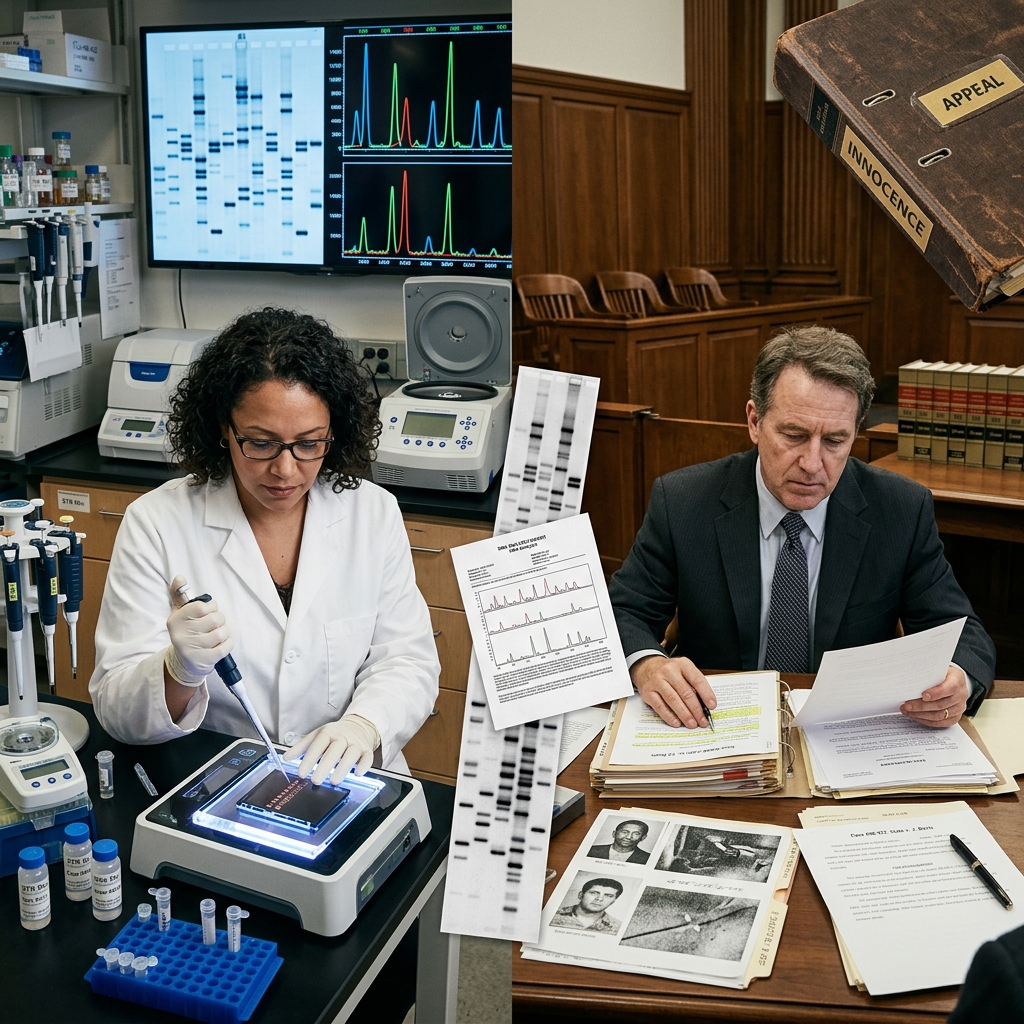
DNA technology has reshaped criminal justice by providing powerful scientific evidence that can both identify perpetrators and reveal when the wrong person was convicted. As post-conviction DNA testing has become more widely available, hundreds of people have been exonerated after years, and sometimes decades, of imprisonment for crimes they did not commit. This article explains how DNA works as an exoneration tool, how the legal system handles post-conviction testing, and what these cases have taught us about preventing future miscarriages of justice.
Understanding DNA Evidence in Criminal Cases
Deoxyribonucleic acid (DNA) carries the genetic information unique to each person. In criminal investigations, biological material collected from a crime scene—such as blood, semen, saliva, skin cells, or hair—can be analyzed to develop a DNA profile. That profile is then compared to samples from suspects or to entries in large databases.
DNA is considered particularly valuable in criminal cases because, when properly collected and analyzed, it can strongly associate an individual with a piece of physical evidence or exclude them as the source.[10] This makes DNA a critical tool both for securing convictions and for correcting them when new testing reveals earlier errors.
Common Types of DNA Forensic Testing
Over the last several decades, the types of DNA testing used in criminal justice have evolved significantly.
- Short Tandem Repeat (STR) analysis – The dominant method in modern forensic labs. STR testing examines highly variable regions of DNA to generate a profile that can be compared across individuals and databases.
- Y-STR analysis – Focuses on markers on the Y chromosome, useful in cases involving male contributors where mixed samples make standard STR testing difficult.
- Mitochondrial DNA (mtDNA) testing – Analyzes mitochondrial DNA, often used for degraded samples such as old hairs or bones where nuclear DNA is unavailable.
- Mini-STRs – A refinement of STR methods designed to work with highly degraded or very small quantities of DNA, increasingly important in older cases and cold cases.
Advances in these techniques have allowed laboratories to revisit biological evidence that was once considered uninterpretable, opening the door to new exonerations years after convictions were entered.
Sources of DNA Evidence in Exoneration Cases
Post-conviction DNA testing often relies on biological material preserved from the original investigation. A large analysis of U.S. DNA exonerations found that several types of evidence recur frequently in these cases:
| Type of Evidence | Role in Exonerations |
|---|---|
| Intimate swabs (e.g., sexual assault kits) | Most common exculpatory evidence; can directly link or exclude a suspect in sexual assault cases. |
| Clothing collected from victims or scenes | Often contains biological traces such as blood or semen that can be tested long after trial. |
| Hair samples | Used particularly where other biological materials are unavailable or degraded. |
| Fingernail scrapings | May capture DNA from an assailant in violent confrontations. |
| Items handled by the perpetrator (e.g., cigarettes) | Can preserve trace DNA useful for later comparison. |
When these samples are properly preserved and cataloged, they can be re-tested with modern technology to either confirm a conviction or reveal that the wrong person was held responsible.
Post-Conviction DNA Testing: How It Works
Post-conviction DNA testing refers to the analysis of biological evidence after a person has already been convicted and sentenced. In many jurisdictions, statutes now explicitly allow incarcerated individuals to petition for DNA testing when such evidence could be relevant to guilt or innocence.[10]
Typical Steps in a Post-Conviction DNA Process
- Locating biological evidence – Defense lawyers and innocence organizations work with courts and law enforcement to identify whether any biological material from the original case was preserved and remains testable.
- Legal motion for testing – A motion is filed asking the court to authorize DNA testing, often supported by expert declarations explaining the scientific significance of the requested tests.
- Laboratory analysis – A forensic laboratory performs testing, develops DNA profiles, and compares those profiles to the convicted person and any relevant databases such as CODIS.[10]
- Interpretation of results – Results are evaluated to determine whether they support the original conviction, are inconclusive, or contradict key assumptions made at trial.
- Post-results litigation – If DNA excludes the convicted individual or identifies another plausible perpetrator, lawyers may seek to vacate the conviction or obtain a new trial.
Forensic labs may use DNA samples post-conviction in at least three important ways:
- Comparing a sample to the convicted person’s profile to determine inclusion or exclusion.
- Searching government DNA databases to see whether the profile matches an unknown or known offender.
- Comparing DNA from multiple crime scenes to reveal patterns or a common perpetrator.
When DNA results exclude the convicted person and point to another individual, courts are often confronted with compelling evidence that a miscarriage of justice has occurred.
DNA as an Exoneration Tool
DNA exoneration occurs when post-conviction DNA testing becomes a key factor in clearing someone who was wrongfully convicted. Exoneration may take the form of a vacated conviction, dismissal of charges, or a finding of actual innocence leading to release from custody.
Scope of DNA Exonerations in the United States
Since the late 1980s, post-conviction DNA testing has led to a substantial number of exonerations. Academic and governmental sources highlight several important trends:
- Hundreds of individuals have been exonerated where DNA evidence played a central role in establishing that they did not commit the offenses for which they were convicted.
- A major study of 194 DNA exonerations found that, in 43% of these cases, post-conviction testing identified the true perpetrator.
- DNA-based exonerations are particularly common in sexual assault and homicide cases, where biological evidence is more likely to exist and be preserved.
Special significance has been attached to DNA exonerations on death row. The first American death row prisoner exonerated through DNA testing was cleared in the early 1990s, and since then dozens of others have had their capital convictions overturned based in part on DNA evidence. These cases have fueled ongoing debates about the reliability of capital punishment systems.
What DNA Exonerations Reveal About Wrongful Convictions
Patterns in DNA exoneration cases provide insight into why innocent people are convicted in the first place. Research and policy analyses emphasize several recurring problems:
- Eyewitness misidentification – One major study found misidentification was present in about three-quarters of DNA exoneration cases, often involving victims who misidentified the accused.
- Flawed forensic practices – DNA exonerations have prompted a broader reevaluation of forensic disciplines that lack strong empirical foundations or that were misapplied.
- False confessions – Some exonerees had confessed under pressure or coercion, only for later DNA evidence to show they could not have committed the crime.
- Inadequate legal defense – Limited resources, lack of expert assistance, or failure to pursue forensic testing at the time of trial have contributed to erroneous convictions.
- Official misconduct – In a subset of cases, exonerations have revealed suppressed evidence or misrepresented forensic results.
These findings have spurred reforms in both investigative practices and forensic science, including stronger standards for evidence, improved training, and more rigorous oversight of laboratories.
Legal and Policy Framework for DNA Exonerations
The increasing use of DNA in criminal justice has led to significant legislative and policy developments. Many jurisdictions have enacted laws that govern access to post-conviction DNA testing, address evidence preservation, and establish mechanisms for compensating the wrongfully convicted.[10]
Access to Post-Conviction DNA Testing
Access to testing varies by state and country, but common policy elements include:[10]
- Statutory rights allowing incarcerated individuals to request DNA testing under defined conditions (such as when testing was not previously done or new methods could yield more informative results).[10]
- Requirements that the requested testing could produce evidence materially relevant to guilt or innocence, rather than merely exploratory results.[10]
- Procedures for appointing counsel to assist indigent prisoners with DNA petitions.
- Rules on when courts may deny testing requests, for example, when evidence has been destroyed or the case does not involve biological material.
Evidence Preservation Obligations
DNA exoneration depends on the existence of testable evidence decades after conviction. Policy responses have therefore emphasized the need for robust preservation practices.[10]
- Many jurisdictions require law enforcement agencies to preserve biological evidence in serious felony cases for extended periods, often throughout a person’s incarceration.[10]
- Standardized cataloging and storage procedures reduce the risk that critical evidence is lost, contaminated, or destroyed.
- Reform efforts have called for increased funding and infrastructure to maintain evidence rooms and forensic archives.
Implications for Forensic Science Regulation
DNA exonerations have underscored the need for strong scientific standards across all forensic disciplines. Analyses of these cases show that, while DNA results can be robust when properly generated, other forms of forensic evidence historically lacked comparable reliability or oversight.
Consequent recommendations include:
- Independent accreditation of crime laboratories and certification of forensic practitioners.
- Clear validation requirements and published error rates for forensic techniques.
- Separation of laboratory functions from investigative or prosecutorial pressures to minimize bias.
- Greater transparency in disclosing forensic limitations to courts and juries.
Benefits and Limitations of DNA as an Exoneration Tool
While DNA has proven transformative, it is not a universal remedy for wrongful convictions. Understanding its strengths and constraints is essential for realistic expectations and sound policy.
Key Benefits
- High evidentiary value – When properly obtained and interpreted, DNA evidence can strongly support findings of guilt or innocence, sometimes providing near-conclusive answers about whether a person contributed biological material found at a crime scene.[10]
- Ability to identify true perpetrators – DNA profiles can be matched to entries in state and national databases, enabling investigators to identify actual offenders in a substantial portion of exoneration cases.[10]
- Catalyst for systemic reform – The undeniable nature of DNA-based exonerations has forced legal systems to recognize and address underlying causes of wrongful convictions.
- Historical reach – Advances such as mini-STRs and improved preservation practices allow testing of old, degraded samples, extending the reach of exoneration efforts.
Important Limitations
- Availability of biological evidence – Many cases involve no biological material, or evidence was never collected, was lost, or degraded beyond use. In such cases, DNA cannot assist.[10]
- Interpretation complexities – Mixed samples, contamination, or incomplete profiles can make interpretation challenging and may require advanced statistical analysis to avoid misleading conclusions.
- Legal barriers – Procedural rules, time limits, and restrictive statutes can prevent individuals from obtaining testing even when science might clarify their cases.[10]
- Overreliance concerns – Some commentators caution against viewing DNA as infallible or as the only metric of justice, emphasizing that non-DNA evidence and broader reforms remain essential.
Frequently Asked Questions About DNA Exonerations
What is a DNA exoneration?
A DNA exoneration is a case in which post-conviction DNA testing, analysis, or interpretation plays a significant role in establishing that a convicted person did not commit the crime. The new evidence leads to the conviction being vacated, charges dismissed, or a formal declaration of innocence.
Can DNA testing prove innocence in every case?
No. DNA can be extremely powerful when relevant biological material exists and was properly preserved, but many cases involve no biological evidence at all. In other cases, samples are too degraded or contaminated to produce usable results. Even when DNA is present, it may only show that a person’s DNA is absent from a particular item, which might not fully resolve questions about their involvement.
How do wrongfully convicted people gain access to DNA testing?
Access typically depends on specific laws and court rules in their jurisdiction. Many places now allow post-conviction petitions for DNA testing when the results could be materially relevant to guilt or innocence. Legal aid organizations, innocence projects, and pro bono counsel often help prisoners file motions, locate evidence, and work with forensic laboratories to conduct testing.[10]
Does DNA exoneration automatically lead to compensation?
Compensation for wrongful convictions is governed by state and national laws and is not automatic. Some jurisdictions have statutes providing financial awards and support services to exonerees, while others require separate civil lawsuits or provide limited or no compensation. DNA exoneration may strengthen a person’s claim, but redress still depends on the legal framework and court findings.
Has DNA changed the way courts view other forensic evidence?
Yes. DNA exoneration cases have revealed that some forms of traditional forensic evidence were more error-prone than previously believed or were presented with overstated certainty. This has led to critical evaluations of forensic science, calls for improved standards, and greater scrutiny of expert testimony in criminal trials.
References
- DNA as an Exoneration Tool — FindLaw. 2024-01-01. https://www.findlaw.com/criminal/criminal-procedure/dna-as-an-exoneration-tool.html
- Wrongful Convictions and DNA Exonerations: Understanding the Role of Forensic Science — National Institute of Justice. 2017-06-01. https://nij.ojp.gov/topics/articles/wrongful-convictions-and-dna-exonerations-understanding-role-forensic-science
- The Genetics of Innocence: Analysis of 194 U.S. DNA Exonerations — Garrett, B.L. et al., Forensic Science International: Genetics. 2011-06-28. https://pubmed.ncbi.nlm.nih.gov/21721941/
- The Use of DNA by the Criminal Justice System and the Federal Role — Congressional Research Service. 2011-05-05. https://www.congress.gov/crs-product/R41800
- What DNA Exonerations Have Taught Us and Where to Go From Here — West Virginia Law Review. 2012-01-01. https://researchrepository.wvu.edu/cgi/viewcontent.cgi?article=1043&context=wvlr
- DNA Exonerations in the United States (1989–2020) — Innocence Project. 2020-12-31. https://innocenceproject.org/dna-exonerations-in-the-united-states/
Similar Articles








Read full bio of medha deb




